
acute appendicitis
"appendicitis"[MeSH Terms]
acute appendicitis CT or ultrasound
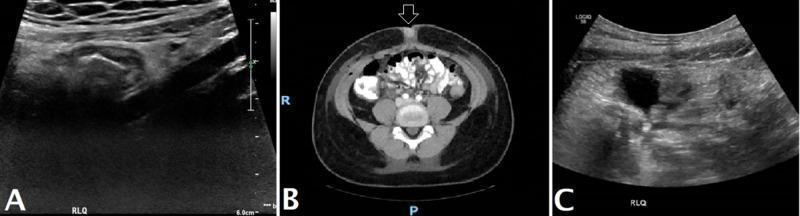
This composite figure displays diagnostic imaging of the abdomen across three panels, illustrating the progression from acute appendicitis to postsurgical status. Panel A shows an ultrasound of the right lower quadrant (RLQ) featuring a blind-ending, non-compressible, tubular structure with a 'target' appearance in the transverse plane, measuring approximately 9 mm in diameter, indicative of acute appendicitis. Panel B is an axial CT scan of the pelvis with intravenous contrast following an appendectomy and terminal ileum resection. It demonstrates postsurgical changes in the right anterior abdominal wall, mild subcutaneous emphysema (air), and high-density, non-enhancing fluid collections in the cul-de-sac and prevesical space, suggesting a phlegmon or postsurgical fluid. Panel C presents a follow-up postsurgical ultrasound of the RLQ, highlighting localized free fluid and hyperechoic inflammatory changes in the mesenteric fat. These images collectively provide a clinical educational overview of radiological features associated with complicated appendicitis and typical postoperative radiological findings.
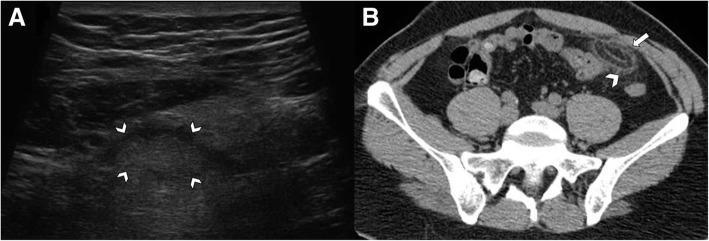
This dual-panel image displays diagnostic imaging of acute epiploic appendagitis in the lower abdomen. Panel A is a transverse abdominal ultrasound scan showing a well-defined, hyperechoic ovoid lesion representing inflamed fat. The lesion is located adjacent to the anterior abdominal wall and is encircled by a thin, hypoechoic rim (indicated by arrowheads), which corresponds to the inflamed visceral peritoneum. Panel B is an axial non-contrast CT image of the pelvis at the level of the sigmoid colon. It demonstrates a corresponding fat-density ovoid lesion characterized by a peripheral hyperattenuating ring (white arrow) and localized perilesional fat stranding (arrowhead). These findings are classic diagnostic markers for primary epiploic appendagitis, helping to differentiate it from acute diverticulitis or appendicitis. The clinical focus is on the identification of the 'hyperattenuating ring sign' on CT and the characteristic echogenicity on ultrasound as non-invasive means of diagnosing this self-limiting inflammatory condition.
PMID: 38682788
Acute appendicitis
Overview
Pathophysiology
- Luminal obstruction starts the process. The most common cause is a fecalith (appendicolith). Others are lymphoid hyperplasia, parasites, neoplasm and foreign body.
- Bacterial overgrowth, mucus and venous congestion follow. The appendix distends and stretches visceral afferent fibres, which gives vague periumbilical pain and early nausea and vomiting.
- Arterial inflow is lost. This causes ischaemia, then necrosis, gangrene and perforation. - Current Surgical Therapy 14e
- Tip position varies. The tip can be retrocaecal, subcaecal, pelvic, pre-ileal or post-ileal, which explains the varied presentations. The appendiceal artery is a branch of the ileocolic artery.
Clinical features
- Classic course: vague periumbilical or epigastric pain with anorexia and malaise. Nausea and vomiting follow, then the pain migrates to the right lower quadrant (RLQ).
- Examination: fever, tachycardia, RLQ tenderness, guarding and percussion tenderness. Tenderness is maximal at McBurney's point, one third of the way from the right anterior superior iliac spine to the umbilicus.
- Signs depend on tip position:
- Rovsing's sign is LLQ palpation causing RLQ pain.
- The psoas sign suggests a retrocaecal appendix.
- The obturator sign suggests a pelvic appendix.
- Eponymous signs are specific but insensitive. Reported sensitivity and specificity are:
| Sign | Sensitivity | Specificity |
|---|---|---|
| Rovsing | 30-68% | 58-91% |
| Obturator | 21-34% | 79-96% |
| Psoas | 16-39% | 50-95% |
- Labs: leukocytosis, urinalysis without bacteria, and a negative pregnancy test. - Current Surgical Therapy 14e
- Atypical presentations: retrocaecal and pelvic appendicitis may have little anterior tenderness or rigidity. - S Das, A Manual on Clinical Surgery 13e
Diagnosis
- A plain film is unreliable, even if it shows a calcified appendicolith.
- Ultrasound is first-line in children and in women of childbearing age. It also detects gynaecological mimics such as ectopic pregnancy, haemorrhagic cyst and tubo-ovarian abscess. A normal appendix under 6 mm excludes appendicitis. Retrocaecal appendices are easily missed.
- CT is the usual first test in adults. The criteria are an appendix thicker than 7 mm with periappendiceal fat stranding. Other signs are free fluid, caecal pole thickening, focal ileus and RLQ nodes. CT also detects collections.
- MRI is an option in pregnancy and in children where available, and it avoids radiation.
Treatment
- Appendectomy is the definitive treatment. Give IV fluids and antibiotics first, for example a second-generation cephalosporin. Laparoscopic appendectomy is standard. - Schwartz's Principles of Surgery 11e
- Antibiotics alone for uncomplicated appendicitis (2024 Cochrane review, 13 RCTs, about 3,300 participants):
- About 31% of antibiotic-treated patients needed appendectomy within 1 year, but the evidence is very uncertain.
- Treatment success was probably lower with antibiotics than with surgery (low-certainty evidence).
- Wound infections were lower with antibiotics (RR 0.25).
- There was no clear mortality difference (very low-certainty evidence).
- Nonoperative management suits selected patients with simple appendicitis and no fecalith, after shared decision-making.
- Perforated appendicitis with abscess can be managed with percutaneous drainage and antibiotics, followed by an interval appendectomy. - Current Surgical Therapy 14e
Special populations
- Children:
- Appendicitis is the most common acute surgical problem. Children aged 2 to 6 often present perforated.
- Ultrasound or MRI is preferred over CT.
- Nonoperative management works in 80 to 90% of simple cases in the short term, but recurrence may reach 40%. Many pediatric surgeons still prefer operating within 12 to 24 hours. - Current Surgical Therapy 14e; Schwartz 11e
- In girls, exclude ovarian pathology.
- Pregnancy:
- It is the most common surgical emergency in pregnant patients. Incidence is the same as in nonpregnant patients, but delayed diagnosis raises perforation, fetal loss and maternal morbidity.
- The appendix is in the RLQ in over 75% of third-trimester patients. Signs of peritoneal irritation can be lost.
- Physiologic leukocytosis confuses the picture. - Rosen's Emergency Medicine