
Describe clinical manifestation and management of nephrotic syndrome due to glomerulonephritis. minimal change.
Reading File
Now I'll search the medical library for nephrotic syndrome and minimal change disease simultaneously.
Finding Sources
Finding Sources
Searching PubMed
"minimal change disease" AND "nephrotic syndrome" AND management
Good. Now I'll read the key sections from Goldman-Cecil Medicine and the Harriet Lane Handbook, and also search for more specific minimal change disease content.
Reading File
Finding Sources
Excellent sources found. Now I'll read the dedicated minimal change disease sections from Comprehensive Clinical Nephrology and the NKF Primer.
Finding Sources
Reading File
Now let me read the dedicated MCD sections from Harrison's and Comprehensive Clinical Nephrology, as well as NKF Primer.
Reading File
Reading File
Reading File
Excellent content. Let me now read the detailed treatment section from Harrison's (which was truncated) and also get the NKF Primer's detailed chapter on MCD.
Reading File
Reading File
Now let me get the detailed NKF Primer chapter on MCD and also get the Brenner & Rector section on MCD treatment, and also fetch the Harrison's glomerular schematic image.
Finding Sources
Loading Image
Now let me read the Brenner & Rector treatment patterns box and the Comprehensive Clinical Nephrology section on MCD treatment, and also find the Washington Manual section.
Reading File
Reading File
I have very rich data. Let me read one more section - the adult treatment section from Comprehensive Clinical Nephrology to complete the management picture.
Reading File
I now have comprehensive data from multiple authoritative sources. Let me compile the full answer.
Nephrotic Syndrome Due to Minimal Change Disease (MCD)
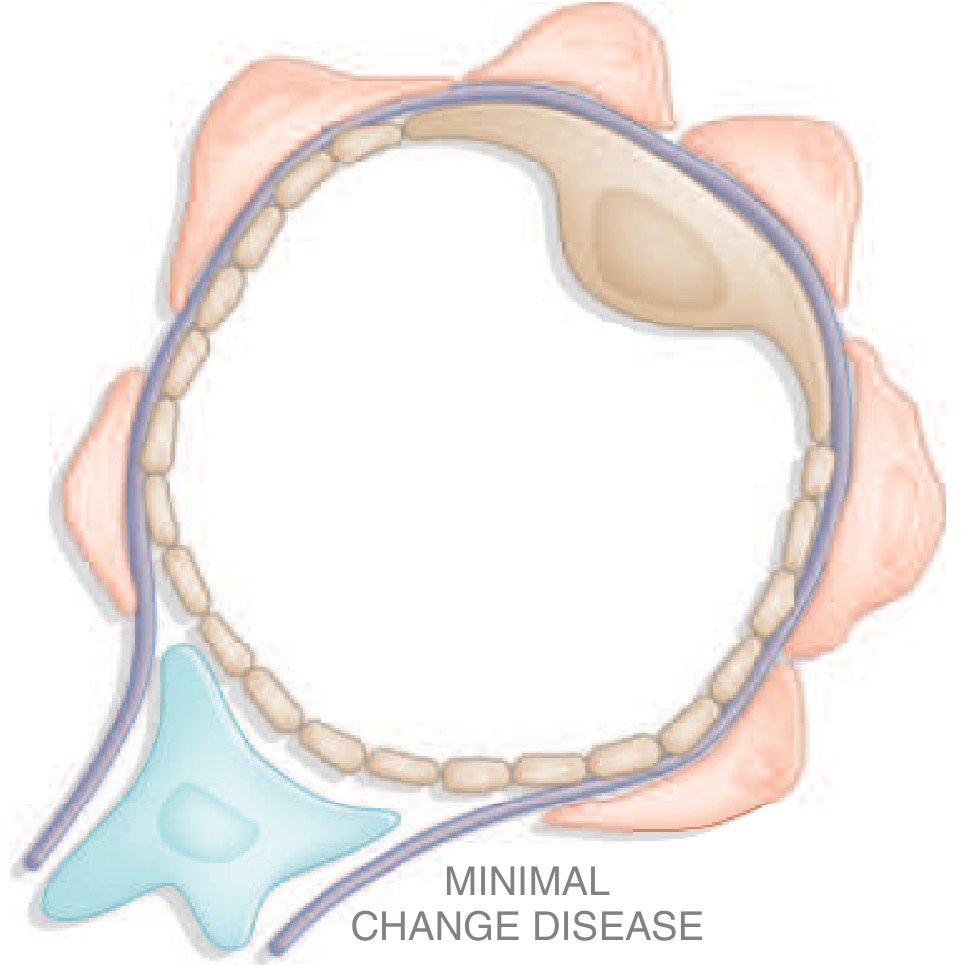
Glomerular schematic of MCD - note the structurally normal-appearing glomerulus on light microscopy, with the characteristic foot process effacement only visible on electron microscopy. (Harrison's Principles of Internal Medicine, 22e)
Overview & Epidemiology
Minimal change disease (MCD) - historically called "lipoid nephrosis" (Munk, 1913) or "nil lesion" - is the leading cause of nephrotic syndrome in the pediatric population and a significant cause in adults:
- Children under 10 years: 70-90% of nephrotic syndrome cases
- Adults: 10-15% of primary nephrotic syndrome
- Geographic variation: higher incidence in Asia than North America/Europe
- Slight male predominance (M:F ratio ~1.1:1 in adults)
(Brenner and Rector's The Kidney, 2-Volume Set; Harrison's Principles of Internal Medicine 22e)
Pathogenesis
The exact mechanism is incompletely understood but immune dysregulation - particularly of T cells - is the central hypothesis:
- T cell dysfunction: T cell hybridomas from MCD patients secrete a circulating factor that induces heavy proteinuria in animal models. Disturbances in T-cell response result in circulating glomerular permeability factors (proposed cytokines: IL-13 and IL-4)
- CD80 (B7.1) overexpression: Elevated CD80 on podocytes correlates with disease activity and promotes dysregulated interactions with T lymphocytes via CTLA-4
- Angiopoietin-like-4: Overexpressed in MCD podocytes, promoting proteinuria; this is suppressible with corticosteroids
- Anti-nephrin antibodies: A subset of patients have antibodies to nephrin despite minimal IgG on immunofluorescence - suggesting a B cell component
- Glomerular endothelial injury: Evidence of mild endothelial injury with circulating biomarkers suggests MCD is not a pure "podocytopathy"
- Secondary causes: NSAID use, lithium, Hodgkin lymphoma, thymoma, allergies, infections
(Comprehensive Clinical Nephrology, 7th Edition; Harrison's 22e)
Histopathology
The triad of findings across microscopy modalities:
| Modality | Finding |
|---|---|
| Light microscopy | Normal (minimal/absent changes) - hence the name |
| Immunofluorescence | Negative; occasionally small amounts of IgM in mesangium |
| Electron microscopy | Extensive diffuse foot process effacement (fusion) - the diagnostic hallmark |
(NKF Primer on Kidney Diseases, 8e; Harrison's 22e)
Clinical Manifestations
Core Nephrotic Syndrome Features
- Massive proteinuria: Mean 24-hour urine protein ~10 g (selective proteinuria in children - predominantly albumin with minimal higher-molecular-weight proteins)
- Severe hypoalbuminemia
- Edema: Characteristically abrupt onset; can be severe (anasarca, periorbital edema - especially in children, ascites, pleural effusions)
- Hyperlipidemia and lipiduria (lipoid nephrosis)
Less Common Features
| Feature | Children | Adults |
|---|---|---|
| Hypertension | ~30% | 20-50% |
| Microscopic hematuria | ~20% | ~33% |
| Atopy/allergic symptoms | ~40% | ~30% |
| Reduced kidney function | 25-40% (often reversible) | similar |
Acute Kidney Injury in MCD
- Occurs more commonly in adults with very low serum albumin and intrarenal edema ("nephrosarca")
- Often responsive to diuretics
- Must be distinguished from AKI due to hypovolemia - the two have opposite treatments
- Acute tubular necrosis and interstitial inflammation can also occur
Salt and Water Retention Mechanisms
In most adults, the expanded plasma volume results from primary salt retention: increased GBM permeability allows filtration of circulating proteases which activate ENaC in the collecting tubule, promoting sodium reabsorption independently of aldosterone. In a minority (mostly children), oncotic pressure-driven intravascular depletion activates the RAAS.
(Harrison's 22e; Goldman-Cecil Medicine)
Diagnosis
- Children: In the setting of classic nephrotic syndrome without hematuria, reduced GFR, hypertension, or low complement - MCD is diagnosed presumptively and treated empirically. Kidney biopsy is generally not required in children.
- Adults: Kidney biopsy is mandatory as many other diagnoses (FSGS, membranous nephropathy) can present identically
Factors Suggesting Diagnosis Other Than Idiopathic MCD (Harriet Lane Handbook)
- Hematuria
- Hypertension
- Low complement levels
- Reduced GFR not responsive to therapy
- Steroid resistance
Management
General Supportive Care (all patients)
| Issue | Treatment |
|---|---|
| Edema | Loop diuretics; avoid over-diuresis causing hypovolemia |
| Proteinuria/hypertension | ACE inhibitor or ARB |
| Hyperlipidemia | Statins (mainly adults; children often reach remission before treatment needed) |
| Thrombosis prevention | Anticoagulation if serum albumin <2 g/dL (low-molecular-weight heparin or warfarin); switch to aspirin once albumin >2 g/dL |
| Diet | Low-salt, protein-restricted (0.8-1 g/kg/day) |
| AKI | Supportive; repeat biopsy if persistent |
(NKF Primer 8e; Comprehensive Clinical Nephrology 7e)
Immunosuppressive Therapy
First-Line: Corticosteroids
In children (ISKDC protocol):
- Prednisone 60 mg/m²/day (max 60 mg/day) for 4-6 weeks, then 40 mg/m² on alternate days for 4-6 weeks, then taper
- ~95% of children with MCD respond to steroids
- ~30% have spontaneous remission; most today are treated empirically before biopsy
In adults:
- Prednisone 1 mg/kg/day (max 80 mg/day) for 4-16 weeks until remission, then slow taper
- Response rates are 80-90% but take longer than children
Definitions of response (Comprehensive Clinical Nephrology 7e):
| Term | Definition |
|---|---|
| Complete remission (CR) | uPCR <0.2 mg/mg (children) / proteinuria ≤0.20 g/day + albumin ≥3.5 g/dL (adults) |
| Partial remission (PR) | 50% reduction in proteinuria + uPCR 0.2-2 mg/mg |
| Relapse | Recurrence of nephrotic-range proteinuria after CR for >1 month |
| SSNS | Steroid-sensitive nephrotic syndrome - CR within 4 weeks |
| FRNS | Frequently relapsing: ≥2 relapses per 6 months or ≥4 per 12 months |
| SDNS | Steroid-dependent: relapse during or within 15 days of stopping steroids |
| SRNS | Steroid-resistant: no CR after 4 weeks full-dose prednisone |
Relapse Management and Steroid-Sparing Therapies
Relapses occur in 70-75% of children after first remission; early relapse predicts future relapses. Relapses are less frequent in adults but more resistant to subsequent treatment.
Calcineurin Inhibitors (CNIs):
- Cyclosporine: 4-6 mg/kg/day, trough levels 150-200 ng/mL
- Tacrolimus (preferred due to side effect profile): 0.05-0.1 mg/kg/day, trough 4-8 ng/mL
- Induce remission in up to 75% of patients
- Relapse is common upon dose reduction; KDIGO recommends 1-2 years of therapy
- Tacrolimus is safe in pregnancy and breastfeeding - preferred in young women
Cyclophosphamide:
- Oral cyclophosphamide 2-2.5 mg/kg/day for 12 weeks (children: 8 weeks)
- Induces longer-term remission: 75% at 2 years and 66% at 5 years in adults
- May be preferred in older adults where fertility preservation is not a concern
- Can be used as initial therapy where steroids are contraindicated
Mycophenolate Mofetil (MMF):
- Used as steroid-sparing agent
- MMF + low-dose prednisolone showed similar efficacy to high-dose prednisolone alone in adults
- Option for FRNS and SDNS
Rituximab (anti-CD20):
- Increasingly used for FRNS, SDNS, and SRNS
- Median time to relapse after rituximab: ~18 months
- Six-monthly maintenance dosing effective for frequent relapsers
- Can be used as first-line therapy in patients with contraindications to steroids
- Note: protein-binding means enhanced dosing may be needed when patients are nephrotic
- Monitor for hypogammaglobulinemia
- Generally well tolerated in both children and adults
(Comprehensive Clinical Nephrology 7e; Harrison's 22e; NKF Primer 8e)
Prognosis
- Children have an excellent long-term renal prognosis despite frequent relapses; relapse frequency decreases after puberty
- Adults have a less favorable prognosis when acute kidney failure or steroid resistance is present
- Complete recovery of renal function is the norm after remission in most patients
- MCD very rarely progresses to ESKD in steroid-responsive disease
Key Sources
- Harrison's Principles of Internal Medicine, 22e (2025), Chapter 326
- Comprehensive Clinical Nephrology, 7th Edition, Chapter 18
- NKF Primer on Kidney Diseases, 8th Edition, Chapter 16/18
- Brenner and Rector's The Kidney, 2-Volume Set, Chapter 31
- Goldman-Cecil Medicine (International Edition)
This is a shared conversation. Sign in to Orris to start your own chat.