
Anaesthetic management of a child posted for congenital diaphragmatic hernia
Reading File
Finding Sources
Finding Sources
Searching PubMed
"congenital diaphragmatic hernia" AND "anesthetic management"
Good - I have strong hits in Miller's Anesthesia and Morgan & Mikhail's. Let me read the dedicated CDH sections from the best anaesthesia sources in parallel.
Reading File
Reading File
Finding Sources
Now let me read the full Morgan & Mikhail CDH section and the Barash section on CDH anaesthesia which appear very detailed.
Reading File
Reading File
Excellent - I have great content from Barash. Let me read more of the Barash perioperative care section and also find the Morgan & Mikhail CDH section which I need to locate at the right offset.
Reading File
Reading File
Now let me get the Barash perioperative care section for CDH (anaesthetic management details) which I saw starts around line 409.
Reading File
I now have comprehensive content from multiple authoritative sources. Let me also fetch the CDH chest X-ray image from Barash to include visually.
Loading Image
I now have comprehensive content from multiple authoritative sources. Let me compile the complete anaesthetic management guide.
Anaesthetic Management of Congenital Diaphragmatic Hernia (CDH) in Children
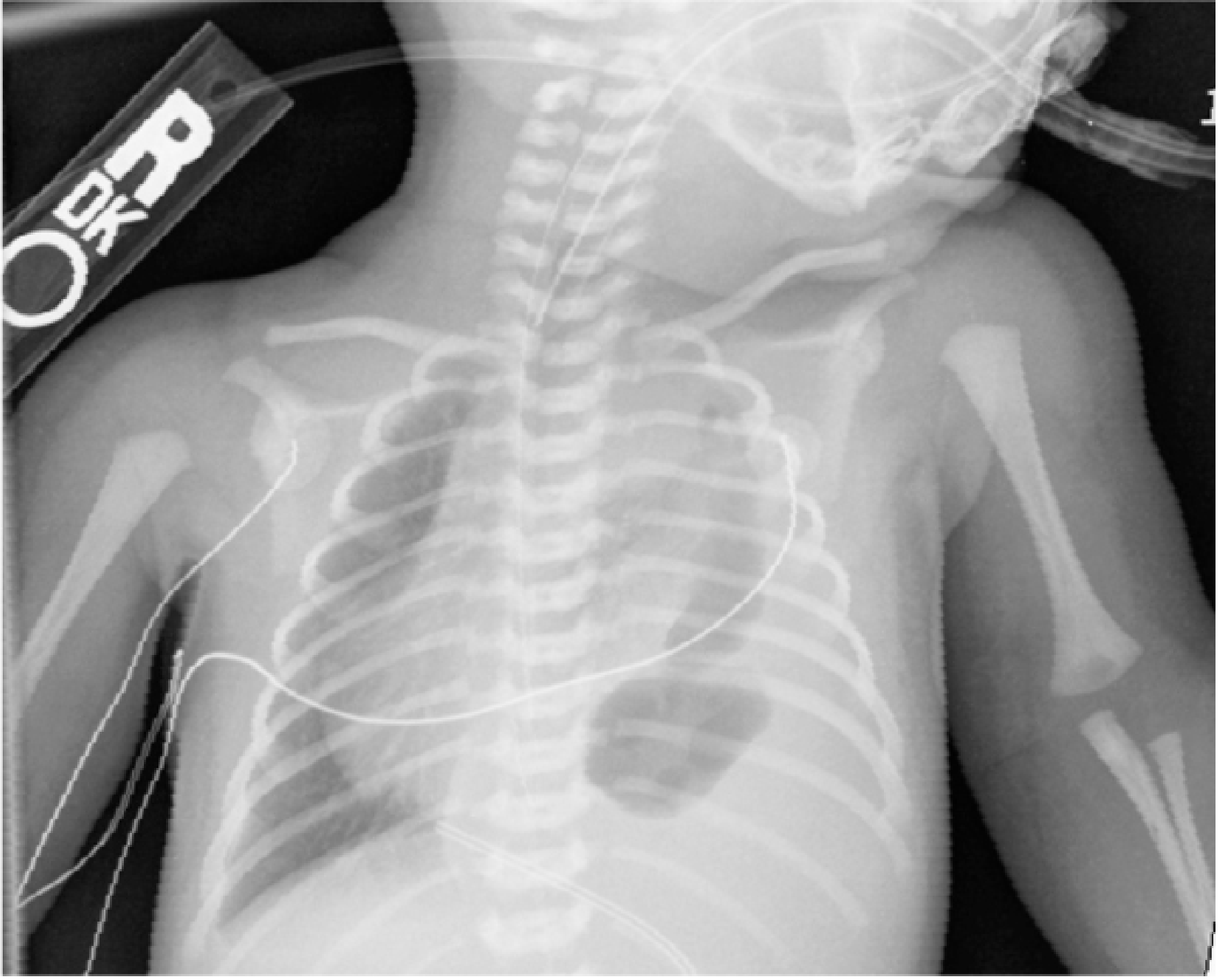
1. Anatomy and Pathophysiology
CDH results from herniation of abdominal viscera through a diaphragmatic defect - most commonly the left posterolateral foramen of Bochdalek (90% left-sided). Less commonly, it occurs through the right Bochdalek foramen or the anterior foramen of Morgagni.
Incidence: 1 in 3,000-5,000 live births. About 50% are diagnosed antenatally.
Key pathological features:
| Feature | Details |
|---|---|
| Pulmonary hypoplasia | Reduction in alveoli and bronchioli bilaterally; ipsilateral lung more severely affected |
| Pulmonary hypertension | Hypoplastic, hyperreactive pulmonary vasculature; right-to-left shunting at PDA and foramen ovale |
| Associated anomalies | >50% have co-existing anomalies - cardiac, chromosomal, gastrointestinal |
| Malrotation | Almost always present |
Critical concept: Cardiopulmonary compromise is primarily due to pulmonary hypoplasia and pulmonary hypertension, not the mechanical mass effect of the herniated viscera. Mortality is 40-50%.
2. Clinical Presentation
- Respiratory distress at birth (severe if large defect)
- Scaphoid abdomen (bowel absent from abdomen)
- Hypoxemia, cyanosis
- Bowel sounds audible in the chest
- Mediastinal shift away from the hernia
- Heart sounds displaced to the right (left-sided CDH)
3. Preoperative Stabilization (Delayed Surgical Strategy)
CDH was once treated as a surgical emergency. The modern approach is stabilization before repair - surgery does not correct pulmonary hypertension, and respiratory status may actually deteriorate post-repair.
Immediate Stabilization Steps
- Airway: Immediate endotracheal intubation - avoid bag-mask ventilation as it distends herniated bowel, worsening compression. Insert a nasogastric tube to decompress the stomach.
- Ventilation goals:
- Prefer permissive hypercapnia (PaCO2 45-55 mmHg acceptable; postductal PaCO2 <65 mmHg)
- Peak inspiratory pressure (PIP) <25 cm H2O (some sources: <30 cm H2O)
- Preductal SpO2 >85%
- Avoid aggressive ventilation-induced respiratory alkalosis (abandoned - causes iatrogenic lung injury)
- High-Frequency Oscillatory Ventilation (HFOV): Used when conventional ventilation is inadequate; reduces barotrauma
- Inhaled Nitric Oxide (iNO): Reduces pulmonary artery pressure; does not clearly improve survival but may facilitate stabilization
- Surfactant: May be given prophylactically if surfactant deficiency is suspected
- ECMO: Reserved for most severe cases with predicted high mortality (≥80% based on birth weight and 5-min Apgar). Right-sided CDH has higher mortality even with ECMO
Pharmacological Management of Pulmonary Hypertension
| Agent | Mechanism |
|---|---|
| Inhaled nitric oxide (iNO) | Pulmonary vasodilator |
| Sildenafil | PDE-5 inhibitor |
| Milrinone | PDE-3 inhibitor |
| Epoprostenol / Iloprost | PGI2 analogues |
| Bosentan | Endothelin receptor antagonist |
| Imatinib | PDGF inhibitor |
4. Preoperative Assessment
- Full systemic evaluation for associated anomalies (especially cardiac - echocardiogram)
- Assess degree of pulmonary hypertension and hypoplasia
- Review current ventilator settings - most neonates arrive already intubated
- Arterial line placement (preductal - right radial preferred for preductal sampling)
- Check umbilical artery catheter availability
- Correct metabolic acidosis and hypothermia before proceeding
5. Intraoperative Anaesthetic Management
Monitoring
- Preductal pulse oximetry (right hand - detects pre-shunt saturation)
- Postductal pulse oximetry (lower limb - identifies right-to-left shunting across PDA)
- Invasive arterial blood pressure (preductal artery - right radial or umbilical artery catheter)
- Central venous access
- Temperature monitoring (rectal/oesophageal) - maintain normothermia
- Capnography (note: ETCO2 may underestimate PaCO2 significantly due to V/Q mismatch)
- Serial arterial blood gases
Induction
- Most neonates arrive already intubated from the NICU
- If not intubated: awake intubation or inhalational induction; the neonate is preoxygenated and intubated typically without muscle relaxants initially
- Avoid bag-mask ventilation at all times - risk of gastric/intestinal distension within the chest
- Rapid sequence principles apply if intubation is required de novo
- Confirm ETT position
Maintenance
- Volatile agents at low concentrations or opioid-based technique depending on anticipated extubation plan
- Nitrous oxide is contraindicated - causes bowel distension and worsens hypoxia
- Muscle relaxants facilitate abdominal closure and ventilation
- Maintain identical ventilator settings from ICU intraoperatively; avoid sudden changes
- Goals: avoid hypoxia, avoid excessive hypercapnia, blunt stress response with deep anaesthesia to manage pulmonary hypertension
Ventilation Strategy Intraoperatively
- Continue permissive hypercapnia approach
- PIP <25-30 cm H2O
- Accept preductal SpO2 >85%
- PEEP: use with caution - can worsen pulmonary hypertension
- Watch for sudden deterioration - may signal contralateral pneumothorax (usually right-sided in left CDH) - have chest drain ready
Fluid and Blood Management
- Blood loss is usually modest; fluid shifts may occur
- Maintain intravascular volume - hypovolaemia causes acidosis which precipitates pulmonary hypertension
- Avoid hypothermia for the same reason (increases O2 demand, triggers pulmonary hypertension)
- Have blood products available
Surgical Approach
- Open repair: Subcostal incision on affected side; bowel is reduced, diaphragm repaired (primary closure or prosthetic patch)
- Thoracoscopic repair: Increasingly common; note increased risk of intraoperative hypercapnia and acidosis during insufflation
- Do NOT attempt forceful re-expansion of the ipsilateral lung - the hypoplastic lung will not expand and attempts increase barotrauma risk
6. Analgesia
- If the infant will remain intubated postoperatively: opioids (fentanyl/morphine) are appropriate
- If small defect with anticipated early extubation: avoid intraoperative opioids; consider:
- Wound infiltration with local anaesthetic
- Caudal catheter threaded to thoracic level
- Paravertebral catheter
- Neuraxial analgesia
7. Postoperative Care
- The majority require continued intubation and ICU-level ventilatory support postoperatively
- Weaning is slow and deliberate
- Pulmonary hypertension may worsen or persist post-repair - continue iNO, pulmonary vasodilators
- Refractory postoperative pulmonary hypertension is common in those who required ECMO
- Monitor for:
- Pneumothorax (ipsilateral or contralateral)
- Haemodynamic instability
- Recurrent pulmonary hypertension
- Abdominal compartment syndrome (increased abdominal pressure impairs ventilation, venous return, renal perfusion)
- Echocardiography is used frequently to guide management of pulmonary hypertension
- Evidence of relative left ventricular hypoplasia in CDH infants should inform cardiovascular management
8. Fetal Surgery
Fetoscopic endoluminal tracheal occlusion (FETO) has been utilised in fetal surgery programs to promote lung growth. However, prenatal intrauterine surgery has not been shown to improve outcomes in randomised trials.
9. Key Anaesthetic Pitfalls - Summary
| Pitfall | Consequence | Avoidance |
|---|---|---|
| Bag-mask ventilation | Bowel distension in thorax | Intubate immediately; NGT decompression |
| Nitrous oxide use | Bowel expansion; worsening hypoxia | Absolutely contraindicated |
| High PIP / aggressive ventilation | Pneumothorax; barotrauma | PIP <25-30 cm H2O; permissive hypercapnia |
| Hypothermia | Increased O2 demand; pulmonary hypertension | Active warming; temperature monitoring |
| Acidosis/hypovolaemia | Triggers pulmonary hypertension | Maintain euvolaemia, correct metabolic acidosis |
| Forceful lung re-expansion | Barotrauma to hypoplastic lung | Never attempt aggressive ipsilateral expansion |
| Contralateral pneumothorax | Sudden cardiovascular collapse | High index of suspicion; immediate chest drain |
Sources:
- Morgan and Mikhail's Clinical Anesthesiology, 7e, p. 1713-1714
- Barash, Cullen, and Stoelting's Clinical Anesthesia, 9e, pp. 3652-3655
- Miller's Anesthesia, 10e, p. 10640
This is a shared conversation. Sign in to Orris to start your own chat.