
How contravtility of heart inc with catecholamines ..
Reading File
Finding Sources
Finding Sources
Reading File
Reading File
Finding Sources
Reading File
Searching Images
catecholamine beta1 adrenergic cAMP calcium contractility mechanism heart
Loading Image
Here is a comprehensive explanation of how catecholamines increase cardiac contractility (positive inotropy):
Catecholamines and Cardiac Contractility
The Signal: β₁-Adrenergic Receptor Activation
Catecholamines (norepinephrine from sympathetic nerves, epinephrine from the adrenal medulla) bind to β₁-adrenergic receptors on the sarcolemma of atrial and ventricular myocytes. This triggers a cascade:
Catecholamine → β₁ receptor → Gs protein → Adenylyl cyclase → ↑cAMP → Protein Kinase A (PKA)
The Gs protein (stimulatory guanine nucleotide-binding protein) couples the receptor to adenylyl cyclase, which converts ATP → cAMP (cyclic AMP). cAMP then activates Protein Kinase A (PKA), which phosphorylates key downstream proteins.
Three Mechanisms by Which PKA Increases Contractility
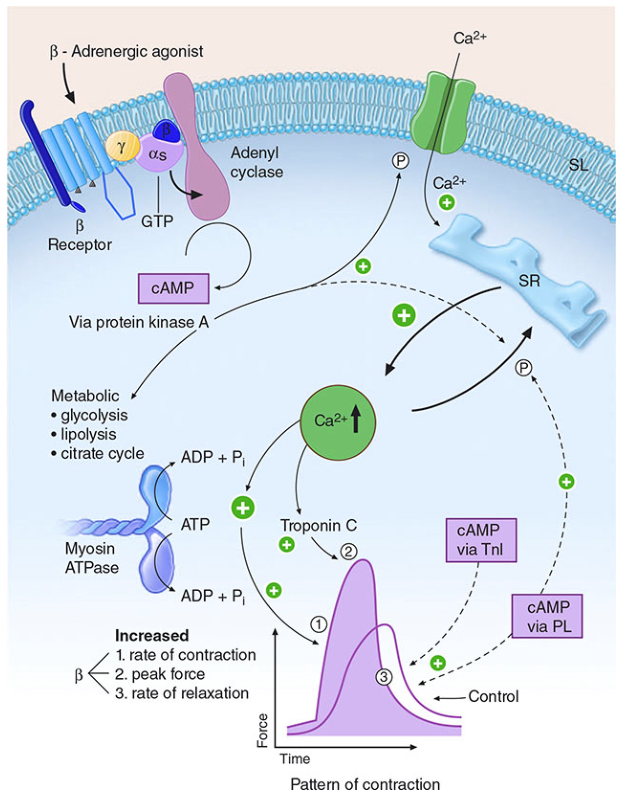
1. Phosphorylation of L-type Ca²⁺ Channels (Sarcolemmal)
- PKA phosphorylates L-type Ca²⁺ channels in the sarcolemma
- → ↑ inward Ca²⁺ current during the action potential plateau
- → More trigger Ca²⁺ enters the cell
- → Greater Ca²⁺-induced Ca²⁺ release (CICR) from the sarcoplasmic reticulum (SR)
- → ↑ peak intracellular [Ca²⁺]
2. Phosphorylation of Phospholamban (via cAMP/PL pathway)
- Phospholamban normally inhibits the SR Ca²⁺-ATPase (SERCA pump)
- PKA phosphorylates phospholamban → relieves SERCA inhibition
- → SERCA pumps Ca²⁺ back into the SR faster and in greater amounts
- Dual effect:
- ↑ Ca²⁺ stored in SR → more Ca²⁺ available for release on the next beat
- Faster Ca²⁺ removal → faster relaxation (positive lusitropy) — shorter twitch, more time for diastolic filling
3. Phosphorylation of Troponin I (via cAMP/TnI pathway)
- PKA phosphorylates Troponin I (TnI)
- This increases the sensitivity/efficacy of Troponin C for activator Ca²⁺
- → The contractile apparatus responds more effectively to available Ca²⁺
- → Further contributes to increased force generation
Net Functional Effects (Positive Inotropy)
| Effect | Mechanism |
|---|---|
| ↑ Peak tension (force) | More Ca²⁺ released from SR, better TnC activation |
| ↑ Rate of tension development | Faster Ca²⁺ availability |
| Faster relaxation | Phospholamban phosphorylation → faster SR Ca²⁺ reuptake |
| Shorter twitch duration | More time for diastolic filling (important at high heart rates) |
Additional Notes
- β₂-adrenergic receptors are also present in the myocardium (more in atria than ventricles), also linked to Gs/adenylyl cyclase — they help preserve catecholamine responsiveness when β₁ receptors are downregulated (as in chronic heart failure).
- Parasympathetic/ACh produces the opposite effect (negative inotropy) via Gk protein → ↓ cAMP, ↓ Ca²⁺ current, ↑ IK-ACh — but this effect is mainly in the atria (ventricles have sparse vagal innervation).
- In heart failure, β₁ receptor downregulation and abnormal Ca²⁺ homeostasis reduce the clinical efficacy of catecholamines — this is why high doses are needed and why they have diminishing returns.
Sources: Costanzo Physiology 7th Edition; Medical Physiology (Boron & Boulpaep); Barash Clinical Anesthesia 9e; Harrison's Principles of Internal Medicine 22e
What about na k pump and na ca exchanger i cant get it
Finding Sources
Finding Sources
Reading File
Reading File
Finding Sources
Reading File
Finding Sources
Loading Image
You've run out of free credits. Sign up for a free account to continue using Orris.
This is a shared conversation. Sign in to Orris to start your own chat.