
Bronchopulmonary segments full details for md exam answer 15 marks from fishman and Murray combined structured
Reading File
Now let me search the library for bronchopulmonary segments content from Fishman and Murray simultaneously.
Finding Sources
Finding Sources
Finding Sources
Finding Sources
The key Fishman content is in block1 (THE LUNG AS AN ORGAN). Let me read that section and also get the Gray's anatomy content and search images, all in parallel.
Reading File
Reading File
Reading File
Searching Images
bronchopulmonary segments right left lung diagram
Now let me read the Fishman block1 content on bronchopulmonary segments (around line 800-870) and the Murray content, plus the rest of the Color Atlas content:
Reading File
Reading File
Loading Image
Now let me fetch the key Fishman diagram of bronchopulmonary segments and also read the Murray BAL section for clinical relevance:
Loading Image
Reading File
Finding Sources
Excellent — I now have comprehensive data from Fishman, Murray & Nadel, Gray's Anatomy for Students, and the Color Atlas. Let me also read the Fishman surgical segmentectomy section and Murray's anatomy section for additional clinical detail:
Reading File
Finding Sources
I now have all the material needed for a comprehensive 15-mark MD exam answer. Let me compile this into a structured, exam-ready response.
Bronchopulmonary Segments — Comprehensive 15-Mark MD Exam Answer
(Combined from Fishman's Pulmonary Diseases and Disorders & Murray & Nadel's Textbook of Respiratory Medicine, supplemented by Gray's Anatomy for Students and Color Atlas of Human Anatomy)
1. Definition
A bronchopulmonary segment is the unit of lung parenchyma supplied by a segmental (tertiary) bronchus and its accompanying branch of the pulmonary artery. It is the smallest functionally independent region of the lung and the smallest area that can be surgically isolated and removed without affecting adjacent parenchyma.
"A bronchopulmonary segment is the smallest functionally independent region of a lung and the smallest area of lung that can be isolated and removed without affecting adjacent regions." — Gray's Anatomy for Students
2. Structure and Shape
- Each segment is pyramidal/wedge-shaped with its apex directed toward the hilum (where the segmental bronchus originates) and its base projecting onto the pleural surface of the lung.
- Each segment contains:
- A centrally placed segmental bronchus (intrasegmental)
- An accompanying pulmonary artery branch (also intrasegmental — bronchoarterial unit)
- Pulmonary vein tributaries — these run intersegmentally, in the connective tissue at the periphery/surface of segments, forming natural anatomical planes/boundaries between adjacent segments.
- The intersegmental connective tissue septa (part of the subpleural connective tissue) demarcate segment boundaries and act as sliding planes that prevent overexpansion.
"Each contains a centrally located (i.e., intrasegmental) segmental bronchus and an accompanying branch of the pulmonary artery. Branches of the pulmonary veins travel within the connective tissue on the surface of a segment, that is, they have an intersegmental course and demarcate the boundaries between segments." — Color Atlas of Human Anatomy, Vol. 2
3. Bronchial Tree — Divisions Leading to Segments
| Level | Right | Left |
|---|---|---|
| Main bronchus | 1 | 1 |
| Lobar bronchi | 3 (upper, middle, lower) | 2 (upper, lower) |
| Segmental bronchi | 10 | 9 (some fused) |
- Right main bronchus: the right upper lobar bronchus branches ~1–2.5 cm from the carina; the right middle and lower lobar bronchi branch ~5 cm from the carina.
- Left main bronchus: divides ~5 cm from the carina into upper and lower lobar bronchi.
4. Enumeration of Bronchopulmonary Segments
Right Lung — 10 Segments (in 3 lobes)
Right Upper Lobe (Segments 1–3)
| Segment | Name |
|---|---|
| 1 | Apical |
| 2 | Posterior |
| 3 | Anterior |
Right Middle Lobe (Segments 4–5)
| Segment | Name |
|---|---|
| 4 | Lateral |
| 5 | Medial |
Right Lower Lobe (Segments 6–10)
| Segment | Name |
|---|---|
| 6 | Superior (Apical) |
| 7 | Medial-basal (absent in left lung) |
| 8 | Anterior-basal |
| 9 | Lateral-basal |
| 10 | Posterior-basal |
Left Lung — 9 Segments (in 2 lobes)
(No middle lobe equivalent; segment 7 absent; segments 1+2 fused)
Left Upper Lobe (Segments 1+2, 3, 4, 5)
| Segment | Name |
|---|---|
| 1+2 | Apicoposterior (fusion of apical + posterior) |
| 3 | Anterior |
| 4 | Superior lingular |
| 5 | Inferior lingular |
Left Lower Lobe (Segments 6, 8, 9, 10)
| Segment | Name |
|---|---|
| 6 | Superior (Apical) |
| 8 | Anterior-basal |
| 9 | Lateral-basal |
| 10 | Posterior-basal |
(Segment 7 = medial-basal is absent in the left lung)
"Left and right upper lobes: (1) apical, (2) posterior, (3) anterior, (4) superior lingular, and (5) inferior lingular segments. Right middle lobe: (4) lateral and (5) medial segments. Lower lobes (6): superior (apical), (7) medial–basal, (8) anterior–basal, (9) lateral–basal, and (10) posterior–basal segments. The medial–basal segment (7) is absent in the left lung." — Fishman's Pulmonary Diseases and Disorders (Figure 2-2 legend)
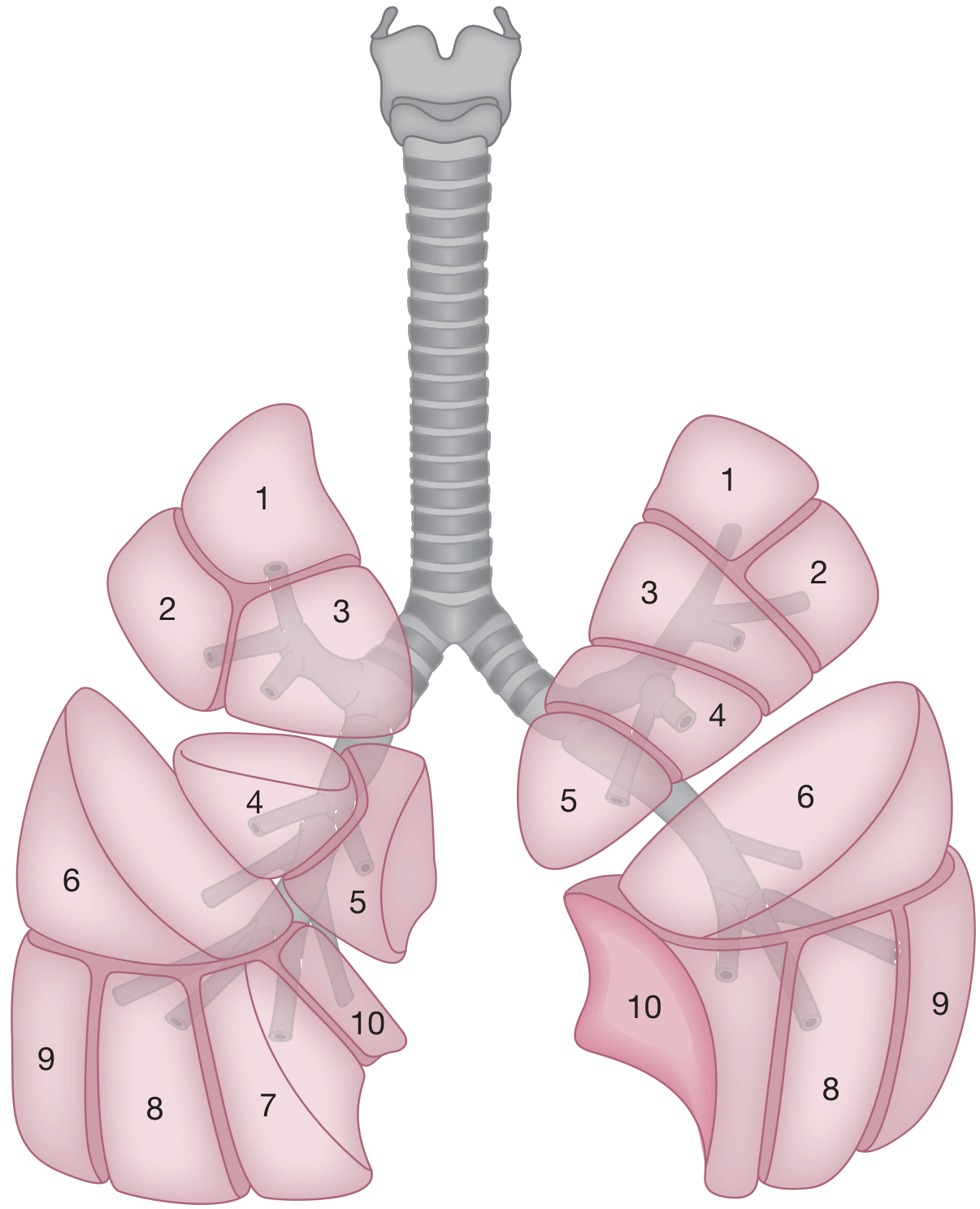
Figure 2-2 from Fishman's Pulmonary Diseases and Disorders — Bronchopulmonary segments, showing all 10 right (left side of image) and 9 left (right side of image) segments numbered 1–10.
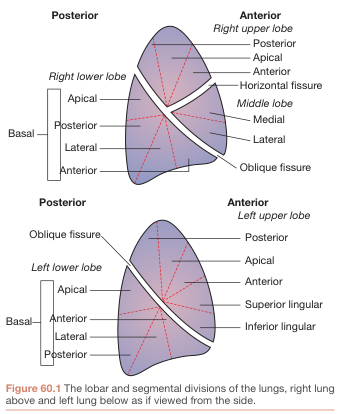
Bailey & Love Figure 60.1 — Lateral views showing segmental divisions and lobar fissures for both lungs.
5. Lobules (Sub-Segmental Unit)
Segmental bronchi divide progressively into medium-sized bronchi → small bronchi → bronchioles, each bronchiole supplying a pulmonary lobule. Lobules are the sub-units of bronchopulmonary segments:
- Located predominantly on the lung surface
- Polygonal, ~0.5–3 cm sides
- Bounded by connective tissue (which appears blue-black due to inhaled particulates)
- Each lobule's bronchiole divides 3–4 times into terminal bronchioles → respiratory bronchioles → alveolar ducts → alveoli
6. Connective Tissue Framework
Two connective tissue systems exist within each lung:
| System | Location | Function |
|---|---|---|
| Peribronchial/periarterial | Surrounds bronchi and pulmonary artery to level of respiratory bronchioles | Permits movement of airways against surrounding lung tissue |
| Subpleural | Lines lobe surfaces; forms septa dividing segments and lobules | Sliding layer; protects against overexpansion; demarcates segment boundaries |
7. Blood Supply and Innervation
- Pulmonary artery branch: accompanies the segmental bronchus intrasegmentally — carries deoxygenated blood for gas exchange.
- Bronchial arteries (systemic): run in the peribronchial connective tissue → supply the walls of bronchi and larger bronchioles.
- Pulmonary veins: run intersegmentally — clinically important as they define the surgical plane between adjacent segments.
8. Histological Structure of Segmental Bronchi
The walls of lobar and segmental bronchi have three layers:
- Mucosa: pseudostratified ciliated respiratory epithelium on a connective tissue lamina propria rich in elastic fibers
- Musculocartilaginous layer: spiral smooth muscle (Reissessen's muscle) + bronchial cartilage plates (hyaline in larger bronchi, increasingly elastic in smaller) + mixed seromucous bronchial glands + venous plexus
- Adventitia: narrow connective tissue; conveys bronchial arteries; site of bronchopulmonary lymph nodes at bronchial divisions
9. Microanatomy — Transition at Bronchiolar Level
As bronchi transition to bronchioles (diameter 0.3–0.5 mm):
- Cartilage disappears completely
- Walls consist of mucosa + muscular layer + adventitia
- Abundant elastic fiber network prevents wall collapse when smooth muscle is relaxed
- Terminal bronchioles end the conducting portion
- Respiratory bronchioles → alveolar ducts → alveolar sacs constitute the gas-exchanging portion
10. Clinical Relevance
10.1 Aspiration Pneumonia (Fishman)
- Aspiration pneumonia typically presents as a focal infiltrate in a dependent bronchopulmonary segment
- Upright/sitting patient: posterior segments of upper lobes (S2) and superior segments of lower lobes (S6) — most dependent in upright position
- Supine patient: superior segments of lower lobes (S6) and posterior basal segments (S10)
- Diagnosis inferred when a patient with known aspiration risk factors develops fever, dyspnea, purulent sputum with an infiltrate in a characteristic dependent segment
"Aspiration pneumonia usually presents as a 'community-acquired pneumonia,' with a focal infiltrate in a dependent bronchopulmonary segment." — Fishman's Pulmonary Diseases and Disorders
10.2 Bronchoalveolar Lavage (Murray & Nadel)
- For diffuse disease: BAL preferentially performed in the right middle lobe or lingula — these segments are most easily "wedged" in a supine patient and gravity maximizes fluid return
- For localized disease: BAL directed to the radiographically abnormal segment
- Patient positioning optimizes recovery: head elevated for upper lobe segments; lateral tilt for lateral segments
"In a supine patient, gravity assists the recovery of a maximal amount of BAL fluid return... either the right middle lobe or the lingula is preferred." — Murray & Nadel's Textbook of Respiratory Medicine
10.3 Surgical Resection (Fishman)
- Lobectomy: gold standard for most lung cancers
- Segmentectomy: appropriate for invasive cancers ≤2 cm (cT1a-b) without lymphatic invasion, or patients with limited pulmonary reserve
- Any segment can be resected individually or in groups
- Prototypical: superior segment (S6) of lower lobe
- Basilar segments often resected as a unit; lingular segments (S4+5) resected together; anterior/posterior segmentectomy of RUL common
- Intersegmental plane identified by: differential inflation, near-infrared fluorescence thoracoscopy with indocyanine green, or 3D-CT reconstruction
- Once segmental artery, vein, and bronchus divided → parenchyma divided along intersegmental plane
- Wedge resection: non-anatomic; crosses lymphatic channels; does not remove the originating bronchus; reserved for adenocarcinoma in situ / patients who cannot tolerate anatomic resection
10.4 Tuberculosis / NTM
- Upper lobe posterior segment (S2) and the superior segment of lingula (S4/5) are classically affected in NTM infection (as noted in Murray & Nadel's eFigure gallery)
- Right upper lobe apical and posterior segments are the classic sites for reactivation tuberculosis (gravity-independent, high V/Q ratio, relatively high PO₂)
11. Summary Table
| Feature | Right Lung | Left Lung |
|---|---|---|
| Lobes | 3 (upper, middle, lower) | 2 (upper, lower) |
| Fissures | Horizontal + oblique | Oblique only |
| Segments | 10 | 9 |
| Upper lobe | S1 apical, S2 posterior, S3 anterior | S1+2 apicoposterior, S3 anterior |
| Middle/Lingula | S4 lateral, S5 medial | S4 superior lingular, S5 inferior lingular |
| Lower lobe | S6, S7, S8, S9, S10 | S6, S8, S9, S10 (no S7) |
| Absent segment | — | S7 (medial-basal) |
| Key fusion | None | S1+2 apicoposterior |
| Bronchial artery origin | Right 3rd intercostal / aorta | Directly from thoracic aorta |
| Vein course | Intersegmental | Intersegmental |
| Surgical plane marker | Intersegmental vein | Intersegmental vein |
12. Memory Aid
"A PALM Seed Makes Little Pinecones" for Right Upper Lobe (Apical, Posterior, Anterior), then Middle (Lateral, Medial), then Lower (Superior/apical, Medial-basal, Anterior-basal, Lateral-basal, Posterior-basal).
For the Left: "APA + lingula (S+I) + lower (SALP)" — Apicoposterior, Anterior, Superior lingular, Inferior lingular; Superior, Anterior-basal, Lateral-basal, Posterior-basal.
Sources:
- Fishman's Pulmonary Diseases and Disorders, 5th ed. — Ch. 2 (Functional Design of the Human Lung), Ch. 69 (Aspiration), Ch. 113 (Lobectomy/Segmentectomy)
- Murray & Nadel's Textbook of Respiratory Medicine, 7th ed. — Ch. 26 (Bronchoscopy/BAL)
- Gray's Anatomy for Students — Ch. 3 (Thorax)
- Color Atlas of Human Anatomy Vol. 2: Internal Organs — Divisions of Bronchi and Bronchopulmonary Segments
This is a shared conversation. Sign in to Orris to start your own chat.