
Varicose vein examination
varicose vein clinical examination assessment
Bailey and Love's Short Practice of Surgery 28th Edition
Page 1051
varicose vein examination clinical findings
Hugging Face pmc clinical VQA raw
Page 0
Trendelenburg test Perthes test varicose veins special tests saphenofemoral junction
Harrison's Principles of Internal Medicine, Twenty First Edition
Page 7796
1) History first
- Leg heaviness, aching, swelling, itching, night cramps, worse on standing
- Visible tortuous veins, skin discoloration, eczema, ulcer history, bleeding episodes
- Prior DVT, thrombophlebitis, trauma, surgery, pregnancy, family history
- Occupation with prolonged standing
(Bailey & Love, p. 1051)
2) Inspection (standing position is essential)
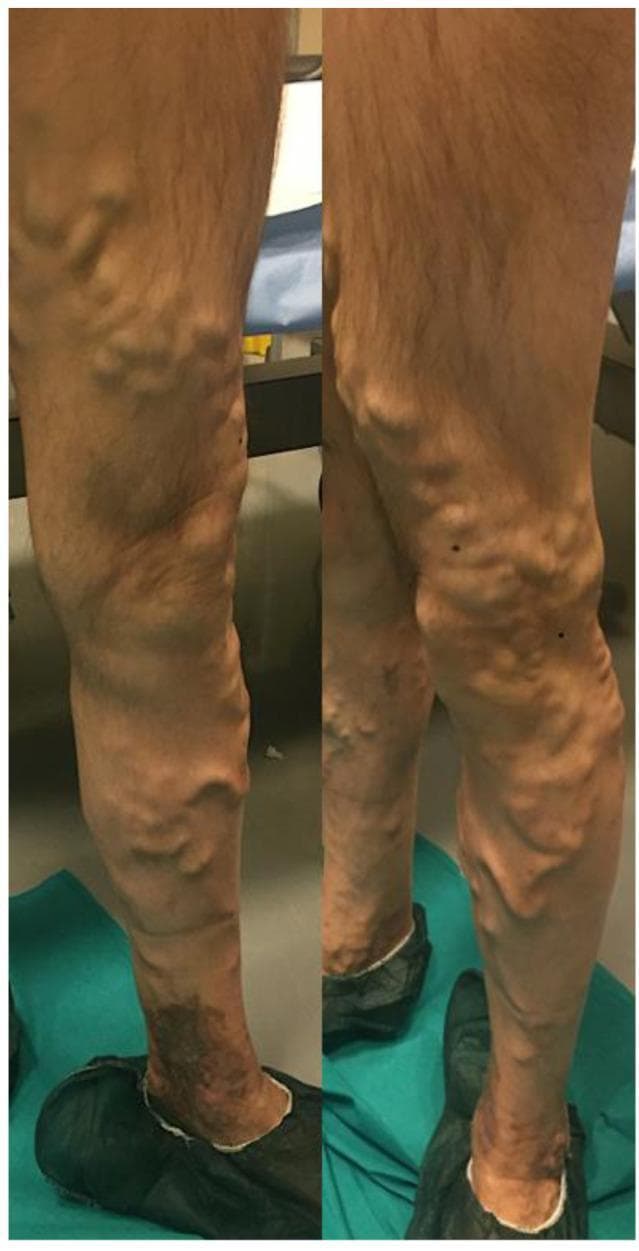
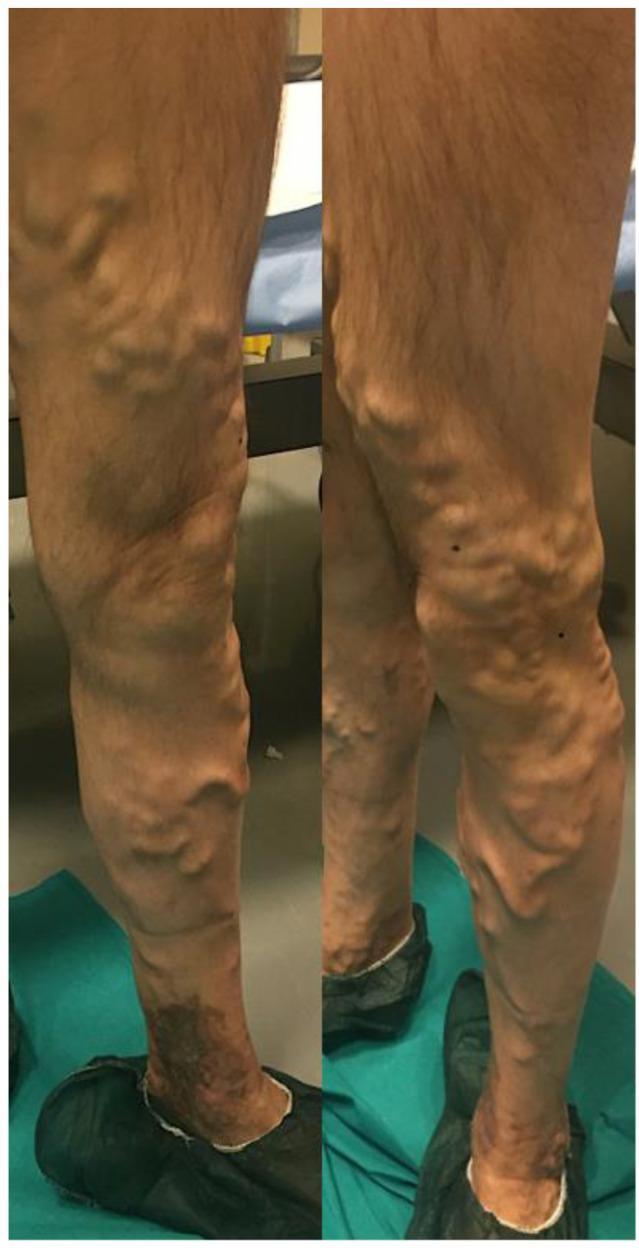
- Dilated, tortuous superficial veins along GSV/SSV territories
- Edema (ankle/calf)
- Skin changes of chronic venous hypertension:
- Hyperpigmentation
- Venous eczema
- Lipodermatosclerosis
- Atrophie blanche
- Healed or active ulcer (usually gaiter area)
3) Palpation
- Temperature and tenderness over veins (suggests thrombophlebitis)
- Compressibility of varicosities
- Saphenous trunk tenderness or cord-like segments
- Pitting edema
- Peripheral pulses (to exclude mixed arterial disease before compression therapy)
4) Bedside special tests (classical; now less used)
-
Brodie-Trendelenburg test
- Supine, elevate leg to empty veins, apply proximal thigh tourniquet, then stand.
- Rapid filling may indicate perforator/deep system incompetence; delayed filling after release suggests superficial reflux patterns.
(Harrison, p. 7796)
-
Perthes test
- Tourniquet to occlude superficial flow, then patient walks.
- Pain/increased distension suggests deep venous obstruction or poor deep outflow.
5) Confirmatory investigation (current standard)
- Duplex venous ultrasound is the key test for:
- Reflux location (SFJ, SPJ, GSV, SSV, perforators)
- Reflux duration/severity
- Deep venous patency and prior DVT changes
- Pre-procedure planning
6) Document severity (exam output)
- C0-C6 clinical class (from no visible disease to active ulcer)
- Etiology, anatomy, pathophysiology (reflux/obstruction)
Yes please
varicose vein OSCE examination sequence steps presentation
Bailey and Love's Short Practice of Surgery 28th Edition
Page 1051
CEAP classification varicose veins grading chronic venous insufficiency
Management of Varicose Veins of the Lower Extremities. Part II
Page 9
Varicose veins OSCE examination script
1) Opening
This will involve looking and feeling your legs, first lying down and then standing.
It should not be painful, but tell me if you are uncomfortable.
Can I confirm your name and get your consent?”
- Wash hands, PPE as needed
- Adequate exposure: from groin to feet (with dignity/chaperone)
- Ensure good lighting
2) Initial overview
- Is patient comfortable?
- Any walking aid/compression stockings/dressings?
- Visible varicosities, ulcers, edema, skin changes
3) Examination in standing position (most important)
Inspection
- Dilated tortuous superficial veins (GSV/SSV distribution)
- Edema (ankle/calf)
- Skin changes of chronic venous disease:
- Hyperpigmentation
- Venous eczema
- Lipodermatosclerosis
- Atrophie blanche
- Ulcers/healed ulcers (gaiter area)
- Scars from prior venous procedures
- Signs of thrombophlebitis (localized erythema over vein)
Palpation
- Temperature, tenderness over varicosities
- Induration/cord-like tender superficial vein
- Pitting edema
- Peripheral pulses (DP/PT) to assess arterial status before compression decisions
4) Supine examination
- Reassess varicosities after elevation (emptying)
- Palpate long saphenous path if needed
- Check for calf tenderness/asymmetry if DVT concern
5) Special tests (mention and perform if required in exam)
-
Brodie-Trendelenburg test
- Elevate leg to empty veins, apply upper-thigh tourniquet, ask patient to stand
- Observe filling before/after release
- Used to infer superficial vs perforator/deep incompetence
(Harrison’s, p. 7796)
-
Perthes test
- Tourniquet to occlude superficial veins, patient walks/heel-raises
- Pain/distension suggests poor deep venous outflow
6) Close examination
7) Presentation to examiner (concise)
There are [right/left/bilateral] tortuous superficial veins predominantly in the [GSV/SSV] territory, with [or without] chronic venous skin changes including [list].
There is [or is no] evidence of active ulceration, superficial thrombophlebitis, or bleeding.
Peripheral pulses are [present/absent].
Overall, this is consistent with chronic venous disease likely due to superficial venous reflux.
I would confirm and map reflux with duplex venous ultrasound and classify severity using CEAP.”
8) What to say for CEAP (quick OSCE add-on)
- C0 no visible disease
- C1 telangiectasia/reticular
- C2 varicose veins
- C3 edema
- C4 skin changes
- C5 healed ulcer
- C6 active ulcer
(Management of Varicose Veins of the Lower Extremities, Part II, p. 9)
9) Suggested “to complete exam” line
- Perform/arrange duplex venous ultrasound,
- Assess VTE risk and DVT history,
- Check ABPI if compression therapy is being considered,
- Do a focused cardiovascular and abdominal exam if secondary causes are suspected.”
Supraumbilical hernia
Key points
- Usually contains preperitoneal fat/omentum, less often bowel
- Presents as a midline swelling above the umbilicus, often more obvious on coughing/straining
- May be asymptomatic or cause pain/discomfort
Clinical features
- Visible/palpable lump above umbilicus
- Cough impulse may be present
- Reducible in many cases
- Pain can worsen with exertion
Red flags (urgent)
- Sudden severe pain
- Irreducible tender swelling
- Vomiting, abdominal distension, constipation
- Skin erythema over swelling
Management
- Definitive treatment is surgical repair (open or laparoscopic, often with mesh depending on defect size and patient factors)
- Watchful waiting may be considered in small minimally symptomatic hernias, but persistent symptoms generally favor repair
- Optimize risk factors: weight, smoking, chronic cough, constipation
Examination
epigastric hernia supraumbilical hernia clinical examination
Bailey and Love's Short Practice of Surgery 28th Edition
Page 1095
abdominal hernia OSCE examination cough impulse reducibility
Bailey and Love's Short Practice of Surgery 28th Edition
Page 1076
Supraumbilical (epigastric) hernia examination (OSCE style)
1) Introduction
I will inspect and feel your abdomen and may ask you to cough or raise your head.
Tell me if you feel pain. May I proceed?”
- Hand hygiene, chaperone, adequate exposure (xiphisternum to pubis)
2) Inspection
- Examine from end of bed and then at abdominal level
- Look for:
- Midline swelling above umbilicus (linea alba)
- Size/shape, skin changes, scars
- Multiple swellings (can have more than one defect)
- Visible cough impulse
- Cough
- Raise head/shoulders (or do a mini crunch) to accentuate hernia
3) Palpation
- Check local temperature/tenderness
- Identify exact site in midline between xiphisternum and umbilicus
- Assess:
- Size of swelling
- Consistency
- Reducibility (gentle pressure)
- Cough impulse on palpation
- Try to feel fascial defect margins (often small, elliptical)
(Bailey & Love, p. 1095)
4) Assess for complications
- Irreducible painful lump
- Marked tenderness
- Overlying erythema
- Features of obstruction (vomiting, distension) from history
5) Complete abdominal exam
- General abdominal palpation for other masses/tenderness
- Check for additional ventral hernias (umbilical, paraumbilical, incisional)
- Optional: examine hernial orifices if differential includes other hernias