
Strabismus pediatric patients anaesthetic considerations
Reading File
Now I'll search the library for strabismus and pediatric anesthesia considerations in parallel.
Finding Sources
Finding Sources
Finding Sources
Finding Sources
Finding Sources
Finding Sources
Excellent - I found dedicated sections. Let me read the key blocks in parallel.
Reading File
Reading File
Reading File
Excellent content retrieved. Let me get the Miller's strabismus section and oculocardiac reflex sections.
Reading File
Reading File
Reading File
Let me get the strabismus section from Miller's and PONV management in detail.
Reading File
Reading File
I now have very rich content from both Miller's and Barash. Let me also quickly search for malignant hyperthermia association and get the MH/succinylcholine detail, plus do a quick pubmed search for recent evidence.
Reading File
Searching PubMed
strabismus surgery pediatric anesthesia complications
I now have comprehensive information from both Miller's Anesthesia (10e) and Barash's Clinical Anesthesia (9e). Let me compile the full answer.
Anaesthetic Considerations for Strabismus Surgery in Pediatric Patients
Strabismus surgery is the most common pediatric ophthalmic operation performed in the United States. Approximately 3% of the population has strabismus (misalignment of the visual axes), and the surgery involves recession (weakening a muscle by moving its insertion) or resection (strengthening a muscle by removing a short strip) of extraocular muscles. While most patients are healthy children, a significant subset has associated neurological conditions or syndromes.
1. Patient Population and Preoperative Considerations
- Most strabismus patients are otherwise healthy children, but strabismus incidence is increased in CNS dysfunction: cerebral palsy, meningomyelocele with hydrocephalus.
- Strabismus may be acquired secondary to oculomotor nerve trauma or sensory abnormalities (cataracts, refractive errors).
- Infantile strabismus presents within the first 6 months; these youngest patients carry the highest risk.
- Patients with Down syndrome, prematurity, or metabolic myopathies require tailored evaluation.
- Standard preoperative assessment applies; laboratory testing is not routinely required for healthy children.
- Premedication with oral midazolam facilitates smooth induction and is not associated with significant IOP change.
2. Malignant Hyperthermia (MH) - Critical Consideration
Strabismus (and ptosis) patients are thought to have an increased incidence of malignant hyperthermia susceptibility. This is consistent with the broader observation that MH-susceptible individuals often have localized skeletal muscle weakness or musculoskeletal abnormalities. Although recent studies have challenged this belief, the theoretical risk must be taken seriously.
Practical implication: Anesthesiologists should be cognizant of this risk and maintain a low threshold for MH vigilance - have dantrolene immediately available, monitor temperature, capnography, and be alert to unexplained tachycardia or increased CO2.
- (Barash's Clinical Anesthesia, 9e, p. 4192)
- (Miller's Anesthesia, 10e, p. 9750)
3. The Oculocardiac Reflex (OCR) - Most Critical Intraoperative Hazard
Mechanism
The OCR (trigeminovagal reflex) is triggered by:
- Traction on the extraocular muscles (especially medial rectus)
- Pressure on the globe
- Manipulation of conjunctiva, orbital structures, or periosteum
Afferent limb: ciliary nerves → ciliary ganglion → ophthalmic division of trigeminal nerve (V1) → Gasserian ganglion → trigeminal sensory nucleus
Efferent limb: motor nucleus of vagus nerve → heart (reduced HR and contractility)
Efferent limb: motor nucleus of vagus nerve → heart (reduced HR and contractility)
Manifestations
- Most common: sinus bradycardia
- Also: junctional rhythm, ectopic atrial rhythm, AV block, ventricular bigeminy, multifocal PVCs, wandering pacemaker, idioventricular rhythm, asystole, ventricular tachycardia
Incidence
- Reported range: 16% to 82%
- Children have higher vagal tone and therefore a higher incidence than adults
- Hypercapnia, hypoxemia, and shallow anesthetic depth exacerbate the reflex
Prevention
| Method | Notes |
|---|---|
| IM anticholinergics (premedication) | Ineffective for prophylaxis |
| IV atropine (0.02 mg/kg) just before surgery | May reduce incidence in pediatric strabismus surgery - but carries risk of arrhythmias itself |
| IV glycopyrrolate (0.01 mg/kg) | Associated with less tachycardia than atropine; preferred by some |
| Ketamine induction | Reported lowest OCR incidence vs propofol (Choi et al.) |
| Retrobulbar block | Blocks afferent limb but not uniformly effective; carries its own risks |
| Opioids (fentanyl, alfentanil, remifentanil) | May contribute to OCR - use cautiously |
| Avoid hypercapnia/hypoxia | Critical; optimize ventilation |
| Adequate anesthetic depth | Shallow anesthesia exacerbates OCR |
Management When OCR Occurs
- Ask the surgeon to immediately cease manipulation (first step)
- Evaluate and correct hypoxia, hypercapnia, inadequate anesthetic depth
- Heart rate typically returns to baseline within 20 seconds with cessation of stimulus
- Note: tachyphylaxis occurs - the reflex attenuates with repeated manipulation
- If bradycardia persists: IV glycopyrrolate 10 mcg/kg or atropine 10-20 mcg/kg
- Severe/refractory cases: epinephrine may be required
- (Miller's Anesthesia, 10e, pp. 9715-9716)
- (Barash's Clinical Anesthesia, 9e, pp. 4150-4151)
4. Oculorespiratory Reflex (ORR) - Lesser Known
A lesser-known companion reflex: extraocular muscle traction also causes bradypnea and respiratory pauses. The afferent limb is the same as OCR but the efferent limb is not fully established. Importantly:
-
Not responsive to anticholinergics
-
May go unnoticed because of assisted ventilation modes
-
A reason to maintain close monitoring of respiratory parameters during strabismus surgery
-
(Miller's Anesthesia, 10e, p. 9751)
5. Forced Duction Test (FDT) and Succinylcholine
The forced duction test (FDT) is an intraoperative maneuver where the surgeon grasps the sclera and moves the eye into each field of gaze to determine whether strabismus is due to muscle paresis or a restrictive force - this informs the surgical plan.
Problem with succinylcholine: Succinylcholine causes prolonged contracture of extraocular muscles, falsely elevating force needed to rotate the globe and giving an abnormal (misleading) FDT. This elevation persists for 15-20 minutes after administration (even though skeletal paralysis resolves in <5 minutes and IOP rise is transient).
Recommendations:
-
Avoid succinylcholine in patients where the ophthalmologist plans to use FDT
-
If succinylcholine is used (e.g., for emergency laryngospasm), the FDT must be delayed at least 20 minutes
-
In current practice, strabismus surgery in children generally does not require neuromuscular blockade at all
-
Succinylcholine in children is reserved for emergencies (laryngospasm)
-
(Barash's Clinical Anesthesia, 9e, pp. 4192-4193)
6. Airway Management
- Laryngeal Mask Airway (LMA/SGA) is the preferred airway for strabismus surgery (provided no aspiration risk):
- Can be inserted without muscle relaxants
- Causes less hemodynamic perturbation than ETT
- Less straining/coughing on removal
- Avoids the succinylcholine/FDT interaction entirely
- Tracheal intubation is reserved for patients at aspiration risk or with specific airway concerns
7. Postoperative Nausea and Vomiting (PONV) - Major Problem
Strabismus surgery is an independent risk factor for postoperative vomiting (POV) in children, with a historical incidence exceeding 50%.
Eberhart's 4-Point Risk Score for POV in Children
| Risk Factor | Points |
|---|---|
| Age > 3 years | 1 |
| Surgery duration > 30 minutes | 1 |
| History of POV (patient/sibling/parent) | 1 |
| Strabismus surgery | 1 |
Predicted POV risk: 2 factors = 30%, 3 factors = 55%, 4 factors = 70%
PONV Prevention Strategy
-
For high risk (≥2 risk factors) - which includes essentially all strabismus patients:
- Dexamethasone 0.1-0.2 mg/kg at start of procedure
- Ondansetron 0.1 mg/kg toward the end of the case
- Propofol infusion at subhypnotic dose + antiemetic combination
-
For 4 risk factors (maximal risk):
- Avoid nitrous oxide and volatile inhalational agents
- Implement TIVA with propofol
-
Other agents: NK1 antagonist aprepitant (oral preop or IV); droperidol (0.075 mg/kg at induction is effective but limited by FDA black box warning for QTc prolongation)
-
Note: TIVA/propofol reduces POV but is associated with a higher incidence of OCR and bradycardia - a trade-off that must be managed
-
(Miller's Anesthesia, 10e, pp. 9750-9751)
-
(Barash's Clinical Anesthesia, 9e, pp. 4193-4194)
8. Anesthetic Agents - Key Interactions Summary
| Agent | Effect Relevant to Strabismus |
|---|---|
| Succinylcholine | Falsely elevates FDT for 20+ min; avoid if FDT planned |
| Ketamine | Lowest OCR incidence on induction; minimal IOP effect |
| Propofol (TIVA) | Reduces POV; increases OCR/bradycardia risk |
| Opioids (fentanyl, alfentanil, remifentanil) | May augment OCR |
| Nitrous oxide | Avoid in high-risk POV patients |
| Volatile agents | Dose-related IOP reduction; avoid in max-risk POV |
| Atropine IV | Reduces OCR but can itself cause arrhythmias |
| Glycopyrrolate IV | Preferred anticholinergic; less tachycardia |
9. Associated Systemic Conditions to Screen For
Because strabismus has a higher incidence in certain populations, preoperative screening matters:
- Cerebral palsy / CNS dysfunction: altered pharmacodynamics, aspiration risk, positioning issues
- Meningomyelocele with hydrocephalus: latex allergy protocol, VP shunt considerations
- Down syndrome: atlantoaxial instability, subglottic stenosis, congenital heart disease
- Neuromuscular disorders (e.g., myopathies): heightened MH susceptibility, avoid succinylcholine broadly
10. Quick Reference - Key "Do Not Miss" Points
- MH susceptibility is theoretically increased - be prepared
- OCR will happen - anticipate it, have anticholinergics drawn and ready
- Avoid succinylcholine if FDT is planned intraoperatively
- LMA is the airway of choice (no muscle relaxant needed)
- Aggressive PONV prophylaxis is mandatory (dual/triple therapy for most)
- TIVA vs inhalational is a deliberate trade-off (less PONV vs more OCR)
- Opioid-sparing where possible (less OCR, less PONV)
- Watch for the oculorespiratory reflex - it won't respond to atropine
Sources: Miller's Anesthesia, 2-Volume Set, 10e (pp. 9708-9751) | Barash, Cullen, and Stoelting's Clinical Anesthesia, 9e (pp. 4131-4194)
Elderly cataract surgery anaesthesia management, blocks
Reading File
This is a broad clinical question on a special population (elderly). Searching headings and paragraphs in parallel across multiple relevant topics.
Finding Sources
Finding Sources
Finding Sources
Finding Sources
Finding Sources
Finding Sources
Now let me read the key sections - the MAC/cataract section, anesthesia options (blocks), and orbital block key points from Miller's and Barash's in parallel.
Reading File
Reading File
Excellent content. Now let me read the MAC for cataract section, the blocks detail, and preoperative evaluation for elderly in parallel.
Reading File
Reading File
Reading File
Excellent. Let me get the remaining orbital blocks (peribulbar, sub-Tenon, topical), MAC management, and preoperative evaluation sections.
Reading File
Reading File
Reading File
Let me get the MAC section continuation, preoperative evaluation, and the topical/facial block detail.
Reading File
Reading File
Reading File
Let me now get the preoperative evaluation for elderly cataract patients, IFIS detail, and the facial nerve block section.
Reading File
Reading File
I now have comprehensive, rich content from both Miller's and Barash's. Let me also fetch the retrobulbar vs peribulbar block diagram image to include it.
Loading Image
Loading Image
I now have comprehensive content and images. Let me compile the full, well-organized answer.
Anaesthetic Management for Elderly Cataract Surgery
Cataract surgery is the most common operation performed in the elderly, and the vast majority are conducted as day-case procedures with local/regional anesthesia and monitored anesthesia care (MAC). The procedure involves phacoemulsification of the opacified crystalline lens through a small self-sealing incision, followed by intraocular lens implantation. It is short (20-40 min), low-risk, and does not cause significant physiologic perturbation - but the elderly patient population brings substantial comorbidity that demands careful perioperative management.
1. Preoperative Evaluation
No Routine Testing
Preoperative laboratory tests, ECG, and investigations are NOT required for cataract surgery and have not been shown to reduce complications or improve outcomes. The Schein et al. multicenter trial of 19,000+ cataract patients demonstrated this conclusively. The Society of Ambulatory Anesthesia recommends testing only if independently indicated by medical history.
Conditions Requiring Optimization Before Proceeding
(Box 65.1, Miller's Anesthesia 10e)
| Condition | Threshold |
|---|---|
| Myocardial infarction | Within 30 days (uncomplicated) or 60 days (complicated) |
| PCI without stents | Within 14 days |
| PCI with stents | Within 30 days |
| Significant arrhythmias | With hemodynamic compromise (e.g., AF with rapid ventricular rate) |
| Decompensated heart failure | Any |
| Active pneumonia / PE within 3 months | Any |
| Stroke/TIA within 3 months | Any |
| Malignant hypertension | Any |
| DKA or HONK | Any |
Elevated BP or hyperglycemia on the day of surgery alone do not warrant cancellation in the absence of the above. Patients should take all routine medications including antihypertensives on the day of surgery.
Key Elderly-Specific History Points
- Systemic ophthalmic drug effects: Timolol (beta-blocker drops) can cause bradycardia, bronchospasm; phenylephrine drops (10%) contain 5 mg per drop - cardiovascular effects in elderly. Acetazolamide causes fluid/electrolyte disturbance. Echothiophate iodide (phosphodiesterase inhibitor) prolongs succinylcholine effect.
- Alpha-1 antagonists (tamsulosin, silodosin): Cause Intraoperative Floppy Iris Syndrome (IFIS) - triad of poor pupil dilation, floppy iris, iris prolapse - persists >1 year after stopping; anesthesiologist must inform the surgeon.
- Anticoagulants/antiplatelets: Safe to continue warfarin (if INR within range) and antiplatelet agents for cataract surgery. Risk of retrobulbar hemorrhage with needle blocks in anticoagulated patients favors topical or sub-Tenon technique.
- Previous intraocular gas bubble (SF6, C3F8): Must avoid nitrous oxide (causes expansion of bubble).
- High myopia (axial length >25 mm): Increased risk of globe perforation with needle blocks - favor sub-Tenon or topical technique.
- Positioning ability: Patient must lie flat (supine) for the duration. Cervical/lumbar spine disease, severe GORD, heart failure, and claustrophobia require special planning.
- Cognitive status: Dementia or inability to cooperate precludes topical anesthesia and may require general anesthesia.
2. Anesthesia Options for Cataract Surgery
Most cataract procedures are performed with topical anesthesia OR orbital block + MAC. General anesthesia is rarely needed (<5% of cases).
Comparison Overview
| Technique | Akinesia | Cooperation Needed | Best For |
|---|---|---|---|
| Topical ± intracameral | None | High | Cooperative elderly, anticoagulated, monocular patients |
| Sub-Tenon block | Variable | Moderate | High myopia, anticoagulated, pediatric |
| Peribulbar block | Good | Moderate | Most routine cases |
| Retrobulbar block | Excellent | Moderate | Complex/longer cases |
| General anesthesia | Full | Not required | Uncooperative, demented, complex procedures |
3. Orbital Block Techniques
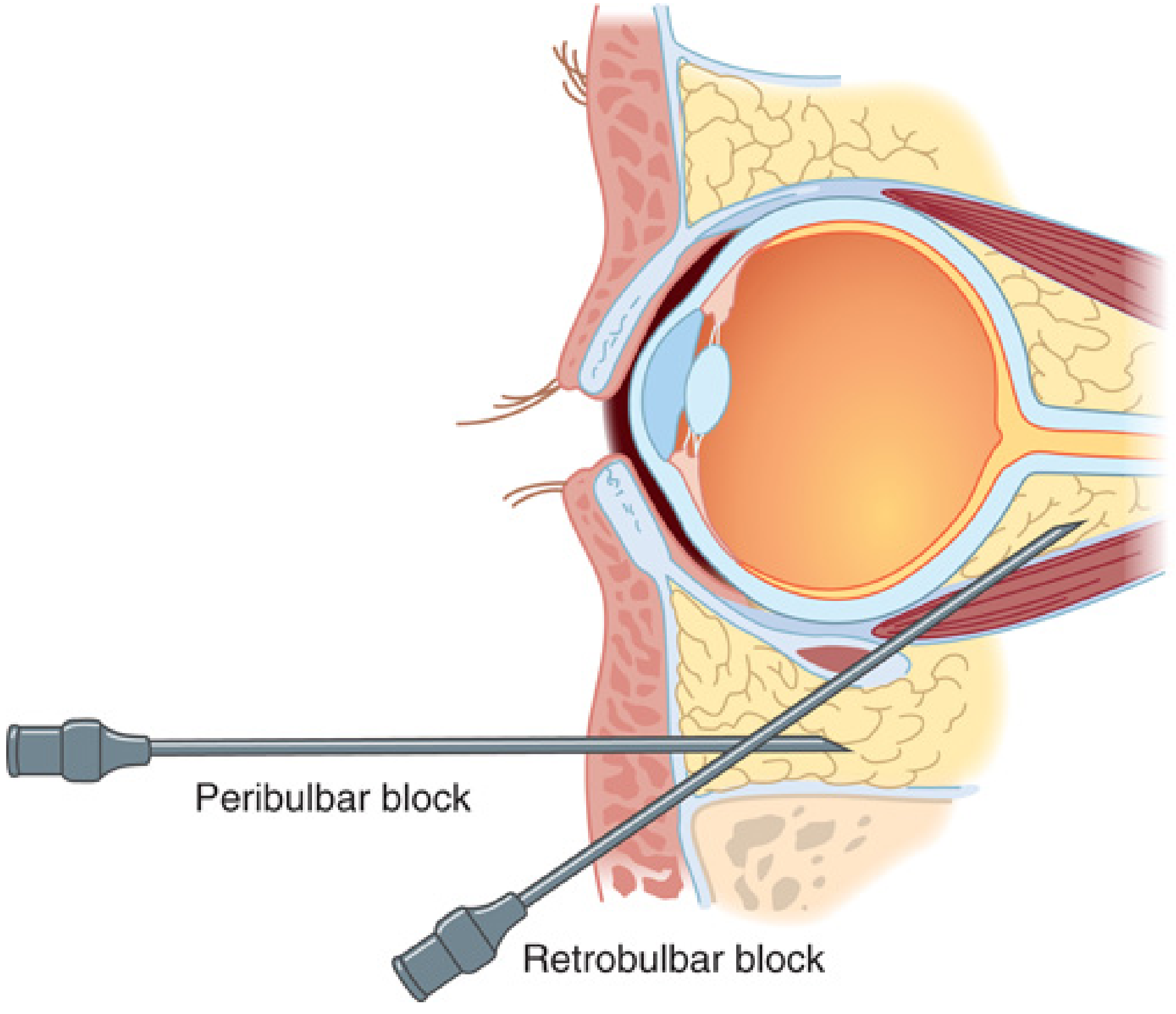
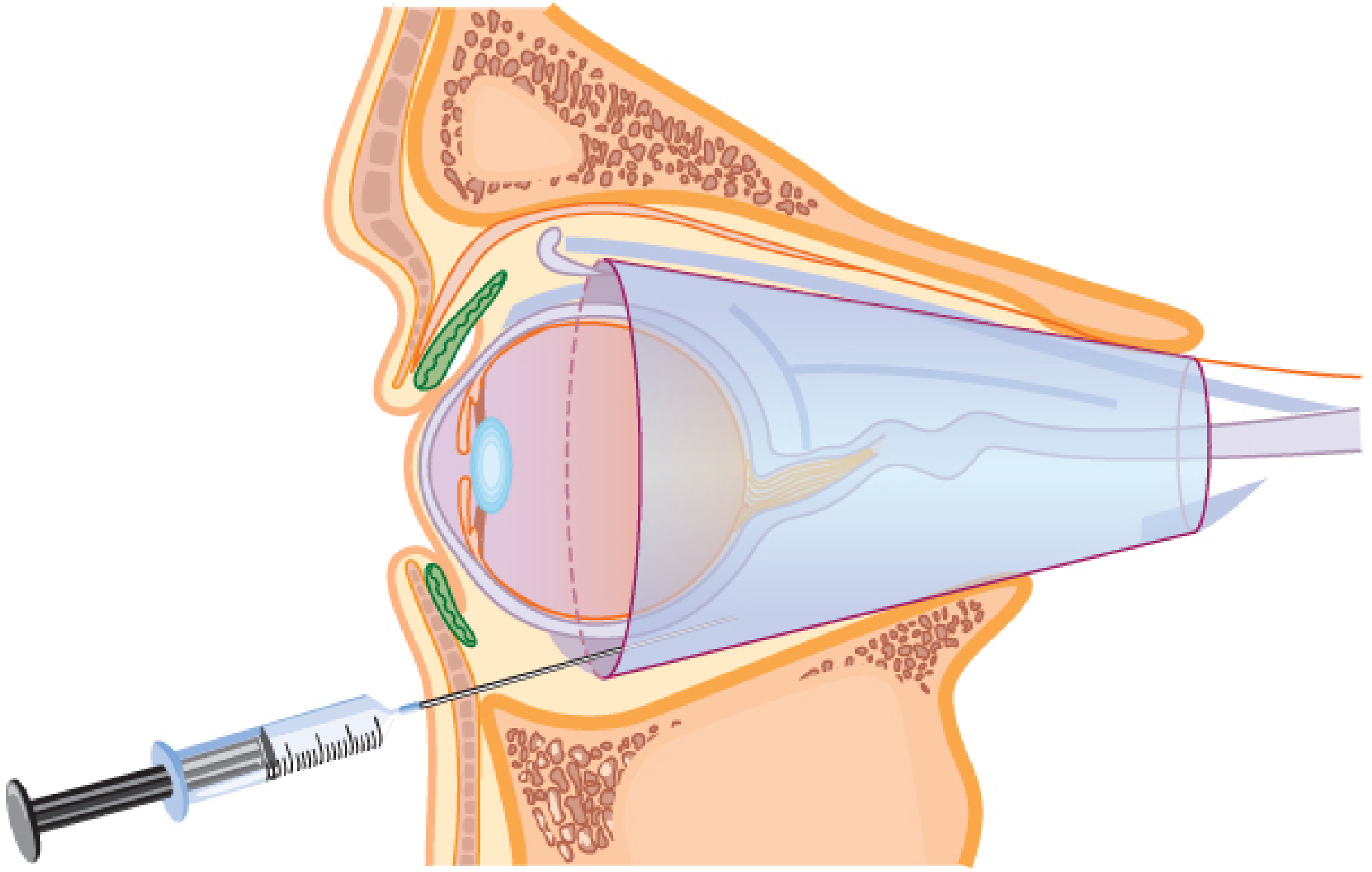
A. Retrobulbar (Intraconal) Block
- Needle position: Inside the muscular cone (intraconal), behind the globe
- Technique: With globe in primary gaze, a 3-cm, 23-27 gauge needle is placed at the junction of the inferior and lateral walls of the orbit just above the inferior orbital rim. Advanced parallel to the orbit floor (~10-degree elevation) for ~15 mm past the equator, then redirected medially and slightly upward toward the pupil-macula axis. 2-5 mL local anesthetic injected.
- Onset: Rapid (5-10 min)
- Provides: Dense analgesia + profound akinesia of all extraocular muscles (note: superior oblique is outside the cone and may not be fully blocked)
- Advantages: Quicker onset, less chemosis than peribulbar
- Complications:
- Retrobulbar hemorrhage (~1%): venous (usually self-limiting) vs arterial (can threaten vision - may require lateral canthotomy)
- Globe perforation: risk higher with high myopia (axial length >25 mm) and inexperienced operators; devastating prognosis if delayed diagnosis
- Brainstem anesthesia: retrograde tracking of LA along the optic nerve sheath into subarachnoid space - presents with aphasia, confusion, apnea, cardiac arrest, loss of consciousness; management is supportive
- Intra-arterial injection: retrograde to ICA → CNS excitation, seizures
- Optic nerve damage
B. Peribulbar (Extraconal) Block
- Needle position: Outside the muscular cone, anterior to equator of the globe
- Technique: A 3-cm, 23-gauge needle at the junction of the middle and lateral thirds of the lower lid, directed vertically backwards parallel to the orbit floor. Classic technique uses two injections (inferotemporal + superonasal). Larger volume (5-10 mL) needed vs retrobulbar.
- Advantages over retrobulbar:
- Needle does not pass through the muscle cone → lower risk of optic nerve injury and direct muscle trauma
- No retrobulbar hemorrhage (needle stays anterior)
- Preferred in the United States since the mid-1990s
- Disadvantages:
- Slower onset (slower diffusion across the cone septae)
- Incomplete akinesia more common
- Greater volume injected → greater IOP rise initially (5-10 mmHg, falls to below baseline within 5 min)
- More chemosis
C. Sub-Tenon (Episcleral) Block
- Technique: After topical anesthesia, a small incision is made in the conjunctiva and Tenon's capsule (usually inferonasal quadrant) with fine scissors. A blunt cannula is guided through the opening and local anesthetic (typically 3-5 mL) is infused into the episcleral space. LA spreads into the posterior orbit.
- Advantages:
- No sharp needle in the posterior orbit - significantly reduced risk of globe perforation, especially in high myopia
- Excellent option for anticoagulated patients (risk of significant hemorrhage is very low)
- Rapid onset of analgesia
- Preferred in the UK and New Zealand
- Disadvantages:
- Requires conjunctival incision (surgeon or skilled anesthesiologist)
- Chemosis, conjunctival bleeding common (cosmetically minor)
- Akinesia may be incomplete (especially with small-volume techniques)
- Complications: Globe perforation (with longer metallic cannulae), hemorrhage, rectus muscle trauma, postoperative strabismus, orbital cellulitis, brainstem anesthesia (rare)
- Note: Sub-Tenon block is the preferred choice in anticoagulated elderly and in high myopia.
D. Topical Anesthesia (TA)
- Agents: 0.5% tetracaine drops, 0.75% bupivacaine drops, 2% lidocaine drops/gel, or lidocaine gel (gels provide higher anterior chamber concentration)
- Supplement: Intracameral injection of 0.1-0.2 mL 1% preservative-free lidocaine into the anterior chamber ("sugarcaine" = lidocaine + bisulfite-free epinephrine)
- Advantages:
- No injection → no risk of retrobulbar hemorrhage or globe perforation
- Ideal for anticoagulated patients, monocular patients (avoids prolonged amaurosis)
- Most widely used technique for routine cataract surgery in cooperative patients
- Limitations:
- No akinesia - requires full patient cooperation and ability to fixate
- Contraindications: Dementia, inability to communicate, photophobia, active infection, dense cataract requiring significant iris manipulation, large scleral incisions anticipated
- Some discomfort - may need IV analgesic supplementation
- Analgesia dissipates with constant irrigation
E. Facial Nerve Block (Adjunct)
- Motor innervation of orbicularis oculi is outside the orbital cone, so retrobulbar/peribulbar blocks do not prevent lid squeezing.
- Facial nerve blocks (van Lint technique at orbital rim, or O'Brien technique at the mandibular condyle) provide lid akinesia.
- Less frequently used with peribulbar technique (which partially obtunds the orbicularis) and not needed with topical anesthesia if patient is cooperative.
4. Local Anesthetic Choice and Adjuvants
| Agent | Feature | Common Use |
|---|---|---|
| Lidocaine 2% | Fast onset, shorter duration | Short cases, intracameral |
| Bupivacaine 0.5-0.75% | Slower onset, prolonged analgesia | Longer/vitreoretinal surgery; 0.75% can cause extraocular muscle toxicity - avoid |
| Ropivacaine | Intermediate - good safety | Good alternative to bupivacaine |
| Mepivacaine 2% | Fast onset, medium duration | Routine cataract |
| Lidocaine + bupivacaine mix | Historically popular | Clinically the advantage is unproven - dilutes both agents |
Hyaluronidase (15-150 IU/mL): Added as an adjuvant to enhance spread and onset. Must be used cautiously - strabismus cases have been reported after use of periocular anesthesia without hyaluronidase (cluster effect).
5. Monitored Anesthesia Care (MAC) - Sedation Strategy
For Topical Anesthesia Cases
- Most patients want sedation even with topical anesthesia.
- Midazolam: Primary anxiolytic; side effects of oversedation, paradoxical reaction, postoperative delirium and memory deficit are particularly concerning in the elderly
- Remimazolam: Newer FDA-approved benzodiazepine with rapid onset/metabolism - promising for elderly cognitive safety; further study needed
- Low-dose propofol + short-acting opioid: Reasonable alternatives
- Dexmedetomidine: Effective sedation with minimal respiratory depression and analgesia; however causes bradycardia, hypotension, and prolonged recovery - use case by case
- Ketamine: NOT appropriate - dysphoric and hallucinogenic properties
- Avoid oversedation: Sudden awakening under drapes leads to disorienting movement - potentially catastrophic for an open eye
For Orbital Block Cases (MAC During Block Placement)
The block placement phase is the most challenging - demands rapid onset, analgesia, and hemodynamic stability without airway compromise.
The 6-2-2 Mixture (propofol + opioid + lidocaine):
- 6 parts 10 mg/mL propofol + 2 parts alfentanil (or fentanyl) + 2 parts 1% lidocaine in a single syringe
- Titrated by age and weight; produces OAA/S level 3 sedation within 30-90 seconds
- Provides excellent analgesia + sedation + hemodynamic stability with minimal airway need
- Sedation maintained at OAA/S 3 (comfortable, follows commands, remains still)
- After the block, an orbital block provides 2-6 hours of postoperative analgesia - reduces PACU analgesic requirements
6. Elderly-Specific Anesthetic Considerations
| Issue | Management |
|---|---|
| Multiple comorbidities (DM, HTN, CAD, COPD) | Optimise; continue most regular medications |
| Polypharmacy / ophthalmic drug interactions | Anticholinesterase drops (echothiophate) → avoid succinylcholine; timolol → watch for bradycardia/bronchospasm |
| IFIS (alpha-1 antagonists) | Alert surgeon; use intracameral epinephrine/pupil expansion devices; consider regional block over topical |
| Cognitive impairment | General anaesthesia may be required; avoid anticholinergics; TIVA preferred over volatiles to reduce POCD risk |
| Anticoagulation | Continue warfarin (if INR therapeutic); prefer sub-Tenon or topical over retrobulbar needle blocks |
| Inability to lie flat | Address with positioning aids; if impossible under local, convert to GA |
| High myopia (axial length >25 mm) | Avoid retrobulbar block; use sub-Tenon or topical |
| Previous intraocular gas bubble | Avoid N2O (avoid for 3 weeks after SF6; 8 weeks after C3F8) |
| Anxiety/claustrophobia | Preoperative counselling; anxiolytic premedication |
| Eye drop systemic effects | Phenylephrine 10% → hypertension/arrhythmia; brief occlusion of nasolacrimal duct and lid closure after drops reduces systemic absorption |
7. IOP Considerations
- Inhalational agents cause dose-related reductions in IOP (favorable for intraocular surgery)
- Increases in IOP occur with: laryngoscopy/intubation (favor LMA), coughing/straining (30-40 mmHg rise), hypoxia, hypercapnia, prone position, forceful lid squeeze (up to 70 mmHg)
- Orbital blocks initially increase IOP by 5-10 mmHg (peribulbar more than retrobulbar due to larger volume), falling below baseline within 5 minutes
- Gentle ocular massage or Honan balloon (30 mmHg for 10 min) applied after the block helps reduce IOP before incision
8. General Anesthesia - When Indicated and Approach
Indications for GA (20-30% of ophthalmic surgeries overall, rare for routine cataract):
- Uncooperative/demented patients
- Unable to remain still (tremor, movement disorder, severe anxiety/claustrophobia)
- Very young children (n/a for elderly cataract)
- Complex, prolonged procedures
If GA used:
- LMA preferred over endotracheal tube: less IOP rise on insertion/removal, less coughing and straining at emergence
- Smooth induction and emergence are paramount to avoid IOP spikes
- Emergence techniques: deep extubation, IV lidocaine 1.5 mg/kg, dexmedetomidine 0.25-1 mcg/kg 15 min before emergence, opioids
- TIVA with propofol preferred in elderly with cognitive vulnerability to reduce POCD risk
9. Postoperative Considerations
- Cataract surgery is a day-case procedure; most patients bypass Phase 1 PACU if regional technique was used
- PONV prophylaxis: lower risk than with GA; regional anesthesia avoids this problem
- Postoperative analgesia: orbital block provides 2-6 hours of excellent pain control post-cataract; topical anesthesia provides less
- Cognitive: monitor for emergence delirium and POCD, especially in older patients who received heavy sedation or GA
- Wrong-site surgery prevention: Time-out and site marking are particularly important - laterality errors in ophthalmic surgery are a recognized medico-legal risk
Sources: Miller's Anesthesia, 2-Volume Set, 10e (pp. 9706-9751) | Barash, Cullen, and Stoelting's Clinical Anesthesia, 9e (pp. 4131-4196) | Goodman & Gilman's Pharmacological Basis of Therapeutics
This is a shared conversation. Sign in to Orris to start your own chat.