
Importance Cavosurface bevels and rounded angles in integrity of different restorations for 25 marks . Hand drawn images also
cavosurface bevel rounded angles importance cavity preparation restoration dentistry
https://ijce.in/archive/volume/7/issue/3/article/3689
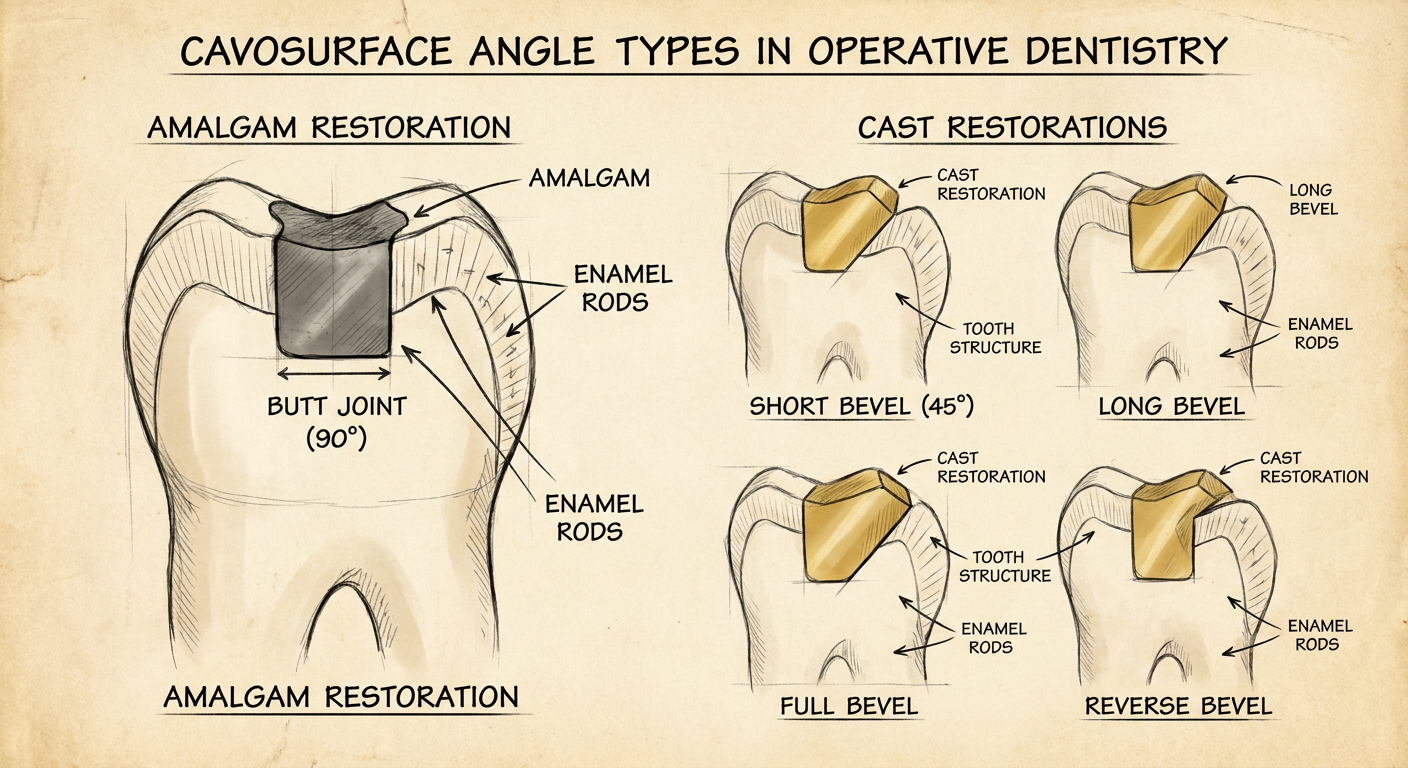
Hand-drawn style dental diagram showing cavosurface angle types: butt joint (90 degrees) for amalgam, bevel types (short bevel 45 degrees, long bevel, full bevel), and reverse bevel for cast restorations. Labeled cross-section diagrams showing enamel rods direction, tooth structure, and restorative material interface. Educational dental operative dentistry illustration.
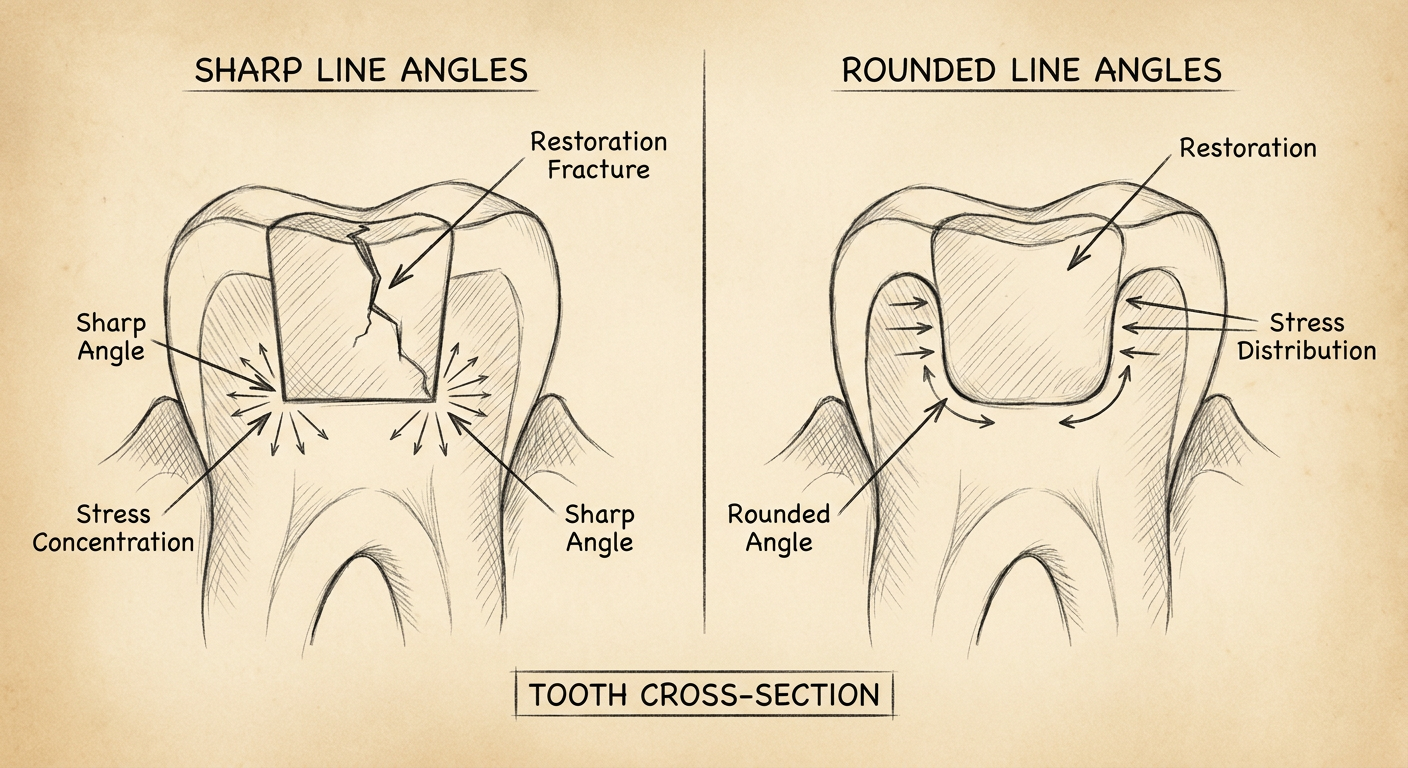
Hand-drawn style dental education diagram showing rounded internal line angles vs sharp line angles in tooth cavity preparation. Left side shows sharp angles causing stress concentration and restoration fracture. Right side shows properly rounded angles distributing stress evenly. Include cross-section of tooth with cavity walls, floor, and rounded angles labeled. Operative dentistry textbook style illustration.
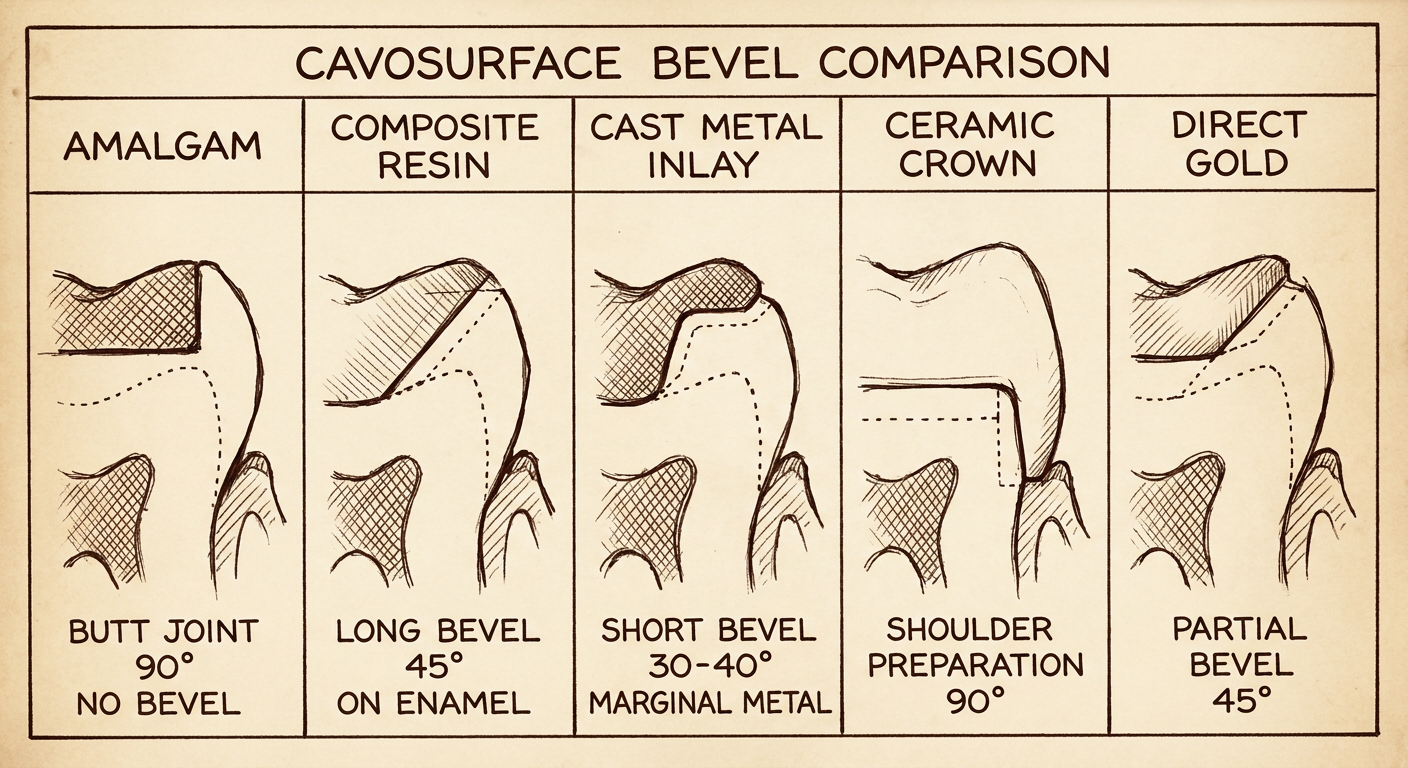
Hand-drawn dental diagram showing cavosurface bevels for different restorations in a comparison chart: Amalgam - butt joint 90 degrees no bevel; Composite resin - long bevel 45 degrees on enamel; Cast metal inlay - short bevel 30-40 degrees marginal metal; Ceramic crown - shoulder preparation 90 degrees; Direct gold - partial bevel 45 degrees. Labeled cross-section views showing each restoration type. Operative dentistry textbook style.
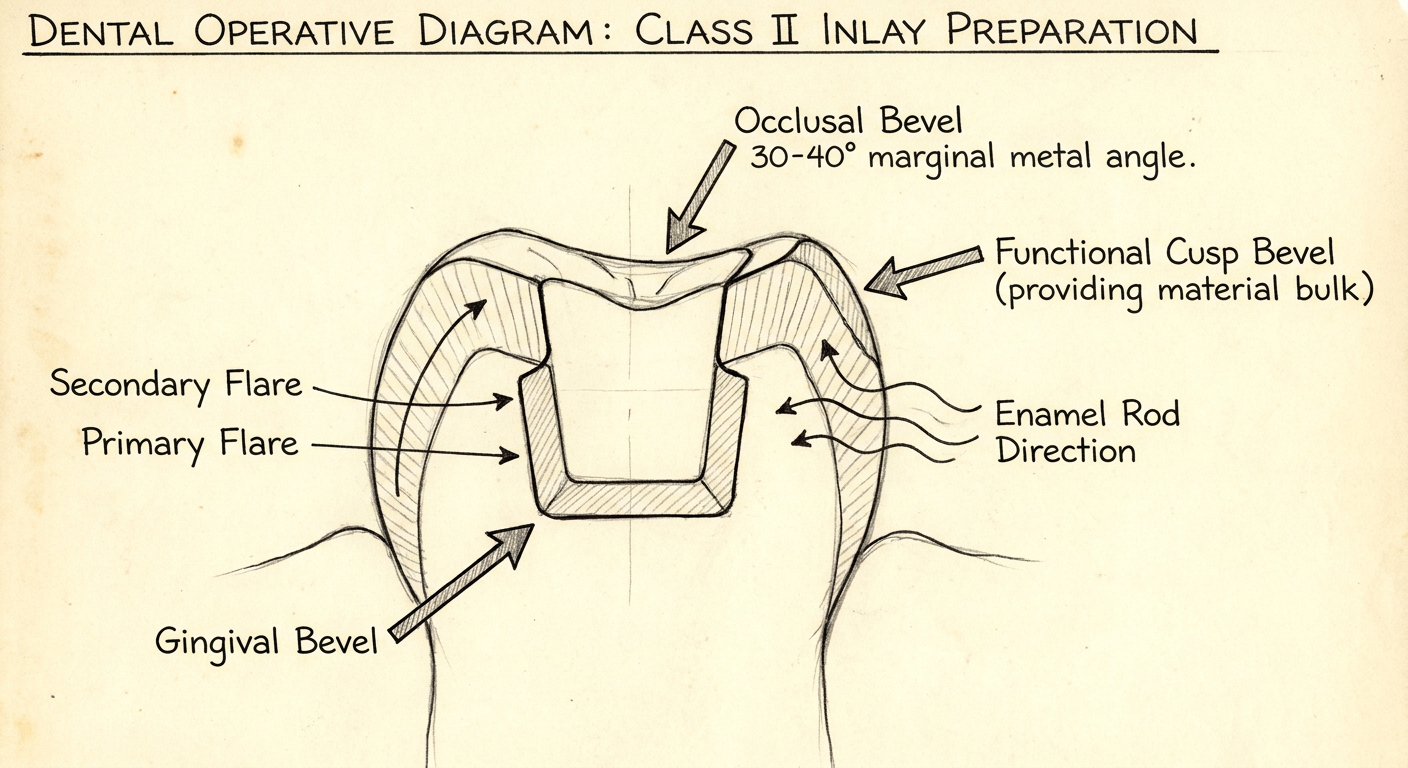
Hand-drawn dental operative dentistry diagram showing: gingival bevel for Class II inlay preparation with primary flare and secondary flare labeled; occlusal bevel producing 30-40 degree marginal metal angle; functional cusp bevel for providing material bulk; enamel rod direction shown with arrows. Educational sketch style with clear labels for each type of bevel and their purposes in cavity preparation.
Importance of Cavosurface Bevels and Rounded Angles in the Integrity of Different Restorations
1. Introduction and Basic Definitions
- Marginal seal
- Resistance to microleakage
- Longevity of the restoration
- Secondary caries prevention
- Structural integrity of both tooth and restoration
- The preparation must rest on sound dentin
- Both inner and outer ends of the cavosurface angle must rest on sound dentin
- The margin must be self-cleansing and accessible for finishing
2. Types of Cavosurface Margins
A. Butt Joint (90-100°)
B. Bevel
| Type | Angle | Depth |
|---|---|---|
| Short/Partial bevel | 45° | 1/4 of enamel wall |
| Long bevel | 45° | 1/2 of enamel wall |
| Full bevel | 45° | Full enamel wall |
| Counter/Reverse bevel | Obtuse | Directed internally |
C. Flare
- Primary flare: First deviation from the vertical wall
- Secondary flare: Additional outward angulation beyond the primary flare
3. Importance of Rounded Internal Line Angles
- Stress distribution - Round angles spread occlusal and functional stresses evenly across the restoration base and cavity floor
- Prevention of fracture - Removes the notch effect; restorations with sharp internal angles fracture more readily under cyclic loading
- Cleanliness of preparation - Rounded angles permit easier complete caries removal
- Better adhesive penetration - Rounded floors allow adhesive resin to flow evenly without void formation in corners
- Reduced pulpal stress - Sharp angles in the axial and pulpal floors can transmit concentrated stress to the pulp, causing post-operative sensitivity
- Ease of condensation - For amalgam and direct gold, rounded internal angles allow instruments to adapt material without voids
- Conservative preparation - Achieving rounded angles requires minimal additional tooth removal when using round-ended burs
4. Cavosurface Bevel for Each Restoration Type
A. Amalgam Restorations
- Amalgam is brittle with low tensile and edge strength
- If the marginal angle is less than 80°, the thin amalgam margin chips under occlusal stress
- A 90° cavosurface angle = maximum material bulk at the margin = maximum compressive strength
- Beveled (feather-edge) amalgam margins are strictly contraindicated
- For Class II gingival cavosurface: A small bevel of 15-20° is acceptable to remove unsupported enamel rods at the cervical box margin, since gingival enamel rods run in an irregular direction
B. Composite Resin Restorations
- Composite bonds micromechanically to etched enamel via hybrid layer
- Beveling increases the surface area of etched enamel available for bonding
- Bevel cuts across enamel rods obliquely, exposing more rod ends for acid etching = stronger bond
- Creates a gradual color transition at the margin (important for anterior aesthetics)
- Conceals the restoration-enamel junction optically
| Class | Bevel |
|---|---|
| Class I composite | No occlusal bevel (occlusal stress would fracture thin bevel) |
| Class II composite | Bevel on axial and gingival walls; none on occlusal |
| Class III composite | Long bevel on accessible enamel surfaces |
| Class IV composite | Full bevel to maximize enamel bonding and aesthetics |
| Class V composite | Short bevel on gingival margin if enamel present; avoid if only cementum/dentin |
C. Cast Metal Restorations (Gold Inlays/Onlays)
- Occlusal bevel depth = approximately 1/4 of respective wall depth
- Bevel angle produces 30-40° of marginal metal at the inlay margin
- This in turn creates a enamel angle of 140-150° - strong and burnishable
- If marginal metal is less than 30°: too thin, weak, and cannot be burnished
- Burnishing the marginal metal closes any microleakage gap at the margin
- A lap sliding fit at the gingival margin
- Improves fit of the casting in this region
- Removes unsupported enamel prisms at the gingival box
- Produces a stronger enamel margin
- Creates a smooth, burnishable metal margin
- Allows finishing and polishing of casting margin
- Prevents sharp enamel edges that fracture
D. Glass Ionomer Cement (GIC) Restorations
- GIC is brittle with low edge strength (similar to amalgam)
- Butt joint provides maximum material bulk at margins
- Chemical adhesion of GIC to enamel and dentin does not require bevel for bonding
- Beveled margins would create a thin GIC edge prone to fracture
E. Ceramic/All-Ceramic Crowns
- All-ceramic materials are brittle and subject to tensile fracture
- A 90° shoulder provides even stress distribution across the ceramic
- Prevents fracture initiation at the crown margin
- Shoulder provides a seal between crown and prepared tooth
- A shoulder bevel (feather edge ceramic margin) is contraindicated as it creates thin, fragile ceramic at the margin
F. Porcelain Fused to Metal (PFM) Crowns
- The metal collar can tolerate a chamfer with a 135° angle
- The ceramic facing area requires a shoulder (90°) to provide adequate ceramic thickness
G. Direct Filling Gold
- Bevel is at 45° to the direction of enamel rods, including 1/4 of enamel wall
- Junction between bevel and dentinal wall must be rounded
- Long and steep bevels are contraindicated
- The bevel removes the roughened enamel surface
- Allows ease in condensing and finishing the restoration
5. Specific Bevel Types and Their Purposes
Functional Cusp Bevel
- Additional removal of tooth structure at the functional cusp (lingual cusp of upper premolars/molars; buccal cusp of lower premolars/molars)
- Creates space for adequate thickness of restorative material
- Prevents perforation of the restoration and cusp fracture under occlusal load
Gingival Bevel
- Applied at the gingival floor of Class II preparations
- Removes unsupported, fractured enamel rods at the cervical margin
- For cast restorations: creates a lap-sliding fit
- For amalgam: only a minimal 15-20° bevel
Counter Bevel (Reverse Bevel)
- Used to create retention features in full-coverage crown preparations
- Directed internally rather than outward
- Used with partial veneer restorations
6. Consequences of Incorrect Cavosurface Angles
| Error | Consequence |
|---|---|
| Beveled amalgam margin | Thin chipping margin; marginal fracture |
| No bevel on composite | Poor bond; visible margin; microleakage |
| Sharp internal angles | Stress concentration; restoration fracture |
| Unsupported enamel rods | Enamel fracture post-restoration |
| Feather edge ceramic | Ceramic fracture; marginal breakdown |
| Incorrect marginal metal angle (<30°) | Unburnishable; thin metal fractures |
7. Role in Preventing Microleakage
- Marginal gaps
- Improper marginal seal
- Secondary (recurrent) caries
- Pulpal irritation and sensitivity
- Eventual restoration failure
- Maximizes material-to-tooth contact
- Enables burnishing (cast metals) or bonding (composites) at the interface
- Ensures self-cleansing margin positions
- Maintains long-term restoration integrity
Summary Table
| Restoration | Cavosurface Design | Rationale |
|---|---|---|
| Amalgam | Butt joint 90° (NO bevel) | Brittle; needs bulk at margin |
| Composite Class I | No occlusal bevel | Occlusal stress fractures thin bevel |
| Composite Class III/IV | Long bevel 45° | Increases bond area; aesthetic transition |
| GIC | Butt joint 90° | Brittle; chemical bond does not need bevel |
| Cast metal inlay | Short bevel + flares | Burnishable marginal metal; strong enamel margin |
| All-ceramic crown | Shoulder 90° | Even stress; prevents fracture |
| PFM | Chamfer (135°) + shoulder | Metal/ceramic material differences |
| Direct filling gold | Partial bevel 45° | Condensability; remove rough enamel |
| Internal line angles (ALL) | Rounded | Stress distribution; prevent fracture |
Key Principle: The cavosurface bevel design must always be tailored to the physical properties of the restorative material - specifically its edge strength, mode of bonding, and brittleness. Brittle materials (amalgam, GIC, ceramics) require butt joints for bulk. Adhesive materials (composites) benefit from bevels for bond area. Cast metals require bevels for burnishability and marginal seal.
Where are contents ?? Is this for 25 marks
https://pocketdentistry.com/cavity-preparation-2
cavosurface bevel types amalgam composite cast metal importance enamel rod direction operative dentistry detailed
Hand-drawn dental operative dentistry sketch showing: A) Cavosurface angle diagram - tooth cross section showing external tooth surface meeting prepared cavity wall, with angle labeled as cavosurface angle, showing 90 degree butt joint vs beveled margin side by side. B) Enamel rod direction diagram showing rods perpendicular to DEJ radiating outward, supported vs unsupported enamel rods at cavity margin. C) Noy's criteria diagram showing inner and outer ends of enamel rods resting on sound dentin. All hand-drawn pencil sketch style with clear labels.
Hand-drawn dental sketch showing 6 types of bevels in cavity preparation: 1) Partial bevel - small incline at margin 2) Short bevel - 1/4 enamel wall depth 3) Long bevel - 1/2 enamel wall depth 4) Full bevel - entire enamel wall 5) Counter/reverse bevel - directed internally 6) Hollow ground bevel - concave shape. Each shown as small cross-section diagram with angle labeled. Educational operative dentistry textbook pencil illustration style with labels.
Hand-drawn dental sketch showing rounded internal line angles importance: Top row showing sharp 90-degree internal line angles in cavity with arrows showing stress concentration cracks forming in restoration and tooth. Bottom row showing rounded internal line angles with arrows showing even stress distribution. Middle section showing specific rounded angles labeled: axiogingival angle, axiopulpal angle, linguogingival angle - all rounded. Pencil sketch educational style for operative dentistry exam.
Error calling model 'gemini-3-pro-image' (RESOURCE_EXHAUSTED): 429 RESOURCE_EXHAUSTED. {'error': {'code': 429, 'message': 'Resource has been exhausted (e.g. check quota).', 'status': 'RESOURCE_EXHAUSTED'}}
We encountered an error while processing your request. Please try again or reach out to us for help.