
Draw a diagram of sfo anterior floor reaction afo and tone inhibiting afo
solid ankle AFO anterior floor reaction AFO tone inhibiting AFO orthosis diagram
Medical orthopedic diagram showing three types of Ankle Foot Orthoses (AFOs) side by side, labeled clearly: 1. LEFT: "Solid Floor Reaction AFO (SFO AFO)" - rigid shell covering the posterior calf, full ankle coverage, solid ankle set in slight plantarflexion (5-10°), anterior tibial shell/strut, designed to resist knee flexion during stance phase, arrow showing ground reaction force directed anterior to knee 2. CENTER: "Anterior Floor Reaction AFO" - solid rigid shell but with the key feature being an anterior tibial shell/pad that contacts the front of the leg, ankle fixed, used in crouch gait, arrow showing ground reaction force vector pushing tibia backward to extend knee, trim lines shown posterior to malleoli 3. RIGHT: "Tone Inhibiting AFO (TIAFO / TI-AFO)" - custom molded AFO with special foot plate featuring toe extension and metatarsal pressure points, intrinsic toe extension built into footplate to inhibit plantarflexion tone and hypertonicity, used in spasticity/cerebral palsy, shows inhibitory pressure points on sole and toes, softer shell All three AFOs shown on a lateral (side) view of a lower leg and foot outline, anatomical labels for tibia, ankle joint, foot. Clean white background, medical illustration style, each labeled with key biomechanical features and clinical indications below each diagram.
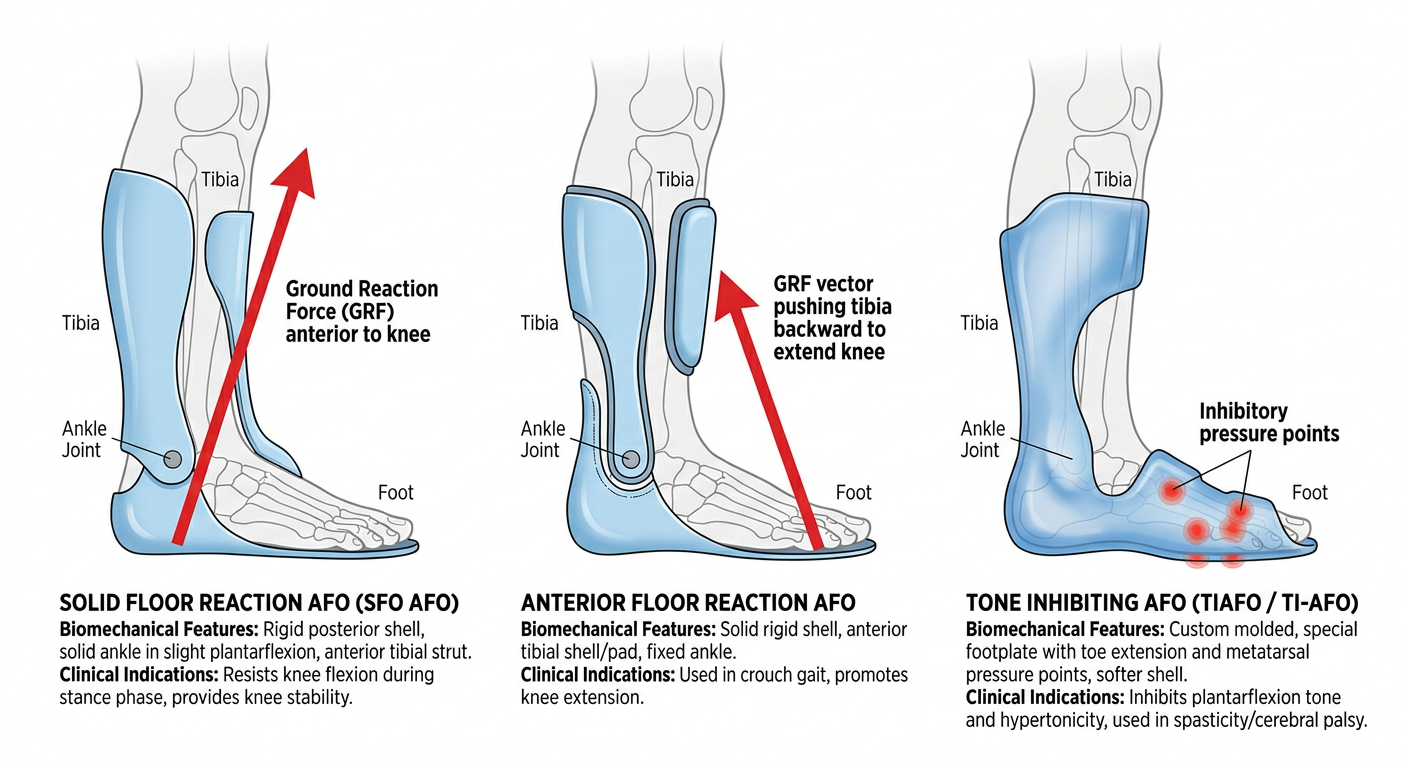
1. Solid Floor Reaction AFO (SFO-AFO)
- Design: Rigid posterior shell with the ankle fixed, typically in slight plantarflexion (5-10°)
- Mechanism: Ground reaction force passes anterior to the knee, creating an extension moment at the knee
- Indications: Quadriceps weakness, crouch gait (mild), patients who need passive knee extension support
- Key feature: Solid ankle - no movement permitted; trim lines are anterior to the malleoli
2. Anterior Floor Reaction AFO
- Design: Similar rigid shell but with an anterior tibial shell/pad - the strut is in front of the tibia rather than behind
- Mechanism: The anterior shell pushes the tibia posteriorly during stance, directing the ground reaction force to extend the knee - ideal for crouch gait correction
- Indications: Crouch gait in cerebral palsy, excessive knee flexion during stance
- Key feature: Anterior tibial contact pad is the defining structural difference
3. Tone Inhibiting AFO (TI-AFO / TIAFO)
- Design: Custom-molded AFO with a specialized foot plate that positions the toes in extension and applies pressure to specific plantar points (metatarsal heads, toe extensions)
- Mechanism: Inhibits plantarflexion spasticity via sensory input - toe extension reduces gastrocnemius/soleus tone through reciprocal inhibition and tendon stretch reflexes
- Indications: Spastic cerebral palsy, upper motor neuron lesions with increased muscle tone
- Key feature: Intrinsic toe extension and inhibitory pressure points built into the footplate - no bony prominences are loaded in the conventional sense
Draw a diagram of weight relieving afo dynamic afo posterior leaf spring afo
Medical orthopedic diagram showing three types of Ankle Foot Orthoses (AFOs) side by side, clean white background, medical illustration style, lateral (side) view of lower leg and foot: 1. LEFT panel - "Weight Relieving AFO (Patellar Tendon Bearing AFO)": Shows a rigid AFO with a prominent padded patellar tendon bearing (PTB) proximal brim just below the knee, rigid upright metal or plastic struts on both sides, a rigid ankle section, and a rocker bottom sole or raised heel on the shoe to offload the foot and ankle. Arrows showing load transfer from foot upward through the PTB brim. Labels: PTB brim, rigid uprights, ankle section, foot plate, rocker bottom. Clinical use noted: offloads ankle/foot fractures, avascular necrosis, Charcot foot. 2. CENTER panel - "Dynamic AFO (Hinged AFO)": Shows an AFO with a posterior calf shell connected to a foot plate via a mechanical hinge joint at the ankle. The hinge allows controlled dorsiflexion with a spring assist or adjustable stop. Shows a free-motion or spring-loaded ankle hinge (depicted as a small circle joint at ankle). Trim lines posterior to malleoli. Labels: calf shell, ankle hinge joint (with spring symbol), foot plate, adjustable plantarflexion stop. Clinical use: drop foot with some active movement, allows dorsiflexion assist. 3. RIGHT panel - "Posterior Leaf Spring AFO (PLS-AFO)": Shows a thin narrow flexible thermoplastic strip running up the posterior calf from the heel, narrow trim lines well posterior to the malleoli giving it a leaf-spring shape. The narrow posterior strut flexes to store and release energy. Depicted as a slim curved flexible strip. Labels: narrow posterior strut (flexible), trim lines, heel section, foot plate. Shows dorsiflexion assist arrow indicating spring-back action. Clinical use: mild drop foot, preserves some ankle motion. Each panel has the AFO type as bold title at top, structural labels with arrows, and a brief clinical indication at the bottom. Anatomical outline of tibia, fibula, ankle, and foot visible for reference.
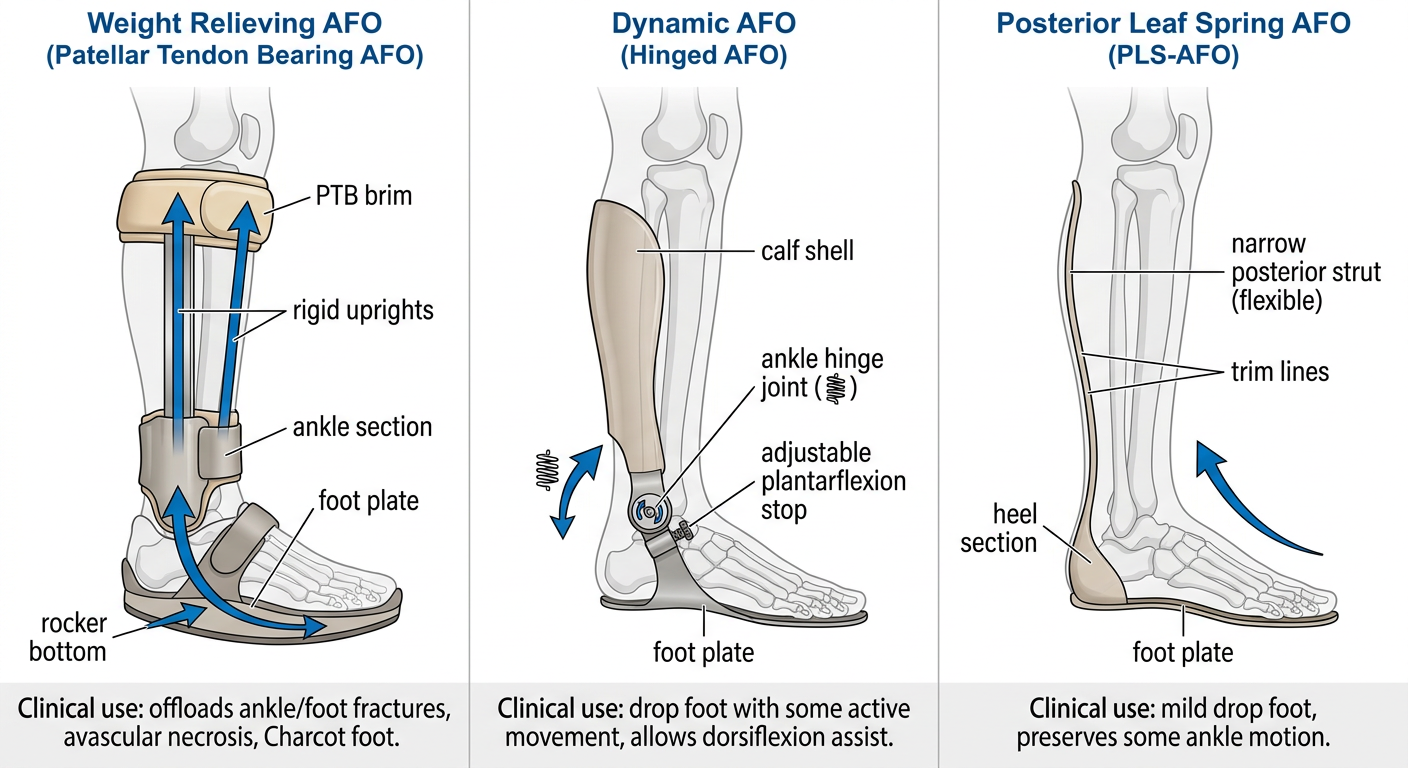
1. Weight Relieving AFO (Patellar Tendon Bearing AFO)
- Design: Rigid bilateral metal or plastic uprights with a padded PTB (patellar tendon bearing) proximal brim, rigid ankle section, and often a rocker-bottom shoe modification
- Mechanism: Transfers body weight from the foot/ankle up through the PTB brim at the knee, significantly offloading the ankle and foot
- Key features:
- PTB proximal brim (primary load-bearing surface)
- Rigid uprights (medial and lateral)
- Rocker bottom sole to assist rollover without ankle movement
- Indications: Charcot arthropathy, avascular necrosis of the talus, tibial fractures, severe ankle arthritis, non-union fractures
2. Dynamic AFO (Hinged AFO)
- Design: Posterior calf shell + foot plate connected by a mechanical ankle hinge joint, which can be set with a spring assist, free motion, or adjustable stops
- Mechanism: Allows controlled, assisted dorsiflexion during swing phase while limiting plantarflexion as needed. The hinge can be tuned to the patient's residual muscle function
- Key features:
- Ankle hinge joint (Tamarack, Gaffney, or metal joint)
- Adjustable plantarflexion/dorsiflexion stops
- Spring-assist option for active dorsiflexion assist
- Indications: Foot drop with some residual active movement, hemiplegia, incomplete spinal cord injury, where preserving ankle ROM is desirable
3. Posterior Leaf Spring AFO (PLS-AFO)
- Design: A thin, narrow strip of thermoplastic running along the posterior leg from calf to heel - the narrowness gives it inherent flexibility, acting like a leaf spring
- Mechanism: During swing phase, the flexible posterior strut stores energy on plantarflexion and springs back to assist dorsiflexion, clearing the foot
- Key features:
- Trim lines narrow and well posterior to both malleoli (this is the defining feature - narrower than a standard solid AFO)
- No rigid ankle - flexibility is built into the material
- Lightweight and low-profile
- Indications: Mild-to-moderate foot drop (e.g., peroneal nerve palsy, mild hemiplegia), patients who need dorsiflexion assist but retain some ankle stability
Quick Comparison Table
| Feature | Weight Relieving | Dynamic (Hinged) | Posterior Leaf Spring |
|---|---|---|---|
| Ankle motion | Rigid/none | Controlled/free | Flexible/spring |
| Primary goal | Offload foot/ankle | Assist movement | Dorsiflexion assist |
| Trim line | Full coverage | Posterior to malleoli | Narrow posterior |
| Best for | Bone/joint pathology | Residual motor function | Mild drop foot |
Draw a diagram of carbon graphite afo neuroorthoses articulation ankle
Medical orthopedic diagram showing three types of specialized Ankle Foot Orthoses (AFOs) side by side, clean white background, detailed medical illustration style, lateral (side) view of lower leg and foot: 1. LEFT panel - "Carbon Graphite AFO (Carbon Fiber AFO)": Shows a sleek, thin, high-performance carbon fiber composite AFO with a characteristic curved blade-like posterior strut running from calf to a full foot plate. The material is shown with a distinctive woven carbon fiber texture (black crosshatch weave pattern). The AFO is very slim and lightweight. Shows energy return arrow at toe-off indicating spring energy storage and release. Labels: carbon fiber composite shell (woven texture), energy-storing keel, rigid ankle section, full foot plate with carbon toe spring, trim lines. Note: ultra-lightweight, high stiffness-to-weight ratio. Clinical use: active patients, high-energy gait, sports rehabilitation, drop foot. 2. CENTER panel - "Neuro-Orthosis (Functional Electrical Stimulation AFO / Peroneal Nerve Stimulator)": Shows a leg with a small electronic device strapped below the knee with electrodes placed over the peroneal nerve / common fibular nerve area on the lateral fibular head. A heel sensor in the shoe sole detects heel-off and triggers electrical stimulation. Wires connect device to electrodes. Shows dorsiflexion of the foot occurring due to stimulation. Labels: stimulator unit (small box on lateral calf), surface electrodes over common peroneal nerve, heel switch sensor in shoe, stimulation trigger arrow, active dorsiflexion response arrow, peroneal nerve location. Clinical use: foot drop from stroke, MS, incomplete SCI. 3. RIGHT panel - "Articulated/Articulation Ankle AFO (Double Metal Upright AFO)": Shows a traditional metal double-upright AFO with medial and lateral metal uprights (bars) connecting a padded calf band at top to a shoe insert/stirrup at the ankle. Clear mechanical ankle joint depicted as a round pivot joint on both medial and lateral sides at the ankle level. Shows adjustable ankle joint stops (set screw or spring). Labels: padded proximal calf band, medial metal upright, lateral metal upright, mechanical ankle joint (pivot point), ankle joint stop/pin, stirrup (shoe attachment), shoe insert. Clinical use: flaccid paralysis, severe spasticity, patients needing adjustable ankle motion control. Each panel has bold title at top, all structural components labeled with leader lines and arrows, brief clinical indications at the bottom. Ankle and foot anatomy outline (tibia, fibula, talus) shown for anatomical reference.
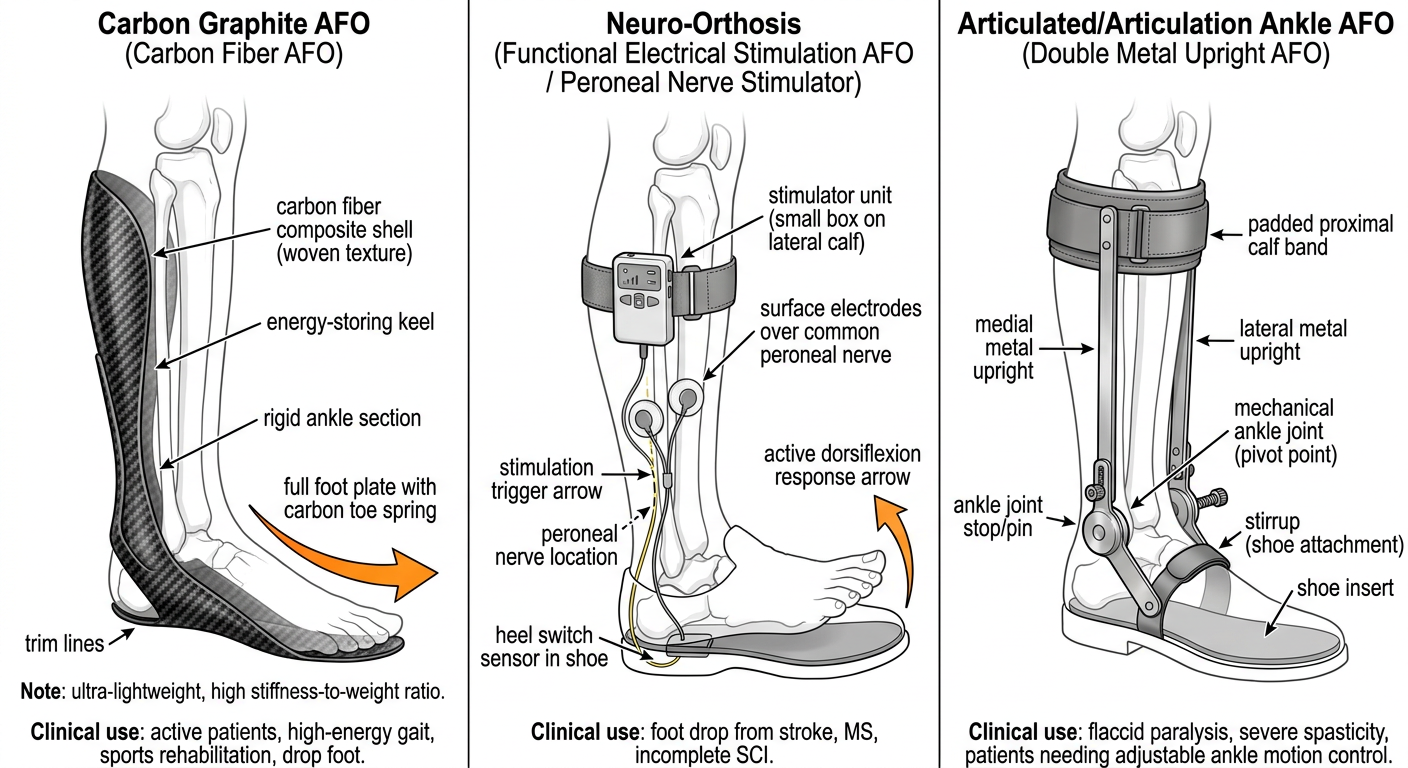
1. Carbon Graphite AFO (Carbon Fiber AFO)
- Material: Woven carbon fiber composite - extremely stiff yet lightweight (much thinner and lighter than thermoplastic)
- Design: A curved blade-like posterior strut with a full foot plate incorporating a carbon toe spring/keel
- Mechanism: Functions like an energy-storing and return (ESAR) device - the carbon keel compresses at heel strike and mid-stance, then springs back at toe-off to propel the limb forward
- Key features:
- Carbon fiber weave gives high stiffness-to-weight ratio
- Can be custom-molded or prefabricated
- Low-profile - fits inside regular footwear
- Rigid or semi-rigid ankle depending on design
- Indications: Active patients with drop foot, post-stroke rehabilitation, sports return, peroneal nerve palsy, patients who need energy return during walking/running
2. Neuro-Orthosis (Functional Electrical Stimulation AFO)
- Design: Not a mechanical brace - instead uses functional electrical stimulation (FES) of the common peroneal (fibular) nerve to produce active dorsiflexion
- Mechanism:
- A heel switch sensor in the shoe detects heel-off during gait
- Triggers a stimulator unit (worn below the knee) to deliver a pulse
- Surface electrodes over the fibular head / common peroneal nerve stimulate the nerve, activating tibialis anterior and peroneal muscles
- This lifts the foot during swing phase - no mechanical brace required
- Key features:
- Stimulator unit (small, lightweight, strapped to leg)
- Surface or implanted electrodes
- Heel switch (gait-triggered)
- Requires intact lower motor neuron (LMN) pathway
- Devices: Bioness L300, WalkAide
- Indications: Foot drop from stroke, multiple sclerosis, incomplete spinal cord injury (upper motor neuron lesion with intact peripheral nerve)
3. Articulated Ankle AFO (Double Metal Upright AFO)
- Design: Classic double upright metal AFO - medial and lateral metal bars connecting a proximal padded calf band to a shoe stirrup, with a mechanical pivot joint at the ankle
- Mechanism: The mechanical ankle joint can be set to:
- Free motion (full ROM)
- Dorsiflexion stop (limits dorsiflexion, resists crouch)
- Plantarflexion stop (limits drop foot)
- Spring assist (assists dorsiflexion)
- Rigid (no motion - like a solid AFO)
- Key features:
- Medial and lateral metal uprights (steel or aluminum)
- Padded proximal calf band
- Mechanical ankle joint with adjustable stops/pins
- Stirrup riveted into shoe
- Highly adjustable and repairable
- Indications: Flaccid paralysis (polio, LMN lesions), severe spasticity, pediatric patients (easy to adjust as child grows), patients requiring tunable ankle control
Comparison Summary
| Feature | Carbon Graphite | Neuro-Orthosis (FES) | Articulated Metal |
|---|---|---|---|
| Type | Passive mechanical | Active electrical | Passive mechanical |
| Ankle motion | Rigid / energy return | Active (muscle driven) | Adjustable (stops/free) |
| Weight | Very light | Very light | Heavier |
| Adjustability | Low | Software-programmable | High (mechanical stops) |
| Best for | Active drop foot | Stroke / UMN drop foot | Flaccid paralysis, growing children |
| Requires intact LMN? | No | Yes | No |