
Mediastenum
I'll look up the mediastinum from the medical library for you.
Reading File
Searching sources...
Finding Sources
Finding Sources
Good hits. Now let me read the core anatomy content from Gray's and the surgical/radiology sources in parallel.
Reading File
Reading File
Reading File
Now let me read the detailed compartment content from Gray's and the Sabiston surgical text, plus fetch the key diagram image.
Reading File
Reading File
Reading File
Loading Image
Now let me grab the subdivisions diagram and the superior mediastinum structures diagram.
Loading Image
Loading Image
Loading Image
Excellent content gathered. Now I have all I need for a comprehensive answer.
The Mediastinum
Sources: Gray's Anatomy for Students; Sabiston Textbook of Surgery; Grainger & Allison's Diagnostic Radiology
Definition and Overview
The mediastinum is a thick midline partition occupying the central compartment of the thoracic cavity. It extends:
- Anteriorly - from the sternum
- Posteriorly - to the thoracic vertebrae
- Superiorly - from the superior thoracic aperture (thoracic inlet)
- Inferiorly - to the diaphragm
The two pleural cavities lie on either side of it. All thoracic viscera except the lungs are contained within it.
Subdivisions
A key horizontal plane - drawn from the sternal angle (angle of Louis) to the intervertebral disc between T4 and T5 - divides the mediastinum into two major parts:
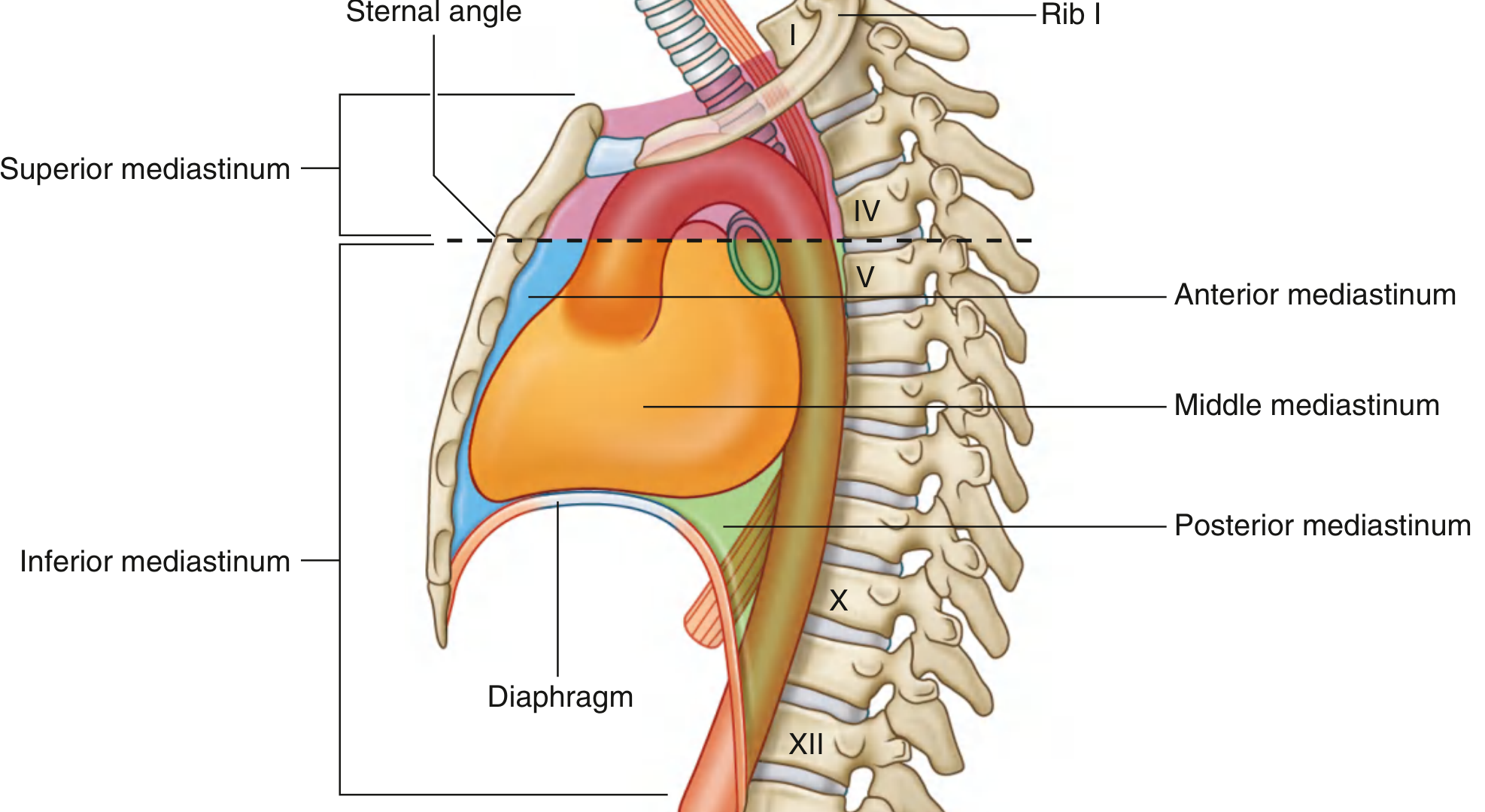
Fig. - Lateral view of the mediastinum showing the T4/T5 dividing plane (dashed line) and all four compartments. (Gray's Anatomy for Students)
1. Superior Mediastinum
| Feature | Detail |
|---|---|
| Boundaries | Superior: oblique plane from jugular notch to T1; Inferior: sternal angle/T4-T5 plane; Lateral: mediastinal pleura |
| Continuous with | Neck above; inferior mediastinum below |
Major contents:
- Thymus (most anterior structure)
- Right and left brachiocephalic veins
- Superior vena cava (SVC)
- Arch of the aorta (with 3 branches: brachiocephalic trunk, left common carotid, left subclavian)
- Trachea
- Esophagus
- Phrenic nerves
- Vagus nerves
- Left recurrent laryngeal nerve (loops under arch of aorta)
- Thoracic duct
- Left superior intercostal vein
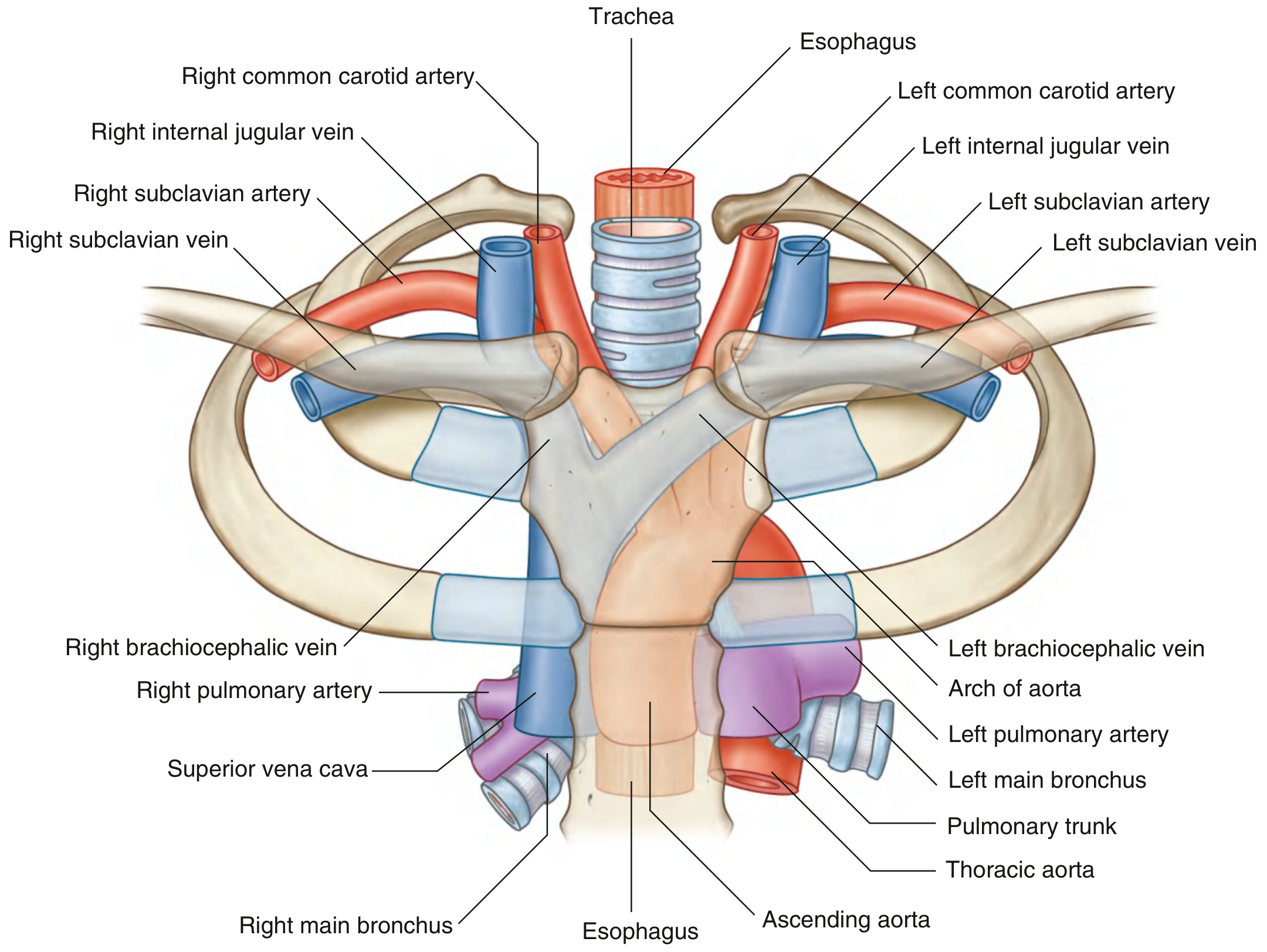
Fig. 3.89 - Structures in the Superior Mediastinum. (Gray's Anatomy for Students)
2. Inferior Mediastinum
The inferior mediastinum lies below the T4/T5 plane and is further divided by the pericardium into three compartments:
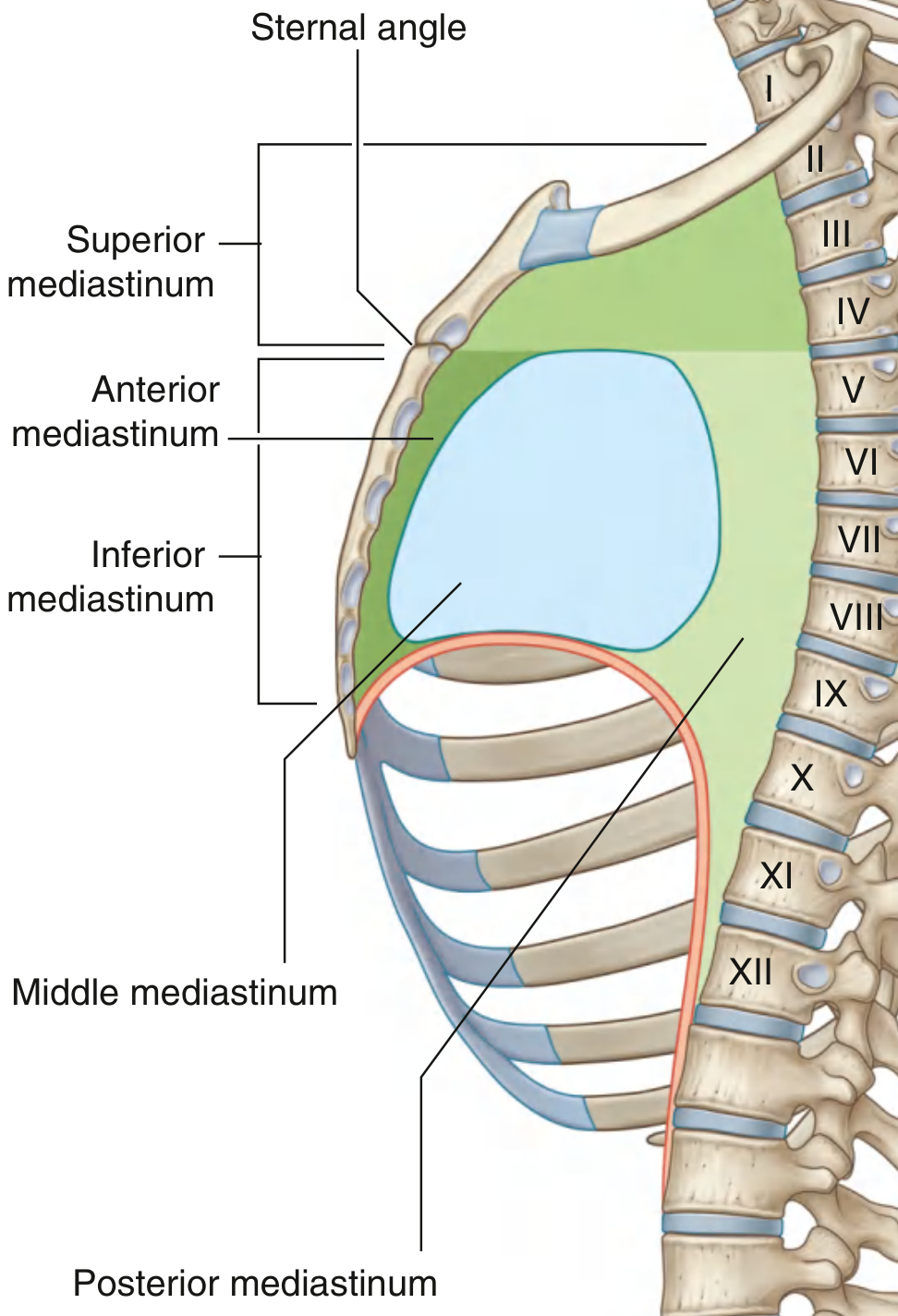
Fig. 3.59 - Subdivisions of the Mediastinum. (Gray's Anatomy for Students)
a) Anterior Mediastinum
- Location: Between the sternum and the anterior surface of the pericardial sac
- Contents: Inferior extension of the thymus gland, fat, connective tissue, lymph nodes, mediastinal branches of the internal thoracic vessels, and sternopericardial ligaments
- Note: the smallest of the three inferior compartments
b) Middle Mediastinum
- Location: Centrally located - defined by the fibrous pericardium
- Contents:
- Pericardium (fibrous + serous layers)
- Heart and its four chambers
- Proximal roots of the great vessels (ascending aorta, pulmonary trunk, SVC, pulmonary veins)
- Phrenic nerves (run along the pericardium)
- Pericardiacophrenic vessels
c) Posterior Mediastinum
- Location: Posterior to the pericardial sac and diaphragm; anterior to the mid and lower thoracic vertebrae (T5-T12)
- Contents:
- Esophagus and esophageal nerve plexus (vagal trunks)
- Descending thoracic aorta
- Azygos system of veins (azygos, hemiazygos, accessory hemiazygos)
- Thoracic duct and associated lymph nodes
- Sympathetic trunks
- Thoracic splanchnic nerves (greater, lesser, least)
Cross-Sectional Orientation
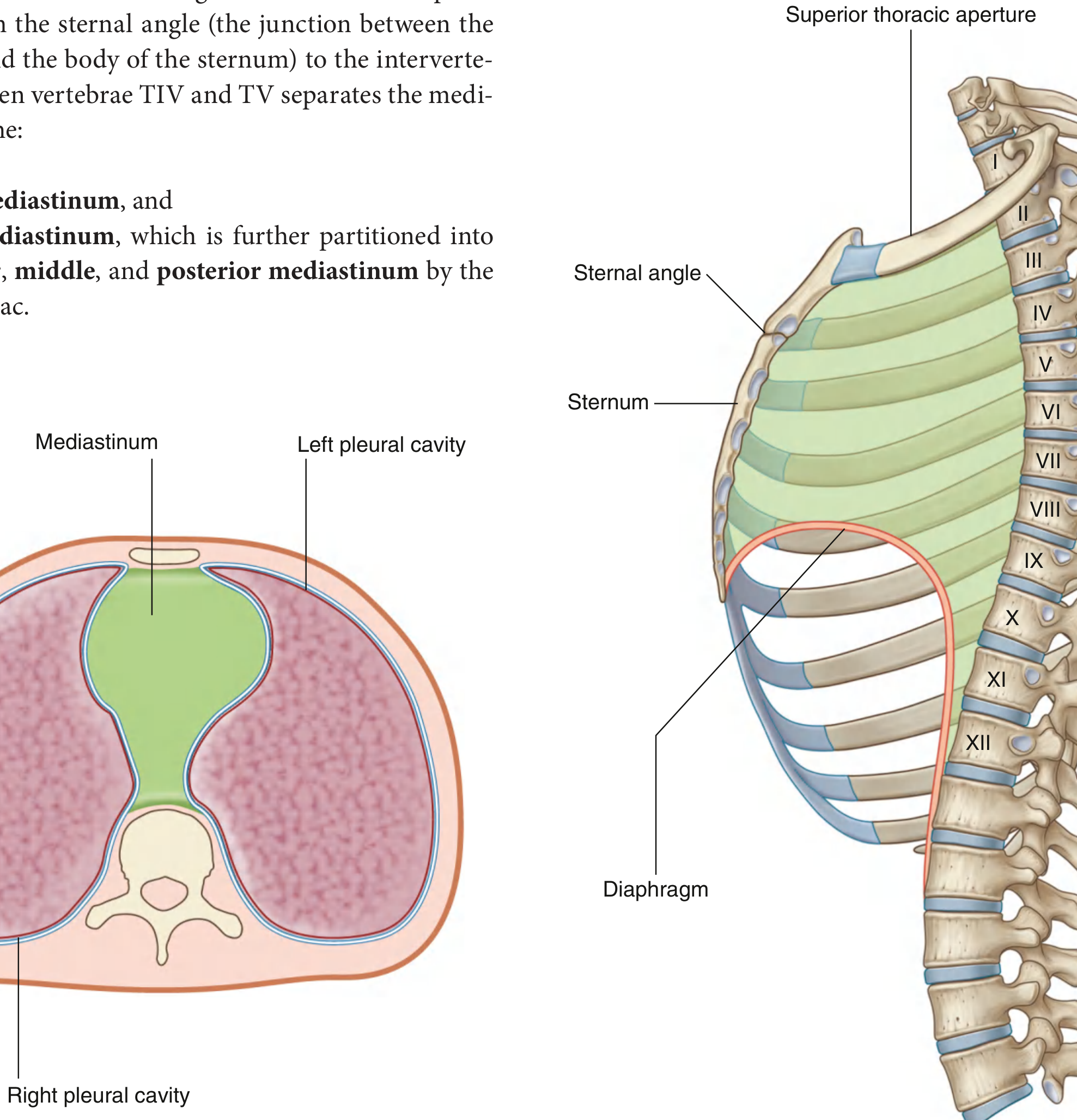
Fig. 3.57/3.58 - Cross-section of the thorax showing the mediastinum flanked by the pleural cavities. (Gray's Anatomy for Students)
Clinical Relevance by Compartment
The compartmental classification guides clinical diagnosis because different pathologies tend to cluster in specific compartments. The classic "4 T's" mnemonic for anterior mediastinal masses captures this:
| Compartment | Common Pathologies |
|---|---|
| Anterior | Thymoma, Teratoma/Germ cell tumor, Thyroid mass, Terrible lymphoma (4 T's) |
| Middle | Lymphoma, pericardial cyst, bronchogenic cyst, aortic aneurysm |
| Posterior | Neurogenic tumors (most common posterior mass - e.g., schwannoma, neurofibroma), esophageal lesions, aortic aneurysm |
| Superior | Retrosternal goiter, lymphoma, SVC syndrome |
Note on nomenclature: Radiologists sometimes use a three-compartment model (anterior, middle/visceral, posterior) without a separate "superior" division. The boundaries are not absolute anatomical planes - they vary between sources and do not form barriers to disease spread. (Grainger & Allison's Diagnostic Radiology)
Summary Table
| Compartment | Anterior boundary | Posterior boundary | Key contents |
|---|---|---|---|
| Superior | Manubrium | T1-T4 vertebral bodies | Aortic arch, SVC, trachea, esophagus, thymus, thoracic duct |
| Anterior (inferior) | Sternum body | Anterior pericardium | Thymus (inferior part), fat, lymph nodes |
| Middle (inferior) | Anterior pericardium | Posterior pericardium | Heart, pericardium, great vessel roots |
| Posterior (inferior) | Posterior pericardium | T5-T12 vertebral bodies | Aorta, esophagus, azygos veins, thoracic duct, sympathetic trunk |
This is a shared conversation. Sign in to Orris to start your own chat.