
Detoxification
Asking for Preferences
What aspect of detoxification are you interested in?
Liver biochemical detoxification involves two main phases: Phase I (cytochrome P450 oxidation, reduction, hydrolysis) and Phase II (conjugation reactions like glucuronidation, sulfation, glutathione conjugation) that convert lipophilic toxins into water-soluble compounds for excretion.
Searching sources...
Reading File
Finding Sources
Finding Sources
Reading File
Reading File
Reading File
Reading File
Finding Sources
Loading Image
Finding Sources
Reading File
Reading File
Here is a comprehensive breakdown of liver biochemical detoxification, drawn from multiple authoritative sources.
Hepatic Detoxification: Phase I, II, and III
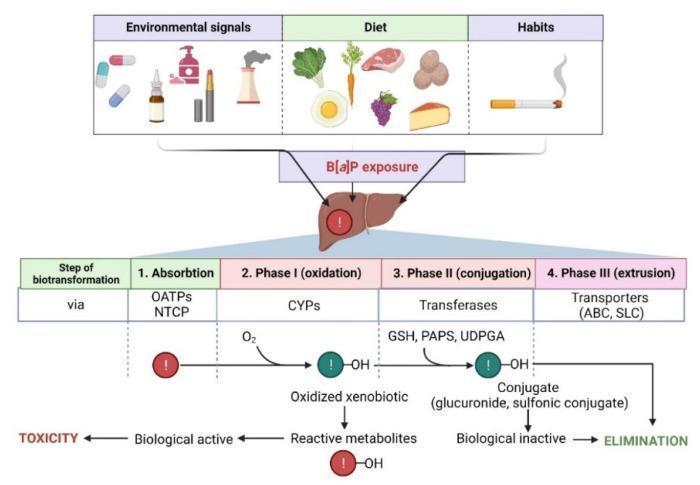
The liver is the primary organ responsible for converting lipophilic, potentially toxic compounds (xenobiotics, drugs, endogenous metabolites) into water-soluble forms that can be excreted. This happens in three sequential phases.
Overview
Most xenobiotics - drugs, pollutants, pesticides - are lipophilic, which helps them cross cell membranes but makes direct renal excretion impossible. The liver uses a three-phase system:
RH (lipophilic) → Phase I → ROH (primary metabolite) → Phase II → RO-Conjugate (water-soluble) → Phase III → Excretion
- Medical Physiology, p. 1412
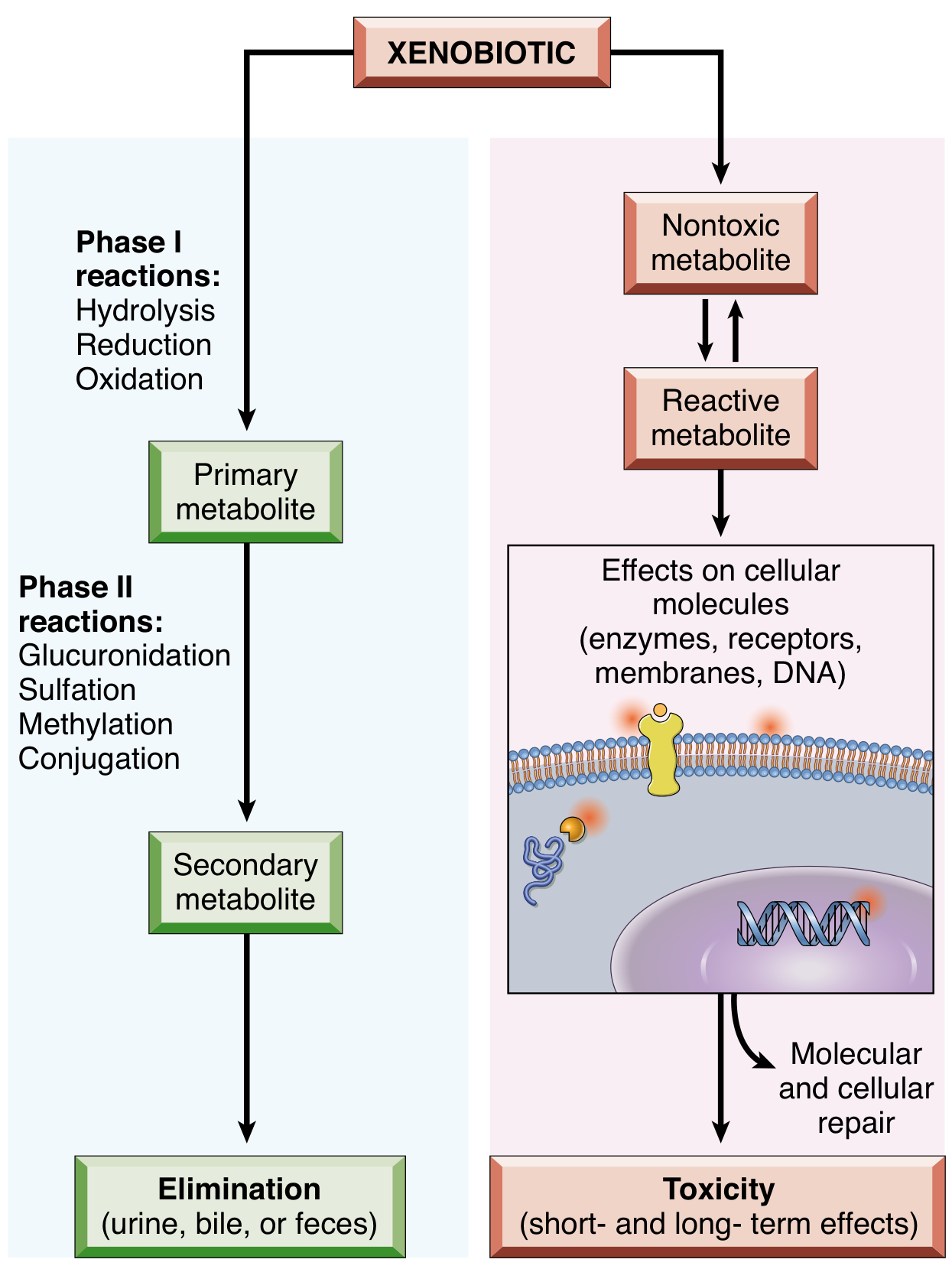
Phase I - Functionalization Reactions
Goal: Introduce or expose a polar functional group on the xenobiotic to make it more reactive for Phase II.
Reactions: Oxidation, reduction, hydrolysis (and sub-types: hydroxylation, dealkylation, dehalogenation)
Common thread: One atom of O₂ is inserted into the substrate (monooxygenase reaction).
The Cytochrome P450 (CYP) System
The key enzyme family in Phase I is the cytochrome P450 (CYP) superfamily - heme-containing monooxygenases located on the smooth endoplasmic reticulum (SER) of hepatocytes.
The overall reaction is:
R-H + O₂ + NADPH + H⁺ → R-OH + H₂O + NADP⁺
- Lippincott's Biochemistry, p. 437
There are 57 human CYP genes encoding hundreds of variants. The most clinically important include:
| CYP Isoform | Key Substrates/Role |
|---|---|
| CYP3A4 | Most common drug-metabolizing CYP; statins, benzodiazepines, immunosuppressants |
| CYP2D6 | Opioids, beta-blockers, antidepressants |
| CYP2C9 | Warfarin, NSAIDs, phenytoin |
| CYP1A2 | Theophylline, caffeine, clozapine |
| CYP2E1 | Ethanol, acetaminophen, volatile anesthetics |
- Medical Physiology, p. 1412; Robbins Pathologic Basis of Disease, p. 387
Two CYP Locations
- Mitochondrial CYPs - involved in steroidogenesis (adrenal cortex, gonads, placenta) and vitamin D hydroxylation
- Microsomal CYPs (SER) - the main detoxification system for xenobiotics and drugs
Dual Outcomes of Phase I
Phase I can go two ways:
- Detoxification: The metabolite is less toxic and more water-soluble (e.g., hydroxylated product ready for Phase II)
- Bioactivation (toxification): The reaction generates a reactive/toxic metabolite that damages cellular components
Classic examples of bioactivation:
- Carbon tetrachloride (CCl₄) → trichloromethyl free radical (•CCl₃) → hepatocellular necrosis
- Benzo[a]pyrene (cigarette smoke) → DNA-binding epoxide → carcinogenesis
- Acetaminophen → NAPQI (N-acetyl-p-benzoquinone imine) → hepatotoxicity when glutathione is depleted
Both reactions also generate reactive oxygen species (ROS) as byproducts, contributing to oxidative cell damage.
- Robbins Pathologic Basis of Disease, p. 387-388
CYP Inducers and Inhibitors
| Inducers (↑ CYP activity) | Inhibitors (↓ CYP activity) |
|---|---|
| Rifampicin, phenobarbital (CYP3A4, CYP2B6) | Ketoconazole, cimetidine (competitive) |
| Carbamazepine, phenytoin | Erythromycin, clarithromycin |
| Tobacco smoke (CYP1A) | Grapefruit juice (CYP3A4 - irreversible) |
| St. John's Wort (hyperforin, CYP3A) | Chloramphenicol |
| Alcohol (CYP2E1) | Metronidazole |
| Cruciferous vegetables (CYP1A2) | Fluconazole |
Inducers act via nuclear receptors (AHR, PXR, CAR, PPAR-α) that bind response elements in CYP gene promoters. Genetic polymorphisms in CYP genes are also a major source of individual variation in drug metabolism.
- Katzung's Basic and Clinical Pharmacology, p. 102; Robbins, p. 388
Phase II - Conjugation Reactions
Goal: Attach a highly polar, water-soluble moiety to the Phase I metabolite (or directly to some xenobiotics) to dramatically increase water solubility and enable excretion.
Phase II reactions are generally faster than Phase I, so they are usually the rate-limiting step only when Phase I is very slow.
| Conjugation Type | Endogenous Co-substrate | Enzyme (Location) | Key Substrates | Examples |
|---|---|---|---|---|
| Glucuronidation | UDP-glucuronic acid (UDPGA) | UGT - UDP glucuronosyltransferase (microsomes) | Phenols, alcohols, carboxylic acids, amines | Morphine, acetaminophen, diazepam, bilirubin |
| Sulfation | PAPS (phosphoadenosyl phosphosulfate) | Sulfotransferase (cytoplasm) | Phenols, alcohols, aromatic amines | Estrone, acetaminophen, methyldopa |
| Glutathione conjugation | Glutathione (GSH) | GSH-S-transferase (cytoplasm, microsomes) | Epoxides, arene oxides | Acetaminophen (NAPQI), bromobenzene |
| Acetylation | Acetyl-CoA | N-Acetyltransferase (cytoplasm) | Amines | Sulfonamides, isoniazid, dapsone |
| Methylation | S-Adenosylmethionine (SAM) | Transmethylases (cytoplasm) | Catecholamines, phenols, amines | Dopamine, epinephrine, histamine |
| Glycine conjugation | Glycine | Acyl-CoA glycinotransferase (mitochondria) | Carboxylic acids | Salicylic acid, benzoic acid, bile acids |
| Water conjugation (EH) | Water | Epoxide hydrolase (microsomes/cytoplasm) | Arene oxides, alkene oxides | Benzo[a]pyrene 7,8-epoxide |
- Katzung's Basic and Clinical Pharmacology, p. 103-104
Important caveat
Phase II was historically viewed as pure detoxification, but some conjugations can generate reactive products:
-
Acyl glucuronidation of NSAIDs can produce protein-reactive acyl glucuronides
-
O-sulfation of N-hydroxyacetylaminofluorene produces a carcinogenic electrophile
-
N-acetylation of isoniazid generates a hepatotoxic metabolite
-
Katzung's Basic and Clinical Pharmacology, p. 104
Phase III - Efflux (Elimination)
After conjugation, the water-soluble product must leave the hepatocyte. This is mediated by transporter proteins on two surfaces:
-
Canalicular membrane transporters (MRP2, BSEP, MDR1/P-gp, BCRP) → conjugate excreted into bile → feces
-
Sinusoidal membrane transporters (MRP3, MRP4) → conjugate returns to blood → renal excretion in urine
-
Medical Physiology, p. 1412
Summary Diagram
Key Clinical Points
- Genetic polymorphisms in CYP and transferase genes (e.g., slow vs. fast acetylators of NAT2) explain major inter-individual differences in drug efficacy and toxicity.
- Drug-drug interactions frequently arise from CYP induction or inhibition - rifampicin induces CYP3A4 and can render oral contraceptives ineffective.
- Liver disease (cirrhosis) reduces Phase I capacity (CYP expression falls), leading to drug accumulation and toxicity at normal doses.
- Acetaminophen toxicity is a textbook example: CYP2E1/CYP3A4 generate NAPQI (Phase I bioactivation); normally GSH conjugation (Phase II) neutralizes it, but in overdose or fasting states, GSH is depleted and NAPQI accumulates causing centrilobular necrosis.
- Nutrition directly affects Phase II: glucuronidation requires dietary glucose (UDPGA), methylation requires SAM (methionine, B12, folate), and glutathione synthesis requires cysteine.
This is a shared conversation. Sign in to Orris to start your own chat.