

I’m a final year md paediatrics student going for final university exams, these are my spotters in nutrition - give me calorie , protien, fibre and important things and basics about each one for my viva with pictures - take references from trusted sources and elizabeth
ICMR NIN Indian Food Composition Tables pulses fruits nutrition values calories protein fibre
~/
child nutrition AND dietary fiber
Indian food nutrition spotter raw rice toor dal chana dal moong dal green gram urad dal ragi jaggery peanuts fruits egg banana apple mango guava papaya custard apple coconut pear
~/attachments/589c3435-dc77-40e2-ab7d-a1c643ab31f3/
mkdir -p "/tmp/workspace/nutrition-spotter/src" "/tmp/workspace/nutrition-spotter/output" && python -c "from pypdf import PdfReader; p='/tmp/workspace/attachments/589c3435-dc77-40e2-ab7d-a1c643ab31f3/Elizabeth nutrition.pdf'; r=PdfReader(p); print('pages',len(r.pages)); open('/tmp/workspace/nutrition-spotter/src/elizabeth_extracted.txt','w',encoding='utf-8').write('\\n\\n'.join((x.extract_text() or '') for x in r.pages))" && wc -c "/tmp/workspace/nutrition-spotter/src/elizabeth_extracted.txt"
"Toor" in ~/nutrition-spotter/src
"Pigeon" in ~/nutrition-spotter/src
"Nutritive value" in ~/nutrition-spotter/src
"Jaggery" in ~/nutrition-spotter/src
"Papaya" in ~/nutrition-spotter/src
https://www.nin.res.in/ebooks/IFCT2017.pdf
A clear educational photographic identification chart of Indian nutrition spotter dry foods, with separate realistic panels showing raw white rice, toor dal, chana dal, split moong dal, whole green gram, white urad dal, ragi grain, sugar crystals, yellow jaggery block, shelled peanuts, and labelled short common names.
A clear educational photographic identification chart of food nutrition spotters, with separate realistic panels showing a chicken egg, banana, red apple, ripe mango, guava cut open, small papaya, custard apple, fresh coconut half, and pear. Include only short common name labels.
ICMR NIN Dietary Guidelines Indians 2024 child healthy diet fruit pulse eggs nuts food safety choking
Nutrition spotter viva sheet
Identification images
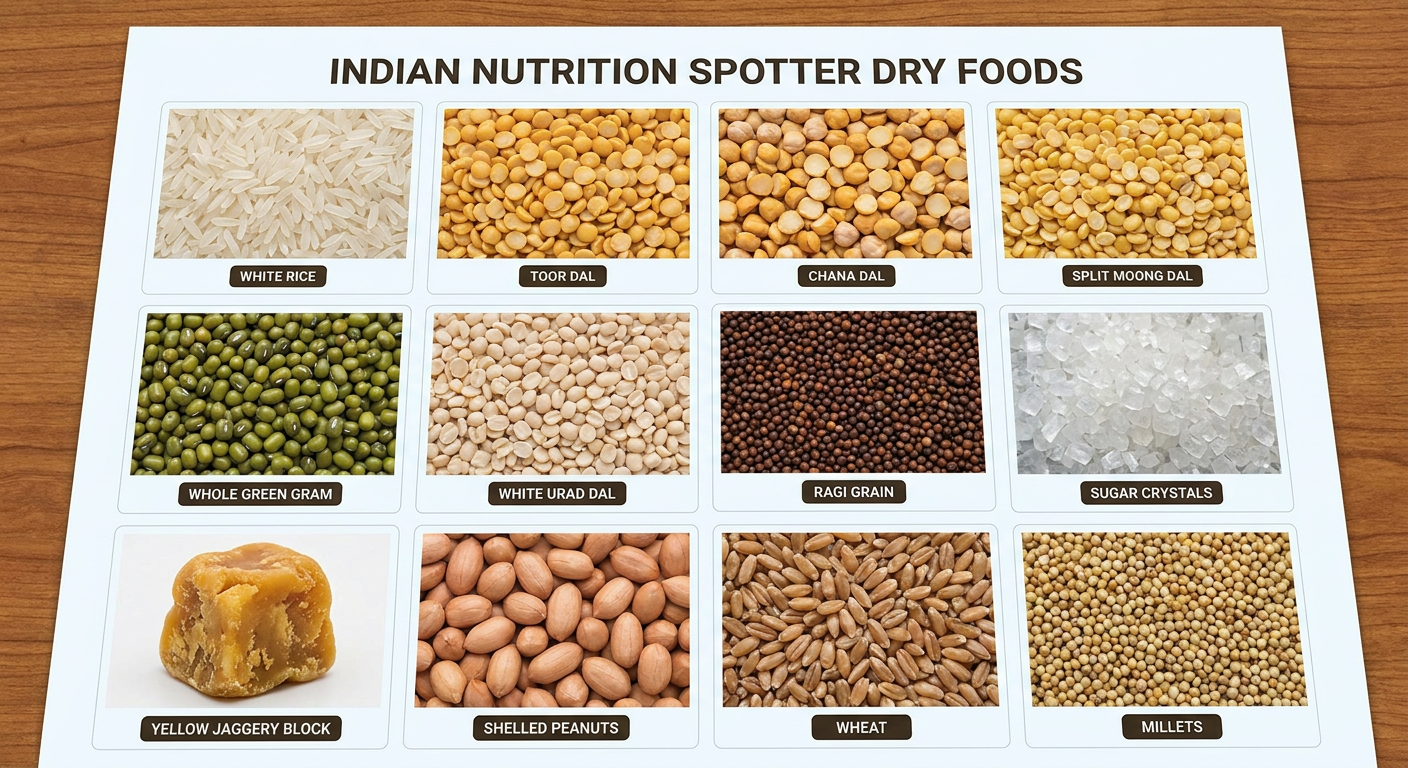
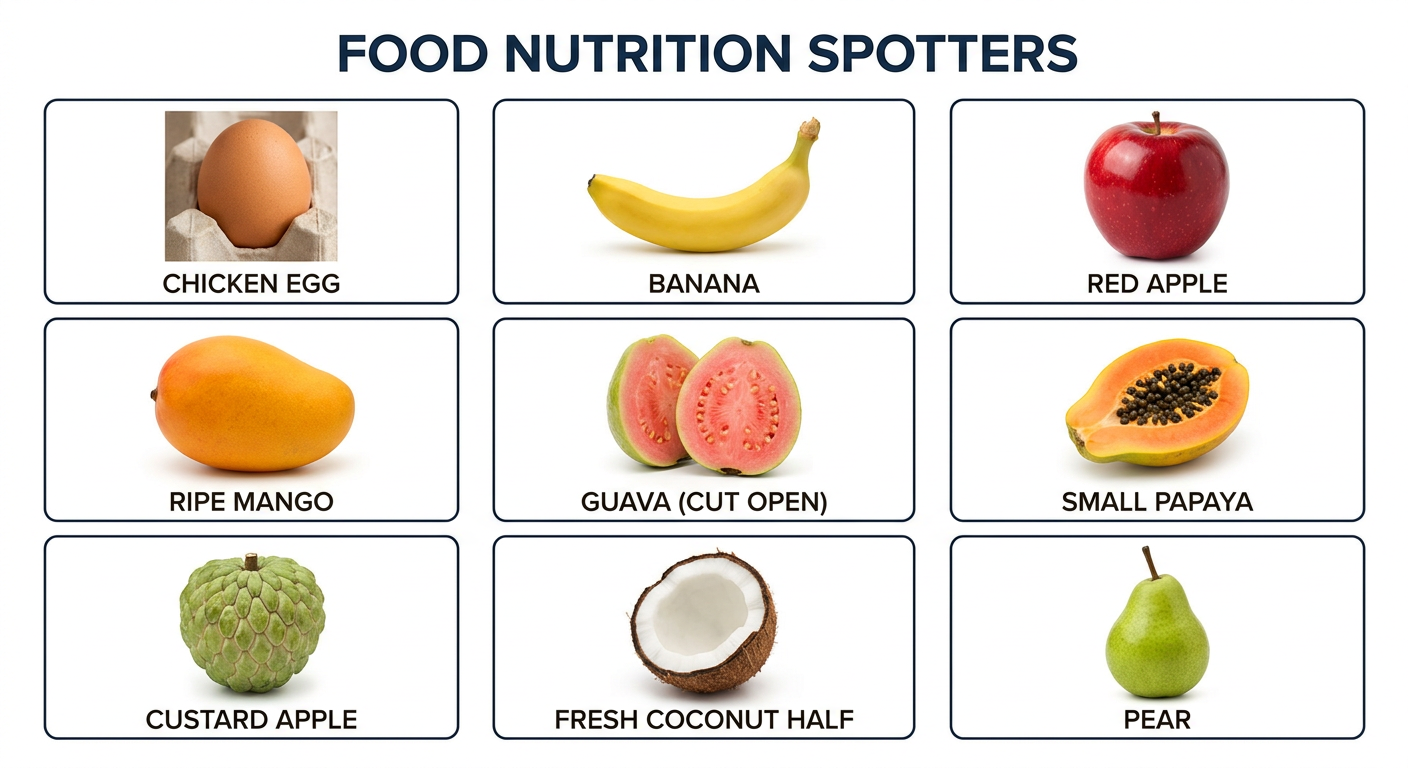
A. Cereals, millets, pulses and other foods
| Spotter | Calorie kcal | Protein g | Fibre g | Viva essentials |
|---|---|---|---|---|
| Raw rice | 350 | 7 | 0.2 | Cereal and major energy source. Mainly carbohydrate, low fibre if polished. Rice protein is deficient in lysine. Combine with dal to improve protein quality. |
| Toor dal / red gram / arhar | 340 | 22 | 1.5 | Pulse, rich in protein, iron and B vitamins. Protein is relatively deficient in methionine. Rice plus dal gives mutual supplementation of amino acids. |
| Chana dal / Bengal gram | 360 | 17 | 3.9 | Split chickpea. Pulse, protein-rich, also supplies iron and fibre. Roasted chana is a useful inexpensive snack. |
| Moong dal, split | 340 | 24 | 4.1 | Easily digestible pulse; commonly used during convalescence. Germination increases vitamin C and improves availability of some nutrients. |
| Whole green gram / green moong | 340 | 24 | 4.1 | Same pulse before dehusking/splitting. A good source of protein, fibre, iron and folate. Sprouted moong is useful because it adds vitamin C. |
| Peas, dry | ~315 | ~20 | ~4-5 | Legume with protein, complex carbohydrate and fibre. Fresh green peas have much lower energy per 100 g because they contain much more water. |
| Urad dal / black gram / white urad dal | 350 | 24 | 0.9 | Protein-rich pulse. “White/idli urad” is dehusked black gram. Important in idli and dosa fermentation. Fermentation improves palatability and may improve nutrient availability. |
| Ragi / finger millet | 330 | 7 | 3.6 | Millet, energy-giving food. Important high-calcium cereal: approximately 344 mg calcium/100 g. Useful in complementary feeding when made as a thick, energy-dense porridge, not watery gruel. |
| Sugar | ~400 | 0 | 0 | Nearly pure sucrose, an energy concentrate. Gives “empty calories,” with no meaningful protein, fibre, vitamins or minerals. Excess increases dental caries risk. |
| Jaggery / bellam / gur | ~380 | ~0.4 | 0 | Unrefined sugar product, energy concentrate. Contains some iron, but must not be prescribed as treatment for iron-deficiency anaemia because the amount and bioavailability are inadequate. Use iron-rich foods and therapeutic iron when indicated. |
| Peanuts / groundnuts | 560 | 25 | 3.1 | Nut/oilseed, highly energy dense, rich in protein and fat. Useful to increase energy density of feeds, for example peanut paste or powder mixed into complementary food. Allergy and choking are important cautions. |
| Fresh coconut | 444 | 4.5 | ~1 | Rich in fat, hence calorie dense. Coconut fat is relatively rich in saturated fat and contains medium-chain triglycerides. Coconut water is not nutritionally equivalent to coconut kernel. |
High-yield pulse viva points
- Pulses are body-building foods, supplying protein, iron, folate, B vitamins and fibre.
- Pulse proteins are relatively low in methionine, whereas cereal proteins are relatively low in lysine. Therefore, cereal-pulse combinations such as rice-dal, khichdi, idli, dosa, roti-dal improve protein quality.
- Soaking, germination and fermentation can improve digestibility and reduce phytate-related inhibition of mineral absorption.
- In a child with poor weight gain, make feeds thick and energy dense. Adding oil/ghee, milk, groundnut paste or roasted pulse flour can increase calorie density.
- The ICMR-NIN 2024 dietary guidance recommends dietary variety, generous vegetables and legumes, and appropriate diets for children during health and illness.
B. Egg, fruits and coconut
| Spotter | Calorie kcal | Protein g | Fibre g | Viva essentials |
|---|---|---|---|---|
| Egg, whole hen’s egg | ~173 | ~13 | 0 | Excellent-quality animal protein with high biological value. Provides fat, vitamin B12, choline, vitamin A and iron. The IFCT notes a high biological value for whole-egg protein. Give fully cooked egg to young children. |
| Banana | 116 | 1.2 | 0.4 | Energy-rich fruit, mainly carbohydrate. Soft, cheap and useful in complementary feeding when mashed. Provides potassium. It does not cause cough or cold. |
| Apple | 59 | 0.2 | 1.0 | Low-energy fruit with modest fibre. Give as grated, stewed or soft pieces depending on the child’s age and chewing ability. |
| Mango, ripe | 75 | 0.6 | 0.7 | “King of fruits.” Rich in carotenoids, the precursor of vitamin A. Ripe mango is calorie richer than most watery fruits. |
| Guava | 50 | 0.9 | 5.2 | Excellent fibre-containing fruit and rich source of vitamin C. Vitamin C helps absorption of non-haem iron from plant foods. |
| Papaya, ripe | 32 | 0.6 | 0.8 | Low-calorie fruit; good source of carotenoids and vitamin C. Soft ripe papaya is useful for young children and during recovery from illness. |
| Custard apple / sitaphal | ~104 | ~1.6 | ~2.4 | Energy-rich fruit relative to papaya and watermelon. Sweet pulp provides carbohydrate; seeds must be removed before feeding children. |
| Coconut, fresh kernel | 444 | 4.5 | ~1 | See above. Calorie dense due to fat. |
| Pear | ~42-57 | ~0.4-0.6 | ~3 | Water-rich fruit with fibre, particularly if peel is eaten after proper washing. Soft pear can be offered as mashed or small safe pieces. |
| If the last item is avocado, “pear-shaped fruit” | ~215 | ~1.6 | ~6-7 | Avocado pear is a fat-rich fruit, unlike most fruits. It provides monounsaturated fat, fibre and potassium. The ICMR-NIN guideline lists avocado among higher-calorie fruits. |
Important correction on the last spotter
- Pear, if the specimen is a typical green/yellow bell-shaped fruit, or
- Avocado pear, if it is dark green, has buttery flesh and one large central seed.
Rapid viva answers
1. Which are energy-dense foods in this list?
- Sugar and jaggery
- Peanuts
- Fresh coconut
- Ragi and raw rice, when dry
- Dals, when dry
- Banana, mango and custard apple among the listed fruits
- Avocado, if present
2. Which have the most protein?
- Peanuts: 25 g/100 g
- Moong and urad: 24 g/100 g
- Toor dal: 22 g/100 g
- Dry peas: approximately 20 g/100 g
- Chana dal: 17 g/100 g
- Egg: approximately 13 g/100 g, but its protein is of excellent quality.
3. Which are fibre-rich?
- Guava: 5.2 g/100 g
- Moong: 4.1 g/100 g
- Chana dal: 3.9 g/100 g
- Ragi: 3.6 g/100 g
- Peanuts: 3.1 g/100 g
- Avocado and pear may also contribute appreciable fibre.
4. Which are useful in iron deficiency prevention?
- Pulses, ragi, jaggery and green leafy vegetables contribute non-haem iron.
- Pair plant sources with vitamin C-rich guava, amla, citrus or papaya to improve absorption.
- Do not rely on jaggery alone to correct iron-deficiency anaemia.
5. Which food is richest in calcium here?
- Ragi is the key answer.
- It contains approximately 344 mg calcium/100 g and is a useful millet in childhood diets.
6. Complementary-feeding message for a 6-month-old
7. Safety points in paediatric feeding
- Do not give whole peanuts to infants or young children due to choking risk. Use smooth paste or finely powdered peanut mixed into food.
- Remove custard apple seeds.
- Give fruit in age-appropriate texture: mashed, grated, stewed or soft small pieces.
- Avoid added sugar and avoid using jaggery as a routine “health food.”
- Give egg thoroughly cooked.
References
- Elizabeth KE, Nutrition and Child Development, Section 3: Applied Nutrition, Table 3.11: Nutritive value of common foods/100 g, pp. 125-126. Your uploaded “Elizabeth nutrition” PDF.
- ICMR-NIN Indian Food Composition Tables, 2017.
- ICMR-NIN Dietary Guidelines for Indians, 2024.
Make a one-page PDF of these nutrition spotters
~/
python - <<'PY' from reportlab.lib import colors from reportlab.lib.pagesizes import A4, landscape from reportlab.lib.styles import getSampleStyleSheet, ParagraphStyle from reportlab.lib.enums import TA_CENTER, TA_LEFT from reportlab.platypus import SimpleDocTemplate, Table, TableStyle, Paragraph, Spacer, KeepTogether from reportlab.lib.units import mm from reportlab.pdfbase.ttfonts import TTFont from reportlab.pdfbase import pdfmetrics from reportlab.lib.colors import HexColor from pypdf import PdfReader import os out='/tmp/workspace/nutrition-spotter/output/Nutrition_Spotters_One_Page.pdf' os.makedirs(os.path.dirname(out), exist_ok=True) page=landscape(A4) doc=SimpleDocTemplate(out,pagesize=page,rightMargin=8*mm,leftMargin=8*mm,topMargin=7*mm,bottomMargin=7*mm) styles=getSampleStyleSheet() title=ParagraphStyle('title',parent=styles['Title'],fontName='Helvetica-Bold',fontSize=16,leading=17,textColor=HexColor('#123B5D'),alignment=TA_CENTER,spaceAfter=2) sub=ParagraphStyle('sub',parent=styles['Normal'],fontName='Helvetica',fontSize=7.2,leading=8.2,alignment=TA_CENTER,textColor=HexColor('#415466'),spaceAfter=4) head=ParagraphStyle('head',parent=styles['Normal'],fontName='Helvetica-Bold',fontSize=7.0,leading=7.7,textColor=colors.white,alignment=TA_CENTER) cell=ParagraphStyle('cell',parent=styles['Normal'],fontName='Helvetica',fontSize=6.45,leading=7.25,textColor=HexColor('#17232C')) food=ParagraphStyle('food',parent=cell,fontName='Helvetica-Bold',fontSize=6.5,leading=7.25) foot=ParagraphStyle('foot',parent=styles['Normal'],fontName='Helvetica',fontSize=5.7,leading=6.4,textColor=HexColor('#45545E'),alignment=TA_LEFT) def P(x,s=cell): return Paragraph(x,s) rows=[ ['Raw rice','350','7','0.2','Cereal; carbohydrate-rich. Pair with dal: cereal is lysine-poor.'], ['Toor dal / red gram','340','22','1.5','Pulse; protein, iron, B vitamins. Methionine-limited.'], ['Chana dal / Bengal gram','360','17','3.9','Protein, iron and fibre; economical pulse.'], ['Moong dal / green gram','340','24','4.1','Digestible pulse; sprouting adds vitamin C.'], ['Peas, dry','~315','~20','~4-5','Legume, protein and fibre. Fresh peas are much less calorie dense.'], ['Urad dal / black gram','350','24','0.9','Protein-rich; used in idli/dosa. Fermentation improves palatability.'], ['Ragi / finger millet','330','7','3.6','Millet; calcium-rich (~344 mg/100 g). Use thick, not watery porridge.'], ['Sugar','~400','0','0','Sucrose: energy only. Excess intake promotes dental caries.'], ['Jaggery / bellam','~380','~0.4','0','Energy concentrate with some iron; not treatment for IDA.'], ['Peanuts / groundnuts','560','25','3.1','Energy-dense protein and fat. Use paste/powder in young children: choking risk.'], ['Fresh coconut','444','4.5','~1','Fat-rich, energy-dense kernel; relatively high saturated fat.'], ['Egg, whole hen','~173','~13','0','High biological-value protein; B12, choline, vitamin A, iron. Fully cook.'], ['Banana','116','1.2','0.4','Soft energy-rich fruit; potassium; useful mashed in complementary feeds.'], ['Apple','59','0.2','1.0','Low-energy fruit with modest fibre; give age-appropriate texture.'], ['Mango, ripe','75','0.6','0.7','Carotene (pro-vitamin A)-rich seasonal fruit.'], ['Guava','50','0.9','5.2','Vitamin C-rich and high fibre; improves non-haem iron absorption.'], ['Papaya, ripe','32','0.6','0.8','Low-calorie, soft fruit; carotenoids and vitamin C.'], ['Custard apple / sitaphal','~104','~1.6','~2.4','Relatively energy-rich fruit. Remove all seeds.'], ['Pear','~42-57','~0.5','~3','Water-rich fruit; fibre, especially if peel is safely eaten.'], ['Avocado pear*','~215','~1.6','~6-7','Fat-rich fruit, unlike pear; monounsaturated fat and fibre.'], ] data=[[P('Spotter',head),P('kcal',head),P('Protein<br/>(g)',head),P('Fibre<br/>(g)',head),P('High-yield viva points',head)]] for r in rows: data.append([P(r[0],food),P(r[1]),P(r[2]),P(r[3]),P(r[4])]) widths=[46*mm,16*mm,18*mm,15*mm,169*mm] t=Table(data,colWidths=widths,repeatRows=1,rowHeights=[8.4*mm]+[5.35*mm]*len(rows),hAlign='CENTER') t.setStyle(TableStyle([ ('BACKGROUND',(0,0),(-1,0),HexColor('#1C6289')),('TEXTCOLOR',(0,0),(-1,0),colors.white), ('VALIGN',(0,0),(-1,-1),'MIDDLE'),('ALIGN',(1,1),(3,-1),'CENTER'), ('GRID',(0,0),(-1,-1),0.25,HexColor('#B8C8D3')), ('BACKGROUND',(0,1),(-1,-1),HexColor('#F8FBFC')), ('BACKGROUND',(0,1),(-1,11),HexColor('#EDF5F8')), ('BACKGROUND',(0,12),(-1,-1),HexColor('#FFF9EE')), ('LINEBELOW',(0,11),(-1,11),0.8,HexColor('#D58B29')), ('LEFTPADDING',(0,0),(-1,-1),2.3*mm),('RIGHTPADDING',(0,0),(-1,-1),2.3*mm), ('TOPPADDING',(0,0),(-1,-1),0.55*mm),('BOTTOMPADDING',(0,0),(-1,-1),0.55*mm), ])) story=[Paragraph('PAEDIATRIC NUTRITION SPOTTERS: ONE-PAGE VIVA SHEET',title),Paragraph('Approximate values per 100 g edible portion. Dry/raw values apply to rice, dals, ragi and peanuts. Cite the source and mention that variety, maturity and cooking alter values.',sub),t,Spacer(1,2.5*mm),Paragraph('<b>Rapid viva:</b> Cereal + pulse gives mutual amino-acid supplementation (rice + dal). Ragi is calcium-rich. Guava supports iron absorption through vitamin C. Sugar/jaggery are energy concentrates. Complementary feeds after 6 months should be thick and energy-dense. <b>*If the specimen is avocado.</b> <b>Sources:</b> Elizabeth KE, <i>Nutrition and Child Development</i>, Table 3.11, pp. 125-126; ICMR-NIN Indian Food Composition Tables (2017); ICMR-NIN Dietary Guidelines for Indians (2024).',foot)] doc.build(story) reader=PdfReader(out) print(out, 'pages=',len(reader.pages), 'bytes=',os.path.getsize(out)) PY
Nutrition Spotters One Page
PDF Document · PDF