
What is working memory in physiology
Reading File
Finding Sources
Finding Sources
Reading File
Reading File
Reading File
Reading File
Reading File
Here is a comprehensive overview of working memory in physiology, drawn from authoritative neuroscience and physiology textbooks.
Working Memory
Definition
Working memory is the brain's ability to transiently hold and manipulate information for immediate behavioral use. It is active, short-duration memory — the cognitive "scratch pad" that lets you keep a phone number in mind while you dial it, or hold the beginning of a sentence in mind while you finish reading it.
"Working memory keeps incoming information available for a short time while deciding what to do with it." — Ganong's Review of Medical Physiology, 26th Ed.
Key Characteristics
| Feature | Detail |
|---|---|
| Capacity | Very limited — typically 7 ± 2 items (digits, words) |
| Duration | Seconds to minutes |
| Chunking | Capacity expands if items are grouped meaningfully (e.g., 194519692001 → 3 years) |
| Fate of information | Most is discarded when no longer needed; some is converted to long-term memory |
The Baddeley–Hitch Model
The most influential psychological model divides working memory into three components:
- Central executive — located in the prefrontal cortex; controls and steers information into the two rehearsal systems
- Phonological loop — retains verbal/auditory information (allows inner rehearsal of words/numbers)
- Visuospatial sketchpad — retains visual and spatial features of objects
- Episodic buffer (later addition) — integrates information retrieved from long-term memory
— Neuroscience: Exploring the Brain, 5th Ed.
Neural Basis
Prefrontal Cortex (PFC)
The PFC is the cornerstone of working memory. Lesion experiments by Yale physiologist Carlyle Jacobsen in the 1930s first showed that large prefrontal lesions impair delayed-response tasks (where an animal must remember a hidden food location across a delay period).
- Delay-period activity: Neurons in the PFC fire persistently during the delay between memorization and recall — essentially "holding" the information in neural activity.
- Different subregions of the PFC store different types: some preferentially for spatial location, others for object identity.
Distributed Brain Network
Human PET and fMRI studies show working memory is not confined to the PFC alone. Delay-period activity is found in every lobe of the brain, with modality-specific storage:
- Facial identity → ventral frontal areas (object-processing stream)
- Spatial location → dorsal frontal areas (spatial-processing stream)
- Cortical lesions can produce selective deficits in auditory vs. visual working memory, confirming distributed, modality-specific storage.
Hippocampus
Although classically associated only with long-term memory, the hippocampus is also involved in visuospatial working memory processing. Working memory areas of the PFC are richly connected to the hippocampus and parahippocampal cortex of the medial temporal lobe.
Neuronal Mechanisms
- Delay-period spiking: sustained firing of individual neurons bridges the gap between stimulus and response
- Oscillatory activity: theta and gamma oscillations coordinate working memory networks
- Short-term synaptic plasticity: rapid changes in synaptic strength contribute to transient memory storage
Working Memory vs. Short-Term Memory
These terms are often used interchangeably but are distinct:
| Short-Term Memory | Working Memory | |
|---|---|---|
| Nature | Passive storage | Active storage + manipulation |
| Example | Hearing a number and repeating it | Hearing a number and dialing it while walking |
| Hippocampal dependence | Yes (for some tasks) | Less dependent; primarily PFC-based |
Bilateral hippocampal destruction (e.g., in Alzheimer's disease, or the famous patient H.M.) spares working memory but devastates the formation of new long-term memories. This dissociation confirms they are neurologically distinct systems.
Clinical Relevance
- Prefrontal lesions: impair working memory tasks; can cause confabulation (false memories) when ventromedial PFC is damaged
- Alzheimer's disease: destroys CA1 hippocampal neurons → intact working memory but severe inability to form new long-term memories
- Schizophrenia, ADHD, depression: all feature characteristic working memory deficits, linked to dorsolateral PFC dysfunction
- Anesthesia: working memory is among the cognitive functions most sensitive to anesthetic agents
Brain Imaging
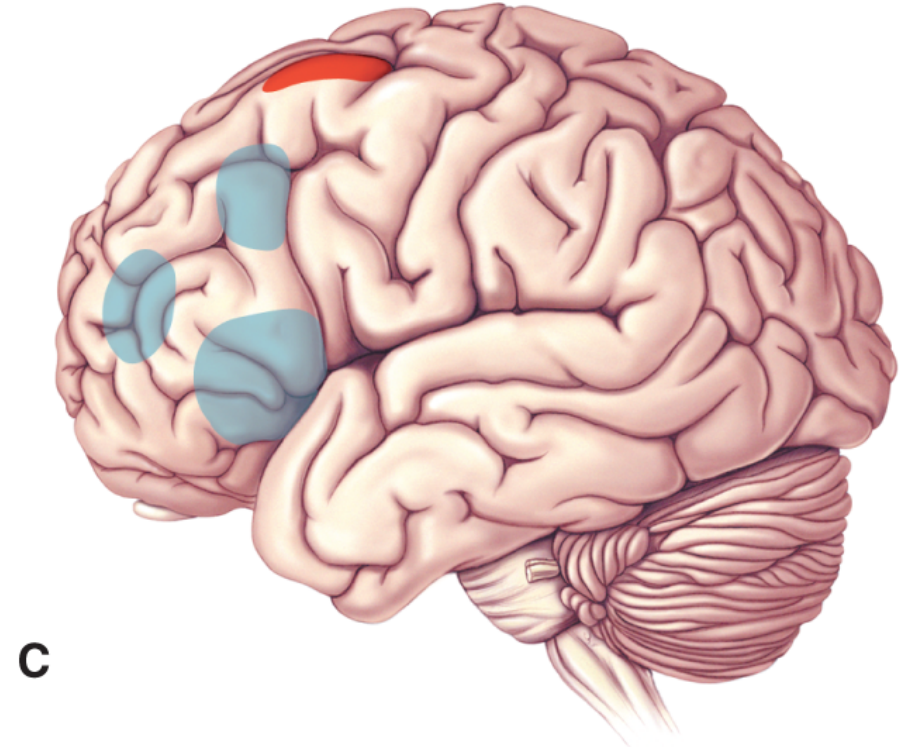
Brain areas showing sustained delay-period activity during working memory tasks for faces and spatial locations. Blue = stronger for identity; Red = stronger for location. (Neuroscience: Exploring the Brain, 5th Ed., Fig. 24.10)
Summary
Working memory is a limited-capacity, active, prefrontally governed system that holds information "online" for seconds to minutes to guide immediate behavior. It is architecturally organized into verbal (phonological), spatial (visuospatial), and integrative (episodic) subsystems, each with distinct but overlapping neural substrates. Its failure is a hallmark of many neurological and psychiatric conditions.
Sources:
- Ganong's Review of Medical Physiology, 26th Ed., pp. 1020–1021
- Neuroscience: Exploring the Brain, 5th Ed., pp. 2136–2148
- Kaplan & Sadock's Comprehensive Textbook of Psychiatry
This is a shared conversation. Sign in to Orris to start your own chat.