
Hi
Hi! How can I help you today?
Multiple myeloma
Asking for Preferences
What aspect of multiple myeloma would you like to cover?
Reading File
Now let me search the library and recent literature in parallel.
Finding Sources
Searching PubMed
"multiple myeloma"[MeSH Terms] AND "therapy"[MeSH Terms]
Reading File
Reading File
Searching PubMed
"multiple myeloma" AND treatment
Now let me get the dedicated Goldman-Cecil myeloma chapter and search for images + diagnosis/treatment content in parallel.
Finding Sources
Finding Sources
Searching Images
multiple myeloma bone marrow plasma cells histology
Reading File
Searching Images
multiple myeloma skull X-ray punched out lytic lesions
Reading File
Reading File
I now have comprehensive information to provide a thorough answer. Let me compile it.
Multiple Myeloma — Comprehensive Overview
Definition
Multiple myeloma (MM) is a malignancy of clonal plasma cells characterized by bone marrow infiltration and extensive skeletal destruction resulting in anemia, bone pain, and fractures. It is defined by all three of:
- ≥10% clonal plasma cells on bone marrow biopsy
- Monoclonal (M) protein in serum or urine (absent in nonsecretory myeloma)
- One or more myeloma-defining events (CRAB criteria or high-risk biomarkers)
— Goldman-Cecil Medicine
Epidemiology
- Accounts for ~1% of all malignancies and >10% of hematologic malignancies in the US
- Annual incidence ~4 per 100,000; ~30,000 new cases/year in the US
- Median age at diagnosis: 65–70 years; <2% of patients are under 40
- More common in males and in people of African descent (incidence nearly 2× that of Whites)
Pathogenesis
- Chromosomal translocations fusing the IgH locus (chromosome 14) to oncogenes (e.g., cyclin D1, cyclin D3) are common — dysregulation of D cyclins drives proliferation
- IL-6 (from marrow stromal fibroblasts and macrophages) is a major survival/proliferation cytokine for myeloma cells
- Late-stage disease may show MYC translocations, indicating aggressive phenotype
Bone Destruction Mechanism
Myeloma cells upregulate RANKL expression on bone marrow stromal cells → osteoclast activation + osteoblast inhibition → net bone resorption → hypercalcemia + pathologic fractures
— Robbins & Kumar Basic Pathology
Clinical Features (CRAB)
| Feature | Details |
|---|---|
| C — HyperCalcemia | 15–20% at diagnosis; from osteoclast-driven bone resorption |
| R — Renal failure | Creatinine >2 mg/dL in 20% at diagnosis |
| A — Anemia | Marrow replacement by plasma cells |
| B — Bone lesions | Lytic lesions, osteoporosis, pathologic fractures |
Additional features: recurrent bacterial infections (due to impaired humoral immunity), hyperviscosity syndrome, peripheral neuropathy.
Histology & Morphology
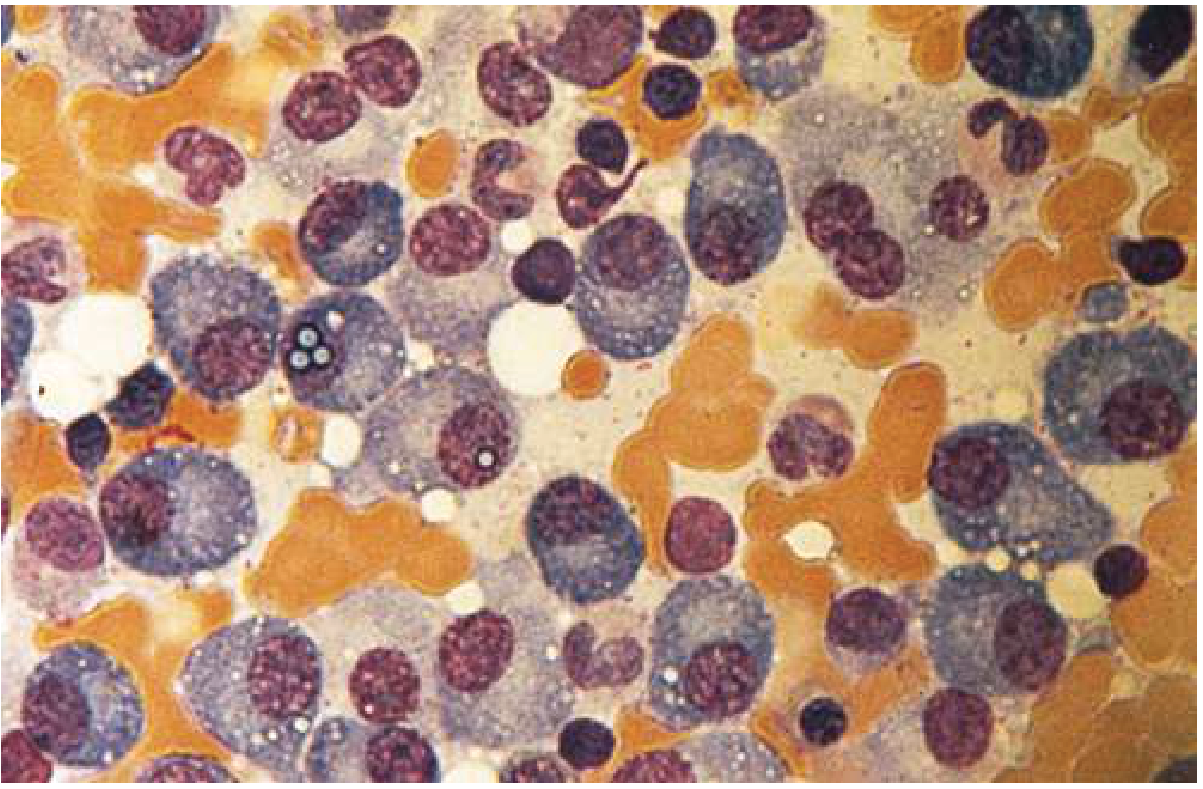
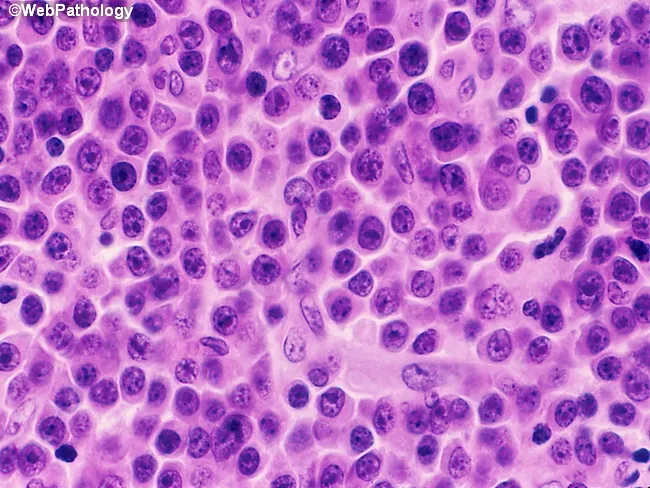
Bone marrow shows >30% plasma cells (normal <5%). Myeloma cells may resemble normal plasma cells or show abnormal features: prominent nucleoli, binucleation, and Russell bodies (cytoplasmic immunoglobulin inclusions).
Bone marrow aspirate showing predominance of plasma cells:
H&E biopsy — sheets of malignant plasma cells replacing marrow:
M Protein Distribution
| Immunoglobulin | Frequency |
|---|---|
| IgG | 60% |
| IgA | 20–25% |
| Light chain only (κ or λ) | Remaining cases |
| IgM, IgD, IgE | Rare |
Diagnosis & Staging
Diagnostic Criteria
- ≥10% clonal plasma cells on BM biopsy
- M protein in serum/urine
- CRAB criteria OR SLiM (60% clonal plasma cells; serum FLC ratio ≥100; >1 focal lesion on MRI)
Revised International Staging System (R-ISS)
| Stage | Criteria | Median OS |
|---|---|---|
| I | β2-microglobulin <3.5 mg/L + albumin ≥3.5 g/dL; no high-risk cytogenetics; normal LDH | Not reached |
| II | Not I or III | ~83 months |
| III | β2-microglobulin >5.5 mg/L + high-risk cytogenetics [del(17p), t(4;14), t(14;16)] or elevated LDH | ~43 months |
MGUS → Smoldering MM → MM Spectrum
| Condition | Risk of Progression at 20 yr |
|---|---|
| Low-risk MGUS (IgG <1.5 g/dL, normal FLC ratio) | 5% |
| High-risk MGUS (all 3 risk factors abnormal) | 58% |
Radiologic Findings
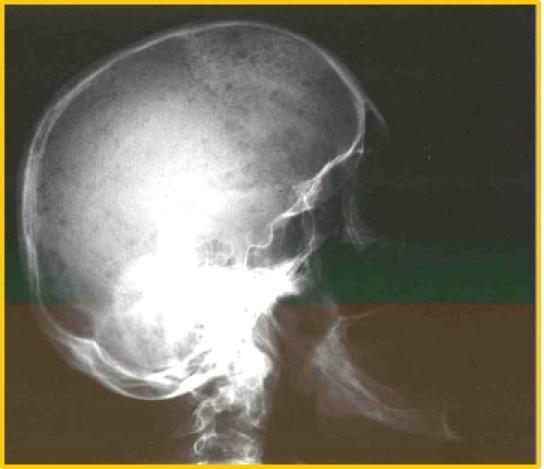
Skeletal survey shows "punched-out" lytic lesions in ~80% of patients. Most common sites: vertebral column, skull, ribs, pelvis, proximal humerus and femur.
Classic "pepper-pot skull" on lateral X-ray:
PET scan showing extensive bony/extramedullary disease (A) and response to chemotherapy (B):
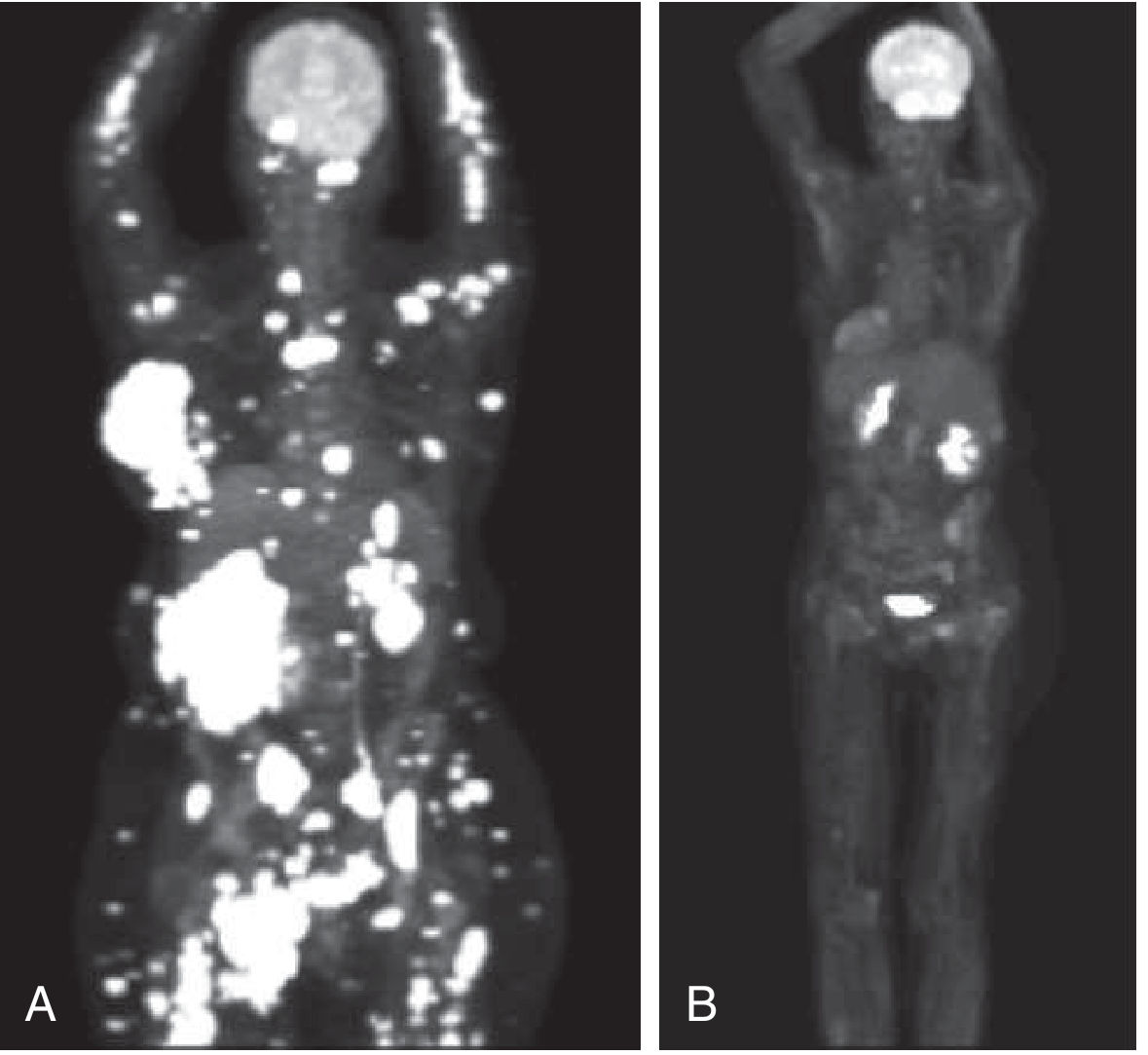
Low-dose whole-body CT and PET are now preferred over plain X-rays for assessing bone disease. MRI is used for spinal involvement or uncertain disease burden.
Complications
Renal
- Light chain cast nephropathy ("myeloma kidney"): waxy laminated casts in distal/collecting tubules from precipitated Bence Jones proteins
- Hypercalcemia-induced renal insufficiency
- AL amyloidosis (~10% of MM), light chain deposition disease, acquired Fanconi syndrome
Immune
- Humoral immune deficiency despite elevated total immunoglobulin (M protein)
- High risk of bacterial infections (e.g., S. pneumoniae, H. influenzae)
Neurologic
- Spinal cord compression from vertebral collapse or plasmacytoma
- Peripheral neuropathy (disease-related or bortezomib-induced)
- Hyperviscosity → headache, visual changes
Treatment
Transplant-Eligible Patients (generally <70 yrs, good performance status)
- Induction (3–4 cycles): VRd (Bortezomib + Lenalidomide + Dexamethasone) — the standard regimen; or Dara-VRd (Daratumumab added) for deeper responses
- Stem cell mobilization + Autologous HSCT (high-dose melphalan conditioning)
- Maintenance: Lenalidomide 10 mg/day (improves OS); add Bortezomib every 2 wk in high-risk disease
Transplant-Ineligible Patients (~50%)
- VRd for ~9 months → Lenalidomide maintenance, OR
- DRd (Daratumumab + Lenalidomide + Dexamethasone) until progression
Relapsed/Refractory MM
Combinations from these drug classes:
| Class | Examples |
|---|---|
| Proteasome inhibitors | Bortezomib, Carfilzomib, Ixazomib |
| Immunomodulatory drugs (IMiDs) | Lenalidomide, Pomalidomide, Thalidomide |
| Anti-CD38 monoclonals | Daratumumab, Isatuximab |
| Anti-SLAMF7 | Elotuzumab |
| Alkylating agents | Cyclophosphamide, Melphalan |
| CAR-T therapy | Idecabtagene vicleucel (ide-cel), Ciltacabtagene autoleucel (cilta-cel) — targeting BCMA |
| Bispecific antibodies | Teclistamab (BCMA × CD3) |
Re-induction with the original regimen is appropriate if relapse occurs >6 months after stopping therapy.
Supportive Care
| Problem | Management |
|---|---|
| Bone pain / lytic lesions | Bisphosphonates (zoledronic acid), denosumab; radiotherapy for focal lesions |
| Hypercalcemia | IV hydration, bisphosphonates, corticosteroids |
| Anemia | Erythropoiesis-stimulating agents, transfusion |
| Infections | Pneumococcal/influenza vaccination; IVIG for recurrent serious infections |
| VTE (from IMiDs) | Aspirin or LMWH prophylaxis |
| Neuropathy (bortezomib) | Switch to subcutaneous administration; dose adjustment |
Prognosis
Median overall survival has improved dramatically with modern therapy — from ~3 years in the pre-novel-agent era to >10 years for standard-risk patients with access to full treatment sequencing including CAR-T. High-risk cytogenetics [del(17p), t(4;14), t(14;16)] confer a significantly worse prognosis.
Recent Evidence
- CEPHEUS trial (2025) — Phase 3 RCT: Daratumumab + VRd showed superior outcomes over VRd alone in transplant-ineligible or transplant-deferred newly diagnosed MM (Nat Med, 2025) [PMID: 39910273]
- A 2024 Nature Reviews Disease Primers review [PMID: 38937492] provides an updated comprehensive overview of MM biology and management
Sources: Robbins & Kumar Basic Pathology; Goldman-Cecil Medicine; The Washington Manual of Medical Therapeutics
This is a shared conversation. Sign in to Orris to start your own chat.