
The answer is D) Lateral medulla.
Searching sources...
Reading File
Finding Sources
Reading File
Reading File
Loading Image
Reading File
Answer: D) Lateral Medulla
The correct answer is D - Lateral medulla (Wallenberg syndrome / Lateral Medullary Syndrome).
Why This Pattern Points to the Lateral Medulla
The key localizing feature here is the crossed sensory pattern:
- Ipsilateral face (right) - loss of sensation
- Contralateral body (left) - sensory symptoms
This crossed pattern is the hallmark of a lateral medullary lesion.
Here is why anatomically:
| Structure Damaged | Result |
|---|---|
| Spinal trigeminal nucleus & tract (CN V) | Ipsilateral face pain/temperature loss (right side) |
| Spinothalamic tract | Contralateral body pain/temperature loss (left side) |
The spinothalamic tract has already crossed before reaching the lateral medulla (it decussates in the spinal cord). The trigeminal spinal nucleus processes ipsilateral facial sensation. A single lateral medullary lesion therefore damages BOTH - producing the crossed pattern seen in this patient.
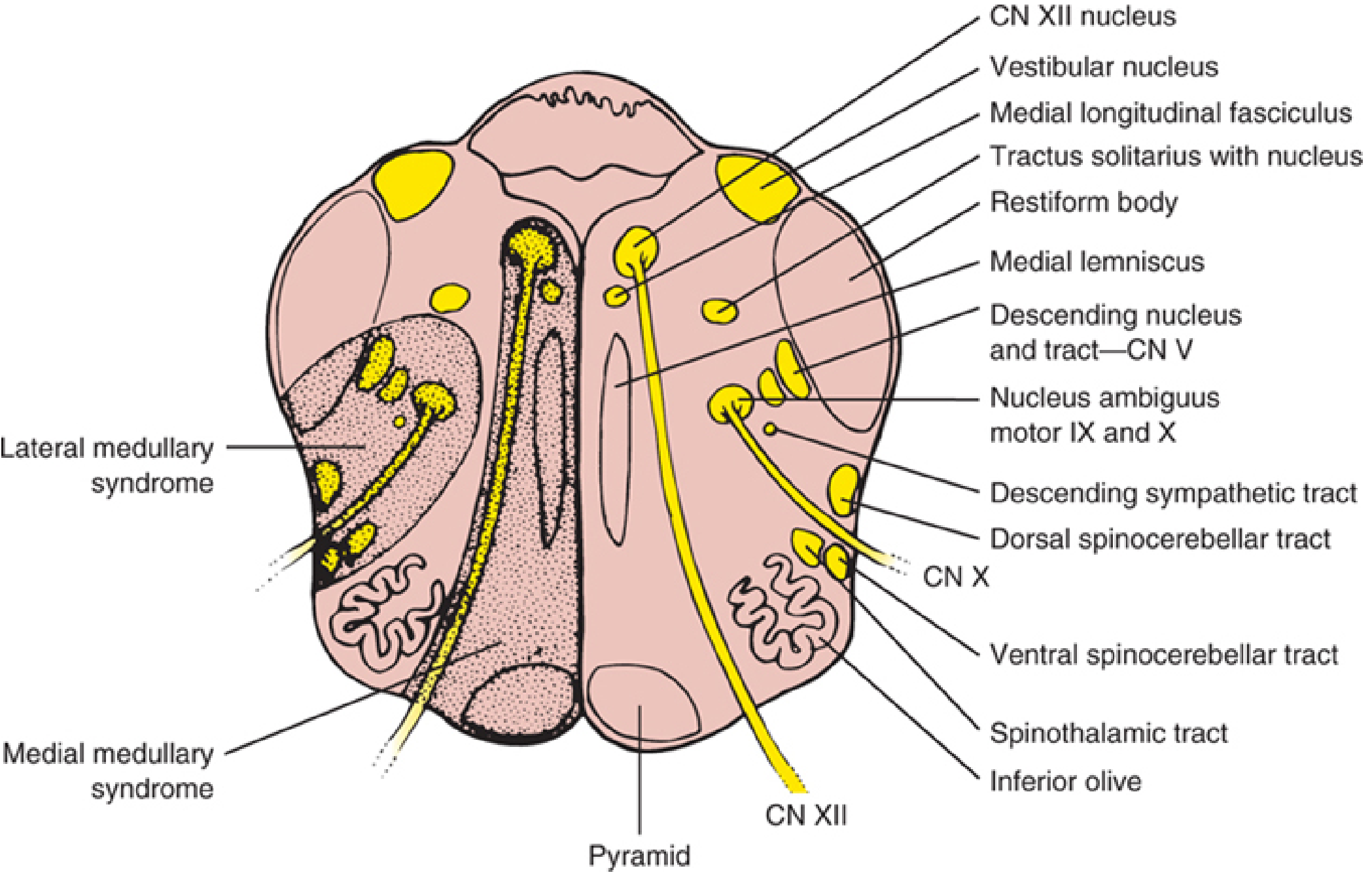
From the diagram above: the lateral medullary syndrome zone (left, dotted area) encompasses the descending nucleus and tract of CN V (ipsilateral face) and the spinothalamic tract (contralateral body).
Why the Other Options Are Wrong
| Option | Why Incorrect |
|---|---|
| A) Medial medulla | Causes contralateral hemiplegia + contralateral loss of vibration/position sense (medial lemniscus) + ipsilateral tongue weakness (CN XII). No crossed face/body sensory pattern. |
| B) Lateral pons | Would involve CN VII/VI (ipsilateral facial weakness, lateral gaze palsy) + contralateral hemiplegia (corticospinal tract). Not a pure sensory crossed syndrome. |
| C) Medial pons | Involves CN VI, corticospinal tract, medial lemniscus - produces motor findings and contralateral vibration/position loss, not crossed pain/temperature. |
| D) Lateral medulla | Correct. Wallenberg syndrome - ipsilateral face + contralateral body pain/temperature loss is the classic presentation. |
Full Classic Wallenberg Syndrome Features (for completeness)
Beyond the sensory findings in this question:
- Ipsilateral facial hypalgesia/thermoanesthesia (spinal trigeminal nucleus)
- Contralateral body hypalgesia/thermoanesthesia (spinothalamic tract)
- Ipsilateral Horner syndrome (descending sympathetic fibers)
- Ipsilateral palatal/pharyngeal/vocal cord paralysis with dysphagia (nucleus ambiguus)
- Ipsilateral limb ataxia (cerebellar connections/inferior cerebellum)
- Vertigo, nausea, hiccups (vestibular nuclei, vagal nuclei)
The cause is typically occlusion of the posterior inferior cerebellar artery (PICA) or vertebral artery.
Source: Localization in Clinical Neurology, 8e - "Lateral Medullary (Wallenberg) Syndrome," p. 921-923
This is a shared conversation. Sign in to Orris to start your own chat.