
Explain sphincterectomy
Reading File
Now let me search the medical library for sphincterotomy content in parallel:
Finding Sources
Finding Sources
Good results. Now let me read the key sections in parallel - the GI/biliary sphincterotomy (ERCP), the surgical sphincterotomy from Maingot's, the lateral internal sphincterotomy (anal), and the urological sphincterotomy:
Reading File
Reading File
Reading File
Reading File
Let me read a bit more of the lateral sphincterotomy (anal) section and also get the ERCP endoscopic sphincterotomy details:
Reading File
Reading File
Finding Sources
I have enough information to write a thorough, well-sourced answer. Let me also fetch the endoscopic images from the textbook for visual clarity:
Loading Image
Loading Image
I now have comprehensive information from multiple authoritative textbooks. Here is a thorough explanation:
Sphincterotomy
A sphincterotomy is a surgical or endoscopic incision (cutting) of a sphincter muscle to relieve obstruction, reduce pressure, or allow access. The term is used across three distinct clinical contexts - biliary/pancreatic, anorectal, and urological - each targeting a different sphincter.
1. Endoscopic (Biliary/Pancreatic) Sphincterotomy
This is the most commonly performed type, carried out during ERCP (Endoscopic Retrograde Cholangiopancreatography).
What is cut?
The Sphincter of Oddi - the smooth muscle valve at the ampulla of Vater where the common bile duct and pancreatic duct empty into the duodenum.
Indications
- Choledocholithiasis (bile duct stones) - the most common indication; ERCP with sphincterotomy clears 95% of CBD stones successfully
- Sphincter of Oddi dysfunction (SOD) - abnormally elevated sphincter pressure causing biliary-type pain
- Access for stent placement or further instrumentation
- Recurrent pancreatitis related to pancreatic ductal outflow obstruction
Technique
Two main approaches:
1. Pull-wire sphincterotomy (standard)
- Deep selective ductal cannulation is first established with a guide wire
- A sphincterotome (catheter with an electrosurgical wire) is inserted and withdrawn until about half the wire is visible outside the papilla
- The pull-wire is tightened, bowing it against the papillary roof
- Electrosurgical current is applied while gently lifting the sphincterotome upward, cutting the sphincter in small increments
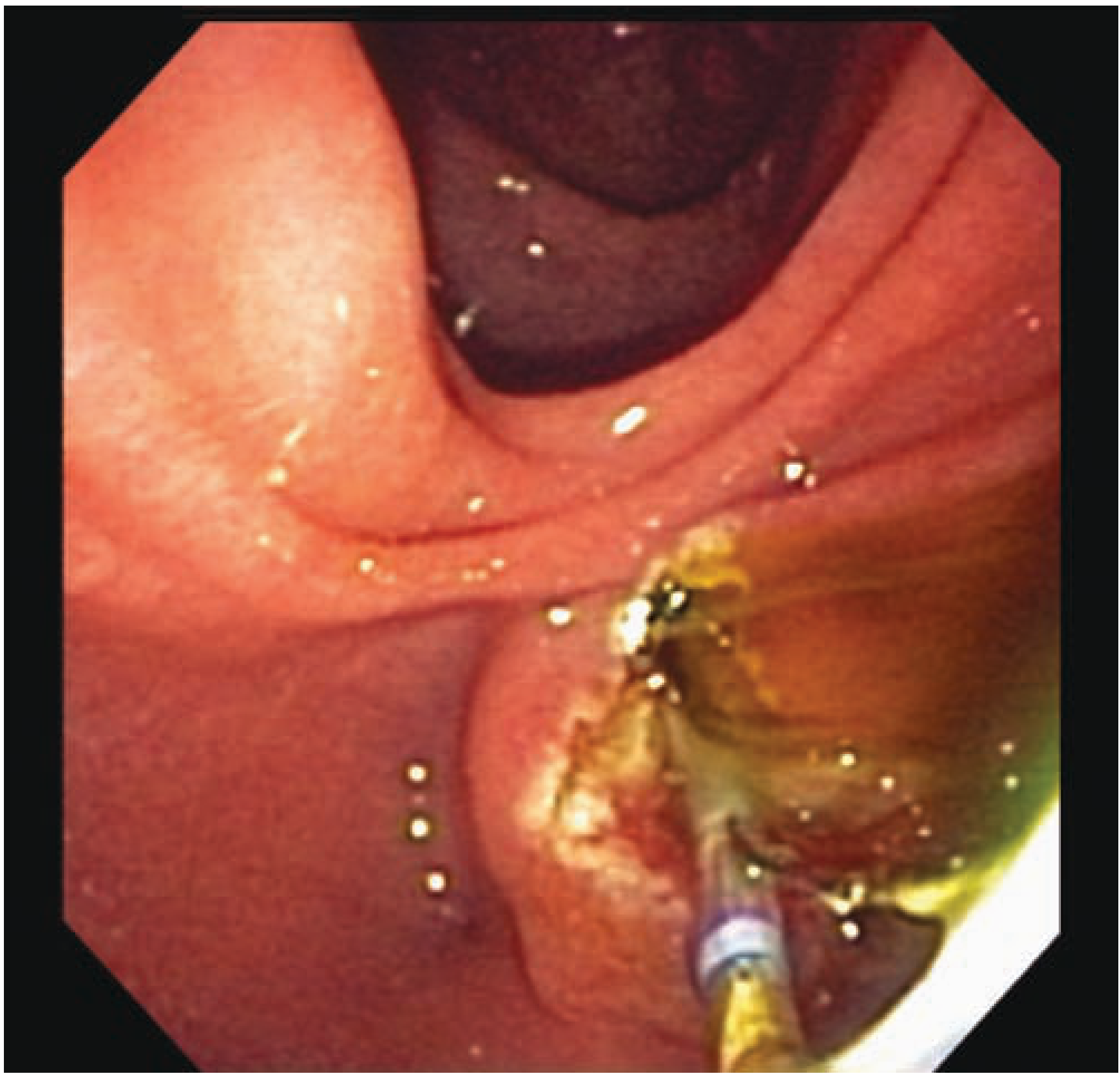
2. Needle-knife sphincterotomy (precut)
- Used when deep selective cannulation cannot be obtained
- Can be done over a previously placed stent or wire, or when an impacted CBD stone is protruding through the ampulla
- More technically demanding with a higher risk profile
Efficacy
- Type I biliary SOD (sphincter stenosis): 90-95% pain relief
- Type II biliary SOD with abnormal manometry: approximately 85% pain relief
- The EPISOD trial established that ERCP has no role in type III SOD (postcholecystectomy pain with no objective findings)
Complications
- Post-ERCP pancreatitis: 10-15% risk (most common complication)
- Bleeding: ~1-2% of cases; risk factors include coagulopathy, thrombocytopenia, cholangitis, anticoagulant use, portal hypertension, renal failure
- Retroduodenal perforation: ~1%
- Late stenosis of the pancreatic or biliary orifice
Sources: Maingot's Abdominal Operations; Sleisenger and Fordtran's Gastrointestinal and Liver Disease; Clinical Gastrointestinal Endoscopy, 3e; Yamada's Textbook of Gastroenterology
2. Lateral Internal Sphincterotomy (Anorectal)
This is a surgical procedure for chronic anal fissure - a painful tear in the anoderm below the dentate line, typically caused by hypertonia of the internal anal sphincter.
Rationale
Chronic fissures result from elevated resting internal anal sphincter pressure, which causes ischemia of the posterior commissure. Cutting the lower portion of the internal sphincter reduces this pressure and allows the fissure to heal.
What is cut?
The lower half of the internal anal sphincter - the involuntary smooth muscle component of the anal sphincters. The external sphincter is deliberately spared.
Two techniques:
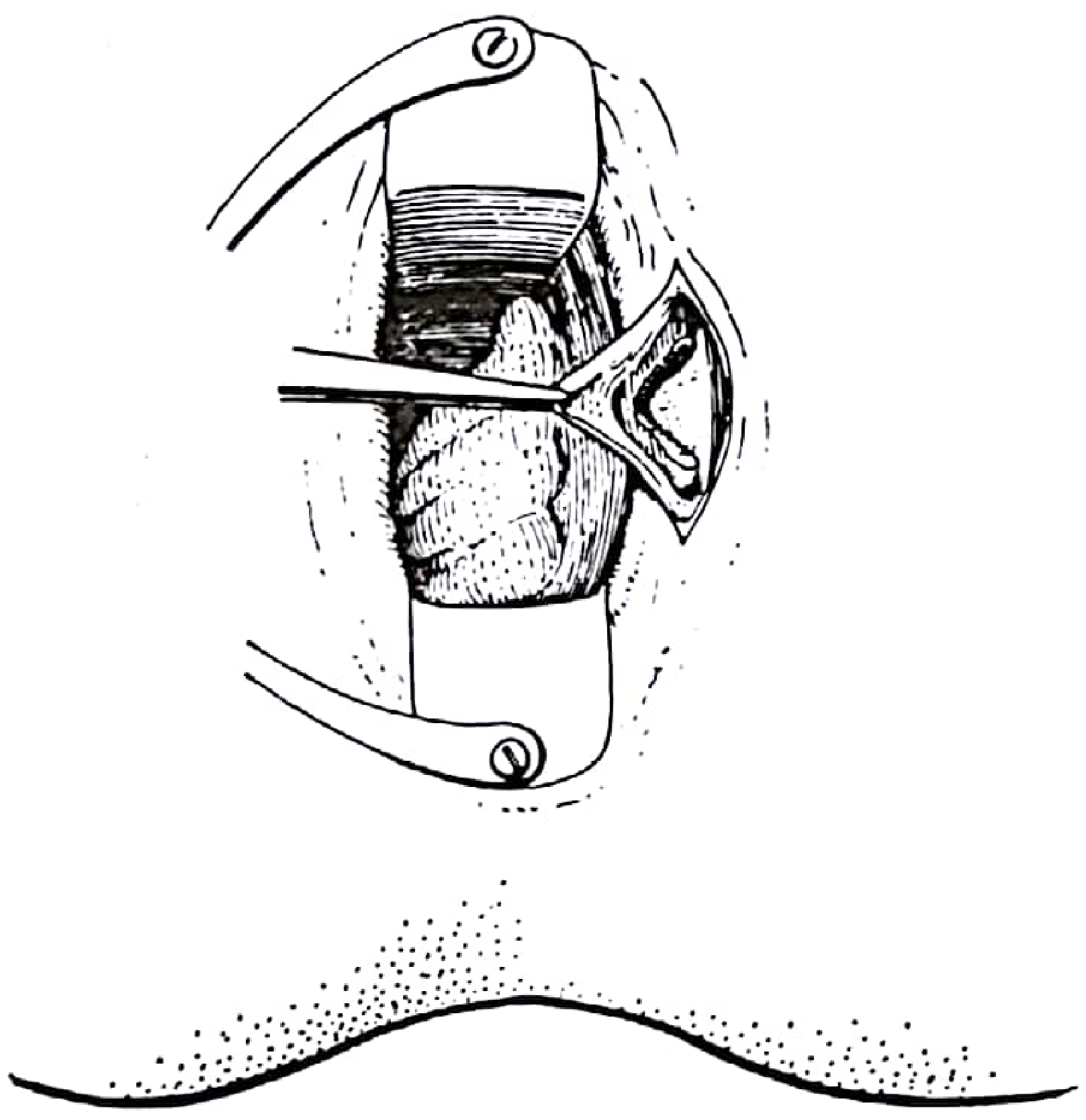
Open method
- An anal retractor is inserted to expose the lateral anal canal
- A short circumferential incision is made in the intersphincteric groove
- The lower border of the internal sphincter is identified
- Scissors are inserted on each side of the internal sphincter, which is then divided up to the level of the dentate line
- The external sphincter is not touched
- Local pressure is applied for haemostasis, wound closed and dressed
Closed (subcutaneous) method
- A tenotomy knife is inserted through the skin into the intersphincteric space
- The blade is turned toward the internal sphincter and divides it below the dentate line with sawing movements
- No formal wound is required
Note on anal stretch
A historical alternative (manual anal dilatation) involves gentle stretching with both index fingers until the middle fingers can also be inserted. This is now largely abandoned due to inconsistent pressure distribution and risk of incontinence.
Source: Pye's Surgical Handicraft, 22nd Edition
3. Urological Sphincterotomy (External Urethral Sphincterotomy)
Context
Used in male spinal cord injury (SCI) patients with detrusor-sphincter dyssynergia (DSD) - a condition where the external urethral sphincter contracts involuntarily during bladder contraction (instead of relaxing), causing functional outlet obstruction.
Indications
- Detrusor overactivity refractory to medications and clean intermittent catheterization (CIC)
- Patients unwilling or unable to perform CIC
- Preferred over an indwelling urethral catheter
What is cut?
The external urethral sphincter (striated muscle) is incised.
Effects
- Significantly lower intravesical pressures
- Reduced post-void residuals (PVRs)
- Decreased occurrence of autonomic dysreflexia
Complications
- Bleeding and clot retention
- Urosepsis
- Erectile dysfunction
- Sphincterotomy failure (requiring repeat procedure)
Alternative
OnabotulinumtoxinA (Botox) injections into the sphincter at the 3, 6, 9, and 12 o'clock positions - a reversible, less invasive alternative to surgical sphincterotomy.
Source: Smith and Tanagho's General Urology, 19th Edition
Summary Table
| Type | Sphincter Cut | Indication | Approach |
|---|---|---|---|
| Biliary/Pancreatic (ERCP) | Sphincter of Oddi | CBD stones, SOD, pancreatitis | Endoscopic (pull-wire or needle-knife) |
| Lateral Internal | Internal anal sphincter | Chronic anal fissure | Open or closed surgical |
| Urological | External urethral sphincter | DSD in spinal cord injury | Surgical or Botox injection |
This is a shared conversation. Sign in to Orris to start your own chat.