
Give me hcl secretion in stomach notes for mbbs 1st year
Reading File
Searching for comprehensive notes on HCl secretion in the stomach.
search_medical_text
HCl hydrochloric acid secretion stomach parietal cells mechanism
Bailey and Love's Short Practice of Surgery 28th Edition
Page 1171
search_medical_text
gastric acid secretion regulation phases cephalic gastric intestinal
Bailey and Love's Short Practice of Surgery 28th Edition
Page 1172
search_medical_image
HCl secretion parietal cell mechanism stomach diagram
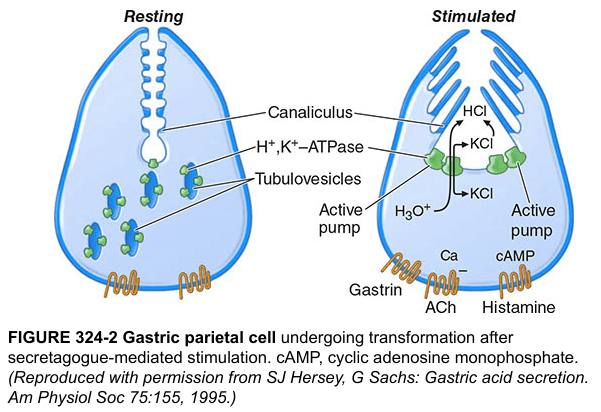
Harrison's Principles of Internal Medicine, Twenty First Edition
Page 8891
GradeResponse
GradeResponse
GradeResponse
Here are comprehensive MBBS 1st year notes on HCl Secretion in the Stomach:
HCl Secretion in the Stomach
1. Site of Secretion
- Secreted by Parietal cells (also called Oxyntic cells)
- Located in the fundus and body of the stomach (oxyntic glands)
- pH of secreted HCl: ~0.8 (highly acidic)
2. Functions of HCl
| Function | Detail |
|---|---|
| Kills microorganisms | Acts as a barrier against ingested pathogens |
| Activates pepsinogen | Converts it to active pepsin (protein digestion) |
| Provides acidic pH | Optimal for pepsin activity (pH 1.5–2.5) |
| Denatures proteins | Uncoils proteins for easier enzymatic digestion |
| Stimulates secretin | Acidic chyme in duodenum triggers secretin release |
| Aids iron absorption | Converts Fe³⁺ → Fe²⁺ (absorbable form) |
3. Cellular Mechanism of HCl Secretion
The parietal cell secretes H⁺ into the gastric lumen via the proton pump (H⁺/K⁺-ATPase).
Step-by-step:
- CO₂ + H₂O → H₂CO₃ (catalyzed by carbonic anhydrase inside parietal cell)
- H₂CO₃ dissociates → H⁺ + HCO₃⁻
- H⁺ is pumped OUT into the gastric lumen in exchange for K⁺ by H⁺/K⁺-ATPase (proton pump)
- Cl⁻ is secreted into the lumen via Cl⁻ channels
- H⁺ + Cl⁻ → HCl in the gastric lumen
- HCO₃⁻ exits the cell into the blood in exchange for Cl⁻ via Cl⁻/HCO₃⁻ exchanger → this is the "alkaline tide"
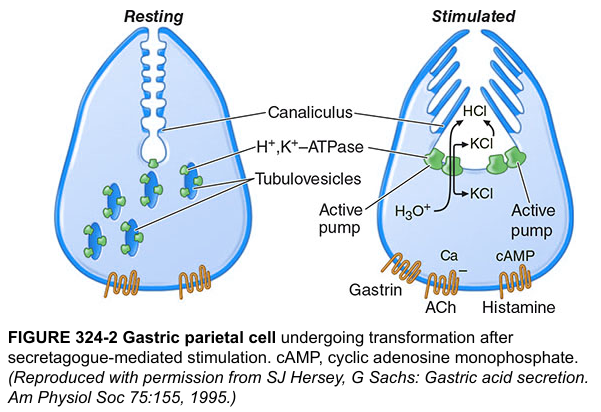
4. Stimulants (Secretagogues) of HCl Secretion
Three main stimulants act on the parietal cell:
| Stimulant | Source | Receptor on Parietal Cell | Second Messenger |
|---|---|---|---|
| Histamine | ECL cells (paracrine) | H₂ receptor | ↑ cAMP |
| Gastrin | G cells (pyloric antrum) | CCK-B receptor | ↑ Ca²⁺ |
| Acetylcholine (ACh) | Vagus nerve (M₃ receptor) | Muscarinic (M₃) | ↑ Ca²⁺ |
The most important stimulant is histamine acting via H₂ receptors — this is why H₂ blockers (e.g., ranitidine) are effective in reducing acid secretion. (Bailey & Love, p. 1171)
5. Phases of Gastric Acid Secretion
(Bailey & Love's Surgery, 28th Ed., p. 1172)
A. Cephalic Phase (~30% of total acid)
- Stimulus: Sight, smell, taste, thought of food
- Mediator: Vagus nerve (ACh)
- ACh directly stimulates parietal cells + stimulates gastrin release from G cells
- Demonstrated by Pavlov's sham feeding experiment
B. Gastric Phase (~60% of total acid)
- Stimulus: Food entering the stomach (distension + chemical stimulation)
- Mediators: Gastrin (main) + local reflexes (vagovagal, enteric)
- Proteins/peptides stimulate G cells → gastrin → HCl secretion
- Stomach distension activates stretch receptors → vago-vagal reflex
C. Intestinal Phase (~10% of total acid)
- Stimulus: Chyme in the duodenum and small intestine
- Initially stimulatory (intestinal gastrin), but mainly inhibitory
- Acidification of duodenum → Secretin release → inhibits gastric acid
- GIP, CCK, VIP also inhibit HCl secretion
6. Inhibition of HCl Secretion
| Mechanism | Detail |
|---|---|
| Somatostatin (D cells) | Released in response to low gastric pH; inhibits G cells, ECL cells, and parietal cells directly |
| Secretin | Released when duodenal pH < 4.5; inhibits gastrin and acid |
| Low pH in antrum | pH < 3 → inhibits gastrin release (negative feedback) |
| GIP (Gastric inhibitory peptide) | Released by fat/carbs in duodenum; inhibits acid |
| Prostaglandins (PGE₂) | Inhibit cAMP in parietal cells → reduce acid output |
7. Drugs Acting on HCl Secretion (Clinical Correlation)
| Drug | Mechanism |
|---|---|
| PPIs (omeprazole, pantoprazole) | Irreversibly block H⁺/K⁺-ATPase (proton pump) — most potent |
| H₂ blockers (ranitidine, famotidine) | Block H₂ receptors → ↓ cAMP → ↓ acid |
| Antacids (Mg(OH)₂, Al(OH)₃) | Neutralize acid already secreted |
| Anticholinergics (atropine) | Block M₃ receptors → ↓ ACh effect |
| Misoprostol | PGE₁ analogue → inhibits acid, protects mucosa |
8. Gastric Mucosal Barrier (Protection Against HCl)
The stomach protects itself from its own acid by:
- Mucus layer — secreted by surface mucous cells; forms a gel layer
- Bicarbonate secretion — neutralizes H⁺ near the epithelium
- Tight junctions — prevent back-diffusion of H⁺
- Prostaglandins — stimulate mucus and HCO₃⁻ secretion, maintain blood flow
- Disruption of this barrier (by NSAIDs, H. pylori, alcohol) → peptic ulcer disease
Quick Recap for Exams
- Cells: Parietal (oxyntic) cells
- Enzyme: Carbonic anhydrase (inside cell), H⁺/K⁺-ATPase (proton pump)
- Stimulants: Histamine (H₂) > Gastrin (CCK-B) > ACh (M₃)
- Phases: Cephalic (vagus) > Gastric (gastrin) > Intestinal (inhibitory)
- Alkaline tide: HCO₃⁻ release into blood after acid secretion
- Key pharmacology: PPIs are the most effective acid suppressants (act on final common pathway)
This is a shared conversation. Sign in to Orris to start your own chat.