
Junctional epithelium bds final year
Reading File
Finding Sources
Finding Sources
Reading File
Finding Sources
Reading File
Reading File
Finding Sources
Finding Sources
Reading File
Searching Images
junctional epithelium gingival sulcus histology diagram
Reading File
Finding Sources
Loading Image
Finding Sources
Reading File
Finding Sources
Now I have comprehensive information. Let me compile a thorough BDS Final Year answer on the Junctional Epithelium.
Junctional Epithelium — BDS Final Year Notes
Definition
The junctional epithelium (JE), also called the attachment epithelium or epithelial attachment, is the specialized non-keratinized stratified squamous epithelium that forms the apical boundary of the gingival sulcus and adheres firmly to the tooth surface. It seals the periodontium from the oral environment.
Location
- Situated at the base of the gingival sulcus
- Surrounds the neck of the tooth (cervical region)
- In young individuals → attached to enamel (at or coronal to the CEJ)
- In older individuals / passive eruption → attached to cementum (root surface exposed)
Origin / Development
The JE has a dual origin:
- Primary junctional epithelium — derived from the reduced enamel epithelium (REE) of the enamel organ. Before eruption, the dental organ degenerates and the remaining REE cells later participate in forming the JE. As the tooth erupts, the REE fuses with the oral epithelium.
- Secondary junctional epithelium — derived from oral gingival epithelium that replaces the initial REE-derived attachment over time.
Color Atlas of Human Anatomy, Vol. 2: "Before eruption, the dental organ degenerates, and the remaining cells are later involved in formation of the junctional epithelium."
Structure / Histology
| Feature | Detail |
|---|---|
| Type | Non-keratinized stratified squamous epithelium |
| Thickness | 15–30 cells thick coronally, tapering to 1–3 cells apically |
| Rete ridges | Absent (smooth interface with connective tissue) |
| Cell junctions | Wide intercellular spaces; fewer desmosomes than oral epithelium |
| Turnover rate | Very rapid (~4–6 days — fastest of all oral epithelia) |
| Permeability | High — allows fluid and cell movement |
Epithelial Attachment (How JE Adheres to Tooth)
The mechanism by which JE attaches to the tooth surface:
- JE cells secrete a basal lamina-like material onto the tooth surface (enamel or cementum)
- Hemidesmosomes on the cell membrane anchor the cells to this basal lamina
- The basal lamina + hemidesmosomes together = "epithelial attachment" (Gottlieb's epithelial attachment)
Histology: A Text and Atlas (Pawlina): "A basal lamina-like material is secreted by the junctional epithelium and adheres firmly to the tooth surface. The cells then attach to this material via hemidesmosomes. The basal lamina and the hemidesmosomes are together referred to as the epithelial attachment."
This is unique: hemidesmosomes exist on both the internal (tooth-facing) and external (connective tissue-facing) basal surfaces.
Relations
Oral cavity
     ↓
Free gingival margin
     ↓
Gingival sulcus (lined by sulcular/crevicular epithelium)
     ↓
Base of sulcus → JUNCTIONAL EPITHELIUM ← adheres to tooth
     ↓
Connective tissue (lamina propria)
     ↓
Alveolar bone
- Coronally: continuous with crevicular (sulcular) epithelium which lines the gingival sulcus
- Laterally: rests against the tooth surface
- Apically: terminates at the CEJ (in health)
Gingival Sulcus
- Shallow space between the free gingiva and tooth surface
- Normal depth: 1–3 mm (clinically up to 2–3 mm is healthy)
- Floor = coronal limit of JE
- Lined by crevicular epithelium (non-keratinized, permeable)
- Contains gingival crevicular fluid (GCF) — a transudate/exudate with antibodies and neutrophils
"The depth of the gingival sulcus, measured during clinical dental examinations, is an important indicator of potential periodontal disease." — Junqueira's Basic Histology, 17e
Functions of Junctional Epithelium
- Seals the periodontium from the oral cavity (primary protective function)
- Attachment to tooth surface via epithelial attachment
- Immunological defense — high permeability allows GCF, leukocytes (mainly PMNs), and immunoglobulins to pass through
- Rapid renewal — damaged cells quickly replaced (~4–6 days turnover)
- Cell migration — cells migrate coronally into the sulcus, acting as a "conveyor belt" removing adherent bacteria
Clinical Significance
Periodontal Disease Progression
- Gingivitis: Inflammation confined to gingiva; JE intact; sulcus depth ≤3 mm; reversible
- Periodontitis: Apical migration of JE down the root surface → pocket formation → JE detaches from enamel and migrates onto cementum
- Periodontal pocket: Deepening of sulcus beyond 3 mm due to apical migration/destruction of JE and supporting structures
Color Atlas: "Deepening of the gingival sulcus leads to formation of pockets, leaving the neck of the tooth exposed."
Biological Width
The biologic width = JE (~0.97 mm) + supracrestal connective tissue attachment (~1.07 mm) ≈ 2 mm total
This dimension is critical in restorative dentistry — crown margins placed within biologic width cause chronic inflammation.
Comparison: JE vs Oral Epithelium
| Feature | Junctional Epithelium | Oral Gingival Epithelium |
|---|---|---|
| Keratinization | None | Keratinized/parakeratinized |
| Rete ridges | Absent | Present |
| Intercellular spaces | Wide | Narrow |
| Hemidesmosomes | Present (to tooth) | Absent (tooth-facing) |
| Turnover | ~4–6 days (very fast) | ~10–12 days |
| Permeability | High | Low |
Diagram Reference
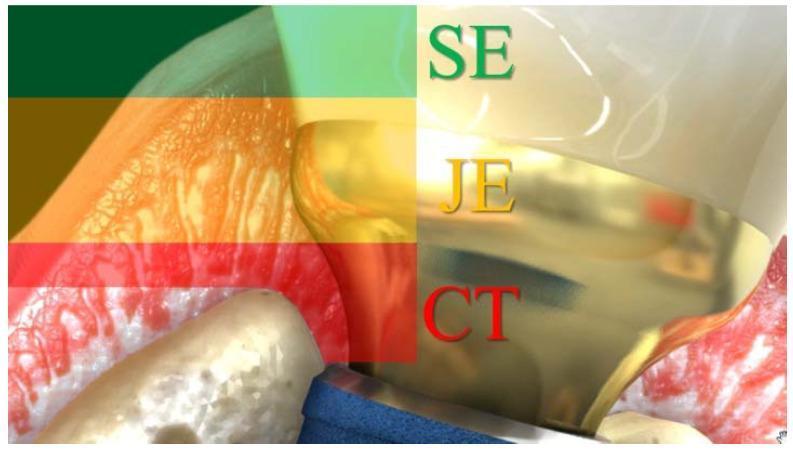
The image below shows the spatial relationship of JE (yellow band), sulcular epithelium (SE, green), and connective tissue (CT, red) in the periodontal/peri-implant attachment zone:
Key Points to Remember for Exams
- JE = non-keratinized, no rete ridges, wide intercellular spaces
- Attachment = hemidesmosomes + internal basal lamina (epithelial attachment)
- Origin = reduced enamel epithelium (primary) + oral epithelium (secondary)
- Normal sulcus depth = 1–3 mm
- Fastest turnover of all oral epithelia (~4–6 days)
- Apical migration of JE = hallmark of periodontitis → pocket formation
- Biologic width ≈ 2 mm (JE + supracrestal CT attachment) — relevant for crown margins
Sources: Histology: A Text and Atlas with Correlated Cell and Molecular Biology (Pawlina), p. 1462–1463 | Junqueira's Basic Histology, 17e, p. 751 | Color Atlas of Human Anatomy Vol. 2 (Thieme), p. 269
This is a shared conversation. Sign in to Orris to start your own chat.