
Give me a 15 m and for purine metabolism
Reading File
Now let me search the library for purine metabolism content:
Finding Sources
Finding Sources
Excellent sources found. Let me read the most comprehensive ones - Harper's Biochemistry, Basic Medical Biochemistry, and Rheumatology sections in parallel:
Reading File
Reading File
Reading File
Now let me get more content on de novo synthesis steps and regulation, and fetch the key pathway diagram:
Finding Sources
Reading File
Loading Image
Let me get the detailed de novo synthesis steps and the degradation/catabolism pathway:
Reading File
Loading Image
Now let me get the de novo synthesis steps detail and the salvage pathway content, plus clinical disorders:
Reading File
Loading Image
I now have all the core content needed. Let me compile the comprehensive 15-minute mnemonic-rich answer:
Purine Metabolism - Complete Notes (15-Minute Review)
1. Structure of Purines
Purines are double-ring nitrogenous bases consisting of a pyrimidine ring fused with an imidazole ring (9-membered bicyclic system). The two biologically important purines are:
- Adenine (A) - amino group at C6
- Guanine (G) - keto group at C6, amino at C2
2. Sources of Purine Ring Atoms
Mnemonic: "GAG CAN" (read around the ring)
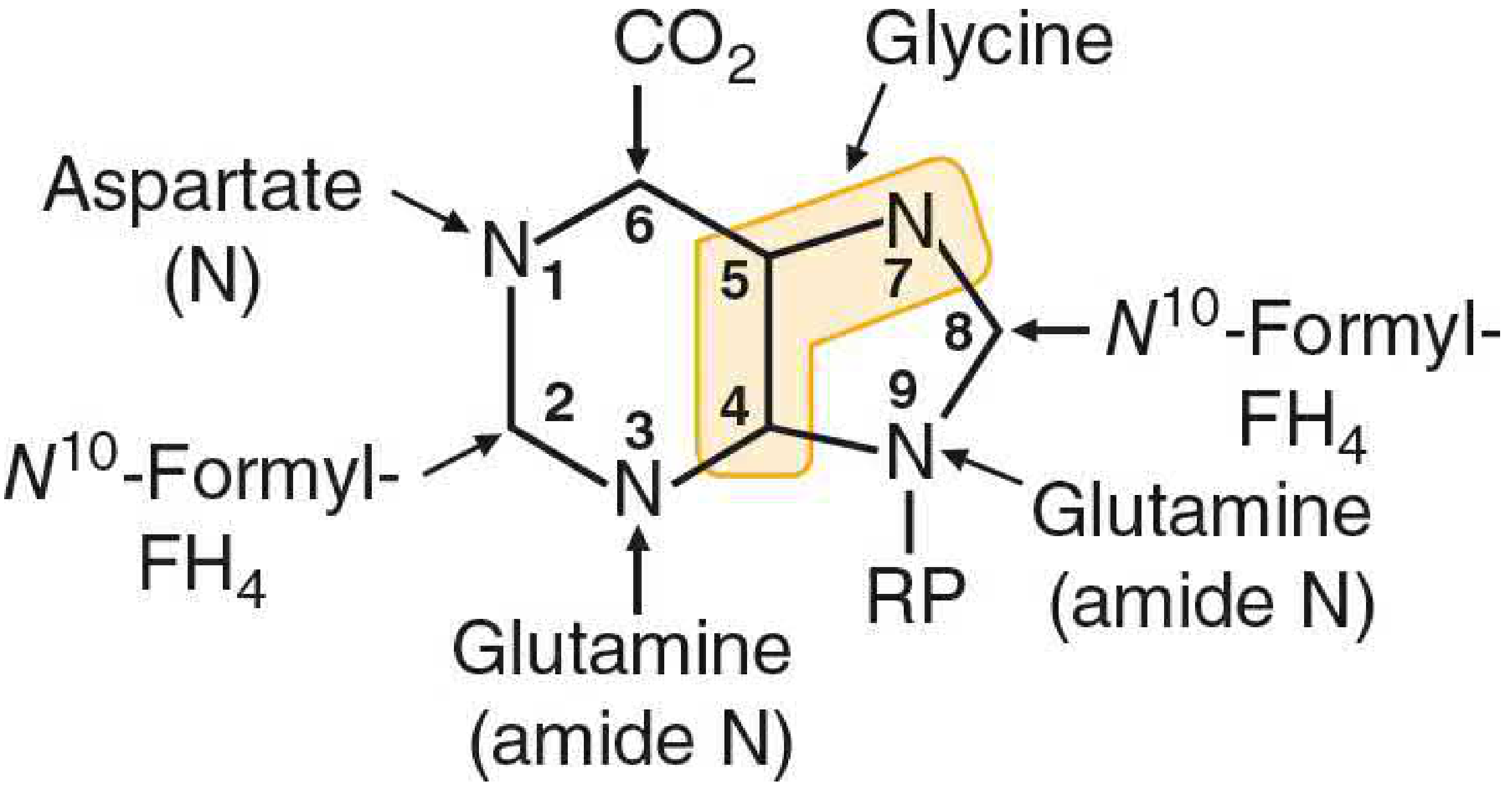
| Ring Atom | Contributed By |
|---|---|
| N1 | Aspartate |
| C2 | N¹⁰-Formyl-FH₄ (tetrahydrofolate) |
| N3 | Glutamine (amide-N) |
| C4, C5, N7 | Glycine (entire molecule donated) |
| C6 | CO₂ |
| N9 | Glutamine (amide-N) - attached to ribose |
| C8 | N¹⁰-Formyl-FH₄ |
Memory trick: "All Good Cooks Grow A Flavor" = Aspartate, Glutamine, CO₂, Glycine, formate (FH₄) x2
3. De Novo Synthesis of Purines
Key principle: The purine ring is assembled directly on ribose 5-phosphate (unlike pyrimidines, where the ring is built first, then attached to ribose). - Basic Medical Biochemistry, p. 1408
Occurs mainly in the LIVER, then purines are transported to other tissues via red blood cells.
Step 0 - PRPP Formation (NOT the committed step)
Ribose 5-phosphate + ATP → PRPP (5-phosphoribosyl-1-pyrophosphate)
Enzyme: PRPP synthetase
(Ribose 5-phosphate comes from the pentose phosphate pathway)
Enzyme: PRPP synthetase
(Ribose 5-phosphate comes from the pentose phosphate pathway)
Steps 1-10 - Building IMP (Inosine Monophosphate)
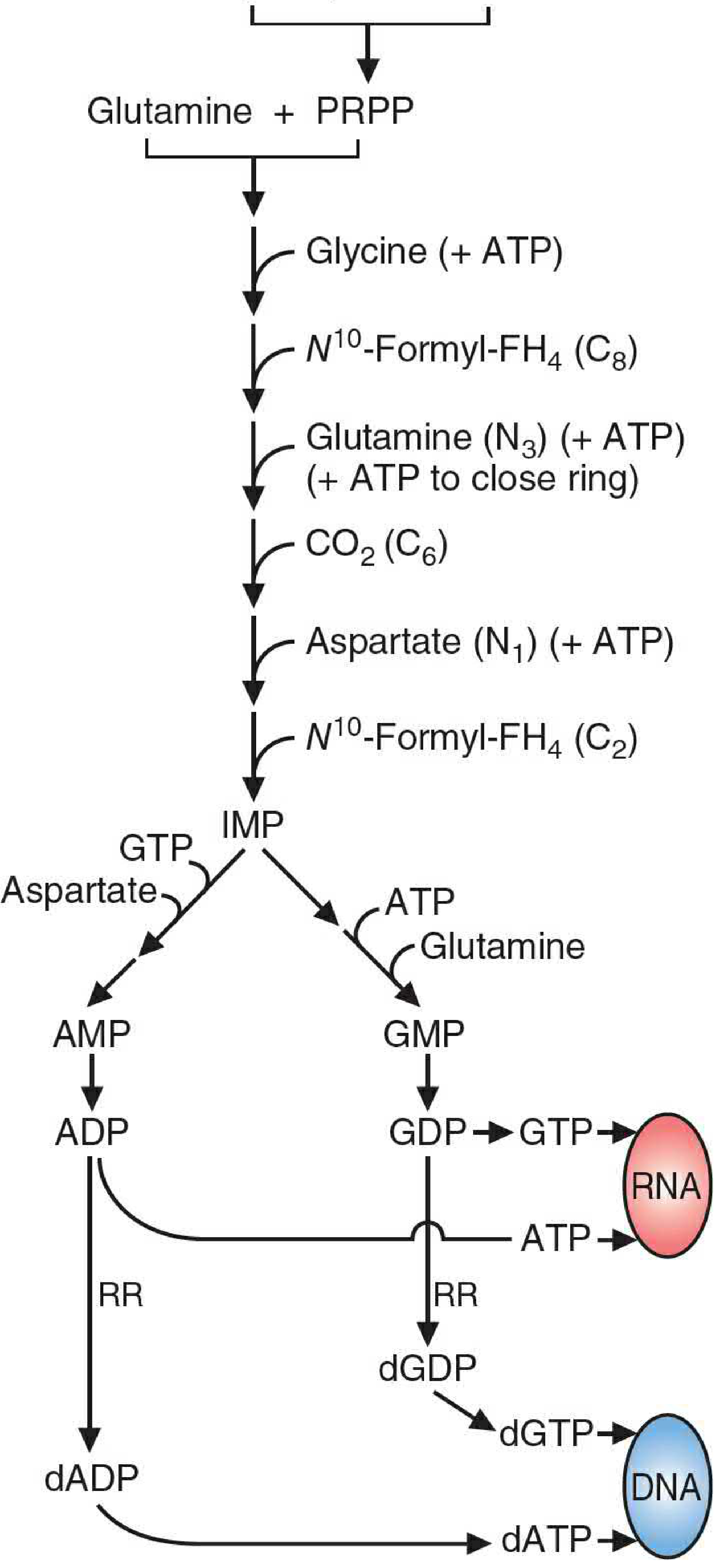
| Step | What Happens | Donor | ATP Used? |
|---|---|---|---|
| 1 (committed step) | PRPP + Glutamine → 5-phosphoribosylamine (PRA) | Glutamine (adds N9) | Yes |
| 2 | Glycine added → GAR | Glycine (C4, C5, N7) | Yes |
| 3 | C8 formylation → FGAR | N¹⁰-formyl-FH₄ | No |
| 4 | N3 added → FGAM | Glutamine | Yes |
| 5 | Ring closure → AIR (5-membered ring closes) | - | Yes |
| 6 | CO₂ added → CAIR | CO₂ | (No, in animals) |
| 7 | N1 added → SAICAR | Aspartate | Yes |
| 8 | Fumarate released → AICAR | - | No |
| 9 | C2 formylation → FAICAR | N¹⁰-formyl-FH₄ | No |
| 10 | Ring closure → IMP | - | No |
Total energy cost: 6 ATP per IMP synthesized - Basic Medical Biochemistry, p. 1407
Step 1 is the COMMITTED and rate-limiting step - enzyme: Glutamine phosphoribosylamidotransferase (amidotransferase)
IMP → AMP and GMP (two-step branches)
IMP → AMP:
- IMP + Aspartate → Adenylosuccinate (uses GTP)
- Adenylosuccinate → AMP + Fumarate
IMP → GMP:
- IMP → XMP (uses NAD⁺, by IMP dehydrogenase)
- XMP + Glutamine → GMP (uses ATP)
Cross-regulation mnemonic:
- "A needs G to be made" (AMP synthesis uses GTP)
- "G needs A to be made" (GMP synthesis uses ATP)
This ensures balanced production of adenylates and guanylates.
4. Regulation of De Novo Synthesis
PRPP synthetase - inhibited by AMP, ADP, GDP
Amidotransferase (committed step) - inhibited by AMP, GMP, IMP (end product feedback inhibition)
Amidotransferase (committed step) - inhibited by AMP, GMP, IMP (end product feedback inhibition)
PRPP availability is the major rate determinant - its increase drives purine overproduction (seen in Lesch-Nyhan, von Gierke disease). - Harper's Illustrated Biochemistry, 32nd Ed, p. 355
5. Salvage Pathway
Many cell types (especially brain, RBCs, rapidly dividing cells) rely heavily on salvage rather than de novo synthesis.
Key enzymes:
| Enzyme | Reaction | Substrates |
|---|---|---|
| HGPRT (Hypoxanthine-Guanine Phosphoribosyl Transferase) | Free base + PRPP → Nucleotide + PPi | Hypoxanthine → IMP; Guanine → GMP |
| APRT (Adenine Phosphoribosyl Transferase) | Adenine + PRPP → AMP + PPi | Adenine → AMP |
| Adenosine kinase | Adenosine + ATP → AMP + ADP | Adenosine → AMP |
Memory: "HGPRT saves hypoxanthine and guanine; APRT saves adenine"
Purine nucleotide cycle (important in muscle):
AMP → IMP (releasing NH₃) → AMP (via aspartate donation)
- Replenishes TCA intermediates during exercise by converting aspartate → fumarate
6. Catabolism (Degradation) of Purines
End product in humans = URIC ACID (because humans lack uricase)
In other mammals: uric acid → allantoin (more soluble)
In other mammals: uric acid → allantoin (more soluble)
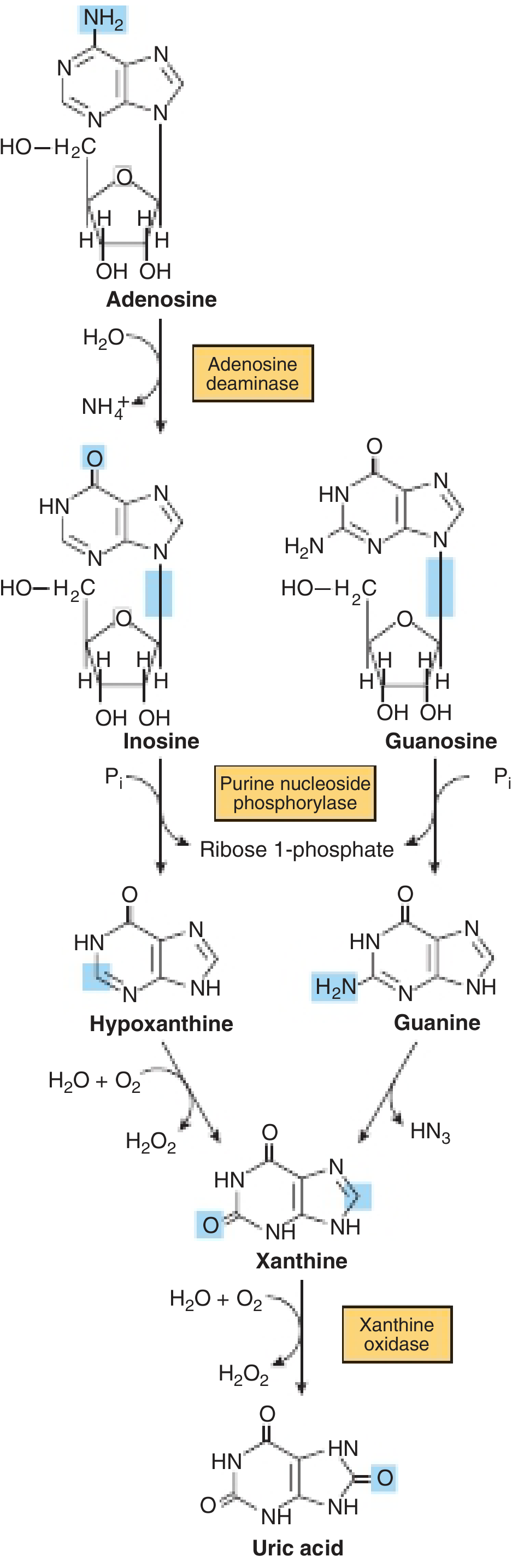
Degradation pathway:
Adenosine  →(Adenosine deaminase)→  Inosine
                                         ↓
AMP →(AMP deaminase)→ IMP           (Purine nucleoside phosphorylase)
                                         ↓
                                    Hypoxanthine
                                         ↓ (Xanthine oxidase)
Guanosine →(PNP)→ Guanine →(Guanase)→ Xanthine
                                         ↓ (Xanthine oxidase)
                                      URIC ACID
Key enzyme: Xanthine oxidase (XO)
- Converts: Hypoxanthine → Xanthine, and Xanthine → Uric acid
- Uses O₂, generates H₂O₂ (reactive oxygen species)
- Inhibited by Allopurinol (used in gout treatment)
- Rheumatology 2-Vol Set, p. 1765
Uric acid excretion:
- ~60% renal (proximal tubule transporters: URAT1, OAT)
- ~30-40% intestinal (ABCG2 transporter)
7. Disorders of Purine Metabolism
| Disorder | Defect | Mechanism | Features |
|---|---|---|---|
| Gout | Multifactorial (underexcretion 90%, overproduction 10%) | Urate crystals in joints | Acute arthritis, tophi, renal stones |
| Lesch-Nyhan Syndrome | HGPRT deficiency (X-linked) | Hypoxanthine/guanine not salvaged → ↑PRPP → ↑purine synthesis → ↑uric acid | Hyperuricemia + self-mutilation, choreoathetosis, intellectual disability |
| SCID (ADA deficiency) | Adenosine deaminase (ADA) deficiency | Toxic deoxyadenosine accumulates → T and B cell destruction | Severe combined immunodeficiency |
| PNP deficiency | Purine nucleoside phosphorylase deficiency | Toxic deoxyguanosine accumulates → T cell deficiency | T-cell immunodeficiency |
| Xanthinuria | Xanthine oxidase deficiency | Hypoxanthine/xanthine accumulate, no uric acid | Xanthine kidney stones, hypouricemia |
| von Gierke Disease | Glucose-6-phosphatase deficiency | ↑Ribose-5-P → ↑PRPP → ↑purine synthesis + lactic acidosis raises renal urate threshold | Secondary hyperuricemia |
| PRPP synthetase overactivity | PRPP synthetase mutation (X-linked) | ↑PRPP → ↑purine synthesis | Gout + sometimes sensorineural deafness |
8. Key Drugs Targeting Purine Metabolism
| Drug | Target | Use |
|---|---|---|
| Allopurinol | Xanthine oxidase inhibitor (substrate analog) | Gout - reduces uric acid production |
| Febuxostat | Xanthine oxidase inhibitor (non-purine) | Gout - reduces uric acid production |
| 6-Mercaptopurine (6-MP) | Inhibits HGPRT, amidotransferase | Leukemia, IBD |
| Azathioprine | Prodrug → 6-MP | Immunosuppression |
| Mycophenolate | Inhibits IMP dehydrogenase (blocks GMP synthesis) | Immunosuppression |
| Methotrexate | Inhibits DHFR → ↓FH₄ → ↓formyl donors for C2, C8 of purine ring | Cancer, autoimmune diseases |
| Probenecid | Blocks URAT1 (uricosuric) | Gout - increases uric acid excretion |
9. Quick High-Yield Summary Table
| Feature | Detail |
|---|---|
| De novo site | Mainly liver |
| First committed step | PRPP + Glutamine → PRA (glutamine amidotransferase) |
| First intermediate | IMP |
| Energy cost | 6 ATP per purine |
| End product of catabolism | Uric acid (humans lack uricase) |
| Rate-limiting enzyme | Glutamine amidotransferase (PRPP amidotransferase) |
| Key salvage enzyme | HGPRT |
| Key catabolic enzyme | Xanthine oxidase |
| Lesch-Nyhan defect | HGPRT |
| ADA deficiency → | SCID |
Sources: Basic Medical Biochemistry - A Clinical Approach, 6e, p. 1406-1412; Harper's Illustrated Biochemistry 32nd Ed, p. 354-357; Rheumatology 2-Volume Set (Elsevier 2022), p. 1764-1767
This is a shared conversation. Sign in to Orris to start your own chat.