
Metachromic leucodydtrophy
I'll look this up in the medical library for you right away.
Reading File
Now searching the medical library for metachromatic leukodystrophy.
Finding Sources
Finding Sources
Searching PubMed
metachromatic leukodystrophy
Excellent. Now reading the most detailed sections from Adams & Victor's Neurology and Goldman-Cecil Medicine.
Reading File
Reading File
Reading File
Now fetching the MLD MRI image and reading the juvenile/adult form section and Tietz lab section.
Loading Image
Reading File
Reading File
I now have comprehensive information from multiple authoritative textbooks. Here is a full synthesis:
Metachromatic Leukodystrophy (MLD)
Definition and Pathogenesis
Metachromatic leukodystrophy (MLD) is a lysosomal storage disorder (sphingolipidosis) caused by deficiency of the enzyme arylsulfatase A (ARSA), which normally converts sulfatide to cerebroside - a major component of myelin. Without ARSA, sulfatides accumulate in the CNS, peripheral nervous system, and other tissues (including the gallbladder), causing progressive demyelination.
A rarer form results from mutation in PSAP (encoding prosaposin), which is also needed for sulfatide breakdown.
- Inheritance: Autosomal recessive
- Gene locus: Chromosome 22q13 (ARSA gene); >60 mutations identified
- Stored substance: Sulfatides (galactosyl sulfatide)
- Sulfatides stain brown-orange (metachromatic) rather than purple with aniline dyes; also PAS-positive in frozen sections
Clinical Forms
| Form | Age of Onset | Predominant Features |
|---|---|---|
| Late infantile (most common) | 6 months - 2 years | Motor regression, gait disorder, hypotonia, lower-limb areflexia - peripheral neuropathy precedes CNS involvement |
| Juvenile | 3-16 years | Motor + behavioral problems, intellectual decline, ataxia, peripheral neuropathy |
| Adult | Mid-teens to 7th decade | Dementia, behavioral disturbances, psychiatric symptoms (hallucinations, delusions); often misdiagnosed as schizophrenia |
Late-Infantile Form (Classic):
- Progressive impairment of motor function (gait disorder, spasticity)
- Reduced speech output and mental regression
- Tendon reflexes initially brisk, later decreased/lost as peripheral nerves involved
- Later: visual impairment, strabismus, nystagmus, intention tremor, dysarthria, dysphagia, optic atrophy (1/3 of patients), macular gray degeneration
- Seizures are rare; no somatic abnormalities; head size usually normal
- Progresses to bedridden, quadriplegic, speechless state within 1-3 years
Adult Form:
- Often presents as psychiatric illness: auditory hallucinations, bizarre delusions, personality change, disinhibition, catatonic posturing
- Neurologic signs (dysarthria, spasticity) appear later
- Slowly evolving intellectual decline over 3-5 years
- Eventually progresses to loss of vision, speech, hearing, and decerebrate state
Pathology
- Widespread demyelination of cerebrum, cerebellum, spinal cord, and peripheral nerves
- Metachromatic granules in glial cells and engorged macrophages - characteristic finding
- Extensive segmental demyelination and abnormally thin myelin sheaths on nerve biopsy
- Metachromatic inclusions within Schwann cells and macrophages
MRI Findings
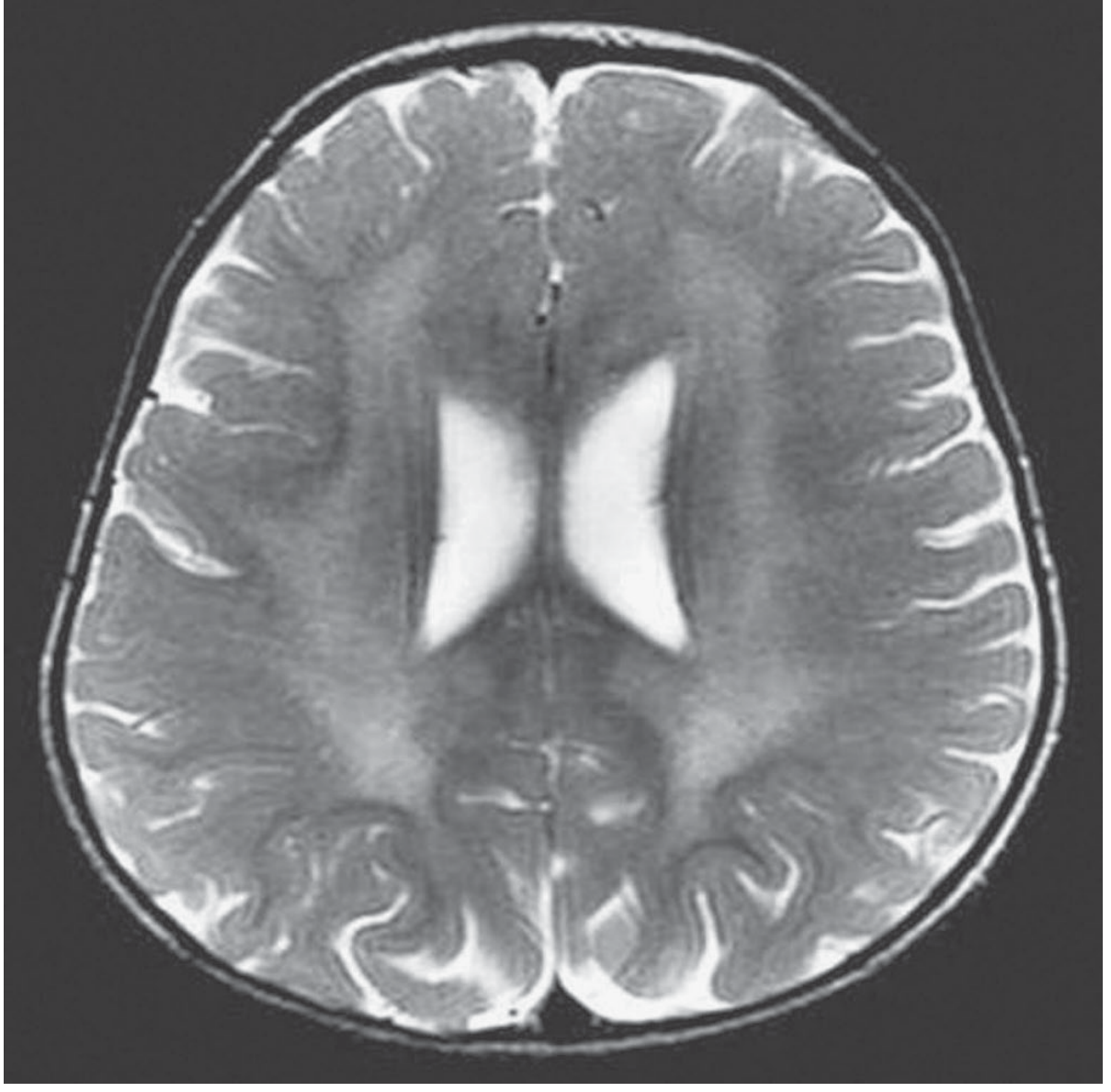
Axial T2-weighted MRI of a 2-year-old girl with MLD: symmetric central white matter hyperintensity with sparing of the subcortical arcuate (U) fibers. Confluent periventricular white matter lesions are hypointense on T1 and hyperintense on T2/FLAIR. - Adams and Victor's Neurology, 12th Ed.
Diagnosis
| Test | Finding |
|---|---|
| MRI brain | Symmetric confluent periventricular white matter hyperintensity (T2/FLAIR); sparing of subcortical U-fibers |
| CSF protein | Elevated: 75-250 mg/dL |
| Urine sulfatides | Markedly increased |
| ARSA enzyme activity | Absent/severely reduced in white blood cells, serum, cultured fibroblasts |
| Nerve conduction velocity | Markedly and uniformly slowed (especially late-infantile and juvenile forms) |
| Evoked potentials | Delayed visual and somatosensory evoked potential latencies (adult cases) |
| Peripheral nerve biopsy | Metachromatic inclusions in Schwann cells and macrophages (rarely needed now) |
| Molecular testing | ARSA gene mutation analysis (confirmatory) |
Important caveat - Pseudodeficiency: A pseudodeficiency allele (Pd) exists with carrier frequency of 15-20%. Homozygotes for this allele have enzyme activity ~10% of normal but NO clinical disease. Therefore, ARSA enzyme assay alone is not sufficient - must confirm with urine sulfatides AND/OR molecular testing, especially in atypical presentations.
Treatment
| Approach | Status |
|---|---|
| Allogeneic hematopoietic stem cell transplantation (HSCT) | Can slow progression if performed early in mildly affected patients; cord blood is a source; not curative |
| Gene therapy (ARSA gene) | Preliminary evidence for slowing progression; complications remain a concern |
| Gene therapy + HSCT combined | Under investigation |
| Enzyme replacement therapy (ERT) with recombinant human ARSA | Currently in clinical trials |
Key Points to Remember
- Enzyme: Arylsulfatase A (ARSA) deficiency - prevents sulfatide → cerebroside conversion
- Stored material: Sulfatides - stain metachromatic (brown-orange) with aniline dyes
- Inheritance: Autosomal recessive; gene on chromosome 22q13
- Classic finding: Symmetric periventricular white matter changes on MRI, with U-fiber sparing
- Peripheral neuropathy is an early feature (precedes CNS in infantile/juvenile forms)
- Adult form mimics psychiatric disease - a recognized cause of psychosis in adults
- Pseudodeficiency allele is common - always confirm with urine sulfatides or molecular testing
- Gallbladder involvement is common (hyperplastic polyps; possible increased carcinoma risk)
- CSF protein is consistently elevated
Sources: Adams and Victor's Principles of Neurology 12th Ed. | Goldman-Cecil Medicine | Bradley and Daroff's Neurology in Clinical Practice | Tietz Textbook of Laboratory Medicine 7th Ed.
This is a shared conversation. Sign in to Orris to start your own chat.