
Treatment regimen for tenia corporis and precautions to be taken
Reading File
Searching sources...
Tinea corporis (ringworm of the body) is treated primarily with topical antifungals for localized disease, while extensive or recalcitrant cases require systemic therapy. Let me pull the full details from the medical library now.
Finding Sources
Finding Sources
Searching PubMed
tinea corporis treatment antifungal
Good results. Now let me read the dedicated tinea corporis sections from the best sources.
Reading File
Reading File
Reading File
I got the clinical description. Now let me read the treatment sections specifically.
Reading File
Reading File
Searching Images
tinea corporis ringworm skin lesion annular rash
Excellent - I now have comprehensive data from multiple textbooks. Let me also fetch the textbook image of tinea incognita that appeared in the content.
Loading Image
I now have comprehensive information to provide a thorough answer. Let me compile everything.
Tinea Corporis (Ringworm of the Body): Treatment Regimen and Precautions
What It Is
Tinea corporis is a superficial dermatophyte infection of the glabrous (non-hairy) skin of the trunk and extremities - excluding scalp, beard, hands, feet, and groin. It presents as one or more circular, sharply circumscribed, erythematous, scaly patches with a raised, advancing border and central clearing - the classic "ringworm" appearance. Common causative organisms include Trichophyton rubrum, T. mentagrophytes, T. tonsurans, Microsporum canis, and Epidermophyton floccosum.
Treatment Regimen
1. Topical Antifungals (First-Line - Localized Disease)
Localized disease without follicular involvement is treated topically. Therapy is continued for 2-4 weeks in most cases.
| Drug | Formulation | Frequency | Notes |
|---|---|---|---|
| Terbinafine | 1% cream | Once daily | Can shorten course to 1 week; age ≥12 y |
| Clotrimazole | 1% cream or solution | Twice daily | All ages; OTC available |
| Miconazole | 2% cream | Twice daily | Age ≥2 y |
| Ketoconazole | 2% cream | Once daily | All ages (caution: safety in children not fully established) |
| Econazole | 1% cream | Once-twice daily | All ages |
| Luliconazole | 1% cream | Once daily | Age ≥2 y; apply for 2 weeks |
| Naftifine | 2% cream | Once daily | Age ≥12 y |
| Butenafine | 1% cream | Once daily | Age ≥12 y |
| Ciclopirox | 0.77% cream | Twice daily | Age ≥10 y |
| Oxiconazole | 1% cream | Twice daily | All ages |
| Sulconazole | 1% cream or solution | Once-twice daily | Adults only |
Note on species: Trichophyton species respond better and faster to terbinafine; Microsporum species respond better to griseofulvin. - Andrews' Diseases of the Skin, p. 347
2. Systemic Antifungals (Second-Line)
Systemic therapy is indicated when:
- Lesions are extensive or widespread
- Infection is unresponsive to topical treatment after adequate duration
- Follicular involvement (Majocchi granuloma) is present - topical therapy cannot penetrate deeply enough
- Patient is immunocompromised
- Concurrent tinea capitis is present
| Drug | Dose | Duration |
|---|---|---|
| Griseofulvin (microsized) | Pediatric: 10-20 mg/kg/day | 4-6 weeks |
| Terbinafine (oral) | 250 mg/day (adults) | 2-4 weeks |
| Itraconazole | 100 mg/day or 200 mg/day for 1 week | 2-4 weeks |
| Fluconazole | 150-200 mg once weekly | 4-6 weeks |
- Red Book 2021 (AAP), p. 1171
- Andrews' Diseases of the Skin, p. 347-348
For Majocchi granuloma, oral antifungal therapy is mandatory as topical agents are inadequate. - Red Book 2021, p. 1170
Important Precautions
Treatment-Related Precautions
-
Avoid topical corticosteroid-antifungal combination products (e.g., clotrimazole/betamethasone dipropionate): these frequently cause widespread tinea spread, fungal folliculitis, Majocchi granuloma, and increased relapse rates. Their use should be avoided. - Andrews' Diseases of the Skin, p. 347
-
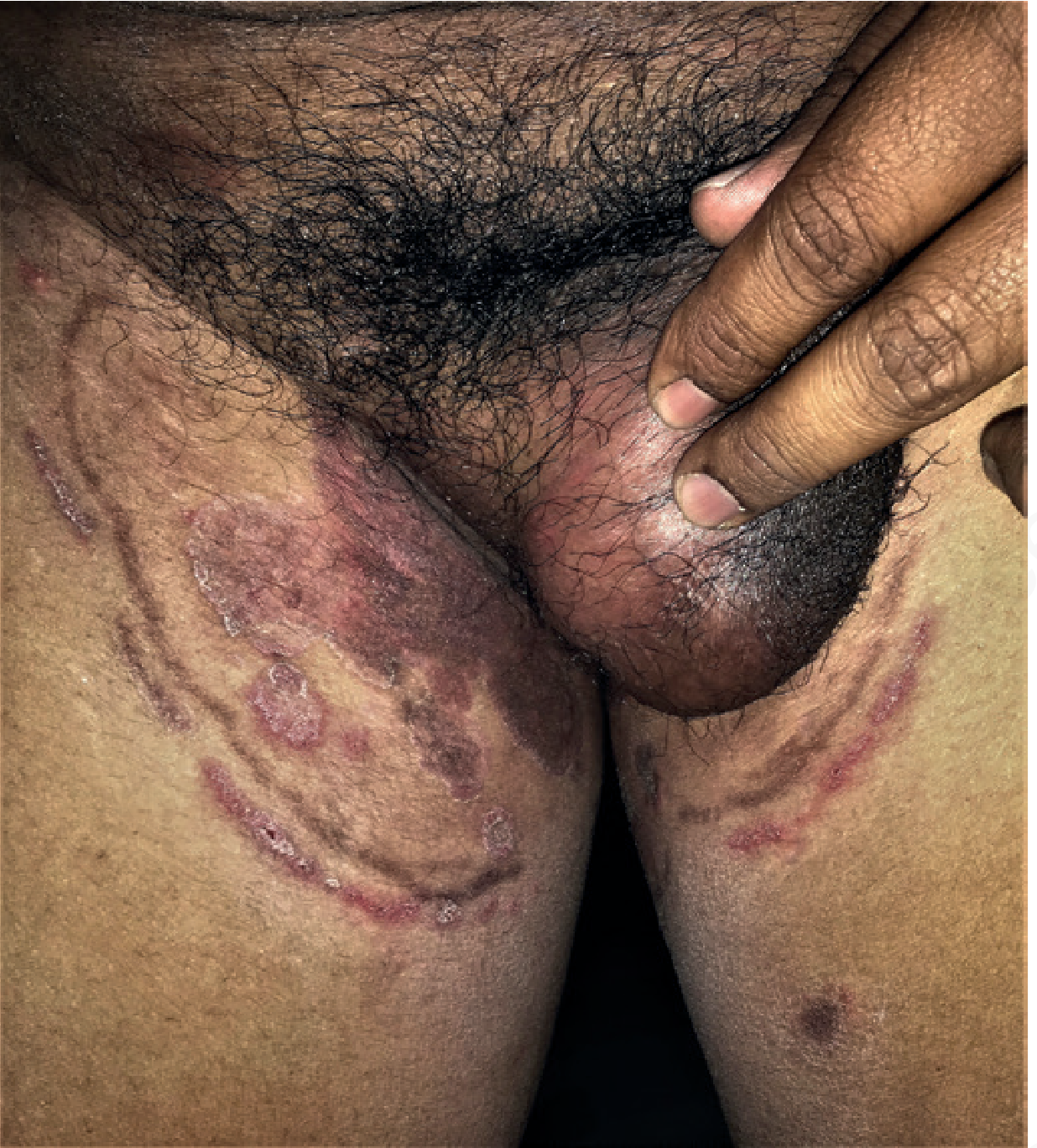
Tinea incognita: Application of topical steroids or calcineurin inhibitors to tinea lesions masks the typical appearance - erythema diminishes, scaling borders disappear - making diagnosis difficult. The lesions become atypical, widespread, with multiple edges and no central clearing. The image below shows this steroid-modified appearance:Steroid-modified tinea with double-edged borders and widespread involvement - Andrews' Diseases of the Skin
-
Treat all concurrent dermatophyte infections simultaneously (e.g., tinea pedis, onychomycosis) to prevent reinfection.
-
Id reaction awareness: A pruritic, papular, vesicular rash at sites distant from the fungal infection can occur as a hypersensitivity response. This may appear after initiating therapy and does NOT represent drug allergy - it is a dermatophytic "id" reaction. - Red Book 2021, p. 1168
Hygiene and Transmission Precautions
- Avoid sharing towels, clothing, combs, brushes, or hats - the organism can remain viable on fomites for prolonged periods.
- Avoid contact with infected individuals - the fungus spreads by direct skin-to-skin contact (especially relevant in contact sports like wrestling - "tinea gladiatorum").
- Check for animal sources: Multiple small lesions in a household are often linked to pets infected with M. canis. The pet should be evaluated and treated.
- Examine the scalp in wrestlers and children - tinea corporis can coexist with tinea capitis (especially T. tonsurans).
- Keep skin dry: Fungi thrive in warm, moist environments. Dry the skin thoroughly after bathing, especially skin folds.
- Immunocompromised patients (HIV, on immunosuppressants) are at higher risk for extensive, atypical, or deep infections and often require systemic therapy from the outset.
Infection Control (Hospitalized Patients)
Standard precautions apply. Outbreaks have been reported in both acute and chronic care facilities, so contact precautions are advisable during active outbreaks. - Red Book 2021, p. 1171
When to Refer / Escalate
- Failure to respond after 4 weeks of topical therapy
- Suspicion of Majocchi granuloma (deep, granulomatous nodular lesion, especially on shins or wrists)
- Widespread disease in an immunocompromised host
- Concurrent tinea capitis (requires systemic treatment regardless)
Sources: Red Book 2021 (AAP Committee on Infectious Diseases), pp. 1168-1171 | Andrews' Diseases of the Skin, pp. 347-348 | Fitzpatrick's Dermatology, Vol. 1-2
This is a shared conversation. Sign in to Orris to start your own chat.