
Diabetic keto acidosis treatment
Reading File
Now let me search the medical library for DKA treatment content in parallel with a PubMed search for recent guidelines.
Finding Sources
Searching PubMed
"diabetic ketoacidosis"[MeSH Terms] AND treatment
Good. Now let me read all three textbook sections in parallel.
Reading File
Reading File
Finding Sources
Let me read more of the Washington Manual DKA table and also fetch the flowchart image.
Reading File
Loading Image
I now have comprehensive textbook content and a clear DKA treatment algorithm. Let me compile a thorough response.
Diabetic Ketoacidosis (DKA) - Treatment
Overview
DKA is an acute, life-threatening complication of diabetes characterized by hyperglycemia, ketosis, and metabolic acidosis. Management ideally takes place in an ICU. The three pillars of treatment are: fluid replacement, insulin administration, and potassium repletion.
Treatment Algorithm
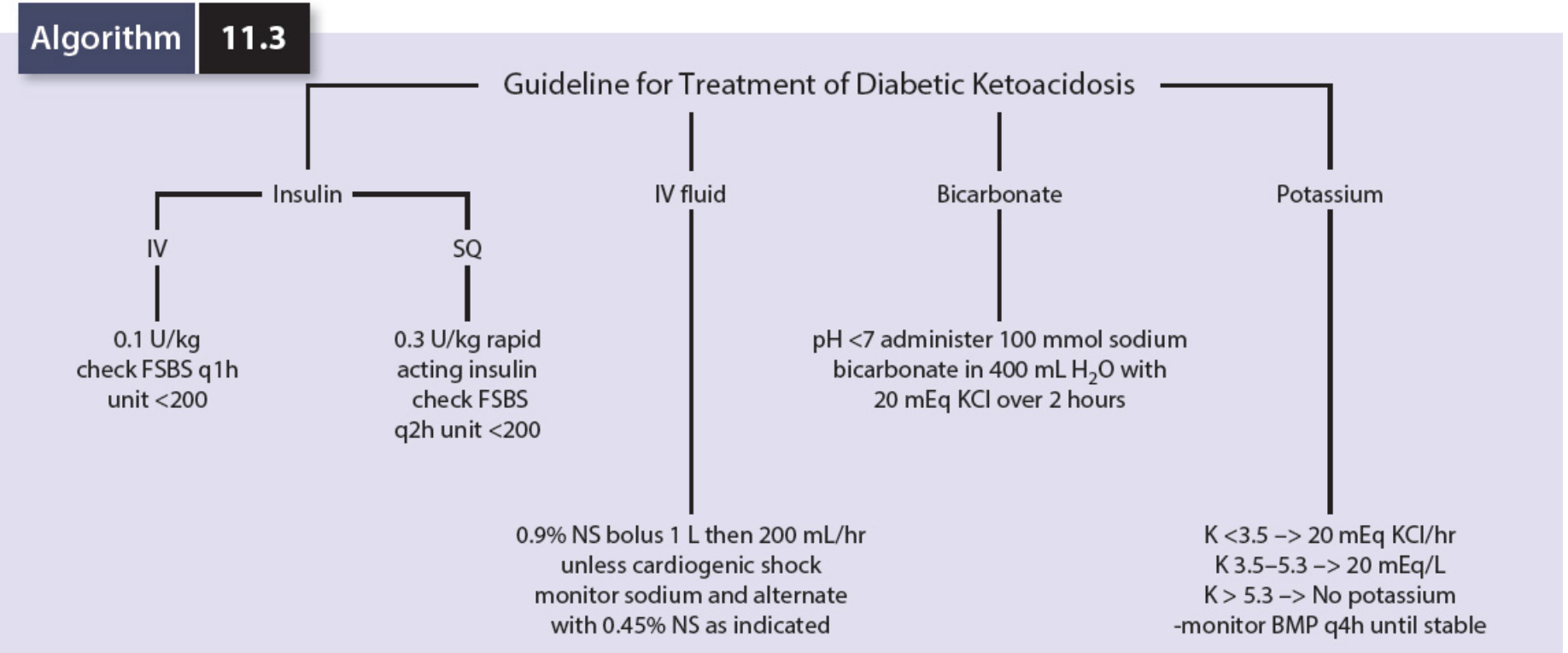
Algorithm 11.3 - Mulholland and Greenfield's Surgery
1. Initial Workup
Before starting treatment, confirm the diagnosis and identify the precipitant:
- Serum glucose, electrolytes, ketones, arterial blood gas
- CBC with differential, urinalysis, chest X-ray, ECG
- Beta-hydroxybutyrate levels (more reliable than urine ketones)
- Look for precipitants: infection, missed insulin, MI, pancreatitis, new-onset T1DM
Diagnostic criteria:
- Blood glucose >250 mg/dL
- pH <7.3
- Serum bicarbonate <18 mEq/L
- Anion gap >10-12
- Ketonemia/ketonuria
2. IV Fluids
The first priority is restoring circulating volume and then replacing total-body water deficit (usually 7-9% of body weight).
| Phase | Fluid | Rate |
|---|---|---|
| Immediate bolus | 0.9% NS | 1 L (children: 20 mL/kg) over 1-3 hours |
| Volume repletion | 0.9% NS | 500-1000 mL/h (if cardiac and renal function normal) |
| After initial repletion | 0.45% NS (or 0.9% NS if hyponatremic) | 150-500 mL/h |
| When glucose ≤300 mg/dL | Switch to D5W/0.45% NS | Continue until ketoacidosis resolves |
- Adjust rate based on BP and urine output
- Avoid correcting osmolality faster than 3 mOsm/kg/h
- Aim for positive fluid balance over 12-24 hours
- Serum sodium should rise as hyperglycemia corrects - if it doesn't, suspect overhydration
3. Insulin
Do NOT start insulin if K+ < 3.3-3.5 mEq/L - correct potassium first.
- Bolus: 0.1 units/kg IV regular insulin
- Infusion: 0.1 units/kg/h IV (regular insulin 100 units in 100 mL 0.9% NS at 10 mL/h = 10 units/h)
- Target glucose fall: 50-75 mg/dL/h (do not exceed 100 mg/dL/h - risk of osmotic encephalopathy)
When glucose reaches <250 mg/dL:
- Add dextrose (D5W) to prevent hypoglycemia while continuing insulin
- Consider the "two-bag approach" - separate dextrose infusion + reduced insulin at 0.05 units/kg/h (allows independent titration; shown to shorten treatment duration)
- Subcutaneous (SQ) approach for mild-moderate DKA: 0.3 units/kg rapid-acting insulin SQ, check glucose q2h
Stopping the insulin drip:
- Continue infusion until HCO3- >15 mEq/L, anion gap closed, and clinical improvement
- Give SC basal insulin 2 hours before stopping the IV infusion to prevent rebound ketosis
4. Potassium
DKA causes total-body potassium depletion (3-10 mEq/kg), even if serum K+ appears normal or high at presentation (due to transcellular shifts from insulin deficiency and acidosis). Insulin drives K+ into cells, causing serum K+ to fall during treatment.
| Serum K+ | Action |
|---|---|
| < 3.3-3.5 mEq/L | Replace K+ BEFORE starting insulin; 20 mEq KCl/hr |
| 3.5-5.3 mEq/L | Add 20-40 mEq KCl to each liter of IV fluid |
| > 5.3 mEq/L | No potassium yet; monitor BMP every 4 hours until stable |
- Check ECG for hyper/hypokalemia changes
- Potassium phosphate (KPhos) is preferred if co-existing hypophosphatemia
5. Bicarbonate
Not routinely recommended. Administer only in selected situations:
- pH <6.9, or HCO3- <5 mEq/L
- Shock or coma
- Severe cardiac or respiratory dysfunction
- Severe hyperkalemia
Dose: 50-100 mEq NaHCO3 in 1 L 0.45% NS over 30-60 min. Always add 10 mEq KCl to avoid hypokalemia. Follow arterial pH.
6. Phosphate & Magnesium
- Phosphate: Not routinely replaced, but potassium phosphate (KPhos) IV may be given in non-eating patients or if hypophosphatemia is significant
- Magnesium: 10-20 mEq MgSO4 IV if ventricular arrhythmias or documented deficiency
7. Monitoring
| Parameter | Frequency |
|---|---|
| Blood glucose | Every hour |
| Electrolytes, HCO3-, anion gap | Every 2-4 hours |
| Arterial blood gas | As needed (more frequently if severely acidotic) |
| Vital signs + urine output | Continuous |
| Fluid balance | Running total |
| Beta-hydroxybutyrate | Serial measurements helpful |
Telemetry is recommended given electrolyte instability.
8. Treat the Precipitant
Always search for and correct the underlying cause:
- Infections (most common) - start IV antibiotics promptly for documented/suspected infections; DKA itself causes leukocytosis, so fever is a meaningful sign
- Missed insulin doses
- New-onset Type 1 DM
- Myocardial infarction, stroke
- Drugs (steroids, SGLT2 inhibitors - euglycemic DKA)
- Pancreatitis (use lipase, not amylase, for diagnosis - amylase can be elevated in DKA)
9. Resolution Criteria (to stop insulin drip)
- Serum HCO3- >15 mEq/L (most reliable index of metabolic recovery)
- Anion gap closed (note: hyperchloremia from NS may close gap before true resolution - rely on HCO3-)
- Blood glucose <200-250 mg/dL
- Clinical improvement
10. Admit / Disposition
- ICU preferred for moderate-severe DKA
- Telemetry unit acceptable for stable patients
- Outpatient treatment may be considered in children only if: initial pH ≥7.35, HCO3- ≥20 mEq/L, tolerating oral fluids, symptoms resolved, reliable caregiver, no underlying precipitant
Recent Guideline Update (2024)
A 2024 consensus report on hyperglycemic crises (reviewed in Cleveland Clinic J Med 2025) has updated management recommendations, including guidance on SGLT2 inhibitor-associated euglycemic DKA. This should be considered when patients present with DKA but relatively normal glucose levels.
Sources:
- The Washington Manual of Medical Therapeutics, pp. 890-891
- Rosen's Emergency Medicine, Box 115.1
- Mulholland and Greenfield's Surgery, Algorithm 11.3
- Goldman-Cecil Medicine
Treatment for boils
Boils (furuncles) are deep bacterial infections of hair follicles, most commonly caused by Staphylococcus aureus. Treatment depends on size and severity: small boils often resolve with warm compresses alone, while larger ones require incision and drainage (I&D). Antibiotics are added when there is surrounding cellulitis, systemic signs, or MRSA risk.
Searching sources...
Finding Sources
Searching PubMed
"furuncle" OR "boil" AND "skin abscess" AND treatment
Finding Sources
Searching PubMed
"skin abscess"[MeSH Terms] AND "incision and drainage"
Good results. Let me read the most relevant sections in parallel.
Reading File
Reading File
Reading File
Let me get the antibiotic table and the treatment algorithm from Rosen's, plus the Dermatology textbook section on furuncle treatment.
Reading File
Finding Sources
Reading File
Reading File
I now have comprehensive content for a thorough answer. Let me read just a bit more of the antibiotic and post-I&D management section.
Reading File
I now have all the information needed for a comprehensive answer.
Treatment of Boils (Furuncles and Carbuncles)
Definitions
- Furuncle (boil): A deep abscess of a hair follicle, most commonly caused by Staphylococcus aureus (increasingly CA-MRSA). Presents as a painful, warm, erythematous, often fluctuant nodule. Common sites: axilla, inframammary region, buttocks, inner thigh.
- Carbuncle: A coalescence of multiple furuncles with loculations and connecting sinuses, often with multiple drainage points. Typically occurs on the back of the neck. More common in diabetics and middle-aged men.
Step 1: Confirm It Is a Boil, Not Cellulitis
Distinguishing an abscess from cellulitis is important because treatment differs:
- Boil/abscess: Fluctuant mass, hypoechoic on ultrasound with posterior acoustic enhancement
- Cellulitis: No central fluctuance, "cobblestoning" on ultrasound (interstitial edema)
- Bedside ultrasound with a high-frequency linear probe is the best tool when diagnosis is uncertain
Step 2: Primary Treatment - Incision and Drainage (I&D)
I&D is the first-line and definitive treatment for any fluctuant boil.
Needle aspiration alone is NOT adequate - blunt dissection is needed to disrupt loculations.
I&D Procedure:
- Attain adequate analgesia - local ring block with bupivacaine (25-gauge needle, allow 20 min), or procedural sedation. Adjuncts: ibuprofen + acetaminophen ± oxycodone ± low-dose diazepam
- Prep skin with povidone-iodine (nonsterile procedure)
- Incision - single incision along cutaneous tension lines (leaves smaller scar)
- Blunt dissection - use small clamp to probe cavity and disrupt loculations
- Irrigation - optional but may further break loculations
- Packing - traditional practice; packing is typically removed by the patient at home after 2-4 days. Evidence supporting packing is limited; loop drainage is a less painful alternative
Small, non-fluctuant furuncles: May resolve with warm compresses alone - no immediate I&D needed.
Step 3: Antibiotics
Antibiotics are not routinely required after I&D of an uncomplicated boil. A majority of patients (70-90%) achieve clinical cure with I&D alone.
When to add antibiotics:
| Indication | Action |
|---|---|
| Surrounding cellulitis or lymphadenitis | Antibiotics indicated |
| Systemic illness (fever, tachycardia) | Antibiotics indicated |
| Multiple sites of infection | Antibiotics indicated |
| Immunosuppression or significant comorbidities | Antibiotics indicated |
| Location difficult to drain (face, hand, genitalia) | Antibiotics indicated |
| Extremes of age | Antibiotics indicated |
| Septic phlebitis | Antibiotics indicated |
| Poor response to I&D alone | Add/change antibiotics |
| Furuncle not yet fluctuant | Consider antibiotics |
| Furuncle on the face | Consider antibiotics |
Antibiotic choices (oral):
| Drug | Adult Dose | Coverage | Notes |
|---|---|---|---|
| TMP-SMX (Trimethoprim-sulfamethoxazole) | 160 mg TMP BD | MSSA + MRSA | First choice for CA-MRSA; avoid in G6PD deficiency |
| Doxycycline | 100 mg BD | MSSA + MRSA | Empty stomach; sun sensitivity; ≥8 yrs only |
| Clindamycin | 300-450 mg TDS | MSSA + Strep ± MRSA | Variable MRSA coverage (check local sensitivity) |
| Cephalexin | 500 mg QID | MSSA + Strep | No MRSA coverage |
| Dicloxacillin | 250-500 mg QID | MSSA | Take on empty stomach; no MRSA coverage |
| Amoxicillin-clavulanate | 875 mg BD | MSSA + Strep + anaerobes | No MRSA coverage |
Key point: CA-MRSA now accounts for the majority of skin abscesses in the US. TMP-SMX or doxycycline should be favored when MRSA is a concern.
Step 4: Special Situations
Carbuncles:
- Have multiple interconnecting sinuses and tend to recur despite drainage and antibiotics
- Surgical drainage and resection of the lesion are often necessary
- Antibiotic cover required more often than for simple furuncles
Recurrent furuncles:
- Send wound cultures at time of I&D
- Screen for nasal carriage of S. aureus - decolonization with intranasal mupirocin + chlorhexidine body wash is recommended
- Screen for diabetes, HIV, or other immunodeficiency
Facial boils:
- Do NOT attempt home squeezing or self-drainage - risk of cavernous sinus thrombosis via facial veins
- Antibiotic therapy should be added
Diabetic patients:
- Higher risk of carbuncle formation and complications
- Lower threshold for antibiotic use and specialist referral
Pilonidal abscess:
- Treat acutely as a standard cutaneous abscess (I&D)
- Refer for surgical excision of the underlying cyst in recurrent cases
Step 5: Monitoring and Follow-Up
- Discharge after I&D of an uncomplicated boil is appropriate
- Patient removes packing at home after 2-4 days
- Return if: persistent or worsening pain, spreading redness, fever, or failure to improve
- Wound culture: Not routinely needed for uncomplicated first-episode boils, but indicated for recurrent infections, treatment failure, or when dual antibiotic coverage is being considered
When to Admit
Consider hospital admission for:
- Systemic sepsis
- Rapidly spreading infection or necrotizing fasciitis features (severe pain out of proportion, skin discoloration, crepitus)
- Immunocompromised patient with severe infection
- Failed outpatient I&D + antibiotics
Sources:
- Rosen's Emergency Medicine, Ch. 126
- Textbook of Family Medicine, 9e, p. 937
- Miller's Review of Orthopaedics, 9e, Table 1.28
- Sherris & Ryan's Medical Microbiology, 8e
Doxycycline duration
The duration of doxycycline therapy varies widely by indication - from a single dose (traveler's diarrhea) to lifelong (malaria prophylaxis in endemic areas). Common examples: community-acquired pneumonia 5-7 days, chlamydia 7 days, Lyme disease 10-21 days, acne 3-6 months.
Searching sources...
Finding Sources
Finding Sources
Finding Sources
Finding Sources
Finding Sources
Finding Sources
Finding Sources
Finding Sources
Finding Sources
Finding Sources
I have good data from the library. Let me compile a comprehensive, well-organized answer from all the sources gathered.
Doxycycline - Duration by Indication
Doxycycline is a broad-spectrum tetracycline antibiotic used across many infectious and non-infectious conditions. The treatment duration varies enormously depending on the indication. The standard adult dose is 100 mg twice daily (BD) unless otherwise noted.
Infections - Short Course (1-14 days)
| Condition | Dose | Duration | Notes |
|---|---|---|---|
| Chlamydia trachomatis (urethritis/cervicitis) | 100 mg BD | 7 days | CDC recommended |
| Chlamydial epididymitis | 100 mg BD | 10 days | With ceftriaxone 500 mg IM once |
| Pelvic inflammatory disease (PID) | 100 mg BD | 14 days | Usually combined with ceftriaxone |
| Sexually transmitted proctitis | 100 mg BD | 7 days | With ceftriaxone 500 mg IM once |
| Community-acquired pneumonia | 100 mg BD | 5-7 days | Atypical organisms, Mycoplasma |
| Chlamydia pneumoniae | 100 mg BD | 10-14 days | |
| Psittacosis (Chlamydophila psittaci) | 100 mg BD | 7-10 days | Azithromycin is alternative |
| Q fever (acute) | 100 mg BD | 14 days | Coxiella burnetii; quinolones also effective |
| Rocky Mountain Spotted Fever (RMSF) | 100 mg BD | 5-14 days | Continue until afebrile 3 days; doxycycline is drug of choice including in children |
| Rickettsial infections (general) | 100 mg BD | 5-14 days | Defervescence usually within 1-2 days |
| Skin/soft tissue infections (MRSA) | 100 mg BD | 5-7 days | After I&D of abscess |
| Leptospirosis | 100 mg BD | 7 days | Also used for prophylaxis (single 200 mg dose) |
| Plague (post-exposure prophylaxis) | 100 mg BD | 7 days | Treatment course is 10-14 days |
| Anthrax (post-exposure prophylaxis) | 100 mg BD | 60 days | Or ciprofloxacin; long course due to spore germination risk |
Infections - Intermediate Course (2-6 weeks)
| Condition | Dose | Duration | Notes |
|---|---|---|---|
| Lyme disease (erythema migrans) | 100 mg BD | 10-14 days | Some guidelines use up to 21 days |
| Lyme disease (early disseminated) | 100 mg BD | 14-21 days | Longer if CNS/cardiac involvement |
| Brucellosis | 100 mg BD | 6 weeks | Combined with rifampin or streptomycin |
| Trench fever (Bartonella quintana, bacteremic) | 200 mg/day PO | 28 days | Combined with gentamicin IV 14 days |
| Tularemia (less severe) | 100 mg BD | 14-21 days | Ciprofloxacin is an alternative |
| Q fever (chronic / pregnancy) | TMP-SMX preferred in pregnancy | Duration of pregnancy | Doxycycline avoided in pregnancy |
| Granuloma inguinale / Donovanosis | 100 mg BD | ≥3 weeks | Until lesions heal completely |
Chronic / Long-term Use
| Condition | Dose | Duration | Notes |
|---|---|---|---|
| Acne vulgaris | 50-100 mg BD | 3-6 months | Systemic tetracyclines; used for moderate-severe or topical-resistant acne |
| Rosacea | 40 mg once daily (subantimicrobial) or 100 mg BD | Months to years | Low-dose (40 mg) minimizes antibiotic resistance; isotretinoin for resistant cases |
| Malaria prophylaxis | 100 mg once daily | Start 1-2 days before travel, continue 4 weeks after departure | Effective against all Plasmodium species including chloroquine-resistant strains |
| Scrub typhus / Melioidosis (prophylaxis in hyperendemic areas) | 100 mg BD | Situational |
Key Pharmacology Points Relevant to Duration
- Long half-life (~18-22 hours): Once or twice-daily dosing is sufficient; better compliance than older tetracyclines
- Photosensitivity: Risk increases with prolonged use - patients should use sun protection
- Food interactions: Can be taken with food (unlike tetracycline HCl), which improves GI tolerance during long courses
- Esophageal ulceration: Take with full glass of water and remain upright for 30 min - important in long-term users
- Children <8 years: Generally avoided due to dental staining/bone effects - except in life-threatening rickettsial disease (RMSF) where it is still the drug of choice
- Pregnancy: Avoid after 1st trimester (teratogenic, dental discoloration)
- Resistance risk: Long courses (e.g., for acne) increase risk of resistance development; subantimicrobial dosing (40 mg) for rosacea avoids this
Summary Quick Reference
| Duration | Indications |
|---|---|
| 7 days | Chlamydia, STI proctitis, leptospirosis treatment |
| 10-14 days | Chlamydia pneumoniae, leptospirosis, early Lyme disease, psittacosis, plague treatment |
| 14 days | Acute Q fever, PID, RMSF (min) |
| 14-21 days | Tularemia, Lyme (disseminated) |
| 28-42 days | Trench fever (bacteremic), brucellosis |
| 60 days | Anthrax post-exposure prophylaxis |
| 3-6 months | Acne vulgaris |
| Ongoing | Malaria prophylaxis (while at risk + 4 wks after), rosacea maintenance |
Sources:
- Goldman-Cecil Medicine, Chapters on STIs, Parasitic Diseases, and Zoonoses
- Harrison's Principles of Internal Medicine, 22e (2025)
- Goodman & Gilman's Pharmacological Basis of Therapeutics
- Fitzpatrick's Dermatology
- Red Book 2021 - Report of the Committee on Infectious Diseases
For boils
Based on the previous conversation, this is asking specifically about doxycycline duration for boils (furuncles/skin abscesses).
From the textbook content already retrieved in this session:
Doxycycline Duration for Boils (Furuncles/Skin Abscesses)
Standard Duration: 5-7 days
- Dose: Doxycycline 100 mg orally, twice daily (BD)
- Duration: 5-7 days after incision and drainage (I&D)
Important Points
Antibiotics are not always needed. The primary treatment for a boil is I&D. Doxycycline (or TMP-SMX) is added only when:
- Surrounding cellulitis is present
- Systemic signs (fever, tachycardia)
- MRSA is suspected or confirmed
- Multiple sites of infection
- Immunocompromised patient
- Facial or genital boil
- Poor response to I&D alone
Why doxycycline specifically? Doxycycline covers both MSSA and CA-MRSA, making it a good empiric choice when MRSA is a concern. TMP-SMX (co-trimoxazole) is the alternative with similar MRSA coverage.
| Drug | MSSA | MRSA | Strep | Duration |
|---|---|---|---|---|
| Doxycycline | ✓ | ✓ | ± | 5-7 days |
| TMP-SMX | ✓ | ✓ | ✗ | 5-7 days |
| Clindamycin | ✓ | ± | ✓ | 5-7 days |
| Cephalexin | ✓ | ✗ | ✓ | 5-7 days |
Note: For patients ≥8 years only - avoid doxycycline in children under 8 and in pregnancy.
- Rosen's Emergency Medicine, Table 126.2
This is a shared conversation. Sign in to Orris to start your own chat.