
urticaria
Reading File
Finding Sources
Searching PubMed
urticaria management guidelines
Now let me read the most comprehensive sources — Fitzpatrick's (dermatology gold standard), Goldman-Cecil (internal medicine), and Rosen's (emergency):
Reading File
Reading File
Reading File
Good content from Goldman-Cecil and Rosen's. Let me now read the Goldman-Cecil pathobiology/treatment section and get more from Rosen's management section:
Reading File
Reading File
Searching Images
urticaria hives wheal and flare skin
Now let me get the detailed management section from Goldman-Cecil and the dermatology textbook (Dermatology 5e) for classification and physical urticaria:
Finding Sources
Reading File
I have enough content. Let me search for more on classification and physical urticaria types:
Finding Sources
Finding Sources
Excellent — Harrison's has a dedicated section. Let me read Fitzpatrick's subtypes and Harrison's urticaria section simultaneously:
Reading File
Reading File
I now have comprehensive content. Let me compile the full answer.
Urticaria (Hives)
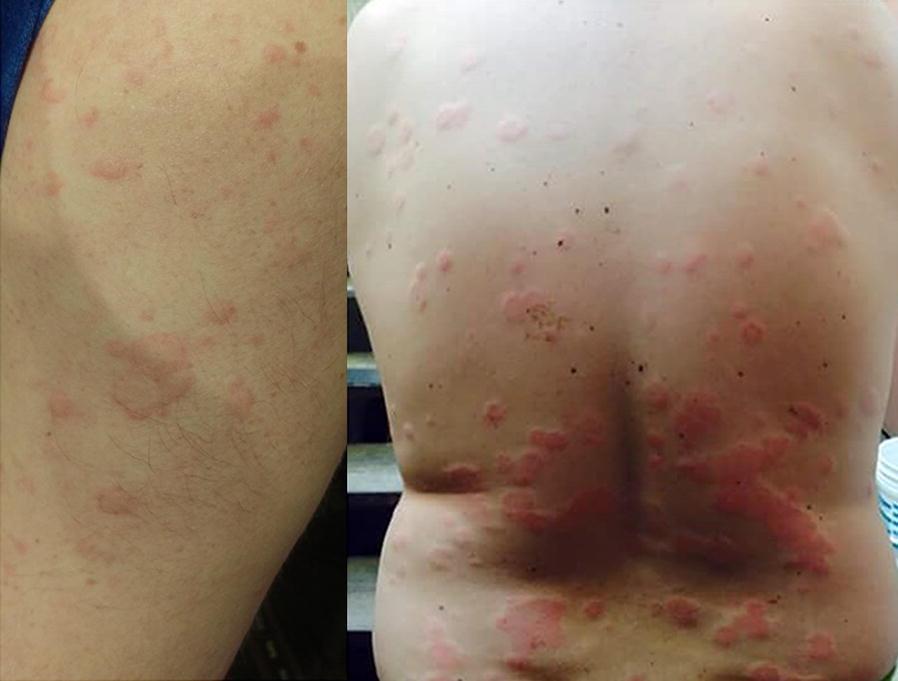
Definition
Urticaria consists of transient, pruritic, edematous plaques (wheals) with pale centers and red borders — the classic "wheal and flare" reaction. Individual lesions reflect localized dermal edema from transvascular fluid extravasation and resolve within <24 hours, although new lesions may continuously appear. Angioedema represents the same process in the subcutaneous/submucosal layer.
Epidemiology
- ~15–20% of the population experiences at least one episode during their lifetime
- Acute urticaria: seen equally in both sexes; common in children with atopic dermatitis
- Chronic urticaria: more common in women in their 40s–50s; peaks in the 3rd–4th decade overall
- 50% of patients with chronic urticaria have disease lasting ≥5 years
- Dermographism alone affects ~5% of the general population
Classification (EAACI 2013 Consensus)
| Duration | Type | Subtypes |
|---|---|---|
| Acute | <6 weeks | Spontaneous |
| Chronic | ≥6 weeks | Spontaneous (CSU) — no identifiable trigger |
| Inducible — physical stimuli |
Inducible (Physical) Urticaria Types:
- Symptomatic dermographism — linear wheals from minor pressure/scratching; most common physical type
- Cold urticaria — exposed skin after cold exposure; risk of wheezing and syncope (avoid cold water swimming); associated with cryoglobulins; autosomal dominant form linked to cryopyrin dysfunction
- Delayed pressure urticaria (DPU) — urticaria/angioedema hours after sustained pressure
- Heat urticaria — provoked by local heat application
- Solar urticaria — within minutes of sun exposure; skin sign of erythropoietic protoporphyria
- Cholinergic urticaria — small wheals with large flares; triggered by heat, exercise, or emotion; occasionally associated with wheezing
- Vibratory angioedema — vibratory stimuli
- Aquagenic urticaria — water contact regardless of temperature
- Contact urticaria — direct skin contact with causative agent
Pathophysiology
Common final pathway: Local mast cell degranulation → release of histamine, bradykinin, kallikrein, acetylcholine, slow-reacting substance of anaphylaxis → dermal edema and vasodilation.
Mechanisms:
| Immunologic | Nonimmunologic |
|---|---|
| IgE-dependent (type I hypersensitivity) | Direct mast cell degranulation (opioids, contrast dye, strawberries, lobster) |
| Autoimmune: functional IgE autoantibodies releasing histamine from mast cells | NSAID/aspirin inhibition (non-IgE; effects persist weeks) |
| Immune complex–mediated (type III) | Vasoactive stimuli |
| Complement-kinin dependent (C1-esterase inhibitor deficiency → hereditary angioedema) |
Causes / Triggers
| Category | Examples |
|---|---|
| Drugs | Penicillin (most common), aspirin/NSAIDs, opioids (virtually any medication can cause urticaria) |
| Foods | Shellfish, tree nuts, peanuts, eggs; histamine releasers: strawberries, lobster |
| Infections | Viral (rhinovirus, rotavirus, hepatitis B/C, EBV, coxsackievirus, SARS-CoV-2); occult Candida, dermatophytes, Helicobacter pylori, parasites |
| Contact | Animal dander/saliva, plants, cosmetics, topical medications, textiles |
| Systemic diseases | Mastocytosis, thyroid disease (hypo/hyperthyroidism), SLE, Sjögren's, rheumatoid arthritis, celiac disease, type 1 DM, Schnitzler's syndrome, Still's disease, serum sickness, hepatitis B/C, cryoglobulinemia, HES, malignancy |
| Physical | Cold, pressure, heat, sun, exercise, vibration, water |
| Idiopathic | ~50% of CSU has no identifiable cause |
Clinical Features
- Morphology: Raised, blanching, erythematous papules/plaques; pale center; red border
- Pruritus: Often intense; stinging or prickling sensation also common
- Duration of individual lesions: <24 hours (key diagnostic feature)
- Angioedema: Eyelids, lips, tongue, larynx, GI tract — occurs in combination with or separate from urticaria; laryngeal involvement is life-threatening
- Urticarial vasculitis: Individual lesions persist >24 hours, may leave bruising; associated with hypocomplementemia and systemic vasculitis
Diagnosis
Acute urticaria: Usually clinical; no routine workup needed for a single episode.
Chronic spontaneous urticaria (CSU) — baseline workup:
- CBC with differential
- ESR and/or CRP
- Thyroid function tests + anti-thyroid antibodies
- Autologous serum skin test (ASST) — assesses for circulating histamine-releasing autoantibodies
Extended workup (based on history):
- Infectious screen (H. pylori, hepatitis serology, stool parasites)
- Allergen-specific IgE / skin prick testing
- Tryptase (rule out mastocytosis)
- ANA, complement levels (if vasculitis suspected)
- Skin biopsy (if lesions >24h, non-blanching, or vasculitis suspected — biopsy shows perivascular eosinophilic/neutrophilic infiltrate)
Inducible urticarias: Provocation + threshold testing with the relevant stimulus (ice cube test for cold urticaria, dermographometer for symptomatic dermographism, etc.) — see Fitzpatrick's Table 41-1.
Differential Diagnosis
- Drug eruption / morbilliform exanthem
- Erythema multiforme (targetoid, non-transient)
- Erythema marginatum
- Urticarial bullous pemphigoid (lesions persist >24h; biopsy required)
- Urticarial vasculitis
- Still's disease (neutrophilic urticarial dermatosis — coincides with fever spikes)
- Mastocytosis (urticaria pigmentosa)
- Neutrophilic urticaria, papular urticaria
Management
Step 1 — Identify and remove triggers
Discontinue offending drug, allergen avoidance, treat underlying infection.
Step 2 — Pharmacotherapy (Stepwise)
| Step | Agent | Notes |
|---|---|---|
| 1st line | 2nd-generation (non-sedating) H1 antihistamines | Cetirizine, fexofenadine, loratadine, desloratadine, bilastine — preferred for chronic use |
| Adjunct | H2 antihistamine (ranitidine/famotidine) added to H1 blocker | Modest additional benefit |
| Acute severe | Systemic corticosteroids | Prednisone or dexamethasone for moderate–severe episodes; 14–21 days with taper for recurrent urticaria; chronic steroid use NOT recommended |
| Refractory CSU | Omalizumab (anti-IgE monoclonal antibody) | Standard of care for H1-antihistamine-resistant CSU; approved and highly effective |
| Refractory CSU | Cyclosporine | Immunosuppressant for omalizumab failure/intolerance |
| Symptom relief | Hydroxyzine | Sedating H1 blocker; for acute pruritus relief |
Anaphylaxis/angioedema with airway involvement: Epinephrine IM immediately → antihistamines + corticosteroids → observation.
Urticaria vs. Angioedema
| Feature | Urticaria | Angioedema |
|---|---|---|
| Layer | Dermis | Subcutis / submucosa |
| Lesion | Wheal + flare, pruritic | Deep swelling, may be painful or burning |
| Sites | Anywhere | Face, lips, tongue, larynx, GI |
| Risk | Discomfort | Airway compromise (laryngeal) |
Key Associations to Remember
- Penicillin → most common drug cause (traces in dairy may sensitize)
- Aspirin/NSAIDs → non-immunologic; effects persist weeks after stopping
- Cholinergic urticaria + cold urticaria → common co-occurring inducible types
- Cold urticaria + cryoglobulins → screen for hematologic/lymphoproliferative disease
- Solar urticaria → consider erythropoietic protoporphyria (pitted nasal/hand scarring)
- CSU + thyroid autoimmunity → well-established association (screen all CSU patients)
- Omalizumab → backed by multiple RCTs and now guideline-recommended for antihistamine-refractory CSU (PMID 41182242 — 2025 Asian-Pacific clinical practice guideline)
Sources: Goldman-Cecil Medicine, Rosen's Emergency Medicine, Fitzpatrick's Dermatology, Harrison's Principles of Internal Medicine (22nd ed.), Dermatology 5e (Elsevier).
This is a shared conversation. Sign in to Orris to start your own chat.