
Cell injury notes explanation in simple terms
Reading File
Finding Sources
Finding Sources
Reading File
Reading File
Reading File
Reading File
Reading File
Reading File
I now have comprehensive content from Robbins & Kumar Basic Pathology. Let me compile a clear, simple explanation.
Cell Injury — Explained Simply
Based on Robbins & Kumar Basic Pathology (Robbins Pathology)
What Is Cell Injury?
Cell injury is any damage to a cell that disrupts its normal function. It is the basis of all disease. Depending on how severe and how long the injury lasts, the cell either recovers (reversible) or dies (irreversible).
🔴 Causes of Cell Injury
Think of these as the "attackers":
| Cause | Simple Explanation |
|---|---|
| Hypoxia / Ischemia | Not enough oxygen (hypoxia) or blood flow (ischemia). Most common cause. No O₂ = no energy for the cell. |
| Toxins | Poisons — pollution, cigarette smoke, alcohol, medications, carbon monoxide. |
| Infections | Bacteria, viruses, fungi, parasites — they release toxins or trigger harmful immune reactions. |
| Immune reactions | Your own immune system turns against your tissues (autoimmune), or overreacts (allergy, chronic inflammation). |
| Genetic defects | Mutations cause wrong or absent proteins — e.g., sickle cell anemia, metabolic enzyme deficiencies. |
| Nutritional imbalances | Too little (malnutrition) or too much (obesity → diabetes, atherosclerosis). |
| Physical agents | Trauma, extreme heat/cold, radiation, electric shock. |
The Two Stages: Reversible vs. Irreversible
Healthy Cell → INJURY → Reversible Injury → Remove cause → RECOVERY
                                         ↘ Injury continues → Irreversible Injury → CELL DEATH
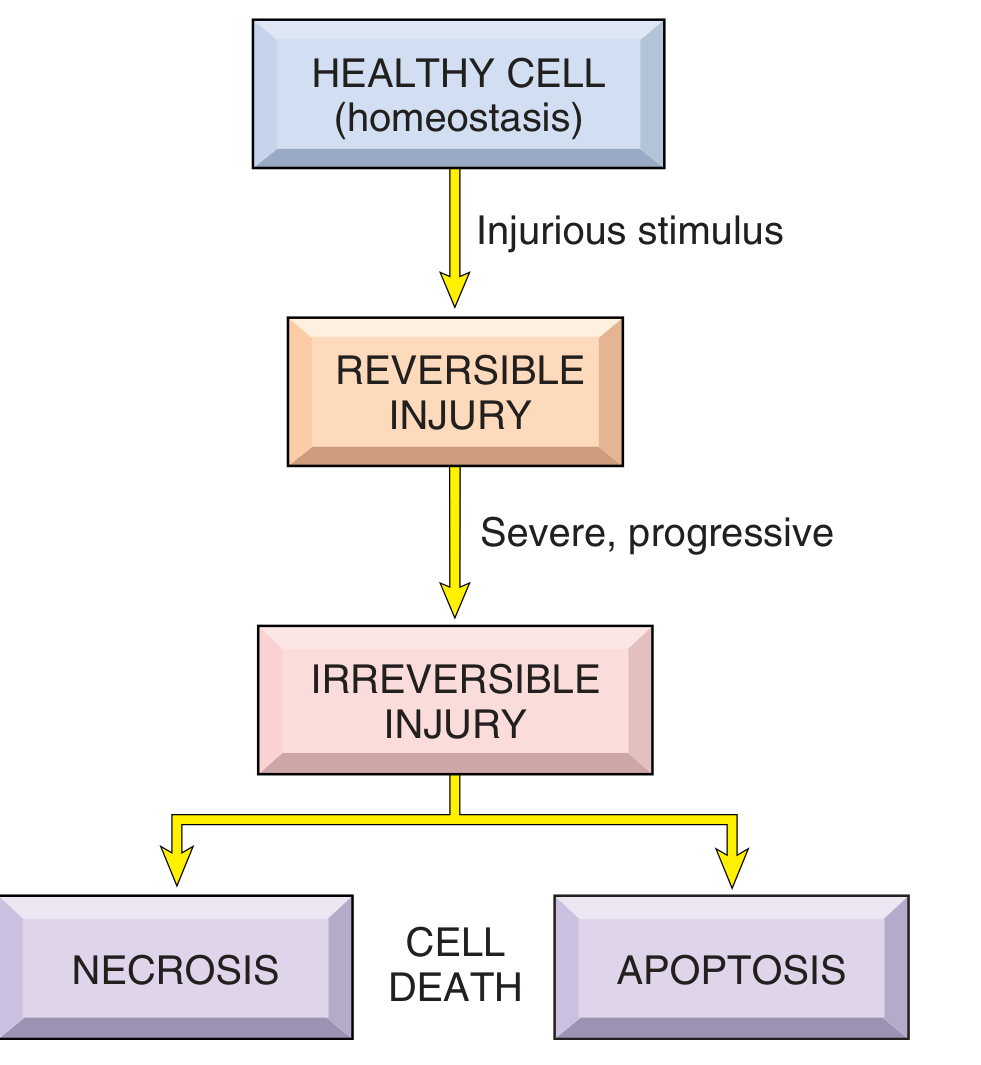
✅ Reversible Cell Injury (Cell is damaged but can recover)
Two key features:
- Cell swelling — ion pumps fail → sodium and water flood in → the cell puffs up like a balloon (called hydropic change or vacuolar degeneration). Visible as small clear vacuoles under the microscope.
- Fatty change — lipid droplets accumulate in the cytoplasm, mainly in the liver.
❌ Irreversible Cell Injury (Point of no return → Cell dies)
Three signs that the cell can't recover:
- Mitochondria are permanently damaged → no ATP ever again
- Cell membranes break down → cell contents leak out
- DNA and chromatin are destroyed
How Does the Cell Actually Get Injured? (Mechanisms)
1. 🔋 Mitochondrial Damage — "Power Plant Failure"
Mitochondria make ATP (the cell's energy currency). When they're damaged (by hypoxia, toxins, radiation):
- No ATP → ion pumps fail → sodium floods in → cell swells
- pH drops (lactic acid builds up) → enzymes stop working
- Ribosomes fall off → protein synthesis stops
- Eventually, membranes rupture → necrosis (messy cell death)
Damaged mitochondria also release cytochrome c — a protein that triggers apoptosis (controlled cell death).
2. ☣️ Reactive Oxygen Species (ROS) — "Rust Inside the Cell"
ROS are unstable, highly reactive molecules (like superoxide O₂⁻, hydrogen peroxide H₂O₂, hydroxyl radical •OH). They're generated during:
- Normal energy production (in small, manageable amounts)
- Hypoxia, radiation, toxins, inflammation
- When blood returns to an ischemic organ (reperfusion injury)
What ROS damage:
- Membranes — attack fat (lipid) molecules → membranes break down
- Proteins — crosslink and fragment them → enzymes stop working
- DNA — cause mutations and strand breaks → apoptosis or cancer
Defenses against ROS: antioxidants (vitamins C, E, beta-carotene), enzymes like superoxide dismutase (SOD).
3. 🧱 Membrane Damage — "The Wall Collapses"
Every cell has membranes protecting it. When membranes break:
- Plasma membrane — cell loses its shape; ions and water flood in
- Mitochondrial membrane — energy production stops
- Lysosomal membrane — digestive enzymes leak out and destroy the cell from the inside (like acid spilling)
4. 💉 Calcium Overload — "Too Much of a Good Thing"
Normally, calcium inside cells is kept very low (~0.1 µmol). It's a signaling molecule in small amounts.
During injury (especially ischemia), calcium floods into the cytoplasm and activates:
- Proteases → digest proteins
- Phospholipases → destroy membranes
- ATPases → deplete energy
- Endonucleases → fragment DNA
Result: cell destruction from within.
5. 🏭 Endoplasmic Reticulum (ER) Stress — "Too Many Faulty Products"
When misfolded proteins accumulate in the ER, it triggers the unfolded protein response (UPR). If the cell can't fix the problem, it activates apoptosis.
Two Ways a Cell Dies
| Necrosis | Apoptosis | |
|---|---|---|
| Trigger | Severe external injury | Programmed signals, DNA damage |
| Appearance | Cell swells and bursts ("messy") | Cell shrinks and fragments neatly |
| Inflammation | Yes — causes inflammation | No — cell is quietly cleaned up |
| Example | Heart attack, severe ischemia | Normal tissue turnover, immune killing |
Clinical Example: Ischemia (Blocked Artery)
- Artery blocked → no blood → no oxygen
- Mitochondria fail → no ATP
- Ion pumps stop → cell swells
- pH falls (lactic acid) → enzymes malfunction
- Membranes start to break
- If blood returns too fast → reperfusion injury — ROS flood in and make things worse
- Final result: necrosis (heart attack, stroke)
Quick Memory Summary
INJURY
  ↓
Mitochondria fail → No ATP → Cell swells → Membranes break
         ↓
    ROS produced → Damage lipids, proteins, DNA
         ↓
    Ca²⁺ floods in → Activates destructive enzymes
         ↓
    Lysosomes leak → Digest cell from inside
         ↓
      NECROSIS or APOPTOSIS
Source: Robbins & Kumar Basic Pathology (Robbins Pathology), Chapter 1 — Cell Injury, Cell Death, and Adaptations.
Apoptosis explain in simple way its pathway
Finding Sources
Finding Sources
Reading File
Reading File
Reading File
Reading File
I now have everything needed. Let me write a comprehensive, simple explanation with the pathway diagrams.
Apoptosis — Explained Simply
Based on Robbins & Kumar Basic Pathology & Basic Medical Biochemistry (6e)
What Is Apoptosis?
Apoptosis = Programmed cell death — the cell deliberately kills itself in a clean, controlled way.
Think of it like a self-destruct button built into every cell. When pressed, the cell:
- Shrinks and breaks into neat little pieces ("apoptotic bodies")
- Keeps its membrane intact (no leakage)
- Gets quietly eaten by nearby macrophages
- Causes NO inflammation — unlike necrosis
The name comes from Greek meaning "falling off" — like leaves falling from a tree.
Apoptosis vs. Necrosis — Quick Comparison
| Feature | Apoptosis | Necrosis |
|---|---|---|
| Type | Controlled, programmed | Accidental, uncontrolled |
| Cell appearance | Shrinks, fragments neatly | Swells and bursts |
| Membrane | Stays intact | Breaks down |
| Inflammation | ❌ None | ✅ Yes |
| DNA | Cleaved in neat fragments | Randomly degraded |
| Cause | Signals (normal or pathologic) | Severe injury, toxins |
When Does Apoptosis Happen?
Normal (Physiologic) — Good apoptosis
- Embryo development — shaping the fetus (e.g., removing webbing between fingers)
- Immune system — destroying self-reactive T cells (prevents autoimmunity)
- Tissue turnover — gut lining cells replaced every few days
- After an immune response — extra white blood cells are removed when they're no longer needed
- Hormone withdrawal — e.g., endometrium shed during menstruation
Abnormal (Pathologic) — Harmful apoptosis
- DNA damage — radiation, chemotherapy → cell detects it can't repair → kills itself
- Misfolded proteins — ER stress triggers apoptosis
- Viral infections — some viruses activate apoptosis; cytotoxic T cells also kill infected cells this way
The Key Players: Caspases
Everything in apoptosis revolves around caspases — protein-cutting enzymes ("molecular scissors").
- Normally sleeping as inactive procaspases (like a locked weapon)
- Once activated → cut up proteins and DNA inside the cell → cell dies
Two types:
- Initiator caspases (caspase-8, -9, -10) — turn ON first, triggered by death signals
- Executor/Execution caspases (caspase-3, -6, -7) — do the actual killing
The Two Main Pathways
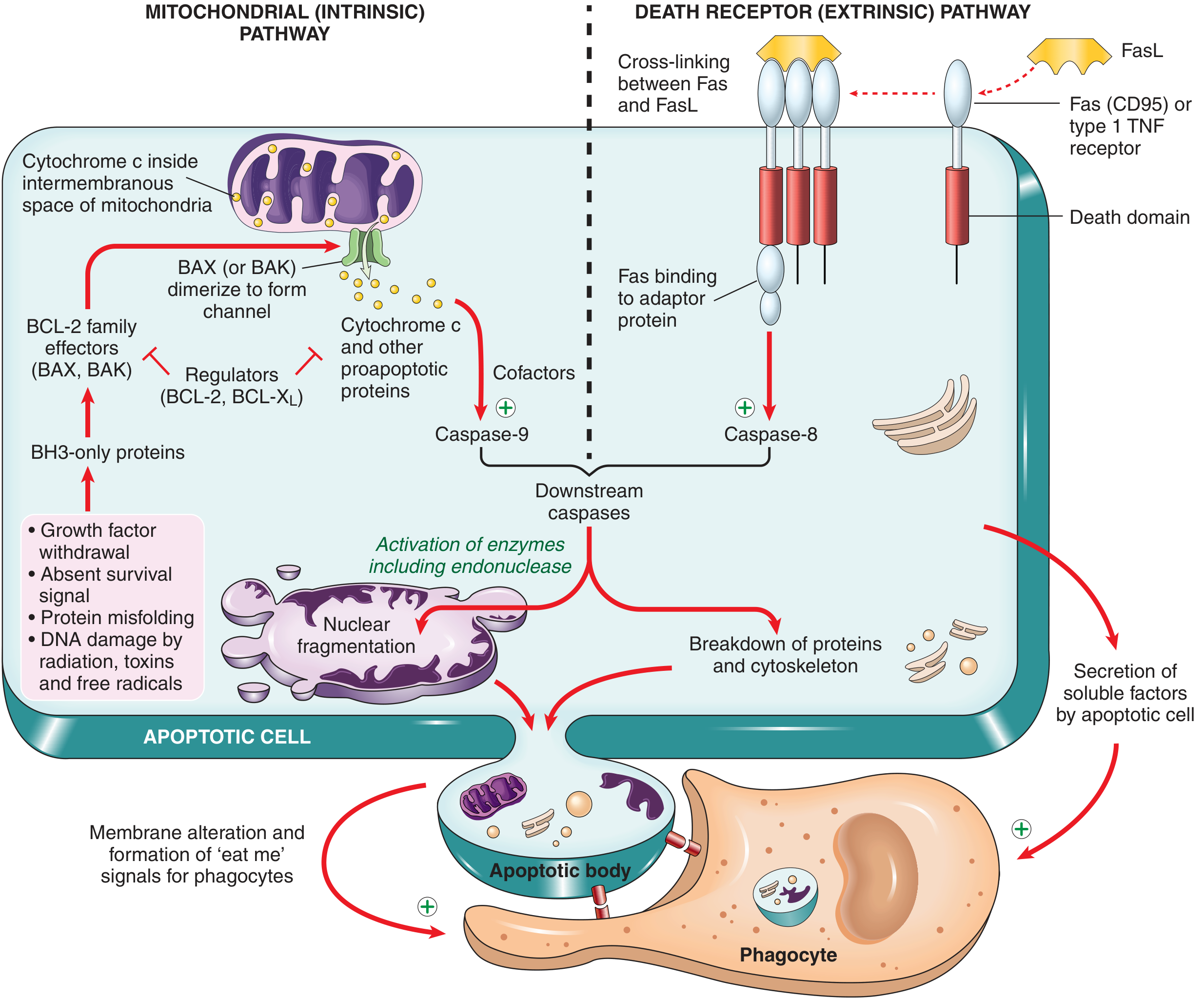
🔵 PATHWAY 1: The Intrinsic (Mitochondrial) Pathway
Triggered from INSIDE the cell
Trigger signals:
- Loss of growth factors / survival signals
- DNA damage (radiation, chemotherapy)
- Misfolded proteins (ER stress)
- Oxidative stress
Step-by-step:
STRESS/DAMAGE
     ↓
BH3-only proteins activated (sensors: BAD, BIM, BID...)
     ↓
They activate BAX + BAK (pro-death proteins)
     ↓
BAX/BAK punch holes in the MITOCHONDRIAL MEMBRANE
     ↓
Cytochrome c leaks out into the cytoplasm
     ↓
Cytochrome c + APAF-1 form the "APOPTOSOME"
     (like a death machine assembly)
     ↓
Apoptosome activates CASPASE-9 (initiator)
     ↓
Caspase-9 activates CASPASE-3, -6, -7 (executioners)
     ↓
Cell is dismantled and dies neatly ✓
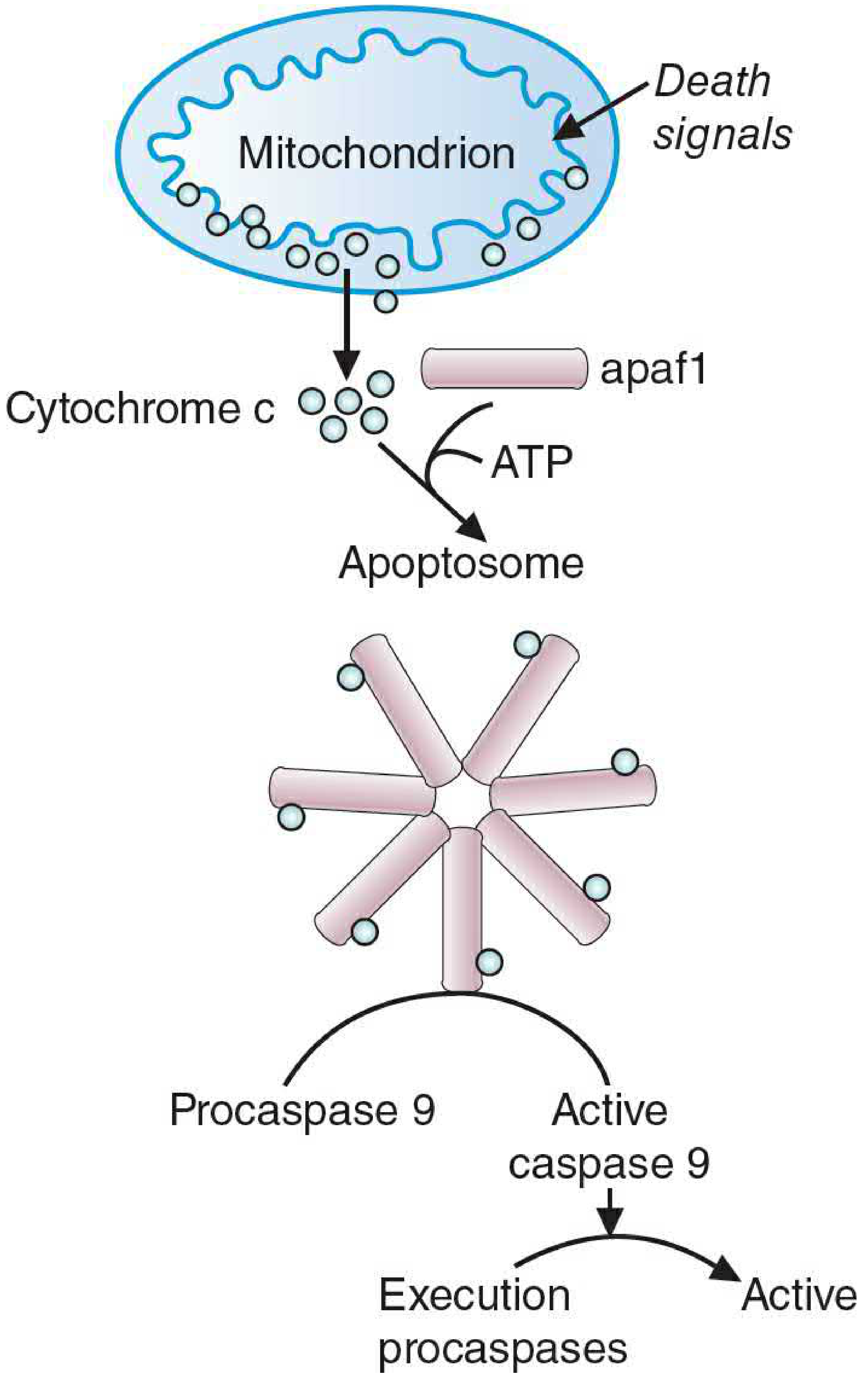
The BCL-2 family — the "vote" between life and death:
| Role | Proteins | What they do |
|---|---|---|
| Anti-apoptotic (Guardians) | BCL-2, BCL-XL, BCL-W | Block mitochondrial leakage → keep cell ALIVE |
| Pro-apoptotic Effectors | BAX, BAK, BOK | Punch holes in mitochondria → release cytochrome c |
| Pro-apoptotic Initiators (BH3-only) | BAD, BIM, BID | Sense damage → activate BAX/BAK |
Simple analogy: BCL-2 = bodyguard protecting the mitochondria. BAX/BAK = hitmen. BH3-only proteins = the person who hires the hitmen when damage is detected. When hitmen overpower the bodyguard → cell dies.
🔴 PATHWAY 2: The Extrinsic (Death Receptor) Pathway
Triggered from OUTSIDE the cell
Trigger: Another cell (e.g., a killer T cell) sends a death signal.
Key receptors: Fas (CD95), TNF-receptor 1 (TNFR1), TRAIL receptors
Key ligands: FasL (Fas ligand), TNF, TRAIL — produced by immune cells (NK cells, cytotoxic T cells, macrophages)
Step-by-step:
Killer T cell / macrophage presents DEATH LIGAND (e.g., FasL)
     ↓
Ligand binds to DEATH RECEPTOR on target cell (e.g., Fas)
     ↓
Receptors cluster → form "DISC"
(Death-Inducing Signaling Complex)
     ↓
DISC recruits + activates CASPASE-8 (initiator)
     ↓
Caspase-8 activates CASPASE-3, -6, -7 (executioners)
     ↓
Cell is dismantled and dies neatly ✓

          ↕ (Cross-talk)
Caspase-8 also cleaves BID → tBID
     ↓
tBID activates BAX/BAK in mitochondria
→ Amplifies the intrinsic pathway too
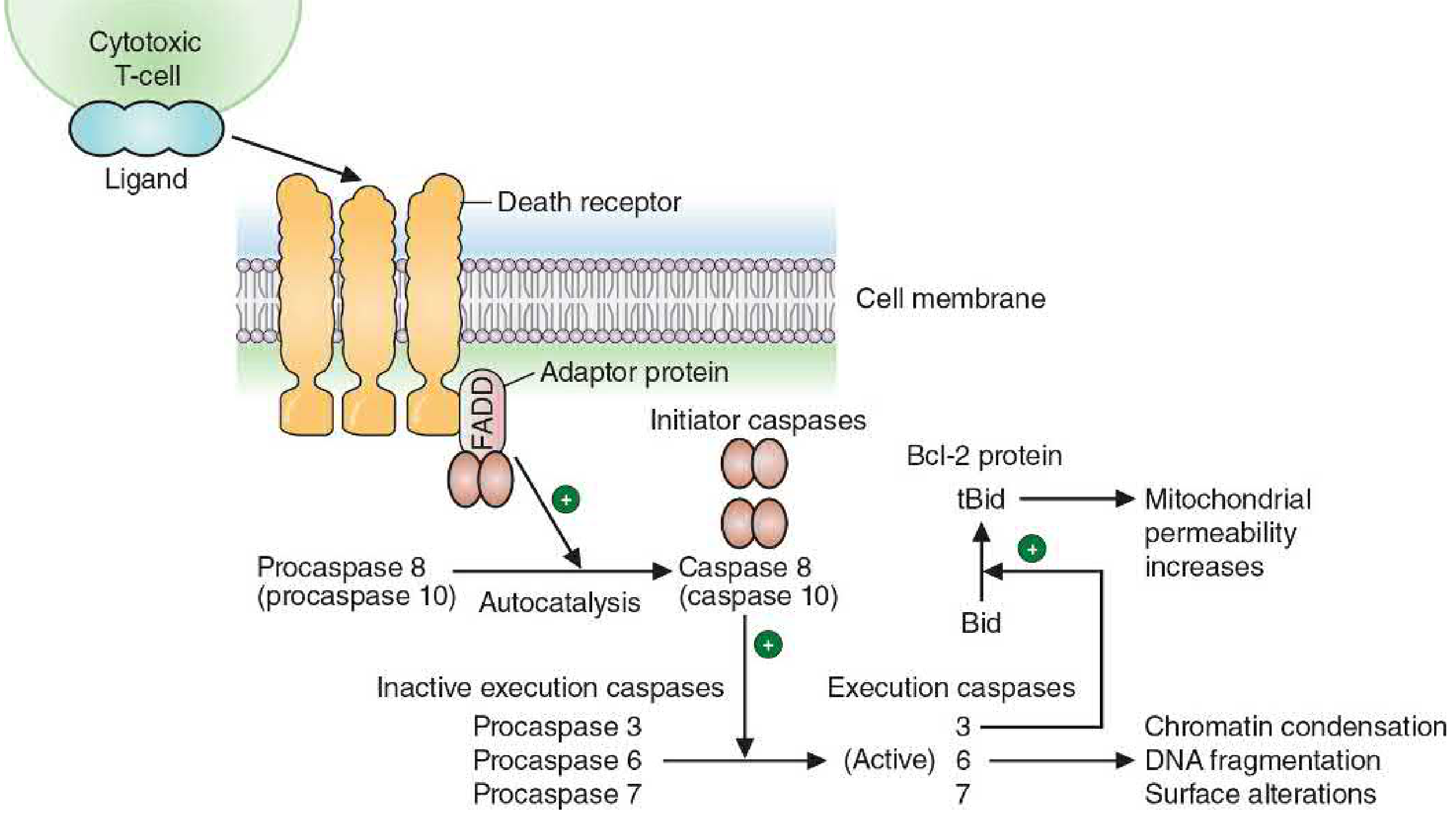
What Do Execution Caspases Actually Do?
Once caspase-3, -6, -7 are active, they destroy the cell methodically:
| Target | Result |
|---|---|
| CAD inhibitor | Releases CAD (DNase) → DNA is chopped into neat fragments |
| Nuclear lamins | Nuclear envelope collapses |
| Cytoskeletal proteins (actin) | Cell shrinks, blebs form on the membrane |
| Cell adhesion proteins | Cell detaches from neighbors |
| DNA repair enzymes | No repair allowed |
The result: the cell packages itself into apoptotic bodies → phagocytes eat them → clean removal, no inflammation.
Full Summary Diagram
       INTRINSIC                    EXTRINSIC
(stress, DNA damage, etc.)     (FasL, TNF, TRAIL)
         ↓                              ↓
    BH3-only proteins         Death receptor activation
         ↓                              ↓
   BAX/BAK activated              DISC formed
         ↓                              ↓
 Mitochondria leaks              Caspase-8 activated
   cytochrome c                        ↓
         ↓                    ←── BID cleaved (crosslink)
   APOPTOSOME forms
         ↓
    Caspase-9 activated
         ↓
    ════════════════════
    CASPASE-3, -6, -7
    (Execution Caspases)
    ════════════════════
         ↓
  DNA fragmentation
  Membrane blebbing
  Apoptotic bodies
         ↓
  Macrophage phagocytosis
         ↓
    CLEAN CELL DEATH ✓
    (No inflammation)
Memory Tricks
| Concept | Memory Aid |
|---|---|
| BCL-2 | "Blocks Cell Lysis" → survival protein |
| BAX | "BAXter kills" → pro-death |
| Cytochrome c | "Cytochrome c = Call to die" |
| Apoptosome | "Death machine = Apaf + Cyto c + Caspase 9" |
| Caspase-8 | "Extrinsic = caspase-8" |
| Caspase-9 | "Intrinsic = caspase-9" |
| Caspase-3 | "Always the final killer" |
Sources: Robbins & Kumar Basic Pathology, Chapter 1 | Basic Medical Biochemistry — A Clinical Approach, 6e, Chapter 17
What is order of apoptotic bodies formation ,blebbing , cell shrinkage
Finding Sources
Reading File
Reading File
The textbooks are very clear on this. Here's the precise answer:
Order of Morphological Changes in Apoptosis
The correct sequence, as described in Robbins, Cotran & Kumar Pathologic Basis of Disease and Junqueira's Basic Histology:
1️⃣  CELL SHRINKAGE
        ↓
2️⃣  CHROMATIN CONDENSATION
        ↓
3️⃣  MEMBRANE BLEBBING
        ↓
4️⃣  APOPTOTIC BODY FORMATION
        ↓
5️⃣  PHAGOCYTOSIS
Step-by-Step Explanation
1. Cell Shrinkage (first)
Caspases destroy the cytoskeleton. The cell loses water and volume — it shrinks and becomes dense (eosinophilic = stains bright pink). This is the opposite of necrosis, where the cell swells first.
2. Chromatin Condensation
This is the most characteristic feature of apoptosis. The chromatin (DNA + proteins) clumps and moves to the edges of the nucleus (peripheral margination). The nucleus may then break into 2–3 fragments.
3. Membrane Blebbing
The plasma membrane starts bubbling outward in blister-like projections called "blebs." This happens because:
- Membrane proteins are degraded
- Lipid (phospholipid) mobility increases as the cytoskeleton collapses
- The cell is still intact at this point — nothing leaks out
4. Apoptotic Body Formation
The blebs pinch off into separate, membrane-bound fragments called apoptotic bodies. Each body contains:
- Condensed cytoplasm
- Tightly packed (but still intact) organelles
- ± Nuclear fragments
The membrane stays sealed the whole time — no contents spill out.
5. Phagocytosis
Apoptotic bodies expose phosphatidylserine on their outer membrane surface (normally on the inner side) — this acts as an "eat me" signal. Nearby macrophages and epithelial cells rapidly engulf and destroy them.
→ No inflammation triggered. Clean removal.
Visual Summary
Healthy Cell
    ↓  Caspases activated
🔽 SHRINKAGE  (cytoskeleton destroyed, cell condenses)
    ↓
🔵 CHROMATIN CONDENSATION  (DNA clumps at nuclear edge)
    ↓
💧 BLEBBING  (membrane bubbles outward)
    ↓
🔴 APOPTOTIC BODIES  (blebs pinch off into sealed fragments)
    ↓
🍽️ PHAGOCYTOSIS  (macrophage eats the bodies quietly)
    ↓
✅ CLEAN DEATH — no inflammation
Why This Order Makes Sense
| Step | What's driving it |
|---|---|
| Shrinkage | Caspases cleave cytoskeletal proteins → cell collapses inward |
| Chromatin condensation | Caspase-activated DNase (CAD) chops DNA; nuclear lamins degraded |
| Blebbing | Loss of cytoskeletal anchors → membrane becomes floppy and bubbles |
| Apoptotic bodies | Blebs pinch off completely, each sealed by membrane |
| Phagocytosis | "Eat me" signal (phosphatidylserine) attracts macrophages |
So the answer in short:
Cell shrinkage → Chromatin condensation → Blebbing → Apoptotic bodies → Phagocytosis
Blebbing always comes before apoptotic body formation (bodies are formed when the blebs pinch off), and both happen after shrinkage. — Robbins, Cotran & Kumar Pathologic Basis of Disease
Now extrinsic from start
Finding Sources
Finding Sources
Reading File
Reading File
Reading File
Your credits are exhausted. Your daily credits reset tomorrow, or you can purchase a top-up for more.
This is a shared conversation. Sign in to Orris to start your own chat.