
Write a short note for regulation of thyroid hormone for MBBS internal exam of 5 marks.
Reading File
Finding Sources
Finding Sources
Reading File
Reading File
Reading File
Loading Image
Here is a well-structured short note on the regulation of thyroid hormone, suitable for a 5-mark MBBS internal exam:
Regulation of Thyroid Hormone
1. Hypothalamic-Pituitary-Thyroid (HPT) Axis
The primary regulatory mechanism is the HPT axis, which operates as a classic endocrine feedback loop.
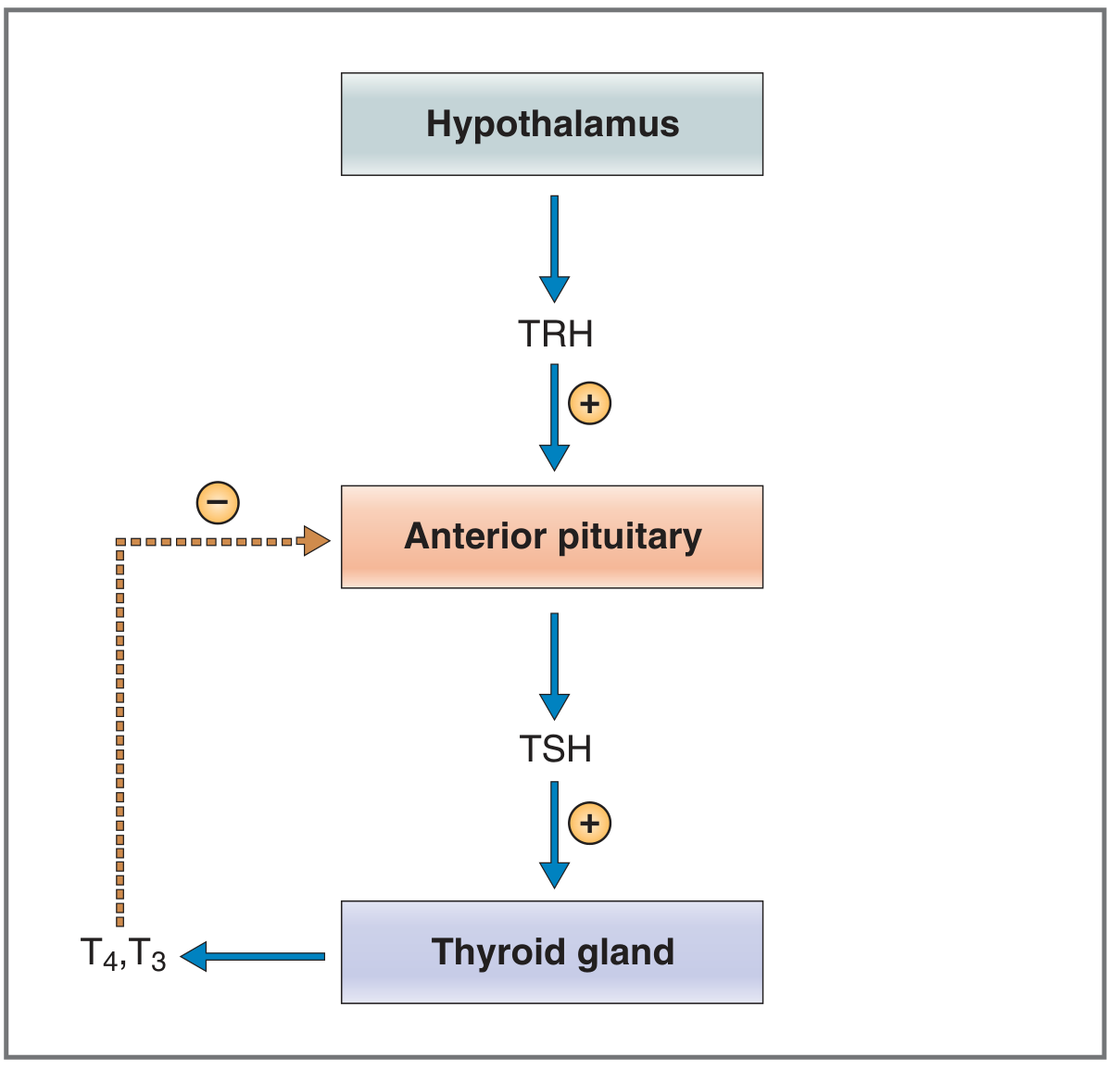
Step 1 - Hypothalamus: The paraventricular nuclei of the hypothalamus secrete Thyrotropin-Releasing Hormone (TRH), a tripeptide. TRH is released in response to low circulating thyroid hormone levels, cold exposure, and other neural inputs.
Step 2 - Anterior Pituitary: TRH acts on thyrotroph cells of the anterior pituitary, stimulating:
- Transcription of the TSH gene
- Secretion of Thyroid-Stimulating Hormone (TSH), a glycoprotein
Step 3 - Thyroid Gland: TSH binds to its membrane receptor on follicular cells (coupled to adenylyl cyclase via Gs protein), raising intracellular cAMP. TSH then stimulates every step of thyroid hormone synthesis:
- Iodide (I-) uptake via the Na+/I- cotransporter (NIS)
- Oxidation of I- to I2 by thyroid peroxidase
- Organification - iodination of tyrosine residues on thyroglobulin to form MIT and DIT
- Coupling of MIT + DIT to form T3 and T4
- Proteolysis of thyroglobulin and secretion of T3 and T4
2. Negative Feedback
The most important regulatory mechanism is negative feedback by free T3 and T4:
- Free T3 (the active form) inhibits TSH secretion at the anterior pituitary by down-regulating TRH receptors on thyrotrophs
- T3 also inhibits TRH secretion at the hypothalamus
- The anterior pituitary itself contains 5'-deiodinase, which converts T4 to T3 locally to mediate this feedback
- This results in a steady (non-pulsatile) rate of thyroid hormone secretion
3. Autoregulation by Iodide
The thyroid gland regulates its own iodide handling independent of TSH:
- Iodide deficiency stimulates uptake and synthesis
- Wolff-Chaikoff effect: Acutely high iodide concentrations paradoxically inhibit thyroid hormone synthesis by blocking organification (a protective mechanism)
- The gland "escapes" from this effect after ~1-2 weeks by down-regulating NIS
4. Other Stimulatory/Inhibitory Factors
| Stimulatory | Inhibitory |
|---|---|
| TSH | Excess iodide (Wolff-Chaikoff) |
| TRH | Propylthiouracil (PTU) - inhibits peroxidase |
| Thyroid-stimulating immunoglobulins (Graves disease) | Perchlorate/thiocyanate - inhibit NIS |
| Increased TBG (e.g., pregnancy) | Decreased TBG (e.g., liver disease) |
| Cold exposure | Glucocorticoids (inhibit TRH/TSH) |
5. Peripheral Regulation (Conversion of T4 to T3)
The main secretory product is T4 (~80 µg/day), which is the less active prohormone. T4 is converted peripherally to the active T3 by 5'-deiodinase in target tissues (liver, kidney, muscle). In starvation, 5'-deiodinase is inhibited in peripheral tissues (but NOT in the brain), reducing BMR - an adaptive mechanism during caloric deprivation.
Key Points to Remember:
- TRH (hypothalamus) → TSH (anterior pituitary) → T3/T4 (thyroid)
- Free T3 mediates negative feedback at the pituitary level
- TSH acts via cAMP as second messenger
- Wolff-Chaikoff = high iodide inhibits synthesis
- T4 is the prohormone; T3 is the active hormone
(Sources: Costanzo Physiology 7th Ed., p. 426-427; Ganong's Review of Medical Physiology 26th Ed.)
This is a shared conversation. Sign in to Orris to start your own chat.