
There’s a whitish spot on inner upper eyelid of a patient with sensation of sand in eye, redness, lacrimation and pain. What could be the reason?
Reading File
Now I'll search the medical library for this condition in parallel with a PubMed search.
Finding Sources
Finding Sources
Finding Sources
Good — found a hit in Kanski's. Let me read the full section on conjunctival concretions and also search for other relevant conditions causing this presentation.
Reading File
Finding Sources
Finding Sources
Excellent — the key passage is found. Let me fetch the image and also look for trachoma and other causes of whitish spots on inner upper eyelid.
Loading Image
Finding Sources
I have all the information needed to give a comprehensive, well-cited answer. The clinical picture is classic for conjunctival concretions.
Diagnosis: Conjunctival Concretions
The combination of a whitish/yellowish-white spot on the inner surface of the upper eyelid (palpebral/tarsal conjunctiva) with foreign body (sand) sensation, redness, lacrimation, and pain is the classic presentation of a conjunctival concretion — most likely one that has eroded through the overlying epithelium.
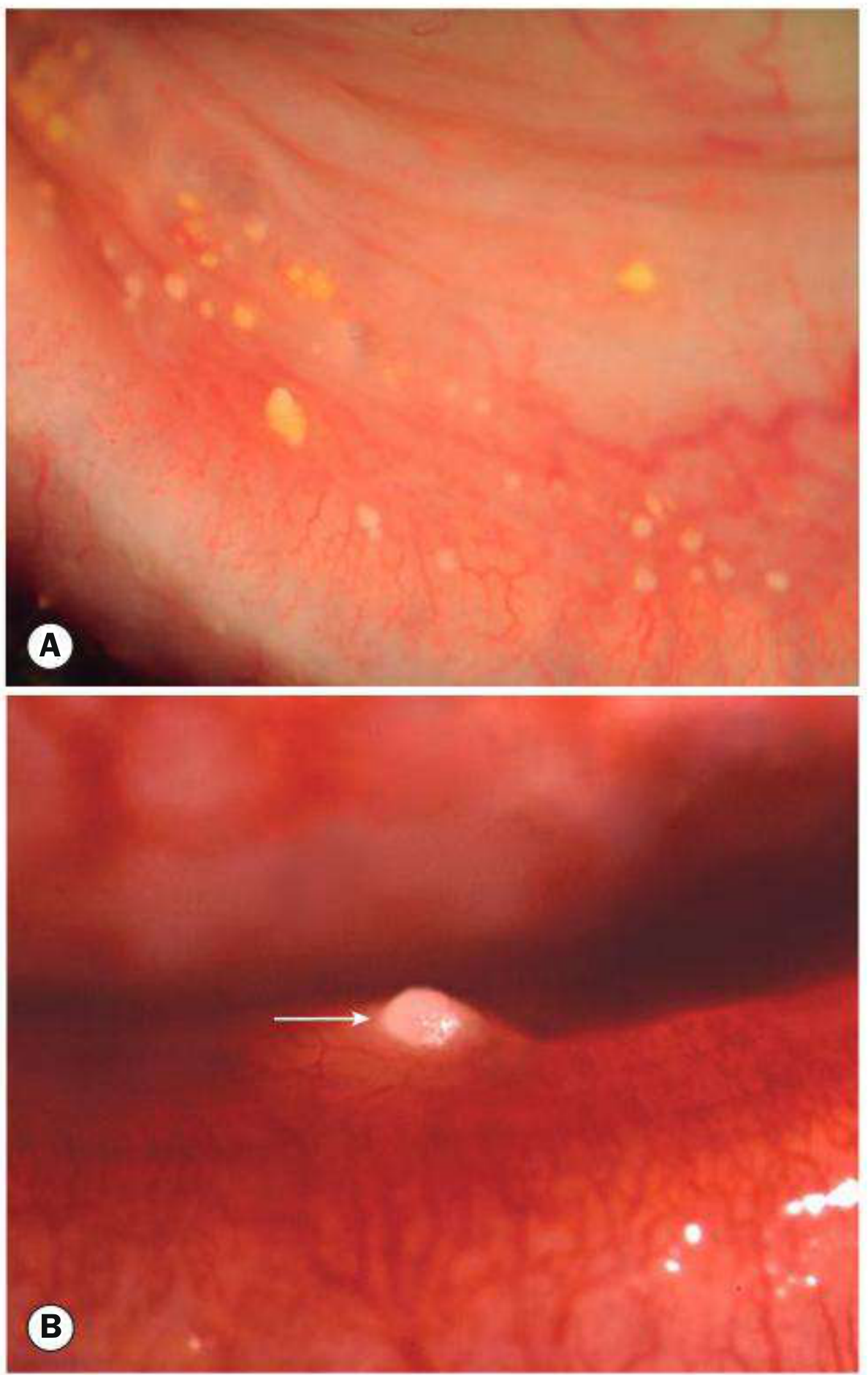
What are Conjunctival Concretions?
Concretions are tiny cysts that form subepithelially in the conjunctiva, containing yellowish-white deposits of epithelial debris including keratin. They are commonly found in the inferior tarsal and forniceal conjunctiva, but can occur in the upper tarsal conjunctiva as well.
| Feature | Detail |
|---|---|
| Appearance | Multiple tiny yellowish-white chalky deposits |
| Location | Subepithelial, tarsal/forniceal conjunctiva |
| Common causes | Aging (most common); chronic conjunctival inflammation (e.g., trachoma, dry eye, blepharitis) |
| Symptomatic when | Large enough to erode through the epithelial surface, creating a rough surface that abrades the cornea |
Why the Symptoms?
When a concretion erodes through the overlying conjunctival epithelium, its hard, calcified surface rubs directly against the cornea with each blink, producing:
- Foreign body / sand sensation — the roughened calcified deposit acts like a particle against the corneal surface
- Pain and lacrimation — reflex tearing from corneal irritation
- Redness — reactive conjunctival hyperemia
Small, subepithelial concretions are asymptomatic; symptoms arise specifically when they break through the surface.
Differential Diagnosis (whitish spot on tarsal conjunctiva)
| Condition | Distinguishing Features |
|---|---|
| Conjunctival concretion (most likely) | Hard, chalky-white; subepithelial or eroded through; causes FBS when exposed |
| Trachoma (follicles/scarring) | Follicles on upper tarsal conjunctiva; associated with Chlamydia trachomatis; scarring (Arlt's line), pannus, Herbert's pits |
| Molluscum contagiosum | Waxy, umbilicated lid nodule; follicular conjunctivitis |
| Milia | Tiny keratin cysts; usually asymptomatic |
| Calcified granuloma | History of prior inflammation/infection |
In the described scenario, the single whitish spot on the inner upper eyelid with mechanical irritation symptoms points most strongly to an exposed/eroded concretion.
Treatment
Simple, definitive, and well-tolerated:
- Slit-lamp removal with a fine needle under topical anaesthesia (e.g., proparacaine drops)
- Immediate symptom relief after removal
- No sutures or surgery required for typical concretions
- Treat any underlying chronic inflammation (blepharitis, dry eye) to reduce recurrence
"If symptomatic, treatment involves removal at the slit lamp with a needle under topical anaesthesia." — Kanski's Clinical Ophthalmology: A Systematic Approach, 10th ed., p. 216
This is a shared conversation. Sign in to Orris to start your own chat.