
Explain Negative and positive feedback mechanisms of hormones in detailed way so that it is understandable to me
Reading File
Finding Sources
Finding Sources
Reading File
Reading File
Reading File
Reading File
Reading File
Loading Image
Loading Image
I now have everything needed for a comprehensive, well-illustrated answer. Here it is:
Feedback Mechanisms of Hormones
The body uses feedback loops to maintain hormonal balance — a process called homeostasis. Think of it like a thermostat: it senses the room temperature and either turns the heater on or off. Hormonal feedback works the same way. There are two types: negative feedback (the far more common one) and positive feedback (rare, explosive events).
The Basic Framework: The Hypothalamic-Pituitary Axis
Most hormonal feedback operates through a 3-tier command chain:
- Hypothalamus → releases a releasing hormone (e.g., GnRH, TRH, CRH)
- Anterior Pituitary → responds by releasing a trophic hormone (e.g., LH, TSH, ACTH)
- Peripheral Endocrine Gland → responds by releasing the final hormone (e.g., testosterone, thyroxine, cortisol)
This final hormone then either suppresses or stimulates the higher levels — that's the feedback.
🔴 Negative Feedback — "The Braking System"
Core concept: When hormone levels are high enough, the hormone itself sends a signal back up the chain to shut off its own production. It prevents overshooting.
"Negative feedback means that some feature of hormone action, directly or indirectly, inhibits further secretion of the hormone." — Costanzo Physiology, 7th Ed.
How it works — step by step:
| Step | What Happens |
|---|---|
| 1 | Hypothalamus releases a releasing hormone (e.g., GnRH) |
| 2 | This stimulates the anterior pituitary to release a trophic hormone (e.g., LH) |
| 3 | Trophic hormone stimulates a gland (e.g., testis) to produce the final hormone (e.g., testosterone) |
| 4 | Testosterone rises to adequate levels |
| 5 | Testosterone feeds back to inhibit LH secretion (pituitary) and GnRH secretion (hypothalamus) |
| 6 | Testosterone production drops — levels normalize |
This is illustrated clearly below:
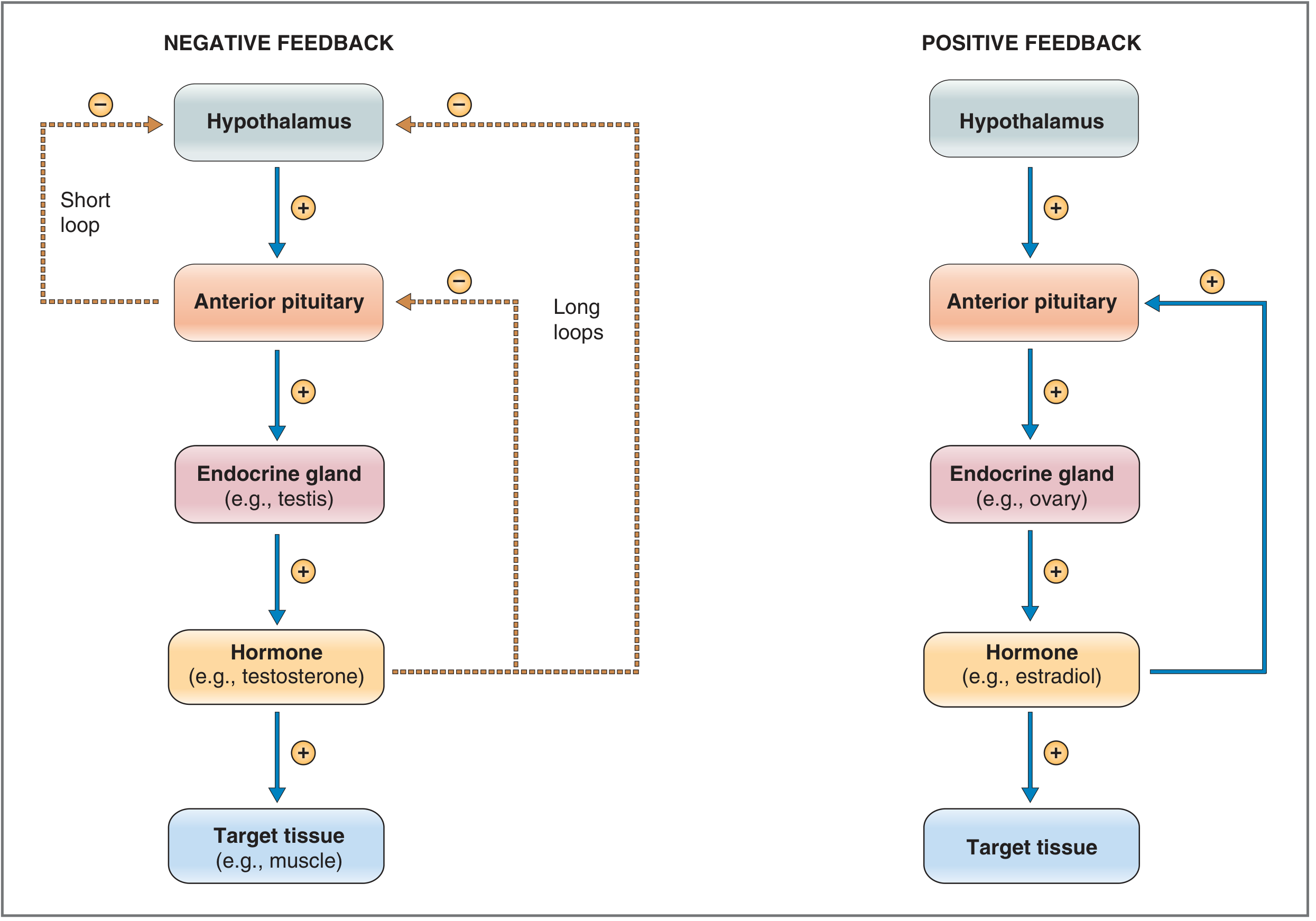
Three types of negative feedback loops:
| Loop Type | What feeds back | Where it acts |
|---|---|---|
| Long-loop | Final hormone (e.g., testosterone) | Feeds back to both hypothalamus AND pituitary |
| Short-loop | Trophic hormone (e.g., LH) | Feeds back to hypothalamus only |
| Ultrashort-loop | Releasing hormone (e.g., GHRH) | Inhibits its own secretion at the hypothalamus |
Classic example — Insulin and blood glucose:
This is the simplest negative feedback, with no hypothalamic-pituitary involvement:
- Blood glucose rises after a meal
- Pancreas detects this → secretes insulin
- Insulin acts on liver, muscle, and fat to bring glucose back down
- Once glucose is low enough, the stimulus disappears → insulin secretion stops
🟢 Positive Feedback — "The Amplifier"
Core concept: Instead of shutting things off, positive feedback amplifies the signal — the hormone causes more of itself to be produced. This is self-reinforcing and builds to an explosive peak, then terminates.
"When compared with negative feedback, which is self-limiting, positive feedback is self-augmenting. When positive feedback does occur, it leads to an explosive event." — Costanzo Physiology, 7th Ed.
Positive feedback is uncommon in biology precisely because it doesn't maintain a steady state — it is useful only when you need a rapid, all-or-nothing response.
Example 1 — The LH Surge Before Ovulation (the most important hormonal example):
This is the best-known hormonal positive feedback:
- During the follicular phase, the ovary produces estradiol
- Estradiol normally exerts negative feedback on the pituitary (keeping FSH/LH in check)
- As the follicle matures, estradiol levels rise sharply and cross a critical threshold (~200 pg/mL)
- Above this threshold, estradiol switches to positive feedback — it now stimulates more FSH and LH release (by up-regulating GnRH receptors on the pituitary)
- More LH → ovary secretes more estradiol → even more LH → explosive LH/FSH surge
- This surge triggers ovulation
- After ovulation, the system switches back to negative feedback (progesterone dominates the luteal phase)
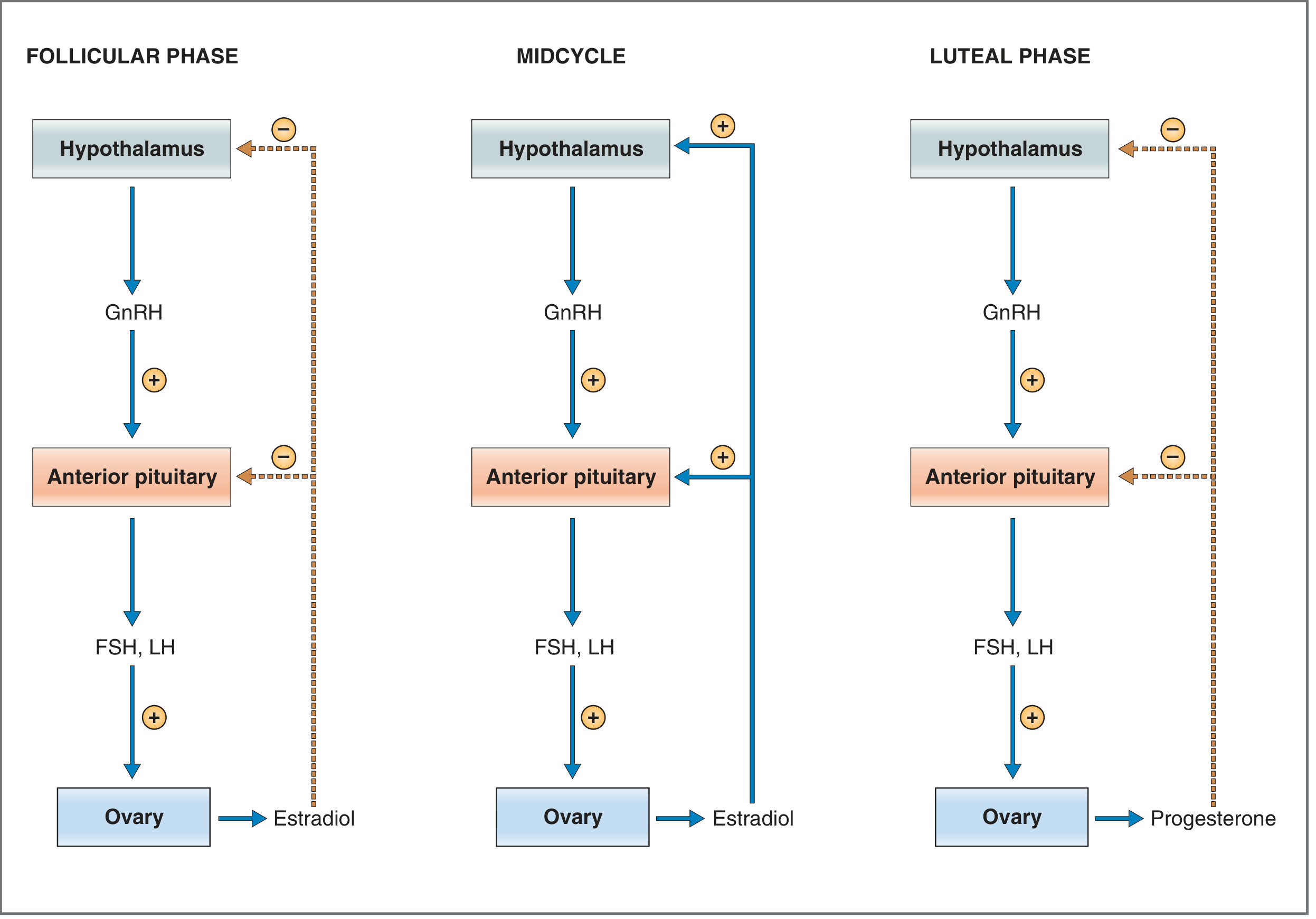
Example 2 — Oxytocin during childbirth:
- Baby's head pushes against the cervix → cervix stretches
- Stretch signals the posterior pituitary → releases oxytocin
- Oxytocin → uterine contractions → more cervical dilation
- More dilation → more oxytocin → stronger contractions → explosive event = delivery of the baby
- Once the baby is delivered, the stretch stimulus is gone → the loop stops
Side-by-Side Comparison
| Feature | Negative Feedback | Positive Feedback |
|---|---|---|
| Purpose | Maintain homeostasis / stability | Amplify a response to a critical point |
| Effect | Self-limiting | Self-augmenting |
| End result | Hormone returns to set-point | Explosive, all-or-nothing event |
| Frequency | Very common | Very rare |
| Examples | Testosterone, cortisol, thyroid hormones, insulin | LH surge (ovulation), oxytocin (labor) |
| Outcome if no "off switch" | System stabilizes | Could be dangerous — needs an external stop |
Why This Matters Clinically
- Primary hypothyroidism: Thyroid is destroyed → low T4 → no negative feedback on TSH → TSH skyrockets. Measuring TSH is how we detect thyroid disease.
- PCOS / anovulation: Disruption of the estradiol threshold → no positive feedback LH surge → no ovulation.
- Synthetic steroids (anabolic steroids): Exogenous testosterone creates strong negative feedback → pituitary stops making LH → testes atrophy (no stimulation).
In summary: Negative feedback is the body's everyday volume knob — always adjusting hormone levels back to a set-point. Positive feedback is the body's emergency launch button — used rarely, only when a rapid, self-reinforcing surge is the desired physiological outcome.
Sources: Costanzo Physiology 7th Ed. | Guyton & Hall Textbook of Medical Physiology | Smith & Tanagho's General Urology, 19th Ed.
This is a shared conversation. Sign in to Orris to start your own chat.