
What is the humidifier? Disscuss the different types of humidifiers for 10 marks with reference to cvts textbooks for PT cvts
I'll start by reading the medical library skill, then search for humidifier content in the CVTS textbooks.
Searching sources...
Reading File
Now let me search the library for CVTS books and humidifier content simultaneously.
Finding Sources
Finding Sources
Found humidifier content in Pye's Surgical Handicraft. Now let me search for more CVTS-specific content and read the humidifier section.
Finding Sources
Reading File
Excellent content found. Let me read further to get the condenser humidifier content completely, and also check the anesthesiology textbook for more detail.
Reading File
Reading File
Let me read a bit more from Morgan & Mikhail for the Active Humidifiers section, and also fetch the relevant diagrams.
Reading File
Loading Image
Loading Image
I now have comprehensive content from two authoritative textbooks. Let me compile the full answer.
Humidifier - Definition and Types
(10 Marks | CVTS Reference - Pye's Surgical Handicraft & Morgan and Mikhail's Clinical Anesthesiology)
Definition of Humidification and the Need for a Humidifier
Under normal physiological conditions, air reaching the main bronchi has been warmed to body temperature (37°C) and is fully saturated with water vapour. This critical process of humidification and warming is performed by the large moist surface area of the nasal mucosa, and to a lesser extent by the pharynx.
When an endotracheal tube or tracheostomy tube is in place (as is routinely the case in CVTS patients), this entire humidifying system is bypassed. Without adequate humidification:
- Dry gases cause the trachea and bronchi to secrete a copious fibrinous exudate
- This exudate dries to form thick crusts that become detached and can cause serious airway obstruction
- Mucosal dehydration and altered ciliary function occur
- Inspissation (thickening) of secretions, atelectasis, and ventilation/perfusion mismatching may follow
- Body heat is lost as the body attempts to warm and vaporise dry inspired gases
Therefore, it is mandatory to humidify all inspired gases delivered through artificial airways.
"Dry gases cause the trachea and bronchi to secrete a copious fibrinous exudate which dries, forming thick crusts which become detached and can cause serious obstruction. For this reason it is necessary to humidify the inspired gases."
- Pye's Surgical Handicraft, 22nd Edition
Absolute humidity is the weight of water vapour in 1 L of gas (mg/L). At 37°C with 100% relative humidity, this equals 44 mg/L. Inhaled anaesthetic gases are typically delivered at room temperature with little or no humidification (<10 mg H₂O/L), making supplemental humidification essential.
Types of Humidifiers
Humidifiers are broadly classified into two categories: Passive and Active.
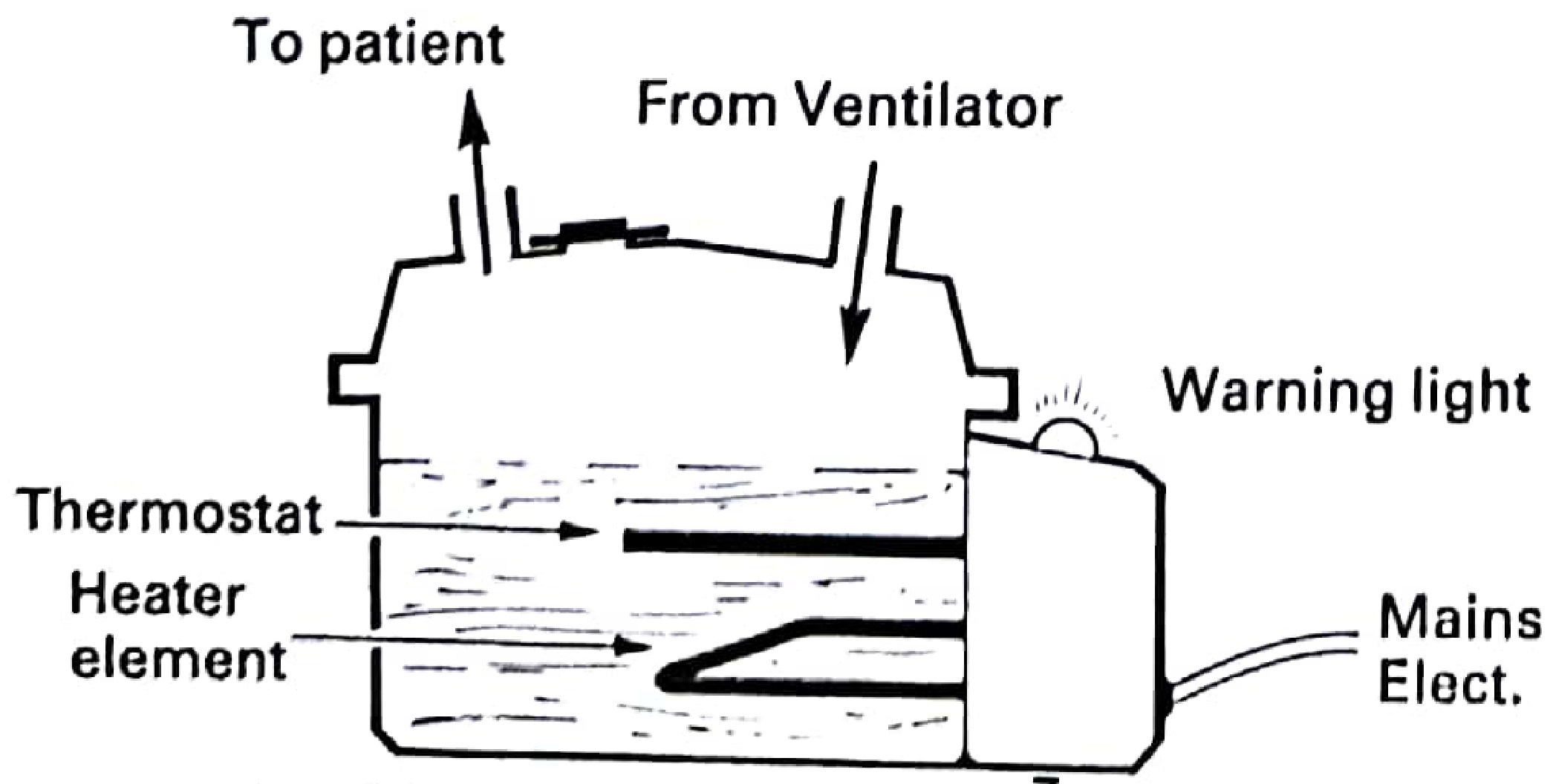
1. Hot Water Humidifier (Active)
This is the most satisfactory type of humidifier for routine use with ventilators, and is the workhorse device in CVTS/ICU settings.
Construction and Mechanism:
- Consists of a tank of water maintained at a fixed temperature by an electric heating element and a thermostat
- Gas from the ventilator en route to the patient passes across the surface of the heated water
- As the gas flows over the water surface, it becomes fully saturated with water vapour
Key technical points:
- Water should be maintained at 60°C - this temperature prevents the growth of microorganisms (Pseudomonas and other nosocomial pathogens are killed)
- A sufficient length of flexible, wide-bore tubing must exist between the humidifier and the patient so the humidified gas cools to slightly below body temperature before entering the lungs
- A thermometer should be placed at the patient end of the airway to monitor temperature
- Water condenses out in the tubing (due to temperature drop) - a condensate drain must be provided
- The humidifier must always be positioned lower than the patient to prevent water from accidentally flooding the airway
2. Condenser Humidifier / Heat and Moisture Exchanger (HME) - Passive
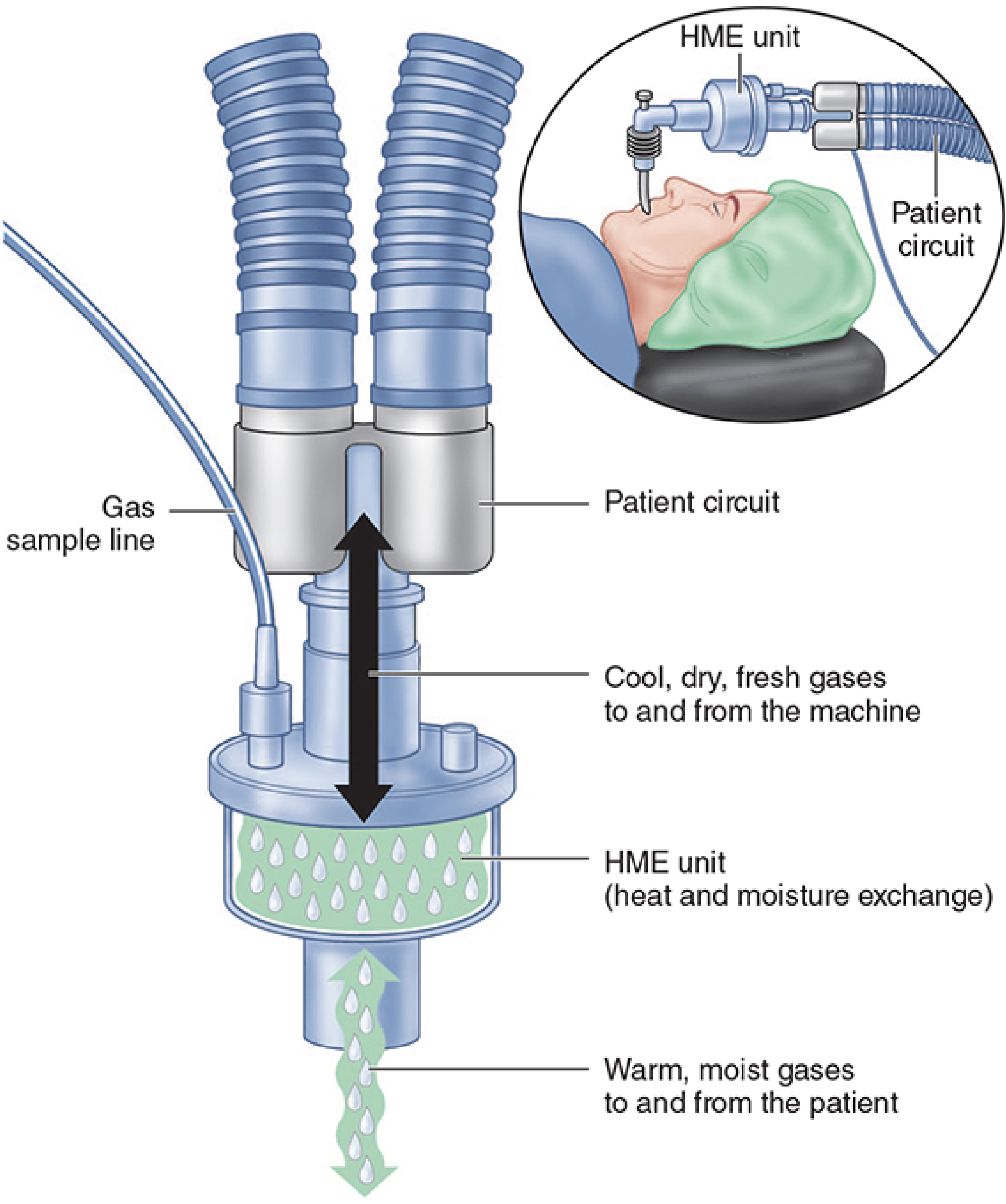
The condenser humidifier (also known as the Heat and Moisture Exchanger or HME, colloquially the "artificial nose") is a passive device primarily intended for partial humidification when attached directly to a tracheostomy or endotracheal tube.
Construction:
- Consists of a disc of brass gauze or concentrically rolled metal foil sheets with low resistance to gas passage
- Some modern versions contain hygroscopic material rather than bare metal
Mechanism:
- During expiration: the patient's warm, fully humidified expired air (37°C) passes through the device, the metal cools, and water condenses out onto the metal surface
- During inspiration: cool, dry room-temperature air passes back through the device, is warmed by contact with the metal, and picks up some water vapour from the condensed water on the surfaces
Efficiency: Only about 50% efficient - delivers approximately 22 mg H₂O/L compared to the body's normal 44 mg/L
Precautions:
- Must be mounted as close to the patient as possible
- Care must be taken that the device is not blocked by coughed-up secretions
- Can increase apparatus dead space by more than 60 mL (significant rebreathing risk in paediatric patients)
- Can increase breathing-circuit resistance and work of breathing
- Excessive saturation with water or secretions can cause circuit obstruction
Advantage: Some condenser humidifiers also act as effective filters against bacterial and viral cross-contamination - particularly important for patients with respiratory infections or immune compromise.
3. Nebulizer (Aerosol Humidifier)
A nebulizer is a specialised form of humidifier that delivers moisture in the form of fine droplets (aerosol/mist) directly into the airway.
Types of nebulizers:
- Jet (pneumatic) nebulizer - uses a high-velocity jet of gas
- Ultrasonic nebulizer - the most efficient type, in which water is broken up by dripping onto a plate vibrating at ultrasonic frequency
Key points:
- Delivers a range of droplet sizes - if droplets are too large, they precipitate out before reaching the lower airways
- Ultrasonic nebulizers are so efficient that they may deliver excessive water
- This excess water is absorbed into the circulation, and in small children may produce dangerous fluid overloading
- Water from nebulizers may also affect lung compliance, so careful monitoring is required
"Ultrasonic nebulizers are so efficient that they may deliver too much water. This is absorbed into the circulation and at least in small children may produce fluid overloading."
- Pye's Surgical Handicraft, 22nd Edition
4. Active Humidifiers (Heated Pass-over / Wick / Bubble-Through / Vapour-Phase)
Beyond the basic hot water type, Morgan & Mikhail describe several subtypes of active humidifiers:
| Type | Mechanism |
|---|---|
| Passover humidifier | Gas passes over the surface of a water chamber |
| Wick humidifier | Gas passes through a water-saturated wick |
| Bubble-through humidifier | Gas is bubbled directly through water |
| Vapour-phase humidifier | Gas is mixed with vaporised water |
All active humidifiers are more effective than passive ones at preserving moisture and heat. Heated active humidifiers with thermostatically controlled elements are the most effective, as increasing temperature increases a gas's capacity to hold water vapour.
Hazards of heated active humidifiers:
- Thermal lung injury - inhaled gas temperature must be monitored and must NOT exceed 41°C
- Nosocomial infection - unlike passive HMEs, active humidifiers do NOT filter respiratory gases
- Increased airway resistance from excess water condensation in breathing circuit
- Interference with flowmeter function
- Increased risk of circuit disconnection
Special value: Particularly valuable in children as they prevent both hypothermia and plugging of small tracheal tubes by dried secretions.
Summary Table
| Type | Mechanism | Efficiency | Best Used For | Key Hazard |
|---|---|---|---|---|
| Hot water humidifier | Heated water tank; gas saturated over water surface | High | Ventilated ICU/CVTS patients | Water in airway if placed too high; burn at >41°C |
| Condenser / HME | Passive condensation on metal/hygroscopic element | ~50% | Short cases; tracheostomy patients | Dead space; obstruction from secretions |
| Nebulizer (Ultrasonic) | Ultrasonic vibration; fine droplet mist | Very high | Drug delivery; severe dry secretions | Fluid overloading (esp. children) |
| Wick / Bubble-through | Active water saturation via wick or bubbling | High | Anaesthesia circuits | Nosocomial infection; circuit disconnection |
References
- 22nd Edition Pye's Surgical Handicraft - Chapter 31 (Tracheostomy, Humidification & Ventilators), pp. 455-457
- Morgan and Mikhail's Clinical Anesthesiology, 7th Edition - Chapter 4 (The Anesthesia Machine), pp. 128-130
This is a shared conversation. Sign in to Orris to start your own chat.