
Importance of smart health devices
importance of smart health devices wearables 2025 2026
wearable health devices remote patient monitoring outcomes
smart health wearable devices monitoring diagram
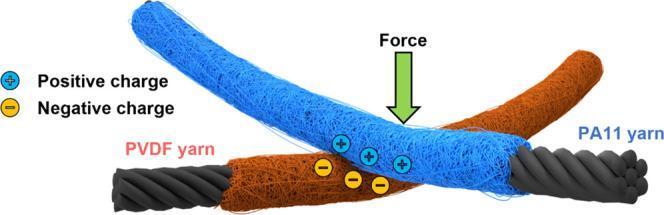
This pathophysiology diagram illustrates the operating principle of a wearable triboelectric nanogenerator (TENG) designed for smart medical textiles and health monitoring. The diagram shows two distinct core-shell fibers: a tribonegative PVDF yarn (blue) and a tribopositive PA11 yarn (brown), both featuring a conductive carbon nanotube (CNT) core (represented in black). The visual demonstrates the contact-electrification mechanism where an external mechanical force (indicated by a green vertical arrow) brings the two yarns into contact. This interaction results in a charge transfer at the interface, depicted by blue circles with '+' signs (positive charges) accumulating on the PVDF shell and yellow circles with '-' signs (negative charges) on the PA11 shell. This medical-grade material concept is used for energy harvesting from body movements and for creating self-powered biomechanical sensors, such as those used in gait analysis or haptic feedback for rehabilitation. The illustration highlights the conversion of mechanical kinetic energy into electrical potential through cyclic contact and separation.
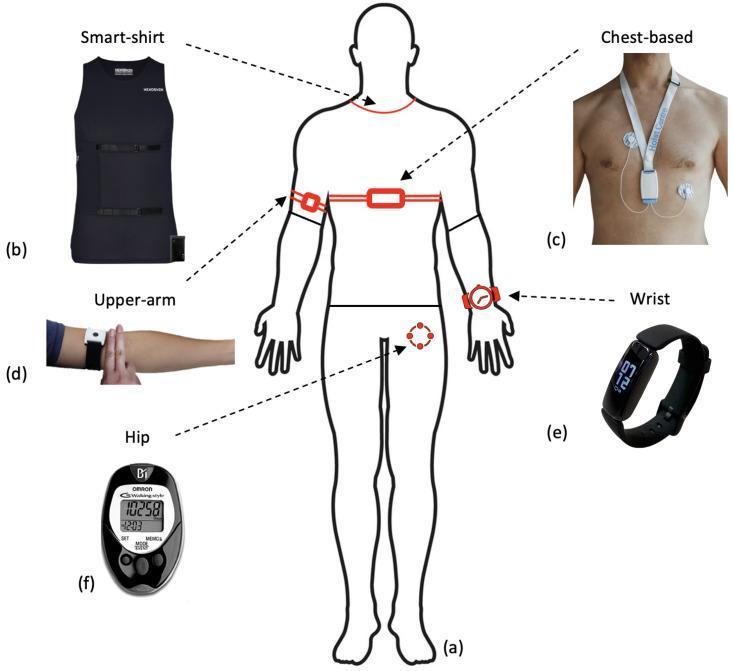
An educational infographic and clinical photograph collage illustrating the anatomical placement of various wearable sensor devices used for perioperative physiological monitoring and health research. (a) A central human silhouette acts as a anatomical map with dotted lines indicating six specific sensor locations. (b) A 'smart shirt' (Hexoskin) covers the torso to collect integrated ECG and respiratory data. (c) A chest-based single-lead ECG wearable is shown as a necklace-style device with adhesive electrodes on the precordium. (d) An upper-arm sensor is pictured utilizing reflective photoplethysmography (PPG) for hemodynamic monitoring. (e) A wrist-worn device (Fitbit) is displayed for tracking physical activity via accelerometry and heart rate via PPG. (f) A hip-worn tri-axis accelerometer (pedometer) is shown for measuring step count and ambulatory movement. The image demonstrates the diversity of medical wearables for longitudinal monitoring of vital signs, including heart rate variability, oxygen saturation, and mobility, used to stratify patient risk and predict postoperative outcomes.
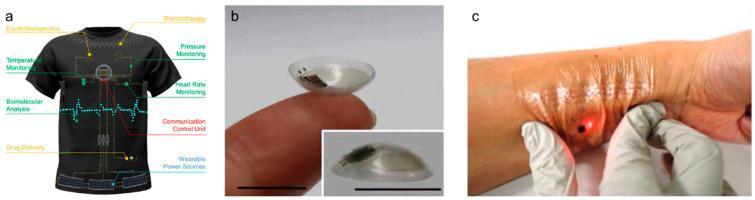
This composite infographic illustrates advanced wearable point-of-care medical technologies. Panel (a) presents a conceptual diagram of a smart textile system integrated into a black t-shirt. It features annotations for various diagnostic and therapeutic functionalities, including temperature monitoring, heart rate monitoring, pressure monitoring, biomolecular analysis, electrotherapeutics, and thermotherapy. A central communication control unit and wearable power sources at the hem facilitate data management and energy supply. Panel (b) consists of clinical photographs showing a smart contact lens resting on a fingertip, with an inset providing a close-up profile view; scale bars denote 1 cm. The lens contains micro-scale electronic components for ocular health monitoring. Panel (c) is a clinical photograph of a wireless electronic tattoo applied to human skin on the forearm. The tattoo is a thin, flexible, transparent film that conforms to the skin's surface, shown here under compressive deformation with visible wrinkling. A red light illuminates from an embedded micro-sensor, indicating active data transmission or monitoring. These panels collectively demonstrate the integration of flexible electronics for personalized healthcare and real-time physiological monitoring.
Smart Health Devices: Why They Matter
What Are Smart Health Devices?
- Smartwatches (Apple Watch, Samsung Galaxy Watch) - heart rate, ECG, SpO2, fall detection
- Fitness trackers (Fitbit, Garmin) - steps, sleep, calories, stress
- Smart rings (Oura Ring) - sleep, readiness, body temperature, respiratory rate
- Wearable biosensors - continuous glucose monitors, smart patches, ECG vests
- Smart clothing - embedded sensors for posture, respiration, muscle activity
- Remote patient monitoring (RPM) devices - blood pressure cuffs, pulse oximeters, smart scales linked to clinical systems
Market Scale (2026)
| Category | 2026 Market / Shipments |
|---|---|
| Wearable fitness tracker market | $70.3 billion |
| Broader wearable tech market | $175 billion (on track to $383.5B by 2032) |
| Global device shipments | 614 million units |
| Smart rings (fastest growing) | 32.5% annual growth |
| AI-enabled devices | ~40% of new launches in 2026 |
Key Areas of Importance
1. Continuous Health Monitoring
- Detection of irregular heart rhythms (e.g., atrial fibrillation) during daily life
- Continuous glucose level tracking for diabetics without finger-prick tests
- Sleep quality analysis identifying disorders like apnea
- Real-time blood pressure and SpO2 surveillance
2. Early Disease Detection
- ECG-capable smartwatches can flag arrhythmias that a standard annual checkup would miss
- Continuous temperature monitoring (Oura Ring) can detect early illness or infection onset
- Skin-temperature and heart rate variability trends help identify systemic inflammation or pre-illness states
3. Remote Patient Monitoring (RPM)
- Physicians to track high-risk patients (post-surgery, heart failure, COPD) from home
- Reduced hospital readmissions
- Faster clinical decision-making based on real data, not patient recall
4. Chronic Disease Management
- Diabetes: Continuous glucose monitors (CGMs) reduce hypoglycemic events and improve HbA1c control
- Heart disease: Wearable ECG patches detect rhythm changes between cardiology appointments
- Hypertension: Connected blood pressure monitors enable daily tracking vs. white-coat readings
- Chronic pain/musculoskeletal disorders: A 2025 systematic review (PMID: 40683855) showed sensor-based monitoring improves quality of life and rehabilitation outcomes in low back pain
5. Personalized Medicine
6. Empowering Patients
- Patients gain ownership of their health data
- Behavioral feedback (step goals, sleep scores, stress alerts) drives healthier habits
- Nudge features and trend visualizations increase health literacy and self-management
7. Reducing Healthcare Costs
- Fewer unnecessary ER visits and hospitalizations through proactive alerts
- Reduced burden on outpatient clinics via RPM
- Earlier interventions cost far less than late-stage disease treatment
8. AI Integration
- Predict adverse events (e.g., falls in elderly, sepsis onset in monitored patients)
- Recommend lifestyle adjustments
- Flag anomalies for clinical review
9. Surgical and Post-operative Care
10. Advancing Medical Research
Challenges and Limitations
| Challenge | Details |
|---|---|
| Data privacy & security | Continuous biometric data is sensitive; breaches can be harmful |
| Regulatory boundaries | Devices that diagnose clinical conditions fall under medical device regulation (e.g., FDA oversight) |
| Accuracy variability | Consumer-grade sensors may not meet clinical-grade accuracy standards |
| Health equity | High cost limits access in low-income populations |
| Data overload | Clinicians can be overwhelmed by passive monitoring data streams |
| User adherence | Long-term consistent wear remains a challenge |