
Swelling of right ankle after he slipped from stairs, conservative immediate treatment
Reading File
Searching for conservative management of acute ankle injury and swelling after trauma.
search_medical_text
ankle sprain swelling conservative immediate treatment RICE protocol
Bailey and Love's Short Practice of Surgery 28th Edition
Page 527
search_medical_text
ankle fracture vs sprain Ottawa rules assessment trauma
Bailey and Love's Short Practice of Surgery 28th Edition
Page 526

GradeResponse
GradeResponse
GradeResponse
Ankle Swelling After Fall — Conservative Immediate Management
Step 1: First, Rule Out a Fracture (Ottawa Ankle Rules)
Before initiating conservative treatment, apply the Ottawa Ankle Rules to decide whether X-ray is needed. (Bailey & Love's, p. 526)
An X-ray is required if any of the following are present:
| Criterion | Location |
|---|---|
| Bone tenderness over distal 6 cm of posterior edge or tip of lateral malleolus | Lateral |
| Bone tenderness over distal 6 cm of posterior edge or tip of medial malleolus | Medial |
| Inability to bear weight (4 steps) at time of injury or at time of examination | Functional |
If none of the above are present, a fracture is unlikely and conservative management can proceed.
Step 2: Immediate Conservative Treatment — PRICE Protocol
The standard immediate care for ankle swelling/sprain is:
| Step | Action | Details |
|---|---|---|
| P — Protection | Avoid further injury | Splint, crutches, or supportive brace if needed |
| R — Rest | Reduce weight-bearing | Limit activity; partial weight-bearing as tolerated |
| I — Ice | Cold therapy | Apply ice pack wrapped in cloth for 15–20 minutes every 2–3 hours for the first 48–72 hours. Never apply ice directly to skin. |
| C — Compression | Elastic bandage | Apply a compression bandage (e.g., crepe/elastic) from toes upward to reduce edema — not too tight |
| E — Elevation | Reduce swelling | Elevate the limb above heart level to promote venous and lymphatic drainage |
Step 3: Pain Control
- NSAIDs (e.g., ibuprofen 400 mg TID with food) — reduce pain and inflammation
- Paracetamol (500–1000 mg up to QID) — adjunct analgesia
- Avoid prolonged NSAID use if there is any risk of fracture healing concerns
Step 4: Ankle Ligament Anatomy (What May Be Injured)
The lateral ligament complex is most commonly injured in inversion injuries (slipping from stairs typically causes inversion + plantarflexion):
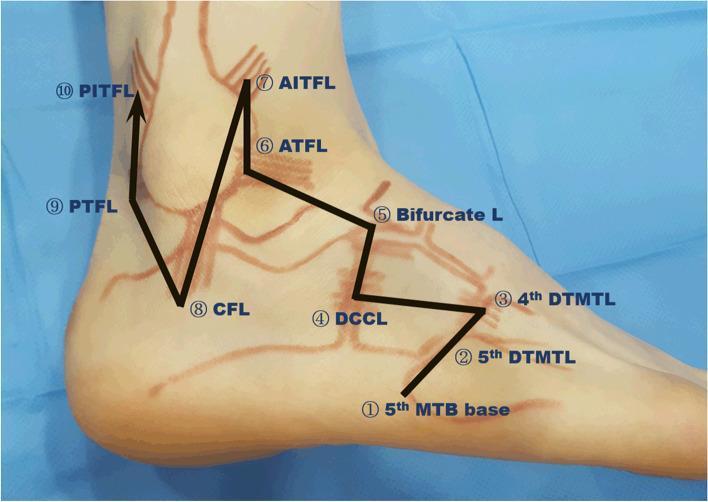
Key structures at risk:
- ATFL (anterior talofibular ligament) — most commonly torn
- CFL (calcaneofibular ligament) — torn in more severe sprains
- PTFL (posterior talofibular ligament) — rarely injured
Step 5: Grading & Subsequent Management (Bailey & Love's, p. 527)
| Grade | Injury | Treatment |
|---|---|---|
| I | Ligament stretch, no tear | PRICE, weight-bearing as tolerated |
| II | Partial tear | PRICE + splint/brace for 2–4 weeks, physiotherapy |
| III | Complete rupture | Immobilization, consider surgical review if instability persists |
Step 6: Follow-Up Rehabilitation
Once pain allows weight-bearing:
- Peroneal strengthening and stretching exercises
- Proprioceptive training (balance board)
- Supportive ankle brace to prevent inversion/eversion stress
- Return to activity guided by pain resolution (typically 2–6 weeks depending on grade)
Red Flags — Refer / Investigate Further If:
- Unable to bear weight
- Bony point tenderness (Ottawa positive)
- Gross deformity or neurovascular compromise
- Swelling not improving after 48–72 hours
- Suspected syndesmotic ("high ankle") injury
This is a shared conversation. Sign in to Orris to start your own chat.