
Bio-electricity (RMP- Action Potential) give me MPT Level 10 marks answer of this question
Reading File
Now let me search for RMP and Action Potential content in the library simultaneously:
Finding Sources
Finding Sources
Reading File
Finding Sources
Reading File
Finding Sources
Reading File
Excellent content found. Now let me fetch the key diagram images and read a bit more for refractory periods and propagation:
Loading Image
Reading File
I now have comprehensive material from Costanzo Physiology. Let me fetch the propagation image as well:
Loading Image
I now have all the content needed for a comprehensive 10-mark MPT answer. Let me compile the full answer.
Bio-electricity: Resting Membrane Potential (RMP) and Action Potential
Source: Costanzo Physiology 7th Ed. | Ganong's Review of Medical Physiology 26th Ed.
1. RESTING MEMBRANE POTENTIAL (RMP)
Definition
The resting membrane potential is the potential difference that exists across the membrane of excitable cells (nerve, skeletal muscle, cardiac muscle) between action potentials. By convention, it is expressed as the intracellular potential relative to the extracellular potential.
- Typical value: -70 to -80 mV (cell interior is negative relative to exterior)
Ionic Basis
| Ion | Intracellular | Extracellular | Equilibrium Potential |
|---|---|---|---|
| K⁺ | 140 mEq/L | 4 mEq/L | -85 mV |
| Na⁺ | 14 mEq/L | 140 mEq/L | +65 mV |
| Cl⁻ | 4 mEq/L | 114 mEq/L | -90 mV |
At rest:
- High permeability to K⁺ and Cl⁻ → K⁺ diffuses out down its concentration gradient → creates a negative interior (K⁺ diffusion potential)
- Low permeability to Na⁺ → minimal inward Na⁺ current
- Because K⁺ conductance dominates at rest, RMP (
-70 mV) is close to the K⁺ equilibrium potential (-85 mV) but far from the Na⁺ equilibrium potential (+65 mV)
Governing Equations
Nernst Equation (for a single ion X):
E_x = (61/z) × log([X]o / [X]i)
Goldman Equation (for multiple ions - considers relative permeability):
Em = (RT/F) × ln [(PK[K⁺]o + PNa[Na⁺]o + PCl[Cl⁻]i) / (PK[K⁺]i + PNa[Na⁺]i + PCl[Cl⁻]o)]
Chord Conductance Equation (weights each ion by its conductance):
Em = (GK/GT)EK + (GNa/GT)ENa + (GCl/GT)ECl + (GCa/GT)ECa
Role of Na⁺/K⁺ ATPase Pump
- Pumps 3 Na⁺ out for every 2 K⁺ pumped in (electrogenic)
- Maintains the concentration gradients that generate RMP
- Directly contributes a small negative charge (net outward current)
Factors Affecting RMP
| Factor | Effect on RMP |
|---|---|
| ↑ Extracellular K⁺ | Depolarization (less negative) |
| ↓ Extracellular K⁺ | Hyperpolarization (more negative) |
| Blocking Na⁺/K⁺ pump | Gradual depolarization |
| ↑ Na⁺ permeability | Depolarization toward ENa |
2. ACTION POTENTIAL (AP)
Definition
An action potential is a rapid, transient reversal of membrane potential in an excitable cell, initiated when the membrane is depolarized to threshold.
Threshold
- Approximately -60 mV in nerve/skeletal muscle
- Depolarizing the cell from RMP (-70 mV) to threshold triggers the AP
Phases of the Action Potential
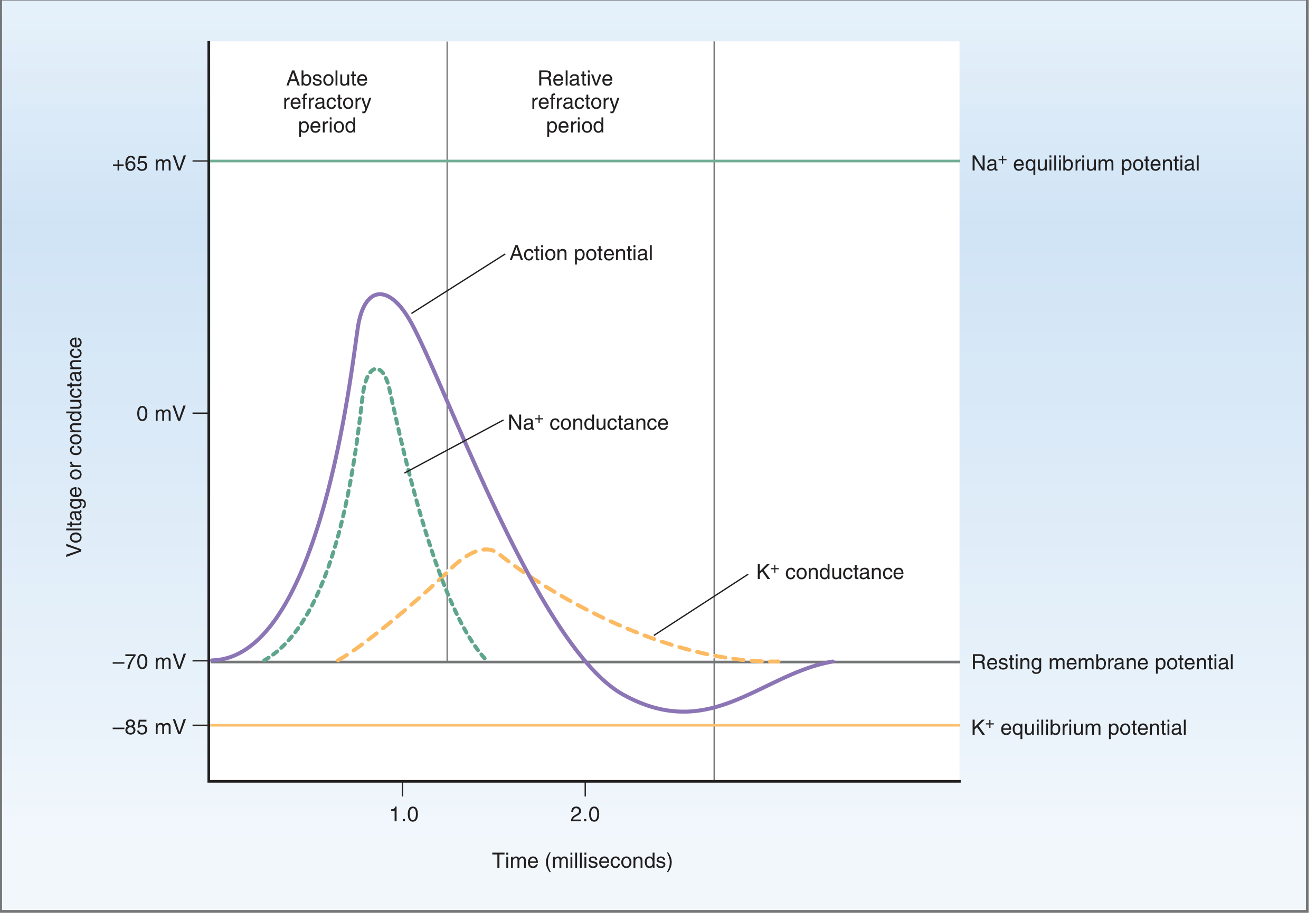
Fig. 1.13 - Costanzo Physiology: Voltage and conductance changes during the action potential of nerve
Phase 1 - Resting State
- Membrane at -70 mV
- Voltage-gated Na⁺ channels: closed (activation gate closed, inactivation gate open)
- K⁺ channels: mostly open (high K⁺ conductance)
Phase 2 - Upstroke (Depolarization)
- Stimulus depolarizes membrane to threshold (~-60 mV)
- Rapid opening of activation gates on voltage-gated Na⁺ channels
- Na⁺ conductance rapidly exceeds K⁺ conductance
- Na⁺ rushes in down its electrochemical gradient (inward current)
- Membrane potential shoots toward ENa (+65 mV) but does not quite reach it
- Peak AP ≈ +30 to +40 mV
- Blocked by: tetrodotoxin (TTX) from puffer fish, lidocaine (local anesthetic)
Phase 3 - Repolarization
Caused by two simultaneous events:
- Na⁺ channel inactivation - Inactivation gates (h-gates) close (slower than activation gate opening) → Na⁺ conductance falls to zero
- Delayed K⁺ channel opening - Voltage-gated K⁺ channels open → K⁺ flows outward → membrane repolarizes toward EK (-85 mV)
Phase 4 - After-Hyperpolarization (Undershoot)
- Membrane transiently goes below -70 mV (closer to -80 to -85 mV)
- Caused by persistently elevated K⁺ conductance after Na⁺ channels have closed
- As K⁺ channels gradually close, membrane returns to RMP
3. IONIC MECHANISM - VOLTAGE-GATED Na⁺ CHANNEL
The Na⁺ channel has two gates:
- Activation gate (m-gate): Closed at rest; opens rapidly upon depolarization
- Inactivation gate (h-gate): Open at rest; closes slowly upon depolarization
| State | Activation Gate | Inactivation Gate | Channel |
|---|---|---|---|
| Resting | Closed | Open | Not conducting |
| Depolarized (upstroke) | Open | Open | Conducting (Na⁺ enters) |
| Inactivated | Open | Closed | Not conducting |
| After repolarization | Closed | Opens again | Returns to resting state |
This gating mechanism explains why the AP is all-or-none and why Na⁺ channels must fully reset before another AP fires.
4. CHARACTERISTICS OF THE ACTION POTENTIAL
1. All-or-None Law
An AP either fires fully or not at all. Once threshold is reached, the AP is inevitable and always has the same shape/amplitude for that cell type. Subthreshold stimuli cause only local, graded potentials.
2. Stereotypical Shape
Every AP for a given cell type depolarizes to the same peak and repolarizes to the same resting level.
3. Propagation (Non-decremental)
APs propagate without loss of amplitude along the entire length of the axon.
5. REFRACTORY PERIODS
Absolute Refractory Period (ARP)
- Occurs during the upstroke and the early repolarization phase
- Na⁺ channels are inactivated (inactivation gates closed) - impossible to open regardless of stimulus strength
- No AP can be generated no matter how strong the stimulus
- Ensures unidirectional propagation and limits firing frequency
Relative Refractory Period (RRP)
- Occurs during late repolarization and the after-hyperpolarization
- Some Na⁺ channels have recovered; K⁺ conductance still elevated
- An AP can be generated but only with a stronger-than-normal stimulus
- Threshold is elevated during this period
6. PROPAGATION OF ACTION POTENTIALS
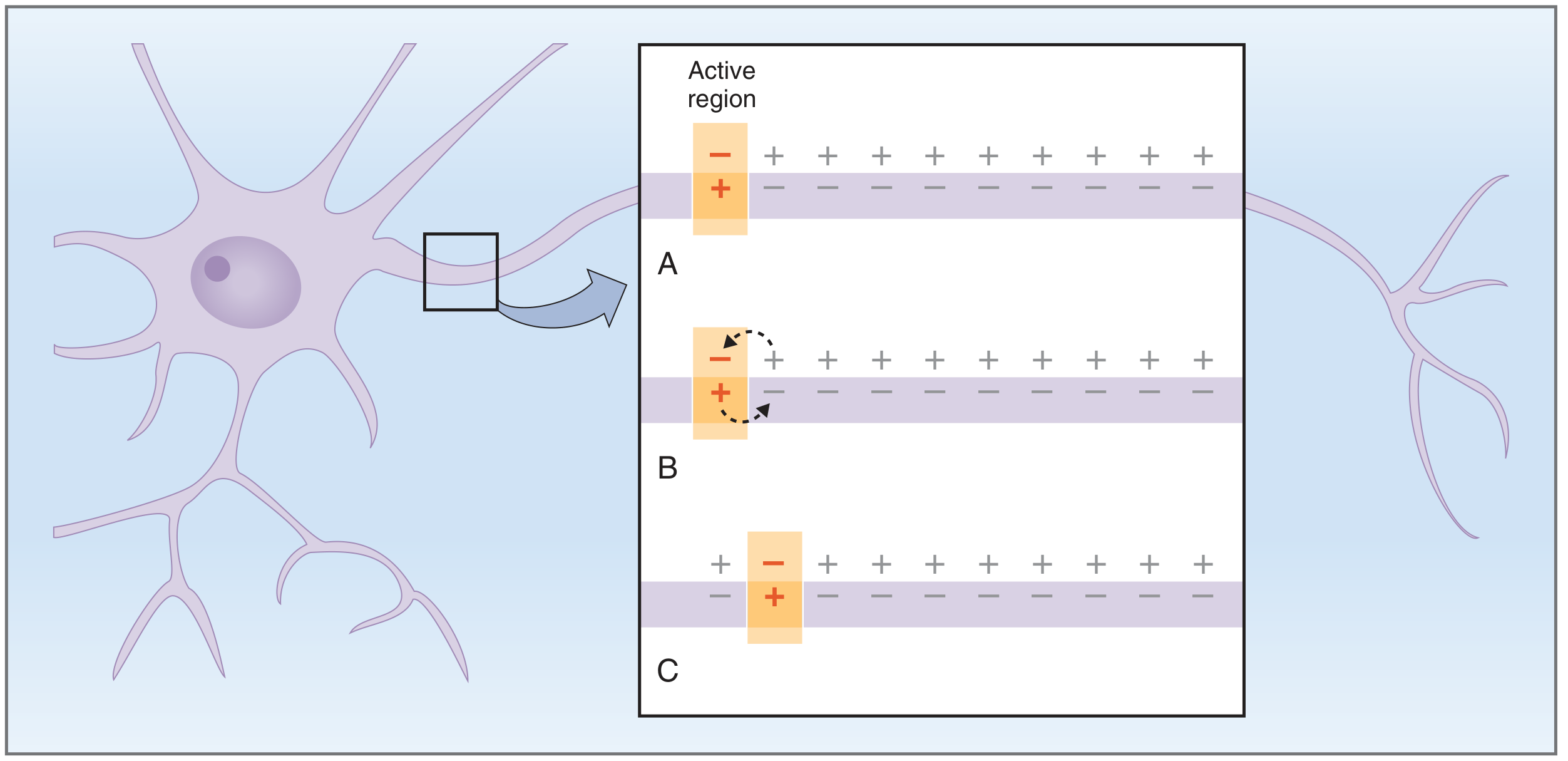
Fig. 1.15 - Costanzo Physiology: Spread of depolarization down a nerve fiber by local currents
Propagation occurs by spread of local currents:
- Active region (depolarized): interior becomes positive
- Adjacent inactive region: interior is negative
- Positive charges flow intracellularly from active → inactive region
- This depolarizes the adjacent region to threshold → fires its own AP
- The original active region repolarizes (is in ARP, so cannot re-fire)
- Result: AP moves in ONE direction only (forward propagation)
7. CONDUCTION VELOCITY
Factors increasing conduction velocity:
| Factor | Mechanism | Example |
|---|---|---|
| Myelination | Saltatory conduction (AP jumps between nodes of Ranvier) | Aα fibers: 70-120 m/s |
| Larger axon diameter | Less internal resistance to current flow | Motor neurons |
| Temperature ↑ | Faster ion channel kinetics | - |
Saltatory conduction: In myelinated nerves, the myelin sheath insulates the internodal regions. Current flows only at nodes of Ranvier (gaps in myelin every 1-2 mm), so the AP "jumps" from node to node - much faster than continuous conduction.
8. CLINICAL CORRELATES
| Condition | Mechanism | Effect |
|---|---|---|
| Hyperkalemia | ↑ [K⁺]o → less negative RMP → inactivation gates on Na⁺ channels close → no APs | Muscle weakness, cardiac arrhythmia |
| Hypokalemia | ↑ K⁺ gradient → hyperpolarization → harder to reach threshold | Muscle weakness |
| Local anesthetics (lidocaine, bupivacaine) | Block voltage-gated Na⁺ channels | Loss of pain sensation |
| Tetrodotoxin (TTX) | Blocks Na⁺ channels externally | Paralysis (puffer fish poisoning) |
| Multiple Sclerosis | Demyelination → loss of saltatory conduction | Slowed nerve conduction |
| Lambert-Eaton syndrome | Antibodies against voltage-gated Ca²⁺ channels | Reduced neurotransmitter release |
SUMMARY TABLE
| Parameter | Value |
|---|---|
| Resting Membrane Potential | -70 mV |
| Threshold | ~-60 mV |
| Peak of AP | ~+30 to +40 mV |
| Na⁺ Equilibrium Potential (ENa) | +65 mV |
| K⁺ Equilibrium Potential (EK) | -85 mV |
| Duration of AP (nerve) | ~1-2 ms |
| Absolute Refractory Period | ~1 ms |
| Relative Refractory Period | ~1-2 ms after ARP |
Key Memory Points for 10-mark answer:
- RMP = -70 mV, set by K⁺ dominance and Na⁺/K⁺ pump
- AP = all-or-none; upstroke by Na⁺ in, repolarization by K⁺ out + Na⁺ inactivation
- ARP = Na⁺ inactivation gates closed; RRP = partial recovery + elevated K⁺ conductance
- Propagation = local currents, unidirectional because of ARP
- Myelination → saltatory conduction → faster velocity
- Costanzo Physiology 7th Ed., Chapter 1 (Cell Physiology), pp. 26-32
- Ganong's Review of Medical Physiology 26th Ed., Chapter 4
Teach me in simple language
Bio-electricity in Simple Language 🧠⚡
Let me teach you this like telling a story.
The Story of a Nerve Cell
Think of a nerve cell like a house with a security system.
- The inside of the house = inside of the cell
- The outside = outside the cell
- The walls = cell membrane
- The doors and windows = ion channels
PART 1: Resting Membrane Potential (RMP)
"The House is Locked and Quiet"
When a nerve cell is just sitting there doing nothing (at rest), it has a charge difference across its membrane.
The inside is NEGATIVE (-70 mV) compared to outside.
Why is the inside negative? - The Simple Story
Imagine you have two types of people:
- 🟡 Potassium (K⁺) - lives mostly INSIDE the cell (140 units inside vs 4 outside)
- 🔵 Sodium (Na⁺) - lives mostly OUTSIDE the cell (140 units outside vs 14 inside)
What happens at rest?
The membrane has K⁺ doors (channels) that are open at rest.
K⁺ says: "There are too many of us inside! Let me go out!" - so K⁺ leaks out.
But wait - K⁺ carries a positive charge. When it leaves, the inside becomes more and more NEGATIVE.
K⁺ keeps going out until... the negativity inside pulls it back. It reaches a balance point at -70 mV. This balance is the Resting Membrane Potential.
Simple rule: K⁺ leaks out → inside becomes negative → that's your RMP of -70 mV
The Security Guard - Na⁺/K⁺ Pump
There's a pump in the membrane that works like a security guard:
- Throws 3 Na⁺ OUT for every 2 K⁺ it brings IN
- This keeps Na⁺ concentrated outside and K⁺ concentrated inside
- It uses ATP (energy) to do this
- Because it pumps more positive charges OUT than IN, it makes the inside slightly more negative (electrogenic)
PART 2: Action Potential (AP)
"The Alarm Goes Off!"
Now imagine someone throws a rock at the house (a stimulus arrives). If the rock is big enough, the alarm goes off - this is the Action Potential.
The "big enough" threshold = -60 mV
If the stimulus depolarizes (makes less negative) the membrane from -70 mV to -60 mV → BOOM - action potential fires!
If the stimulus is too weak and doesn't reach -60 mV → nothing happens (all-or-none law).
The 4 Steps of the Action Potential - Like a Drama in 4 Acts 🎭
ACT 1: AT REST (-70 mV)
- Na⁺ channels: LOCKED (closed, but ready)
- K⁺ channels: slightly open (leaking quietly)
- Inside: -70 mV (negative and calm)
ACT 2: THE UPSTROKE - "Flood of Sodium!" ⬆️
A stimulus arrives → membrane depolarizes to -60 mV (threshold)
The Na⁺ channel doors FLY OPEN!
Na⁺ says: "Finally! I've been waiting outside for so long! I'm rushing IN!"
Na⁺ floods into the cell because:
- There's more Na⁺ outside (concentration gradient pulls it in)
- Inside is negative (electrical gradient pulls it in)
The inside rapidly becomes POSITIVE - shoots up to +30 to +40 mV
This is the UPSTROKE - the spike of the action potential.
Na⁺ rushes IN = cell goes from -70 mV to +40 mV in less than 1 millisecond!
ACT 3: REPOLARIZATION - "Doors Slam Shut + K⁺ Rushes Out" ⬇️
Two things happen together:
Thing 1 - Na⁺ channels INACTIVATE:
The Na⁺ channel has two doors (gates):
- Front door (activation gate): opened when stimulus hit
- Back door (inactivation gate): was open at rest, now slowly CLOSES
Once the back door closes → Na⁺ can no longer enter → upstroke stops.
Thing 2 - K⁺ channels OPEN WIDE:
Depolarization slowly opens more K⁺ channels.
K⁺ says: "Inside is now positive?! That's unusual! I'm getting out!"
K⁺ rushes OUT → inside becomes negative again → repolarization
K⁺ rushes OUT + Na⁺ channels close = cell goes back negative
ACT 4: AFTER-HYPERPOLARIZATION - "Overshoot of negativity" ⬇️⬇️
The K⁺ channels are still open a little too long.
Too much K⁺ leaves → inside goes MORE negative than normal → briefly reaches -80 to -85 mV
Then K⁺ channels slowly close → membrane returns to -70 mV (resting state).
This dip below normal is called the after-hyperpolarization or undershoot.
The Complete Picture
+40 mV  |        /\
        |       /  \
        |      /    \
  0 mV  |     /      \
        |    /        \
        |   /          \
-60 mV  |--/ threshold  \
-70 mV  |/  RMP          \____/  ← after-hyperpolarization
-85 mV  |                       ← K⁺ equilibrium potential
        |________________________
              Time (milliseconds)
PART 3: Refractory Periods
"Don't Bother Me Right Now!"
After an AP fires, the cell cannot immediately fire again. This is called the Refractory Period.
Absolute Refractory Period (ARP) - "COMPLETELY UNAVAILABLE"
- Happens during the upstroke + early repolarization
- Na⁺ back doors (inactivation gates) are CLOSED
- NO stimulus, no matter how strong, can fire another AP
- Like a person who just sprinted 100m - they physically cannot sprint again for a moment
- Why important: ensures the AP travels in ONE direction only (can't go backwards into the ARP zone)
Relative Refractory Period (RRP) - "POSSIBLE BUT HARDER"
- Happens during late repolarization + after-hyperpolarization
- Some Na⁺ channels have recovered, but K⁺ conductance is still high
- A stronger-than-normal stimulus CAN fire an AP
- Like someone who is tired but could still run if you really pushed them
PART 4: Propagation - "How Does the Signal Travel?"
Think of a line of dominoes 🁣🁣🁣🁣🁣
When the first domino (active region) falls (fires AP), it pushes the next one (adjacent region) which pushes the next one, and so on.
The mechanism:
- Active region: inside becomes positive (+40 mV)
- Next region: still negative inside (-70 mV)
- Positive charges flow from active → next region (local current)
- Next region gets depolarized to threshold → fires its own AP
- Original region is now in ARP → cannot fire again → signal only goes FORWARD
PART 5: Myelination - "The Express Highway"
Unmyelinated nerve = a dirt road
AP fires at every single point along the axon - slow!
Myelinated nerve = a highway with toll booths (nodes of Ranvier)
- Myelin sheath covers most of the axon (acts as insulator)
- Gaps in myelin every 1-2 mm = Nodes of Ranvier (the toll booths)
- AP only fires at the nodes → "jumps" from node to node
- This is called Saltatory Conduction (saltare = to jump in Latin)
- Much, much faster! (70-120 m/s vs 0.5-2 m/s in unmyelinated)
Quick Summary Table
| What? | Simple Version | Value |
|---|---|---|
| RMP | Cell at rest, inside negative | -70 mV |
| Threshold | Minimum to trigger AP | -60 mV |
| Upstroke | Na⁺ floods IN | -70 → +40 mV |
| Repolarization | K⁺ floods OUT | +40 → -70 mV |
| After-hyperpolarization | K⁺ lingers | -70 → -85 mV |
| ARP | Cannot fire at all | During upstroke |
| RRP | Can fire with strong stimulus | During repolarization |
| Saltatory conduction | AP jumps between nodes | Fast! |
The ONE sentence to remember everything:
"At rest, K⁺ leaks out making inside -70 mV. A stimulus opens Na⁺ channels (rush in, +40 mV = upstroke), then Na⁺ channels inactivate and K⁺ rushes out (repolarization), the signal travels forward because the used region is refractory and can't re-fire."
That's the whole story! 🎉
This is a shared conversation. Sign in to Orris to start your own chat.