
22 year old burn patient with cheek and and neck contracture posted for contracture release, anaesthetic management. Case presentation and viva questions
Reading File
Now let me search the medical library for relevant content on burn contracture anaesthesia and airway management in parallel.
Finding Sources
Finding Sources
Finding Sources
Finding Sources
Finding Sources
Finding Sources
Finding Sources
Finding Sources
Searching PubMed
burn contracture release anaesthesia airway management
Good. Now let me read the key textbook sections on difficult airway (Morgan & Mikhail) and burn anaesthesia in parallel.
Reading File
Reading File
Reading Article
PMID: 35137105
Now let me read the burn-specific anaesthesia section from Morgan & Mikhail and Miller's, plus fetch the difficult airway algorithm image:
Reading File
Reading File
Excellent - I now have rich textbook content. Let me fetch the difficult airway algorithm image and compile the full answer.
Loading Image
I now have all the content needed to write a thorough, exam-ready response. Let me compile it.
Anaesthetic Management: 22-Year-Old Burn Patient for Cheek and Neck Contracture Release
CASE PRESENTATION
Patient: 22-year-old male/female, ASA II-III
Presenting problem: Post-burn contracture of the cheek and neck, scheduled for contracture release and skin grafting
Burn history: Old flame/scald burns (typically >6 months prior); healed with dense fibrous scar tissue causing restricted neck extension, limited mouth opening, and distorted facial anatomy
PRE-ANAESTHETIC ASSESSMENT
1. History
- Nature, extent, and timing of original burn (% TBSA, depth, site)
- Previous anaesthetic experiences (difficult intubation records are critical)
- Current medications (analgesics, antidepressants - burn survivors often on multimodal pain regimens)
- Nutritional status - chronic burn patients are often catabolic and hypoalbuminaemic
- Psychological status - anxiety is extremely common
2. Airway Assessment - THE KEY CONCERN
This is fundamentally a predicted difficult airway case. A systematic LEMON/MOANS/RODS assessment should be performed:
| Feature | Finding in this patient |
|---|---|
| Mouth opening (inter-incisor gap) | Reduced by cheek contracture - may be <2 cm (trismus-like) |
| Neck mobility | Severely restricted - neck in flexion/fixed due to anterior neck contracture |
| Thyromental distance | May be reduced if chin-to-chest contracture present |
| Mallampati score | Likely III or IV |
| Dentition | Assess for loose or damaged teeth |
| Mask ventilation | May be difficult due to facial scarring, abnormal contours |
The 4 difficult airway predictors in this patient:
- Difficult mask ventilation - scarred face, abnormal anatomy
- Difficult laryngoscopy - restricted neck extension, limited mouth opening
- Difficult SGA insertion - distorted pharyngeal anatomy
- Difficult surgical airway - scarred, fibrotic neck tissue
3. General Examination
- Assess for scar extent over trunk (may restrict chest expansion and positioning)
- Look for scarring over hands/arms - affects IV access and positioning
- Nutritional assessment: BMI, albumin, haemoglobin
- Respiratory: any history of inhalational injury, pulmonary function (restrictive pattern from chest wall burns)
4. Investigations
- CBC, blood grouping and crossmatch (skin grafting involves significant blood loss)
- Serum electrolytes, renal function
- Coagulation profile
- Chest X-ray, ECG
- Pulmonary function tests if chest burns involved
- Echocardiography if extensive burns/cardiomyopathy suspected
- Old anaesthetic records if available
ANAESTHETIC PLAN
Pre-operative Preparation
- Detailed informed consent including discussion of awake intubation
- Anxiolysis: low-dose oral midazolam or alprazolam the night before (avoid heavy premedication that ablates respiratory drive)
- Anti-sialagogue: glycopyrrolate 0.2 mg IM/IV (preferred over atropine - no tachycardia) to dry secretions and improve topical anaesthetic efficacy
- Antacid prophylaxis: ranitidine + metoclopramide (risk of aspiration with difficult airway management)
- Nil by mouth: 6 hours solids, 2 hours clear fluids (standard)
Monitoring
- Standard ASA/AAGBI monitoring: SpO2, NIBP, ECG, EtCO2, temperature
- Pre-induction arterial line (radial preferred; scarring may necessitate femoral/brachial)
- Two large-bore IV cannulas (avoid scarred areas)
- Urinary catheter (prolonged case, blood loss monitoring)
- Temperature monitoring mandatory - burn patients cannot thermoregulate
Positioning and Environment
- Operating room warmed to ~28°C minimum
- Forced-air warming blanket, fluid warmers
- Head-ring or shoulder roll positioned carefully
AIRWAY MANAGEMENT - THE CENTRAL DECISION
The Principle: AWAKE intubation is the technique of choice
Because this is a known, predicted difficult airway with potential difficulty at multiple levels (mask ventilation, laryngoscopy, SGA), the ASA Difficult Airway Algorithm mandates consideration of awake intubation before induction of general anaesthesia. Ablating spontaneous ventilation before securing the airway in this patient risks a "can't intubate, can't oxygenate" scenario.
(Morgan & Mikhail's Clinical Anesthesiology, p. 608)
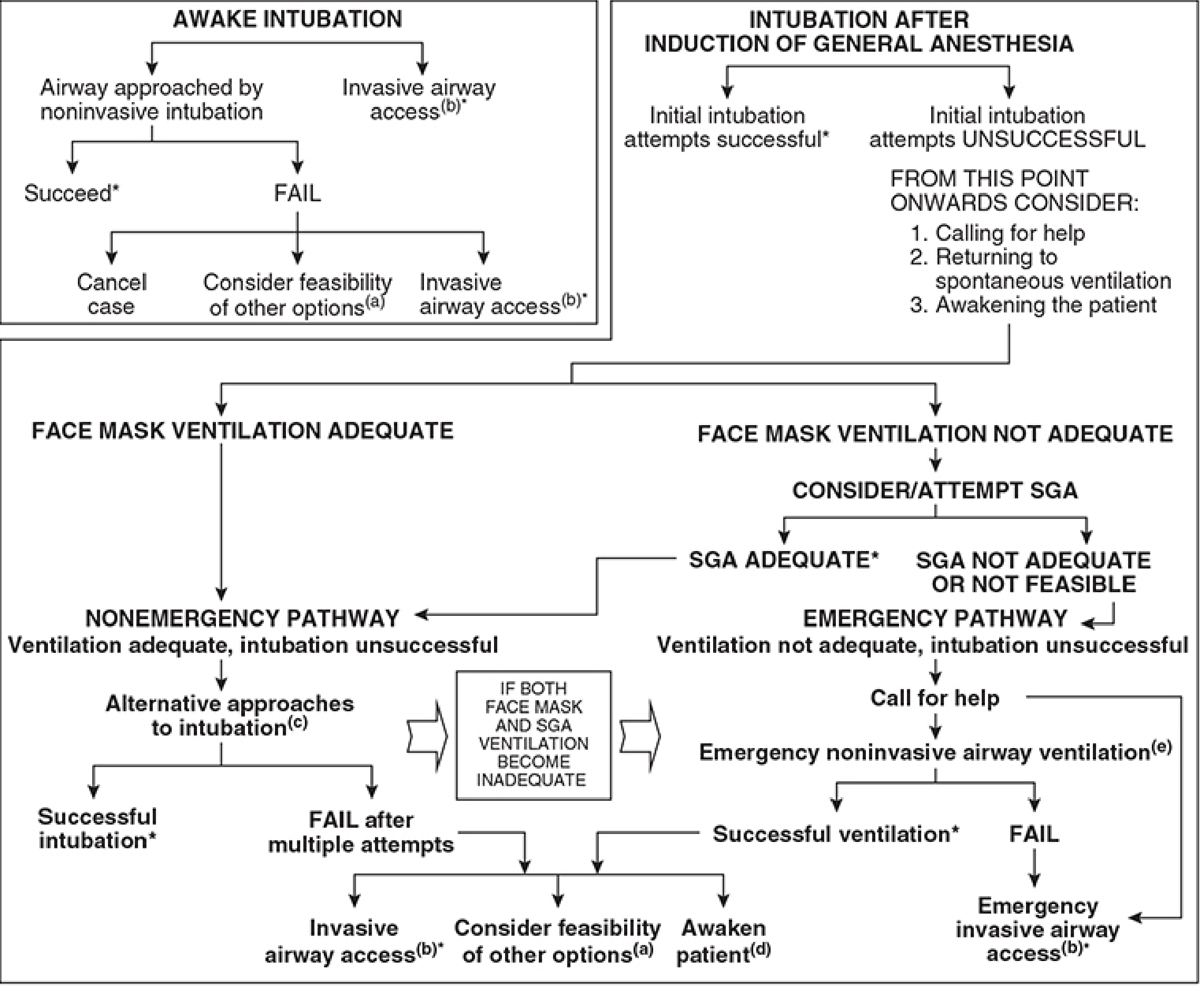
Technique Options (in order of preference)
Option 1: Awake Flexible Fibreoptic Intubation (AFOI) - GOLD STANDARD
Steps:
- Topicalisation of airway mucosa:
- Nasal route preferred if mouth opening is severely limited
- Lignocaine 4% atomised to nasal mucosa, oropharynx, and larynx
- Superior laryngeal nerve blocks (bilateral) using 2% lignocaine - transtracheal instillation of 4 mL 4% lignocaine through cricothyroid membrane at end-expiration
- Total lignocaine dose limit: 4-5 mg/kg (maximum ~300 mg) to avoid toxicity
- Sedation (must maintain spontaneous breathing):
- Dexmedetomidine infusion 0.5-1 mcg/kg/h is ideal - sedation without respiratory depression, cooperative patient
- OR small incremental doses of midazolam 1 mg IV + fentanyl 25-50 mcg IV
- Target: Ramsay score 2-3 (cooperative, responds to commands)
- Flexible bronchoscope passed through nasopharynx → visualise vocal cords → railroaded ETT (size 7.0 or 7.5 mm, reinforced/armoured tube preferred as it resists kinking during head/neck positioning)
- Confirm placement with capnography and direct bronchoscopic vision
- Secure tube carefully - standard taping unreliable over burned/scarred skin; consider suturing or modified fixation
A 2022 systematic review (Unal & Sumak Hazir, J Burn Care Res 2022) confirmed that awake airway management with proper airway anaesthesia can be safely used even in children with burn contracture, with flexible scope intubation being the most commonly reported successful technique.
Option 2: Awake Video Laryngoscopy (Awake VL)
- C-MAC, GlideScope, or Airtraq can be useful when mouth opening is adequate (>2 cm IID)
- A 2025 case report (Ponthus et al., BMC Anaesthesiol) described successful awake intubation using the Airtraq in a resource-limited setting for severe post-burn contracture
- Success depends on degree of mouth opening
Option 3: Supraglottic Airway (SGA) as Conduit
- Pre-shaped SGAs (e.g., Intubating LMA / ILMA) can be used if mouth opening is adequate
- A 2022 case series (Kumar et al.) showed that pre-shaped supraglottic airway devices offer a viable alternative to ETT for post-burn neck contracture management
- Can use as a conduit for fibreoptic-guided intubation
Option 4: Tracheostomy under Local Anaesthesia
- Reserved for cases where mouth opening is virtually nil AND nasal route is not feasible
- Performed by surgeon under LA, before induction of GA
- Provides a definitive, secure airway in extreme cases
What NOT to do:
- Do not induce GA before the airway is secured in a truly difficult airway case
- Do not use rapid sequence induction (RSI) blindly
- Succinylcholine is CONTRAINDICATED in this patient (see below)
MUSCLE RELAXANTS - CRITICAL PHARMACOLOGY
Succinylcholine is CONTRAINDICATED
Beyond 48 hours following a major burn injury, succinylcholine administration can produce lethal hyperkalaemia. This risk persists for up to 2 years following burn injury.
The mechanism: burn injury and immobilization cause upregulation of both fetal (α₂βγδ) and mature (α₂βεδ) nicotinic acetylcholine receptors (nAChRs) throughout the entire muscle membrane (not just at end-plates). When succinylcholine depolarises these receptors, massive potassium efflux from muscle causes life-threatening hyperkalaemia.
(Morgan & Mikhail's Clinical Anesthesiology, p. 1561; Miller's Anesthesia, p. 3331-3332)
Also note: Resistance to non-depolarising NMBDs
- Burn patients show resistance to non-depolarising agents (vecuronium, rocuronium, atracurium) due to the same upregulation of nAChRs
- Onset is slower and duration is shorter; larger doses may be required
- Use a nerve stimulator (TOF monitoring) to guide dosing
Preferred NMBDs:
| Drug | Notes |
|---|---|
| Rocuronium | Safe; may need higher doses (1.2 mg/kg); can be reversed with sugammadex |
| Vecuronium | Safe; increased dose requirements |
| Atracurium / Cisatracurium | Hofmann elimination - organ-independent; preferred if any hepatic or renal dysfunction |
INDUCTION AND MAINTENANCE
If awake intubation succeeds:
- Induction with propofol 1.5-2 mg/kg IV or ketamine 1-2 mg/kg IV
- Ketamine is particularly useful in burn patients - sympathomimetic, maintains BP, provides analgesia; however, increases secretions (give glycopyrrolate)
- Maintenance: TIVA with propofol + remifentanil infusion OR sevoflurane/isoflurane via ETT with opioids
- Nitrous oxide can be used but avoid in suspected inhalation injury (expansion of air spaces)
Temperature Management (MANDATORY)
- Burn patients cannot regulate body temperature - they are obligate poikilotherms
- Operating room temperature: >28°C
- Forced-air warming blankets, warm IV fluids, warm irrigation solutions, overhead radiant heaters
- Active temperature monitoring throughout
INTRA-OPERATIVE CONCERNS
1. Blood Loss
- Contracture release + split-skin grafting involves significant blood loss
- Two large-bore IV lines; consider central venous access
- Blood products available and crossmatched
- Maintain Hb >8 g/dL during acute phases
2. Positioning
- Neck contracture release requires specific surgical positioning - communicate with surgeon
- Avoid pressure necrosis on already scarred tissue
- Padding of all bony prominences
3. Analgesia
- Multimodal approach: opioids + paracetamol + NSAIDs (if no contraindications) + ketamine infusion (0.1-0.5 mg/kg/h sub-anaesthetic dose for opioid-sparing)
- Regional techniques (e.g., cervical plexus block for neck) - consider if anatomy allows
- Burn patients often opioid-tolerant due to prior exposure; be prepared for higher opioid requirements
4. IV Access
- Often challenging due to scarred arms; use the most accessible site
- Intraosseous access if peripheral venous access fails
EXTUBATION
- Deep extubation is relatively contraindicated - the patient has a difficult airway; must be awake with intact airway reflexes before extubation
- Pre-extubation checklist:
- Fully awake, following commands
- Adequate reversal of NMB (TOF ratio >0.9 with sugammadex if rocuronium used)
- Adequate spontaneous breathing (TV >5 mL/kg, RR 10-20)
- Absence of airway oedema (check with leak test if in doubt)
- Analgesia adequate to avoid distress
- Have equipment for re-intubation immediately available
- Consider extubation over an airway exchange catheter (AEC) to facilitate re-intubation if needed
- Post-operative ICU/HDU admission if any concerns about airway oedema
POST-OPERATIVE MANAGEMENT
- ICU or HDU monitoring for 24 hours minimum
- Oxygen supplementation, SpO2 monitoring
- Multimodal analgesia; patient-controlled analgesia (PCA) if feasible
- Continue temperature management
- Physiotherapy instructions for graft care and neck positioning
- Psychological support
VIVA QUESTIONS AND MODEL ANSWERS
Q1. Why is this case considered a difficult airway? How would you assess it?
A: Post-burn neck contracture with cheek involvement causes restriction of neck extension and limited mouth opening. Combined, these impair mask ventilation (distorted face), laryngoscopy (cannot extend neck to create the oral-pharyngeal-laryngeal axis alignment), SGA insertion (distorted pharynx), and potentially surgical airway access (scarred neck). Assessment uses the LEMON criteria - look externally, evaluate 3-3-2 rule (inter-incisor gap >3 cm, hyoid-mental distance >3 finger breadths, thyroid-to-floor of mouth >2 finger breadths), Mallampati score, obstruction, and neck mobility. All of these may be compromised in this patient.
Q2. What is your preferred technique for securing the airway and why?
A: Awake flexible fibreoptic intubation (AFOI) via the nasal route is the preferred technique. This is a predicted difficult airway where both mask ventilation and laryngoscopy are likely to be difficult. AFOI preserves spontaneous ventilation throughout, allowing the patient to maintain their airway. Topicalisation with lignocaine plus dexmedetomidine sedation provides patient comfort without respiratory depression. The nasal route is preferred when mouth opening is restricted. Induction of GA before securing the airway risks a "can't intubate, can't oxygenate" catastrophe.
Q3. Why is succinylcholine absolutely contraindicated in this patient?
A: This patient's burn injury occurred more than 48 hours ago (it is a chronic contracture, suggesting months to years post-injury). Burn injury causes upregulation of extrajunctional nicotinic acetylcholine receptors throughout the muscle sarcolemma. When succinylcholine depolarises these proliferated receptors, massive efflux of intracellular potassium occurs, potentially raising serum K⁺ by 5-10 mEq/L and causing ventricular fibrillation or cardiac arrest. This risk persists for up to 2 years post-burn. Rocuronium (with sugammadex availability for reversal) is the preferred alternative.
(Morgan & Mikhail's, p. 1561)
Q4. What are the effects of burn injury on non-depolarising neuromuscular blockers?
A: Burn patients show resistance to non-depolarising NMBDs (vecuronium, rocuronium, pancuronium). The mechanism is the same upregulation of nAChRs - more receptors means a greater amount of drug is needed to achieve the same degree of block. Onset may be slower and duration is shorter. In practice, 1.5-2x the normal intubating dose may be required. TOF monitoring is mandatory. Atracurium and cisatracurium are less affected because they undergo Hofmann elimination independent of hepatic/renal function.
(Miller's Anesthesia, p. 3331-3332)
Q5. How would you provide airway topicalisation for awake fibreoptic intubation?
A:
- Anti-sialagogue first: Glycopyrrolate 0.2 mg IV/IM 30 minutes before to dry secretions
- Nasal mucosa: 2-3 sprays of oxymetazoline (vasoconstriction, reduces bleeding) + lignocaine 4% atomised or on a cotton pledget
- Oropharynx: Lignocaine 4% spray or nebulisation (4-5 ml via nebuliser for 15-20 min)
- Supraglottic/infraglottic: Bilateral superior laryngeal nerve blocks (2 mL of 2% lignocaine at the greater cornu of the hyoid), plus transtracheal injection of 3-4 mL of 4% lignocaine through the cricothyroid membrane to anaesthetise the subglottis and trachea
- Total dose limit: 4 mg/kg lignocaine (plain); adrenaline-containing solutions are available but with care in vasoconstricted patients
- Sedation: dexmedetomidine 0.5-1 mcg/kg loading over 10 min then infusion, or titrated midazolam + fentanyl, with strict attention to maintaining spontaneous respiration
Q6. A 22-year-old burn patient with neck contracture suddenly cannot be intubated after induction. What is your management?
A: Declare "cannot intubate" and follow the ASA difficult airway algorithm. First, attempt mask ventilation - if adequate, pursue non-emergency pathway (attempt video laryngoscopy, bougie-assisted technique, LMA as conduit for fibreoptic intubation). If mask ventilation is also not adequate - this is a "can't intubate, can't oxygenate" emergency. Immediately: insert SGA (LMA) for emergency ventilation, call for help, prepare for front-of-neck airway access (FONA) - cricothyrotomy (needle or surgical). Never repeat the same failed technique. The key preventive strategy is to never reach this point - awake intubation before induction would have avoided this scenario entirely.
Q7. How would you manage temperature in this patient intraoperatively?
A: Burn patients have lost the thermoregulatory function of skin and cannot retain heat. They are obligate poikilotherms. The operating room must be warmed to at least 28°C (ideally 30-32°C). Forced-air warming blankets (upper and lower body where possible), IV fluid warmers, warm irrigation fluids, radiant heat lamps, and minimising exposure time of non-surgical areas are all mandatory. Core temperature must be monitored continuously (nasopharyngeal, oesophageal, or bladder thermistor). Hypothermia causes coagulopathy, cardiac arrhythmias, shivering, increased metabolic demand, and impaired wound healing.
(Morgan & Mikhail's, p. 1561)
Q8. What are the unique pharmacokinetic challenges in a chronic burn patient?
A:
- Volume of distribution is increased for most drugs due to a hypermetabolic/hyperdynamic state (increased CO, increased plasma volume in early phase) - may need higher drug doses
- Protein binding is reduced (hypoalbuminaemia from protein catabolism) - more free drug available for highly protein-bound drugs (e.g., fentanyl, propofol)
- Renal clearance may be increased (increased GFR in hypermetabolic state) - faster elimination of renally-cleared drugs
- Hepatic metabolism upregulated due to hypermetabolism
- Net effect: unpredictable drug responses; titrate to effect and monitor with nerve stimulator for NMBDs
Q9. What are the concerns during extubation of this patient?
A: Extubation is a high-risk event because re-intubation may be difficult or impossible. The patient must be fully awake (obeying commands), hemodynamically stable, with adequate spontaneous ventilation (TV >5 mL/kg, RR <25/min), and complete reversal of neuromuscular block (TOF ratio >0.9, confirmed with sugammadex if rocuronium was used). Check for airway oedema with the cuff-leak test if there was difficult/prolonged intubation. Extubation over an airway exchange catheter (AEC) is advisable - the AEC remains in the trachea for 30-60 min post-extubation, allowing re-intubation over it if the patient deteriorates. A senior anaesthetist should be present, with full difficult airway equipment immediately available. Patient is best managed post-operatively in the ICU/HDU.
Q10. What would you use for post-operative analgesia in this patient?
A: Multimodal analgesia to minimise opioid requirements (burn patients are often opioid-tolerant):
- Paracetamol 1g IV 6-hourly (around-the-clock)
- NSAIDs (e.g., diclofenac or ketorolac) if no contraindications (avoid in hypovolaemia or renal impairment)
- Sub-anaesthetic ketamine infusion 0.1-0.2 mg/kg/h (opioid-sparing, particularly useful in opioid-tolerant burn patients; also has anti-hyperalgesic properties via NMDA blockade)
- PCA morphine or fentanyl as the opioid backbone
- Regional techniques if feasible (superficial cervical plexus block for neck)
- Gabapentin for neuropathic/scar pain
Key textbook references:
- Morgan & Mikhail's Clinical Anesthesiology, 7e, pp. 608-610 (Difficult Airway Algorithm), pp. 1559-1562 (Burn Anaesthesia)
- Miller's Anesthesia, 10e, pp. 3331-3332 (Neuromuscular Blockade in Burns)
- Unal D, Sumak Hazir M. Airway Management in Pediatric Patients With Burn Contractures of the Face and Neck. J Burn Care Res. 2022 (Systematic Review)
- Mishra D et al. Difficult Airway Management in Post-burn Contracture Neck. Cureus. 2022
- Ponthus S et al. Successful awake intubation using Airtraq in post-burn contracture. BMC Anaesthesiol. 2025
This is a shared conversation. Sign in to Orris to start your own chat.