
TCA cycle eassy
I'll read the medical library skill first, then search for comprehensive TCA cycle content.
Reading File
Now let me search the library for TCA cycle content in parallel:
Finding Sources
Searching the Web
TCA cycle tricarboxylic acid Krebs cycle steps enzymes regulation biochemistry
Excellent - I found rich content in multiple textbooks. Let me read the most comprehensive sources in parallel:
Reading File
Reading File
Excellent content retrieved. Let me get more details on regulation, energetics, and fetch the key TCA diagram:
Reading File
Loading Image
Now let me fetch the regulation diagram and get the anaplerosis/clinical significance section:
Loading Image
Reading File
I now have comprehensive, authoritative content from multiple textbooks. Let me compose the full essay.
The Tricarboxylic Acid (TCA) Cycle - A Comprehensive Essay
1. Introduction and Nomenclature
The tricarboxylic acid (TCA) cycle is one of the most central metabolic pathways in all aerobic organisms. It carries three names, each reflecting a different historical or chemical perspective:
- Krebs cycle - named after Sir Hans Krebs, who first formulated its reactions into a cycle (Nobel Prize, 1953)
- Citric acid cycle - because citrate (citric acid) was one of the first compounds identified as a participant
- TCA cycle - the most precise name, denoting the involvement of the tricarboxylate intermediates citrate and isocitrate
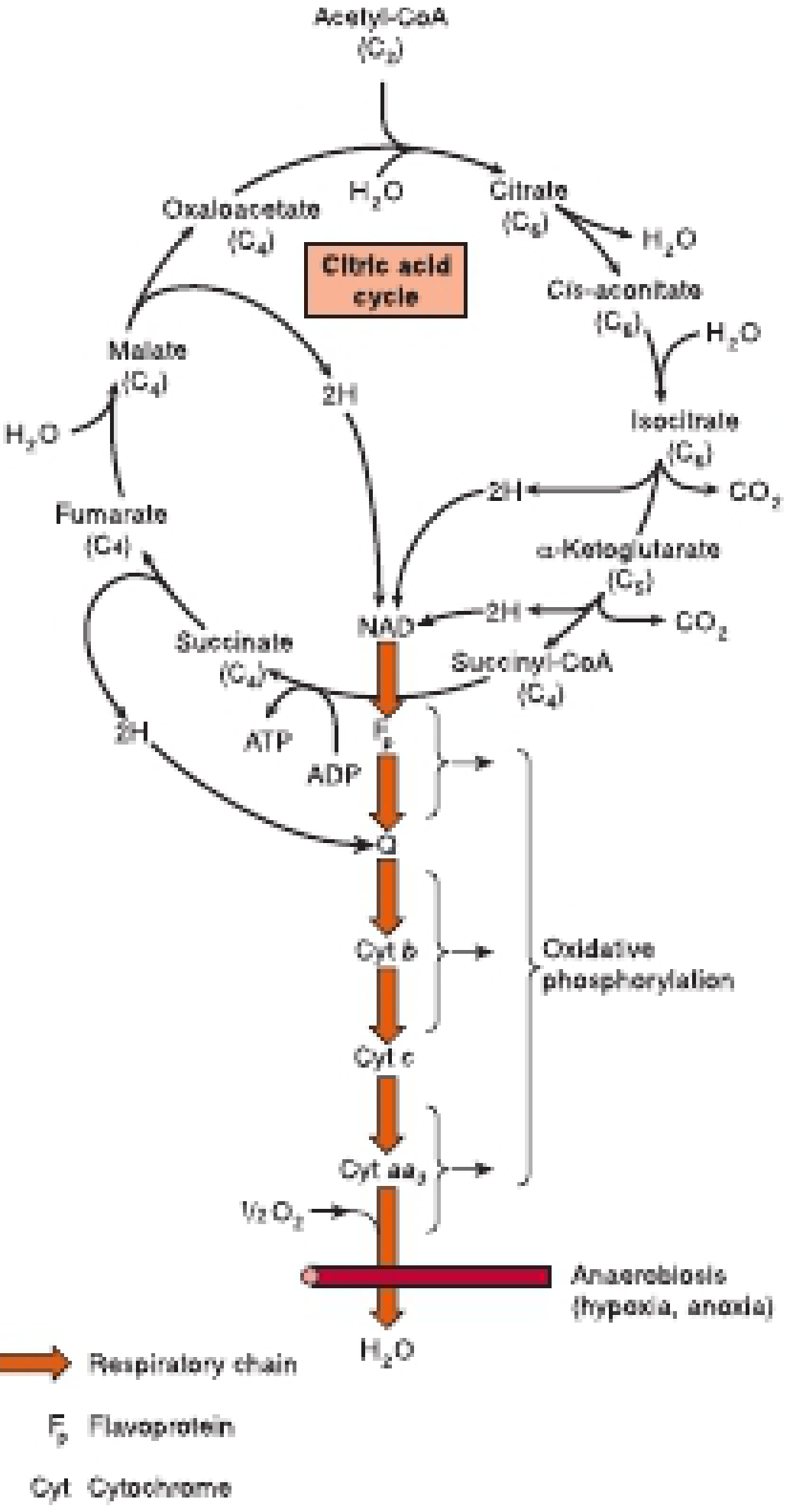
The cycle takes place in the mitochondrial matrix, where its enzymes are located either free in solution or attached to the inner mitochondrial membrane and crista membrane - the same location as the respiratory chain enzymes. This proximity is functionally important, allowing efficient transfer of reducing equivalents directly to oxidative phosphorylation.
- Basic Medical Biochemistry - A Clinical Approach, 6e, p. 827
- Harper's Illustrated Biochemistry, 32nd Ed., p. 168
2. Biological Role and Substrates
The TCA cycle serves as the final common catabolic pathway for all three macronutrient classes:
- Carbohydrates are oxidized via glycolysis to pyruvate, then converted to acetyl-CoA by the pyruvate dehydrogenase complex (PDC)
- Fatty acids undergo beta-oxidation to yield acetyl-CoA directly
- Amino acids are catabolized to acetyl-CoA or to TCA cycle intermediates (alpha-ketoglutarate, succinyl-CoA, fumarate, oxaloacetate)
The 2-carbon acetyl group of acetyl-CoA is the universal entry substrate. The cycle's function is to completely oxidize these carbons to CO2, conserving the released energy as reduced coenzymes (NADH and FADH2) that drive oxidative phosphorylation in the electron transport chain.
3. Reactions of the TCA Cycle (Eight Steps)
The cycle begins when acetyl-CoA (C2) condenses with oxaloacetate (C4) to form citrate (C6), then proceeds through a series of oxidation, decarboxylation, and substrate-level phosphorylation reactions before regenerating oxaloacetate.
Step 1: Citrate Synthase
Acetyl-CoA + Oxaloacetate + H2O → Citrate + CoA
Citrate synthase forms a carbon-carbon bond between the methyl carbon of acetyl-CoA and the carbonyl carbon of oxaloacetate, releasing CoA. This is a condensation reaction. Citrate synthase is irreversible (large negative ΔG°) and is a key regulatory enzyme - inhibited by its product citrate and by ATP/NADH (high-energy signals).
Step 2: Aconitase
Citrate → Cis-aconitate → Isocitrate
Aconitase (aconitase hydratase) catalyzes the isomerization of citrate to isocitrate via the intermediate cis-aconitate, involving dehydration then rehydration. This step repositions the hydroxyl group to allow the subsequent oxidative decarboxylation. Aconitase contains an iron-sulfur (Fe-S) cluster and is inhibited by fluorocitrate (the mechanism of fluoroacetate poisoning).
Step 3: Isocitrate Dehydrogenase
Isocitrate + NAD+ → alpha-Ketoglutarate + CO2 + NADH
Isocitrate is oxidatively decarboxylated to the 5-carbon alpha-ketoglutarate (alpha-KG), releasing the first molecule of CO2 and reducing NAD+ to NADH. This reaction is irreversible and is a major regulatory point - activated by ADP and Ca2+, and inhibited by NADH and ATP.
Step 4: alpha-Ketoglutarate Dehydrogenase Complex
alpha-Ketoglutarate + NAD+ + CoA → Succinyl-CoA + CO2 + NADH
The alpha-ketoglutarate dehydrogenase complex (analogous to the PDC in structure) catalyzes a second oxidative decarboxylation, releasing the second CO2 and generating NADH. The product is the 4-carbon succinyl-CoA, a high-energy thioester. This reaction is also irreversible and is inhibited by its products: succinyl-CoA and NADH. Activated by Ca2+.
At this point, both carbons originally donated by acetyl-CoA have been released as CO2, though not the same specific carbon atoms that entered - they are released in later turns of the cycle.
Step 5: Succinyl-CoA Synthetase (Succinate Thiokinase)
Succinyl-CoA + GDP + Pi → Succinate + CoA + GTP
The high-energy thioester bond of succinyl-CoA is used for substrate-level phosphorylation, generating one molecule of GTP (equivalent to ATP). This is the only step that directly produces a high-energy phosphate bond within the TCA cycle itself. CoA is released.
Step 6: Succinate Dehydrogenase
Succinate + FAD → Fumarate + FADH2
Succinate dehydrogenase oxidizes succinate to fumarate, reducing FAD to FADH2 (written as FAD[2H]). This enzyme is unique because it is embedded in the inner mitochondrial membrane (it is Complex II of the electron transport chain), unlike the other TCA cycle enzymes, which are in the matrix. Malonate is a competitive inhibitor - classically used to demonstrate competitive inhibition.
Step 7: Fumarase (Fumarate Hydratase)
Fumarate + H2O → L-Malate
Fumarase catalyzes the stereospecific addition of water across the double bond of fumarate, producing L-malate. This is a hydration reaction with no oxidation/reduction. Mutations in fumarate hydratase are associated with hereditary leiomyomatosis and renal cell carcinoma (HLRCC), as fumarate accumulates and acts as an oncometabolite.
Step 8: Malate Dehydrogenase
L-Malate + NAD+ → Oxaloacetate + NADH
Malate dehydrogenase oxidizes malate to regenerate oxaloacetate, reducing NAD+ to NADH. This reaction has a positive ΔG° under standard conditions (thermodynamically unfavorable in isolation), but is driven forward by the strongly exergonic removal of oxaloacetate in step 1 (citrate synthase), and by continuous oxidation of NADH in the electron transport chain.
4. Net Equation and Energy Yield
The net reaction for one turn of the TCA cycle is:
Acetyl-CoA + 3 NAD+ + FAD + GDP + Pi + 2H2O → 2 CO2 + 3 NADH + FADH2 + GTP + CoA + 3H+
Products per turn:
| Product | Quantity | ATP equivalent (via ETC) |
|---|---|---|
| NADH | 3 | ~7.5 ATP (2.5 each) |
| FADH2 | 1 | ~1.5 ATP |
| GTP | 1 | 1 ATP |
| Total | ~10 ATP |
The TCA cycle conserves approximately 90% of the energy available from oxidation of the acetyl group (~207 of 228 kcal/mol). The ΔG° for the complete cycle is approximately -13 kcal/mol, a relatively small "loss" as heat that ensures the cycle runs to completion. This efficiency is made possible because the electron transport chain continuously reoxidizes NADH and FADH2, pulling the cycle thermodynamically forward.
- Basic Medical Biochemistry - A Clinical Approach, 6e, p. 838
5. Coenzymes and Cofactors Required
The TCA cycle has extensive vitamin and mineral requirements:
| Cofactor | Vitamin/Mineral Source | Role |
|---|---|---|
| NAD+ | Niacin (Vitamin B3) | Electron acceptor (steps 3, 4, 8) |
| FAD | Riboflavin (Vitamin B2) | Electron acceptor (step 6) |
| Coenzyme A | Pantothenic acid (Vitamin B5) | Carrier of acyl groups |
| Thiamin pyrophosphate (TPP) | Thiamin (Vitamin B1) | Cofactor for alpha-KG dehydrogenase complex |
| Lipoic acid | Lipoate | Cofactor for alpha-KG dehydrogenase complex |
| Mg2+, Ca2+, Fe2+, phosphate | Minerals | Enzyme activation, Fe-S clusters |
Clinical note: Thiamine (B1) deficiency impairs both the pyruvate dehydrogenase complex and alpha-ketoglutarate dehydrogenase, critically blocking entry into and flow through the TCA cycle. This underlies the neurological damage in Wernicke's encephalopathy.
6. Regulation
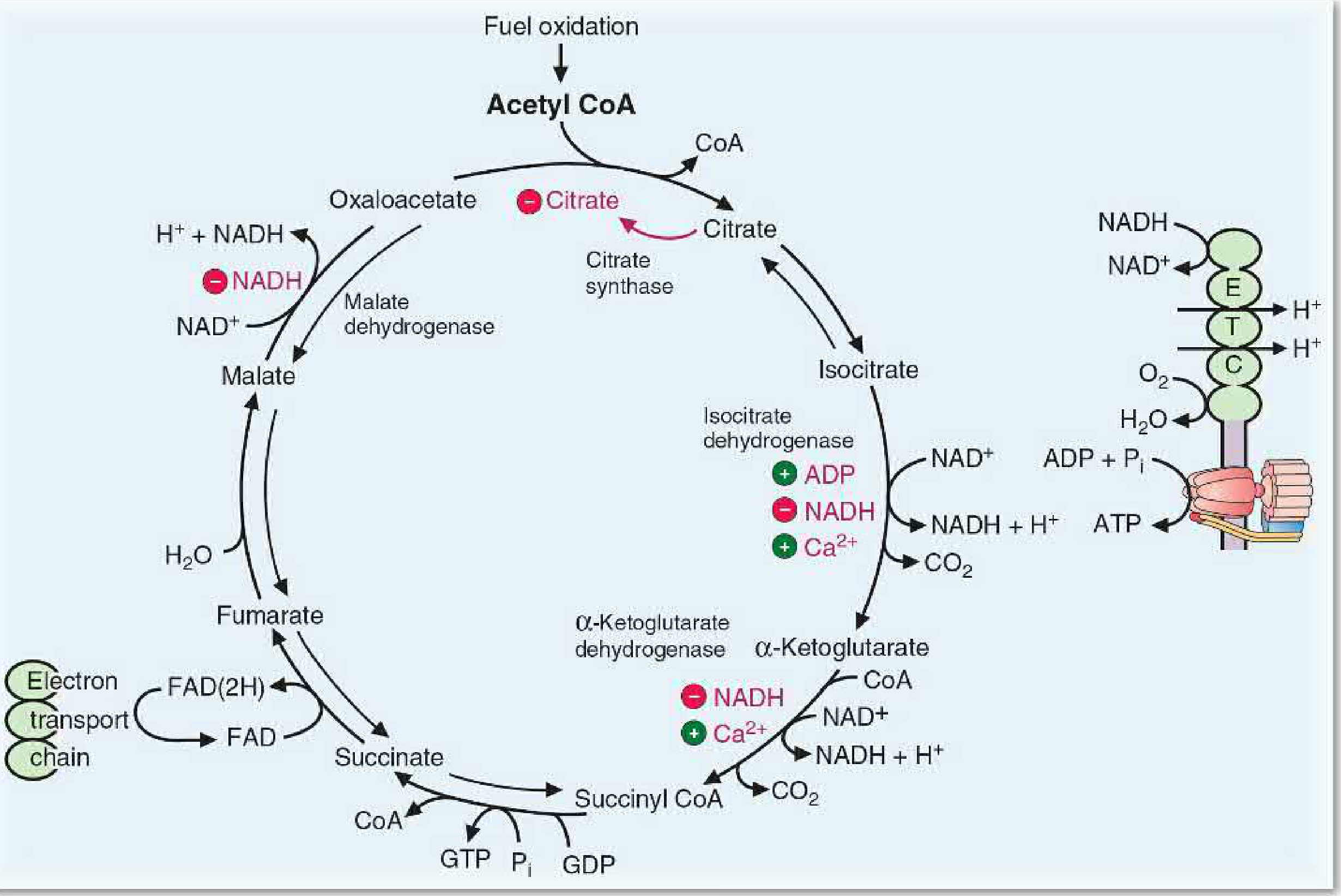
The TCA cycle is regulated primarily to match the rate of ATP utilization in the cell. Two major signals convey information about cellular energy status:
- Phosphorylation state - reflected by ATP/ADP ratio
- Reduction state - reflected by NADH/NAD+ ratio
Key Regulatory Enzymes:
Citrate Synthase (Step 1)
- Inhibited by: ATP, NADH, succinyl-CoA, and its own product citrate (product inhibition)
- The concentration of oxaloacetate is also regulatory - when low, it limits the rate of citrate formation
Isocitrate Dehydrogenase (Step 3) - the primary rate-limiting enzyme
- Activated by: ADP (signals low energy), Ca2+ (signals muscular activity)
- Inhibited by: NADH (signals adequate reduction state), ATP
alpha-Ketoglutarate Dehydrogenase Complex (Step 4)
- Activated by: Ca2+
- Inhibited by: succinyl-CoA and NADH (product inhibition)
Integration with exercise: During muscular contraction, increased Ca2+ concentrations activate isocitrate dehydrogenase and alpha-ketoglutarate dehydrogenase, simultaneously increasing ADP and decreasing the NADH/NAD+ ratio - all signals that accelerate the cycle to match increased ATP demand.
7. Anaplerosis and Cataplerosis
TCA cycle intermediates are not only oxidized for energy - they are also drawn off for biosynthesis (cataplerosis) and must be replenished (anaplerosis) to sustain the cycle.
Anaplerotic reactions (replenish intermediates):
- Pyruvate carboxylase: Pyruvate + CO2 → Oxaloacetate (most important anaplerotic reaction; activated by acetyl-CoA; important in gluconeogenesis)
- Transamination of glutamate: Glutamate → alpha-Ketoglutarate
- Propionyl-CoA metabolism: odd-chain fatty acids → succinyl-CoA
- Amino acid catabolism: aspartate, asparagine → oxaloacetate; isoleucine, methionine, valine → succinyl-CoA
Cataplerotic reactions (remove intermediates for biosynthesis):
- Citrate is exported to the cytoplasm for fatty acid and cholesterol synthesis (ATP-citrate lyase cleaves it back to acetyl-CoA + oxaloacetate)
- alpha-Ketoglutarate feeds amino acid synthesis (glutamate, glutamine)
- Succinyl-CoA is used for heme synthesis
- Oxaloacetate provides the carbon skeleton for gluconeogenesis (via phosphoenolpyruvate)
To sustain the cycle, anaplerosis must equal cataplerosis - for every carbon atom removed, one must be added through a non-acetyl-CoA entry point.
- Harper's Illustrated Biochemistry, 32nd Ed., p. 169
8. The TCA Cycle as an Amphibolic Pathway
The term amphibolic (from Greek "both directions") describes the TCA cycle's dual nature:
- Catabolic role: oxidizes acetyl-CoA derived from carbohydrates, fats, and proteins to generate energy
- Anabolic role: provides biosynthetic precursors for amino acids, nucleotides, heme, lipids, and glucose
This makes the TCA cycle a central metabolic hub - not merely an energy-generating pathway, but the biochemical crossroads of the entire intermediary metabolism.
9. Location and Cellular Context
All TCA cycle enzymes (except succinate dehydrogenase, which is Complex II of the ETC) reside in the mitochondrial matrix. The cycle is therefore strictly aerobic - it depends on the electron transport chain to continuously reoxidize NADH and FADH2 back to NAD+ and FAD. Without oxygen, these coenzymes accumulate in the reduced state, halting the cycle. This is why tissues with high energy demands (heart, brain, liver, exercising skeletal muscle) have the most mitochondria.
10. Clinical Correlations
| Enzyme/Gene | Defect/Disease | Consequence |
|---|---|---|
| Pyruvate dehydrogenase (PDC) | PDC deficiency | Lactic acidosis, neurodegeneration; acetyl-CoA cannot be formed from pyruvate |
| Isocitrate dehydrogenase (IDH1/2) | Gain-of-function mutations | Produce oncometabolite D-2-hydroxyglutarate; seen in gliomas, AML, cholangiocarcinoma |
| Succinate dehydrogenase (SDHA-D) | Loss-of-function mutations | Paraganglioma, pheochromocytoma; succinate accumulates, acting as a competitive inhibitor of prolyl hydroxylase → stabilizes HIF-1alpha |
| Fumarate hydratase (FH) | Loss-of-function mutations | Hereditary leiomyomatosis and renal cell carcinoma (HLRCC); fumarate acts as oncometabolite |
| Aconitase | Fluoroacetate poisoning | Fluoroacetate → fluorocitrate; potently inhibits aconitase; cycle blocks at citrate; used as a rodenticide |
| Thiamine deficiency | Wernicke's encephalopathy | Blocks PDC and alpha-KG dehydrogenase; CNS energy failure |
Oncometabolites: The identification that mutant IDH1/2 produces D-2-hydroxyglutarate (D-2HG) has been a major advance in cancer biology. D-2HG competitively inhibits alpha-ketoglutarate-dependent dioxygenases (including TET methylcytosine hydroxylases and histone demethylases), causing widespread epigenetic dysregulation and driving oncogenesis.
11. Summary
The TCA cycle is the metabolic engine of aerobic life. Per one turn:
- 2 carbons in (as acetyl-CoA), 2 CO2 out
- 3 NADH, 1 FADH2, 1 GTP produced
- ~10 ATP equivalents generated (via oxidative phosphorylation)
- Oxaloacetate is regenerated - catalytic, not consumed
Its regulation is elegant and energy-sensitive, integrating signals from ADP, ATP, NADH, NAD+, and Ca2+ to precisely match the rate of ATP synthesis to demand. Beyond energy production, it functions as an amphibolic hub, supplying carbon skeletons for biosynthesis across virtually every class of biomolecule. Understanding the TCA cycle is therefore central not only to biochemistry but to the pathophysiology of metabolic diseases, cancer biology, and mitochondrial disorders.
Sources:
- Basic Medical Biochemistry: A Clinical Approach, 6th Ed. (Lieberman & Marks) - Chapter 23
- Harper's Illustrated Biochemistry, 32nd Ed. - Chapter 16
- Guyton and Hall Textbook of Medical Physiology - Chapter on cellular metabolism
- Ganong's Review of Medical Physiology, 26th Ed.
This is a shared conversation. Sign in to Orris to start your own chat.