
What is neurolgia and its Functions
Reading File
Neuroglia (also called glial cells) are the non-neuronal supporting cells of the nervous system. They outnumber neurons roughly 10:1 and carry out a wide range of support, protective, and regulatory functions - from providing structural scaffolding to forming the blood-brain barrier.
Searching sources...
Finding Sources
Searching the Web
neuroglia types and functions nervous system
Finding Sources
Reading Web Page
https://www.ncbi.nlm.nih.gov/books/NBK10869
Reading File
Reading File
Loading Image
Reading File
Here is a thorough breakdown of neuroglia and their functions, drawing from authoritative histology and physiology textbooks.
Neuroglia (Glial Cells)
Neuroglia are the non-neuronal supporting cells of the nervous system. The term comes from the Greek word glia meaning "glue," reflecting an early (now outdated) belief that they simply held the brain together. In reality, they perform a wide range of active physiological roles. They outnumber neurons by roughly 3-10:1 and lack axons and dendrites, so they do not directly transmit electrical signals.
There are 6 major types - 4 in the CNS and 2 in the PNS.
Glial Cells of the CNS and PNS
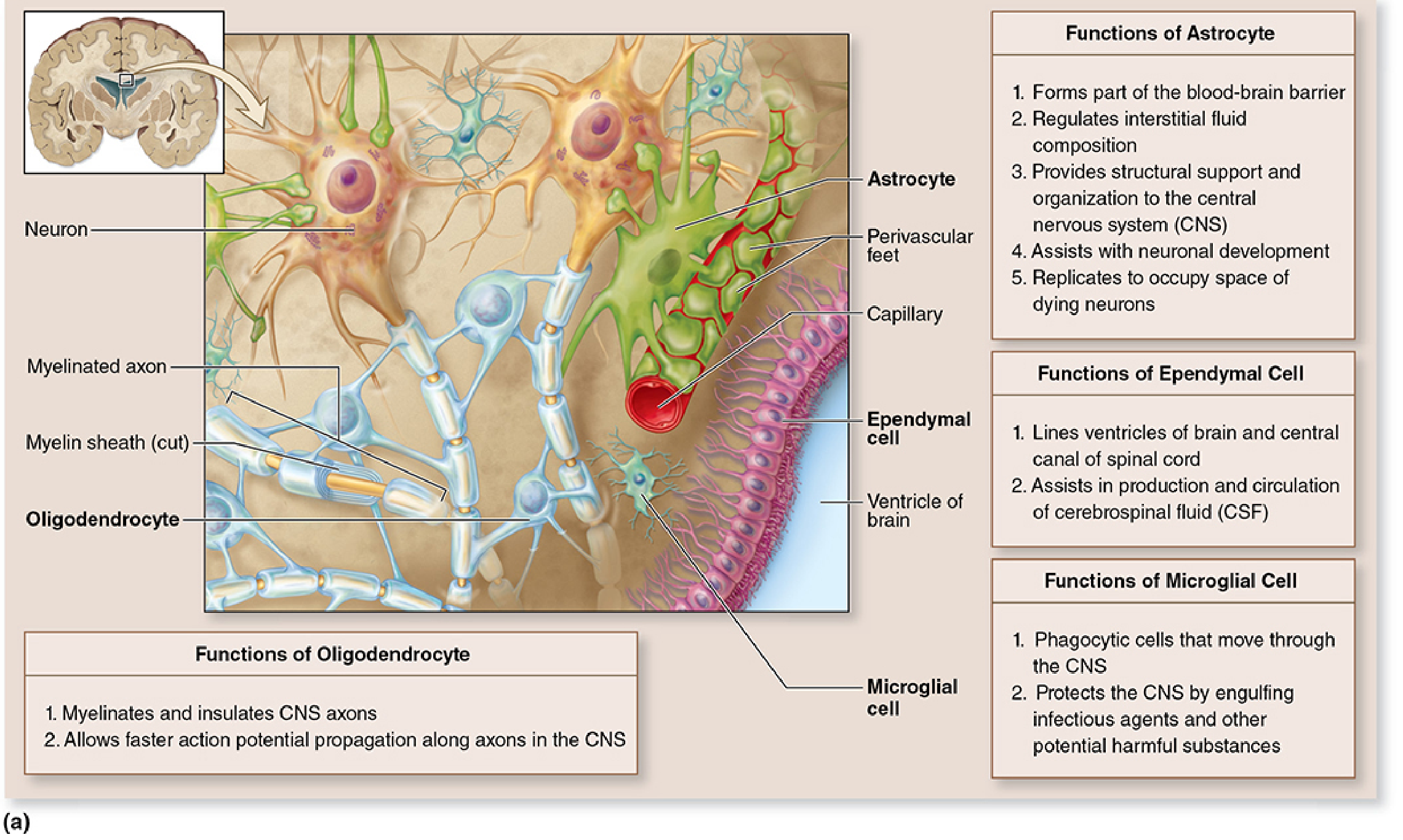
CNS Neuroglia
1. Astrocytes
Astrocytes are the largest and most abundant glial cells in the CNS. They are star-shaped with long, branching processes. Their proximal processes contain glial fibrillary acidic protein (GFAP), which serves as their unique molecular marker. A single astrocyte can interact with up to 2 million synaptic sites.
Two subtypes:
- Protoplasmic astrocytes - found in the gray matter; numerous short branching processes; regulate neurotransmitter, ion, and energy homeostasis at synapses
- Fibrous astrocytes - found in the white matter; fewer, longer, straighter processes
Functions:
- Form part of the blood-brain barrier (via perivascular end-feet on capillaries)
- Regulate the ionic and chemical microenvironment around neurons (especially K+ buffering)
- Provide structural and metabolic support to neurons, especially at synapses
- Guide neuronal migration during brain development (radial glia scaffold)
- Modulate synaptic transmission by controlling neurotransmitter uptake
- Perform phagocytosis of excess synapses during development and clear myelin debris after injury
- Replicate to occupy space left by dying neurons (process called gliosis)
2. Oligodendrocytes
Small cells found predominantly in the white matter. They extend multiple sheetlike processes, each wrapping repeatedly around a segment of a CNS axon to form myelin.
Functions:
- Myelin production in the CNS - a single oligodendrocyte can myelinate segments of multiple different axons simultaneously
- Electrical insulation of axons
- Enable rapid saltatory conduction (fast action potential propagation along myelinated axons)
- Provide metabolic support for axons
Note: One oligodendrocyte myelinates multiple axons; by contrast, each Schwann cell (PNS equivalent) myelinates only one axon segment.
3. Microglia
The smallest glial cells, with small dark elongated nuclei. Unlike other neuroglia, microglia are derived from bone marrow monocytes (not neural tube), making them the brain's resident immune cells. They are physiologically similar to macrophages.
Functions:
- CNS immune defense - phagocytose infectious agents, cellular debris, and harmful substances
- Scavenger activity - remove damaged cells at injury sites and during normal cell turnover
- Surveillance - continuously survey the brain parenchyma
- Neuroinflammation - respond to brain damage; their numbers increase dramatically at injury sites
- Implicated in neurodegenerative diseases (e.g., Alzheimer's disease)
4. Ependymal Cells
Columnar cells that form a single-layered epithelium lining the ventricles of the brain and the central canal of the spinal cord. Many are ciliated.
Functions:
- Line the ventricles and central canal - form the ependyma
- Assist in the production and circulation of cerebrospinal fluid (CSF)
- Beat their cilia to help circulate CSF through the ventricular system
- Act as a barrier between CSF and brain parenchyma
PNS Neuroglia
5. Schwann Cells
The PNS equivalent of oligodendrocytes. Derived from neural crest cells.
Functions:
- Myelinate peripheral nerve axons (one Schwann cell per axon segment)
- Provide electrical insulation in the PNS
- After peripheral nerve injury, they guide axon regeneration (unlike oligodendrocytes)
- Non-myelinating Schwann cells still envelop unmyelinated axons (Remak fibers)
6. Satellite Cells (of ganglia)
Small, flattened cells that surround neuronal cell bodies in peripheral ganglia (sensory and autonomic). Also from neural crest.
Functions:
- Provide structural support for neuronal cell bodies in ganglia
- Regulate metabolic and nutrient exchange around neurons
- Regulate neurotransmitter levels in the ganglionic environment
Summary Table
| Glial Cell | Location | Origin | Main Functions |
|---|---|---|---|
| Astrocyte | CNS | Neural tube | Structural/metabolic support, blood-brain barrier, K+ buffering |
| Oligodendrocyte | CNS | Neural tube | Myelin production, electrical insulation |
| Microglia | CNS | Bone marrow (monocytes) | Immune defense, phagocytosis |
| Ependymal cell | CNS (ventricles) | Neural tube | CSF production and circulation |
| Schwann cell | PNS | Neural crest | Myelin production, axon regeneration |
| Satellite cell | PNS ganglia | Neural crest | Neuronal support in ganglia |
Key Distinguishing Points
- Glia do not generate action potentials or participate directly in synaptic transmission
- They maintain the ionic milieu that neurons require to fire
- They modulate the rate of nerve signal propagation through myelination
- They control neurotransmitter reuptake to regulate signal duration
- Oligodendrocytes (CNS) and Schwann cells (PNS) both make myelin but differ in that one oligodendrocyte myelinates multiple axons, while one Schwann cell myelinates only one segment of one axon
Sources: Histology: A Text and Atlas, 8e; Junqueira's Basic Histology, 17e; NCBI Neuroscience Bookshelf
This is a shared conversation. Sign in to Orris to start your own chat.