
Management of mi from shanbaoints or flow chart g for 6 mark short note in p
I'll read the medical library skill first, then search for MI management content.
Searching sources...
Reading File
Now let me search the library for MI management content in parallel:
Finding Sources
Finding Sources
Good - found relevant content in Fuster & Hurst's The Heart and Harrison's. Let me read the key MI management sections:
Finding Sources
Reading File
This block is about plaque pathology. Let me find the actual STEMI management chapter section and search for specific treatment content:
Finding Sources
Finding Sources
Excellent! Found the best sources. Let me read the Goldman-Cecil and Textbook of Family Medicine sections in parallel:
Reading File
Reading File
Excellent content! Now let me read the Goldman-Cecil treatment section and get the STEMI diagram:
Reading File
Loading Image
I now have rich content. Let me read a bit more of the Goldman-Cecil STEMI treatment section for medications and specific steps:
Reading File
Reading File
Reading File
I now have all the content I need. Let me compose a comprehensive, well-structured 6-mark short note on Management of MI with bullet points and a flowchart-style layout.
Management of Myocardial Infarction (MI)
6-Mark Short Note - Bullet Points / Flowchart Format
(Sources: Goldman-Cecil Medicine, Textbook of Family Medicine 9e, Fuster & Hurst's The Heart 15e)
Overview Diagram (STEMI)
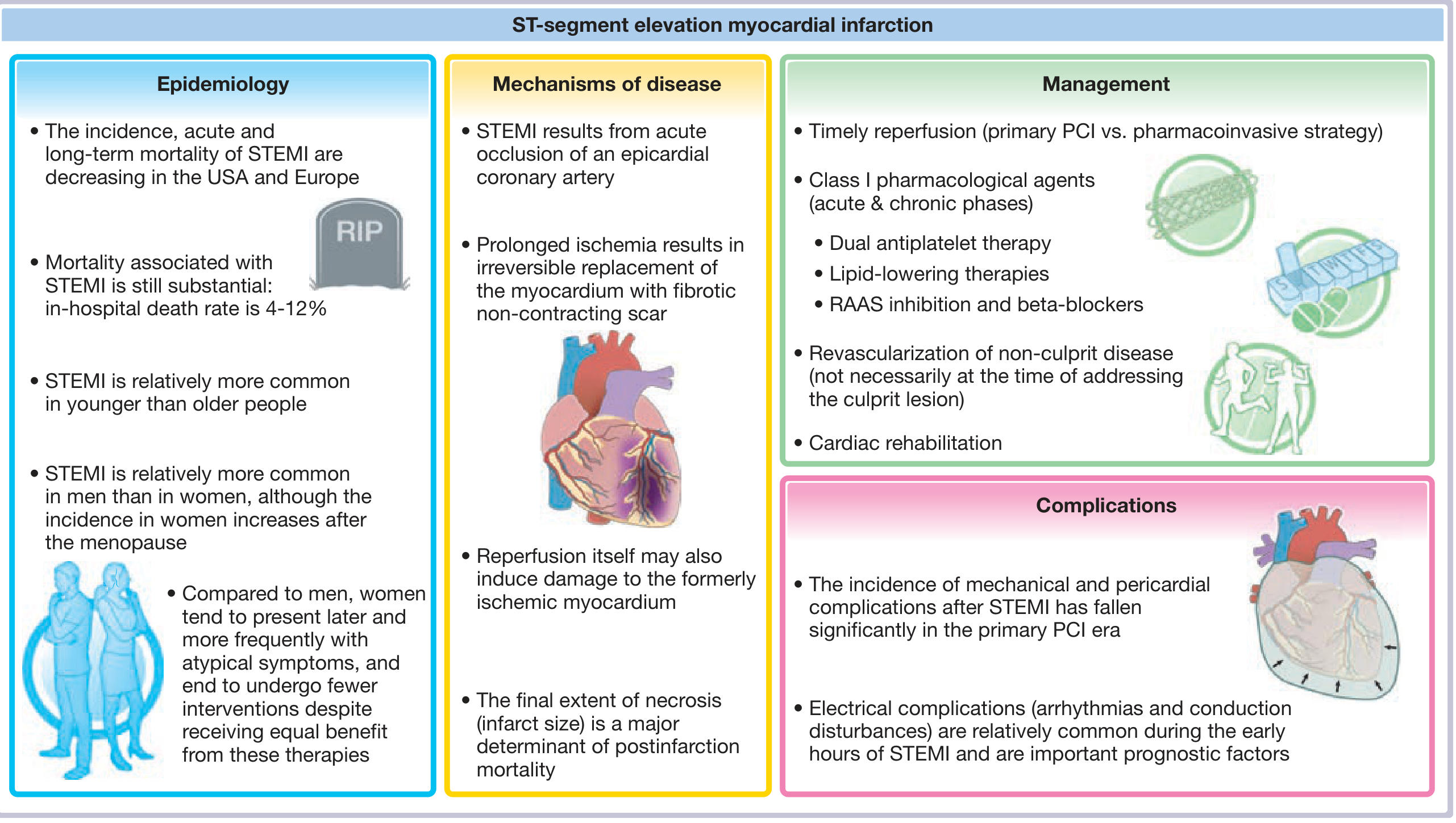
FLOWCHART: Management of Acute MI
SUSPECTED MI (Chest pain > 10-20 min + diaphoresis/dyspnea)
              ↓
    IMMEDIATE ASSESSMENT (within 10 min)
    • 12-lead ECG
    • IV access + cardiac monitoring
    • Serial troponin (high-sensitivity)
    • CXR, CBC, electrolytes, coagulation
              ↓
    ┌─────────────────────────────────────┐
    │         STEMI                        │  ← ST elevation ≥ 1mm in ≥2 contiguous leads
    │         (Complete occlusion)         │     OR new LBBB
    └─────────────────────────────────────┘
              ↓
    ┌─────────────────────────────────────────────────────┐
    │         IMMEDIATE PHARMACOTHERAPY (MONA + more)      │
    └─────────────────────────────────────────────────────┘
    • Morphine IV (pain, anxiety)
    • Oxygen (if SpO₂ < 90%)
    • Nitrates (sublingual/IV if no hypotension)
    • Aspirin 162-325 mg (chewed)
    • P2Y₁₂ inhibitor (Ticagrelor 180 mg OR Clopidogrel 600 mg)
    • Anticoagulation: UFH or LMWH (enoxaparin)
    • β-blocker (oral, within 24h if no contraindication)
    • Statin (high-intensity: atorvastatin 80 mg)
              ↓
    ┌─────────────────────────────────────────────────────┐
    │             REPERFUSION STRATEGY                     │
    └─────────────────────────────────────────────────────┘
           ↓                             ↓
   PCI available?                  PCI NOT available /
   Door-to-balloon ≤ 90 min?       Delay > 120 min?
           ↓                             ↓
  PRIMARY PCI (preferred)       FIBRINOLYTIC THERAPY
  - Stenting of culprit artery   - tPA (alteplase) preferred over SK
  - Best outcomes overall        - Door-to-needle < 30 min
  - Less re-infarction           - Within 12h of symptom onset
  - Fewer intracranial bleeds    - Then transfer for PCI (rescue PCI
                                   if lysis fails; elective PCI 3-24h)
              ↓
    CARDIOGENIC SHOCK → Primary PCI immediately
    (fibrinolysis NOT recommended in shock)
              ↓
    ┌──────────────────────────────────────────┐
    │         POST-MI / LONG-TERM THERAPY       │
    └──────────────────────────────────────────┘
    • Dual antiplatelet (Aspirin + P2Y₁₂) → at least 12 months
    • ACE inhibitor / ARB → especially if EF reduced or anterior MI
    • β-blocker → continue long-term (reduces mortality)
    • High-intensity statin (atorvastatin/rosuvastatin)
    • Complete revascularization of non-culprit vessels (at same or
      subsequent procedure, except in cardiogenic shock)
    • Cardiac rehabilitation
    • Lifestyle modification
KEY POINTS (Bullet Summary)
1. Initial Stabilization ("MONA")
- M - Morphine: relieves pain and reduces sympathetic activation
- O - Oxygen: only if SpO₂ < 90% (routine O₂ is no longer recommended)
- N - Nitrates: sublingual/IV for chest pain relief (avoid if SBP < 90 mmHg or RV infarct)
- A - Aspirin: 162-325 mg chewed immediately (inhibits TXA₂-mediated platelet aggregation)
2. Antiplatelet / Antithrombotic Therapy
- Add a P2Y₁₂ inhibitor: Ticagrelor (preferred) or Clopidogrel
- Anticoagulation: UFH bolus + infusion OR enoxaparin (LMWH)
- Duration: dual antiplatelet for ≥12 months post-stent
3. Reperfusion - The Most Important Goal
| Strategy | Indication | Time Target |
|---|---|---|
| Primary PCI | PCI available, preferred | Door-to-balloon ≤ 90 min |
| Fibrinolysis | PCI unavailable or delay > 120 min | Door-to-needle < 30 min |
| Rescue PCI | Failed fibrinolysis | Urgent transfer |
- Preferred thrombolytics: Tenecteplase (single bolus) or Reteplase (double bolus) - more convenient than alteplase
- Streptokinase is less preferred (lower patency rates)
4. Adjunctive Medications
- β-blocker (metoprolol): within 24h; reduce HR, BP, arrhythmia risk - avoid in acute LVF/cardiogenic shock
- ACE inhibitor (ramipril/lisinopril): start within 24h, especially anterior MI or EF <40%
- High-intensity statin: Atorvastatin 40-80 mg - started immediately, continued indefinitely
5. Complications to Monitor
- Arrhythmias: VT/VF (most common cause of early death) - defibrillation/antiarrhythmics
- Cardiogenic shock: requires emergent PCI + inotropes (dobutamine) ± IABP
- Acute LVF/pulmonary edema: diuretics + vasodilators
- Mechanical complications: free wall rupture, VSD, papillary muscle rupture (surgical emergency)
- RV infarction (inferior STEMI): avoid nitrates + diuretics; give IV fluids
6. Secondary Prevention (Long-term)
- Dual antiplatelet → aspirin lifelong + P2Y₁₂ for 12 months
- ACE inhibitor + β-blocker + statin → lifelong
- Aldosterone antagonist (eplerenone) if EF <40% + symptoms
- Cardiac rehab, exercise, smoking cessation, BP and diabetes control
Memory Aid:
"MONAB + PCI/Thrombolysis + ABCDES"
- Aspirn + Anticoagulation
- Beta-blocker
- Cholesterol (statin)
- Dual antiplatelet
- Eplerenone (if EF low)
- Secondary prevention
Sources: Goldman-Cecil Medicine International Edition | Textbook of Family Medicine 9e | Fuster & Hurst's The Heart, 15th Edition
This is a shared conversation. Sign in to Orris to start your own chat.