
A 31yr old male presented with history of loose stools 10-15 episodes per day with blood ,associated with vomiting, this episode lasted for 15days
Reading File
Now let me search the medical library for relevant content on this clinical presentation - bloody diarrhea with high frequency stools.
Finding Sources
Finding Sources
Finding Sources
Finding Sources
Finding Sources
Finding Sources
Reading File
Reading File
Finding Sources
Reading File
Finding Sources
Finding Sources
Now I have enough to construct a comprehensive clinical analysis. Let me provide the full response.
Clinical Analysis: 31-Year-Old Male with Bloody Diarrhea (10-15 stools/day) + Vomiting for 15 Days
Immediate Impression
This presentation - high-frequency bloody diarrhea with mucus, vomiting, and a 15-day course in a young adult - is a medical emergency until proven otherwise. The key differential to work through systematically:
Top Differential Diagnoses
1. Acute Severe Ulcerative Colitis (ASUC) - Most Important to Rule Out
This fits the classic picture. ASUC is defined by the Truelove-Witts Criteria:
- ≥6 bloody stools per day (this patient has 10-15)
- Plus at least one systemic marker:
- Pulse >90 bpm
- Temperature >37.8°C
- Hemoglobin <10.5 g/dL
- ESR >30 mm/h
This patient likely meets ASUC criteria given the stool frequency alone. ASUC carries a risk of in-hospital colectomy exceeding 50% when ≥3 systemic markers are present.
"Acute severe ulcerative colitis (ASUC) is a medical emergency and requires prompt treatment in hospital, to avoid complications of spontaneous perforation and toxic megacolon." - Yamada's Textbook of Gastroenterology, 7th Ed.
2. Amoebic Dysentery (Entamoeba histolytica)
Classic presentation in a young adult, especially in endemic/resource-limited settings:
- Fever, tenesmus, abdominal pain
- Watery stools with blood and mucus
- Vomiting can occur
Key distinguishing features:
- Stool microscopy: mobile trophozoites containing ingested RBCs (pathognomonic)
- Nonpathogenic ameba cysts do NOT contain host RBCs
- Immune assay of stool can differentiate pathogenic from non-pathogenic species
- Serology may be negative in the first month of infection
"E. histolytica causes an invasive or inflammatory diarrhea. Patients complain of fever, tenesmus, abdominal pain, and watery stool containing blood and mucus." - Rosen's Emergency Medicine, 9th Ed.
3. Infectious Bacterial Dysentery
- Shigella - most likely bacterial cause of high-volume bloody diarrhea with systemic features; can cause >10 stools/day; self-limiting in 5-7 days but may persist longer
- Campylobacter jejuni - bloody diarrhea, fever, vomiting, can last 7-10 days
- Salmonella (non-typhoidal) - bloody diarrhea, high fever, vomiting
- EHEC (E. coli O157:H7) - bloody diarrhea without high fever; watch for HUS (hemolytic uremic syndrome) - especially if oliguria develops
The 15-day duration makes a simple bacterial gastroenteritis less likely unless complicated, or if it has triggered a post-infectious IBD flare.
4. Crohn's Disease (First Presentation)
- Transmural inflammation affecting any part of the GI tract
- Can present with diarrhea (with or without blood), weight loss, abdominal pain, fever
- Less likely as a first-time presentation with this acuity, but must be excluded
- Rectal involvement distinguishes UC from Crohn's (Crohn's may spare the rectum)
5. Pseudomembranous Colitis (C. difficile)
- Especially if the patient had recent antibiotic use
- Can cause severe bloody diarrhea with systemic toxicity
- Must send stool C. diff toxin assay
Workup to Order (Urgency-Based)
Immediate (On Admission)
| Investigation | Rationale |
|---|---|
| CBC with differential | Assess anemia (Hb <10.5 = ASUC criterion), leukocytosis |
| CRP, ESR | Inflammation markers; ESR >30 = ASUC criterion |
| Serum electrolytes, urea, creatinine | Dehydration, AKI from losses |
| Serum albumin | Marker of nutrition and disease severity |
| Stool microscopy + culture | Trophozoites (amoeba), ova, cysts, WBCs, RBCs |
| Stool culture - bacteria | Shigella, Salmonella, Campylobacter |
| C. difficile toxin (EIA or PCR) | Rule out C. diff colitis |
| Stool amoebic antigen test | More sensitive than microscopy for E. histolytica |
| Plain abdominal X-ray | Screen for toxic megacolon (transverse colon >6 cm) or free air |
Secondary
| Investigation | Rationale |
|---|---|
| Abdominal/pelvic CT scan | If severe pain, fever, distension, or elevated WBC |
| Flexible sigmoidoscopy (within 24-48 hrs) | Assess extent, collect biopsies, rule out CMV colitis |
| Serum CMV PCR or biopsy | CMV can trigger/mimic severe UC |
| LFTs, PT/INR | Baseline; rule out liver abscess (amoeba) |
| Hepatitis B surface Ag/Ab/core Ab | Before starting infliximab if ASUC confirmed |
| TPMT enzyme activity | Before starting azathioprine |
| TB Quantiferon/Mantoux | Before biologic therapy |
Management Principles
If ASUC Confirmed:
- Admit to hospital - this is a medical emergency
- IV fluid resuscitation - correct dehydration and electrolytes
- NPO or restricted diet - bowel rest
- IV corticosteroids - methylprednisolone 40-60 mg/day or hydrocortisone 200-300 mg/day
- Monitor for toxic megacolon - daily abdominal X-ray, vitals
- If steroids fail at 3-5 days - rescue therapy with:
- Infliximab (5 mg/kg), OR
- Cyclosporine (2-4 mg/kg IV)
- Surgical consultation early - subtotal colectomy if deteriorating
If Amoebic Dysentery Confirmed:
- Metronidazole 750 mg every 8 hours (10 days) - drug of choice
- Followed by a luminal amebicide to eliminate intraluminal cysts:
- Iodoquinol 650 mg TID x 20 days, OR
- Paromomycin 500 mg TID x 7 days
If Bacterial Dysentery:
- Supportive care, hydration
- Ciprofloxacin or azithromycin for Shigella/Salmonella if severe
- Avoid antispasmodics (risk of ileus/megacolon)
Red Flags Requiring Urgent Surgical Review
- Abdominal rigidity or peritoneal signs
- Toxic megacolon (colon >6 cm on X-ray)
- Free air on imaging (perforation)
- Rapid clinical deterioration despite IV steroids
- Septic shock (hypotension, high fever, altered consciousness)
Summary
| Priority | Likely Diagnosis | Key Differentiator |
|---|---|---|
| 1st | Acute Severe UC | ≥6 bloody stools + systemic toxicity; colonoscopic findings |
| 2nd | Amoebic Dysentery | Tropical/endemic exposure; trophozoites with RBCs in stool |
| 3rd | Bacterial Dysentery (Shigella) | Stool culture; shorter typical course |
| 4th | C. difficile colitis | Recent antibiotics; C. diff toxin positive |
The 15-day duration, extremely high stool frequency (10-15/day), and blood in stool point most strongly toward ASUC or invasive infectious colitis (amoeba/Shigella). These must be differentiated early as treatment differs fundamentally - steroids will worsen amoebic infection, and missing ASUC means risking perforation.
Sources: Yamada's Textbook of Gastroenterology, 7th Ed. | Rosen's Emergency Medicine | Symptom to Diagnosis: An Evidence-Based Guide, 4th Ed.
He also developed skin lesions before this episode
The skin lesions appearing before the GI episode is a very important clue. Let me clarify before diving deeper.
Asking for Preferences
What did the skin lesions look like? · Where were the skin lesions located?
Pustular/scaling rash on the lower limbs preceding bloody diarrhea - this strongly shifts the differential. Let me search the medical library now.
Searching sources...
Finding Sources
Finding Sources
Finding Sources
Finding Sources
Finding Sources
Finding Sources
Reading File
Finding Sources
Finding Sources
Loading Image
Finding Sources
Excellent - now I have a very clear clinical picture. Here is the updated, refined analysis:
Updated Analysis: Pustular/Scaling Rash on Lower Limbs PRECEDING Bloody Diarrhea
This new information is a major diagnostic pivot. A pustular/scaling rash on the lower limbs appearing before the GI episode narrows the differential significantly toward two major diagnoses:
Leading Diagnoses
1. Inflammatory Bowel Disease (UC or Crohn's) with Extraintestinal Skin Manifestations
Skin manifestations of IBD are well-recognized and can precede, accompany, or follow bowel disease activity. The two classic dermatological EIMs (extraintestinal manifestations) on the lower limbs are:
a) Pyoderma Gangrenosum (PG)
- Starts as pustules or papules on the lower limbs/shins, then evolves into deep ulcerating lesions with a purulent, necrotic center and raised dusky-purple border
- Occurs in ~2% of UC patients
- Can appear before or independently of bowel disease activity
- The pustular early stage of PG is easily confused with infection - this is critical to recognize as misdiagnosis leads to harmful debridement
b) Erythema Nodosum (EN)
- Bilateral, raised, erythematous, tender subcutaneous nodules on the anterior tibial surface (shins)
- More common than PG (~15% of IBD patients)
- Strongly correlates with active bowel disease and typically precedes flares
- More nodular/tender than pustular, but early lesions can look erythematous and scaling
"Peripheral and axial arthritis and skin lesions including erythema nodosum and pyoderma gangrenosum are the most common extraintestinal complications." - Tintinalli's Emergency Medicine
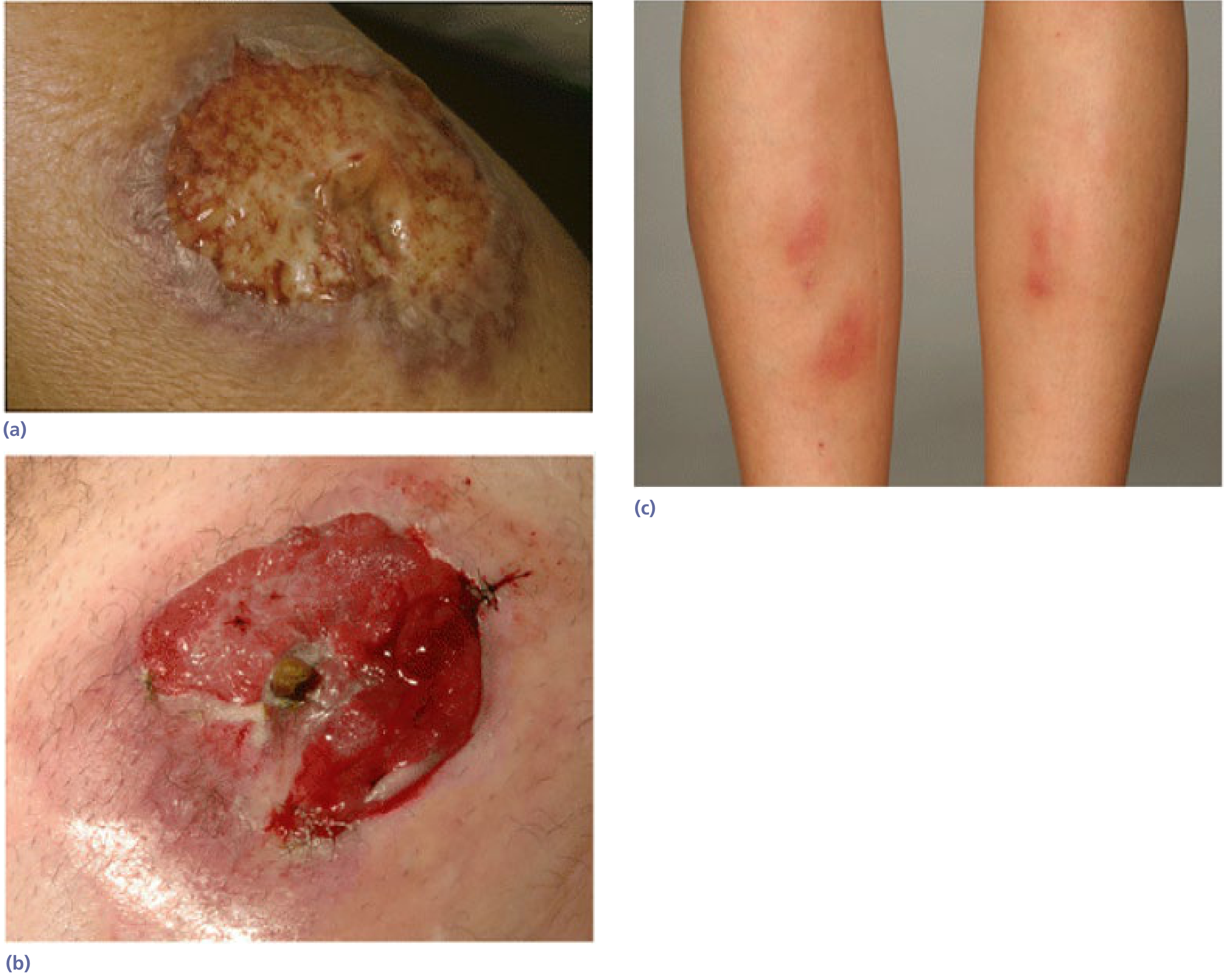
2. Reactive Arthritis (Reiter's Syndrome) - with Keratoderma Blennorrhagica
The classic triad: urethritis + arthritis + conjunctivitis, but the presentation can be incomplete. A key skin finding is keratoderma blennorrhagica - a pustular, scaling rash on the soles and lower limbs that is virtually pathognomonic for reactive arthritis.
The sequence here - skin rash THEN diarrhea - fits the post-enteric reactive arthritis pattern:
- Triggered by enteric infections (Shigella, Salmonella, Campylobacter, Yersinia)
- Skin lesions can appear in the prodromal phase
- Young adult male is the classic demographic (HLA-B27 association)
- However, in reactive arthritis the diarrhea is typically the trigger (comes first), not the result - so this sequence makes UC with PG more likely
3. Psoriasis with Gut Involvement / IBD-Associated Psoriasis
- Psoriasis and IBD share common genetic pathways (TNF-alpha, IL-23/IL-17 axis)
- Pustular psoriasis on lower limbs can precede or coexist with IBD
- UC patients have ~2x higher risk of psoriasis
- If scaling/silvery plaques are present on shins, this fits psoriasis
Revised Differential Priority
| Rank | Diagnosis | Key Clue |
|---|---|---|
| 1st | UC/IBD with Pyoderma Gangrenosum | Pustular lesion on shin BEFORE bloody diarrhea; PG starts as pustules |
| 2nd | UC/IBD with Erythema Nodosum | Red raised nodules on anterior tibia preceding flare |
| 3rd | IBD-associated Psoriasis | Scaling plaques, shared immune pathway |
| 4th | Reactive Arthritis (Keratoderma Blennorrhagica) | Young male, HLA-B27, pustular scaling rash; but diarrhea usually precedes skin here |
How the Skin Changes the Workup
Add these investigations to the previous list:
| Test | Reason |
|---|---|
| Skin biopsy | Differentiate PG vs EN vs psoriasis vs reactive arthritis |
| HLA-B27 | If reactive arthritis suspected |
| ASCA (anti-Saccharomyces), p-ANCA | IBD serological markers (ASCA+ favors Crohn's; p-ANCA+ favors UC) |
| Calprotectin (fecal) | Elevated in IBD flares |
| Colonoscopy with biopsy | Gold standard to confirm IBD type and extent |
| Joint examination | Look for arthritis (another IBD EIM) |
| Eye examination | Uveitis/episcleritis (another IBD EIM) |
| ANA, RF | Rule out connective tissue disease with skin+gut involvement |
Critical Point: Skin Lesion Preceding GI = IBD Until Proven Otherwise
The fact that the skin lesion appeared before the acute GI episode is classic for IBD-related EIMs, particularly pyoderma gangrenosum and erythema nodosum, which can herald a flare by days to weeks. This makes Inflammatory Bowel Disease (likely Ulcerative Colitis) the top working diagnosis, with the current episode representing an Acute Severe UC flare requiring urgent hospitalization.
Do NOT debride or surgically manage the skin lesion without biopsy - PG exhibits pathergy (worsens with trauma/surgery), a feature that distinguishes it from infectious pustular conditions.
Sources: Yamada's Textbook of Gastroenterology, 7th Ed. | Tintinalli's Emergency Medicine | Sleisenger & Fordtran's Gastrointestinal and Liver Disease
This is a shared conversation. Sign in to Orris to start your own chat.