
explain afo in detail and how to write structured proper 10markwr answer in detailed
Which subject/context are you referring to with 'AFO'?
ankle foot orthosis AFO types
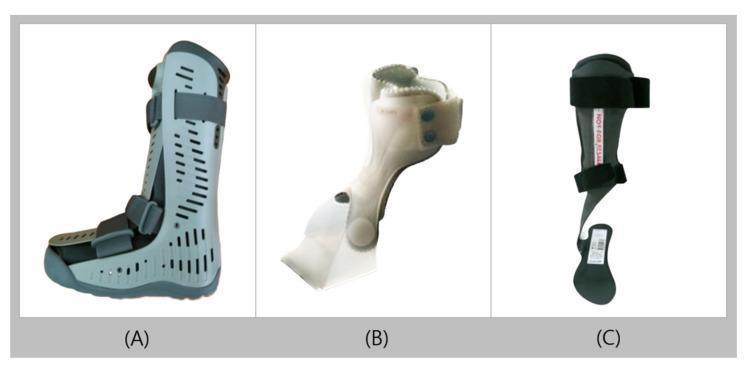
A comparative clinical photograph showing three distinct types of ankle-foot orthoses (AFO) used in rehabilitative medicine. (A) Walking Boot: A rigid, pneumatic orthosis featuring a tall plastic shell with ventilation perforations, multiple Velcro strap closures, and a rocker-bottom sole designed for maximum immobilization and stable gait during acute injury recovery. (B) UD-Flex: A modern, semi-flexible AFO characterized by an anterior-facing shell and an open-heel design. It is constructed from lightweight plastic to facilitate natural ground reaction feedback and proprioception. (C) Carbon Fiber AFO (CFAFO): A streamlined, minimalist orthosis made from high-stiffness carbon fiber. It features a thin shell, open heel, and slender profile to optimize energy storage, weight reduction, and durability. These devices are utilized to manage conditions such as foot drop, spasticity, ligament injuries, and postoperative stabilization by controlling ankle joint kinematics.
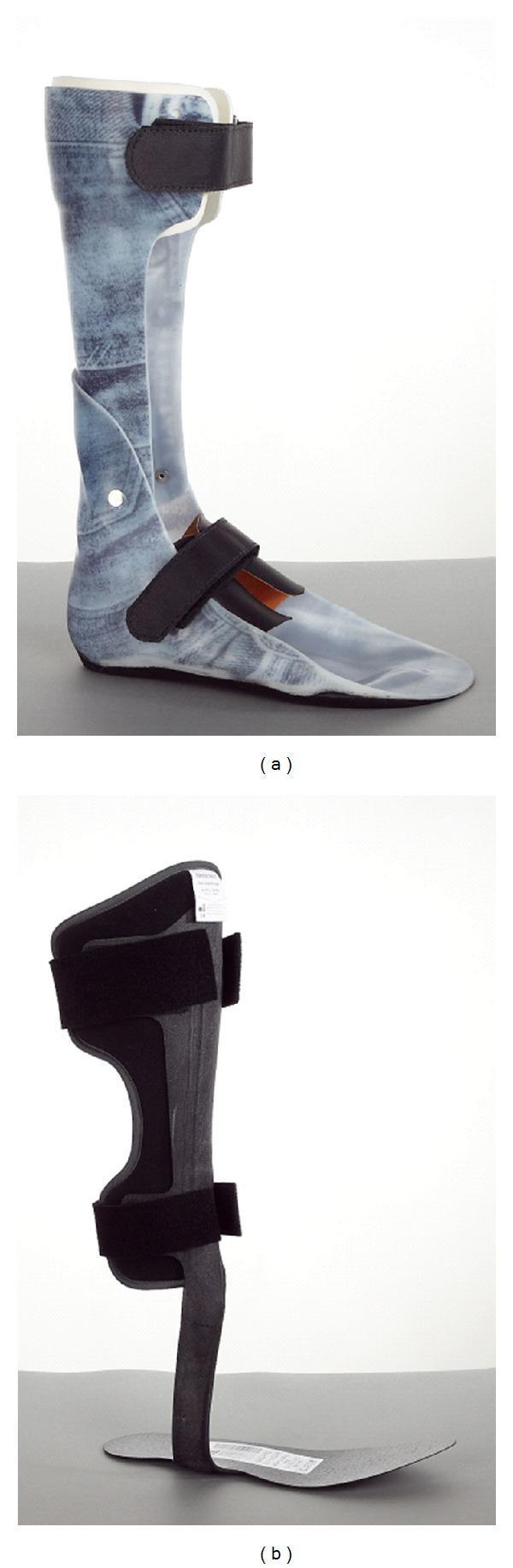
A comparative clinical photograph of two types of Ankle-Foot Orthoses (AFOs). Figure (a) illustrates a dynamic ankle-foot orthosis (DAFO), which is a custom-molded, articulated device made of polypropylene. It features a blue-patterned shell, a 90-degree plantar flexion stop hinge at the ankle, a full-length footplate, and two black hook-and-loop straps for stabilization at the tibia and midfoot. Figure (b) demonstrates a carbon composite AFO (C-AFO), exhibiting a more minimalist, anterior-shell design. It is constructed from lightweight black carbon composite materials with a thinner shank and a dynamic footplate designed for energy return. The C-AFO includes two broad black stabilization straps. These orthoses are used in physical medicine and rehabilitation to manage gait abnormalities, foot drop, and mediolateral ankle instability by providing structural support and facilitating functional mobility.
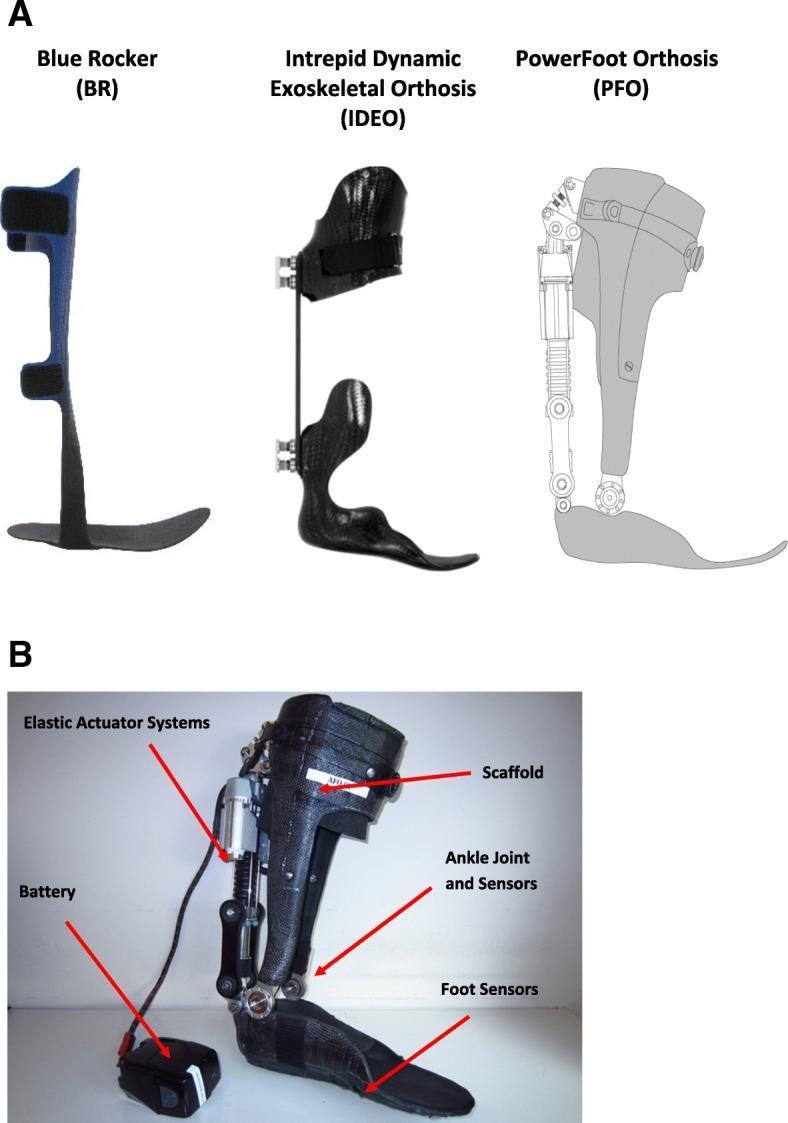
This educational image displays a comparative overview of three types of Ankle-Foot Orthoses (AFOs) used in rehabilitation and gait assistance. Section A shows side-profile views of: 1) The Blue Rocker (BR), a passive carbon fiber AFO featuring a continuous lateral strut and flexible footplate; 2) The Intrepid Dynamic Exoskeletal Orthosis (IDEO), a passive dynamic AFO with a custom carbon fiber cuff and rigid footplate connected by a posterior strut; and 3) A schematic of the PowerFoot Orthosis (PFO), a complex, powered robotic AFO. Section B provides a posterior clinical photograph of the PFO, labeling its integrated electromechanical components. Key features include the 'Scaffold' (a carbon fiber structural shank), 'Elastic Actuator Systems' for motor-controlled power generation, 'Ankle Joint and Sensors' for monitoring position and torque, 'Foot Sensors' for gait phase detection, and an external 'Battery' pack. The image illustrates the technological progression from passive-elastic to active-powered orthotic interventions for addressing lower-limb biomechanical deficits.
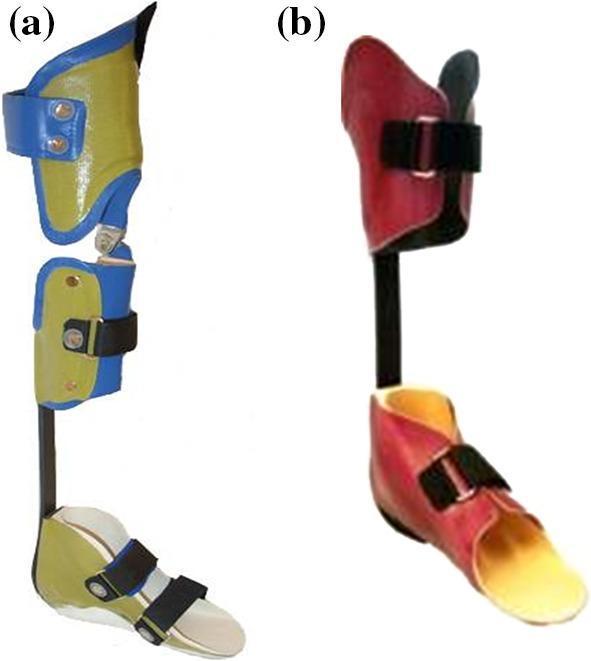
This clinical photograph displays two types of carbon fiber spring orthoses used in pediatric gait rehabilitation. Image (a) depicts a Knee-Ankle-Foot Orthosis (KAFO) featuring a tri-level system with a thigh cuff, a shank cuff, and a footplate. The cuffs are constructed from yellow thermoplastic with blue reinforced edging and integrated mechanical hinges to allow controlled sagittal knee movement. A rigid posterior bar, likely carbon fiber, connects the shank to the foot section. Image (b) shows an Ankle-Foot Orthosis (AFO-C) consisting of a proximal calf cuff and a distal footplate joined by a vertical carbon fiber spring shank. The AFO-C uses red molded thermoplastic with black Velcro strap closures and a low-profile footplate designed for energy storage and push-off assistance. These devices are indicated for conditions like Arthrogryposis Multiplex Congenita (AMC) to stabilize joints and enhance lower limb kinematics during the stance and swing phases of gait.
ankle foot orthosis AFO types classification biomechanics indications
https://pmc.ncbi.nlm.nih.gov/articles/PMC8392067
Ankle-Foot Orthosis (AFO) - Complete Detailed Guide + 10-Mark Answer Structure
PART 1: COMPLETE KNOWLEDGE OF AFO
1. Definition
- Miller's Review of Orthopaedics 9th Edition, p. 887
2. Purpose and Functions
| Function | Mechanism |
|---|---|
| Prevent foot drop | Maintains dorsiflexion during swing phase |
| Improve gait | Provides foot clearance; enables heel strike |
| Stabilize ankle | Controls varus/valgus; prevents sprains |
| Prevent/correct deformity | Manages equinus, pes planus, valgus/varus |
| Protect joints | Reduces load after hindfoot fusions |
| Substitute muscle action | Replaces lost dorsiflexors/plantarflexors |
| Control spasticity | Limits abnormal range in spastic conditions |
3. Anatomy of Control - Trimline Concept
- Full/anterior trimline - Maximum mediolateral control; very rigid
- Intermediate trimline - Moderate support; balances control vs. flexibility
- Posterior trimline (Posterior Leaf Spring) - Minimal mediolateral control; allows sagittal motion; used mainly for foot drop
4. Classification of AFOs
A. By Rigidity
- Completely limits ankle motion in all planes
- Indicated for: foot drop, weak dorsiflexion/plantarflexion, ligament injury, mild knee instability, valgus/varus deformity
- The ankle is fixed - usually at 90° (plantigrade)
- Allows some controlled motion; provides mild-to-moderate support
- Used when some ankle movement is tolerated but partial restriction is needed
- Example: Posterior Leaf Spring Orthosis (PLSO)
- Has a mechanical ankle joint connecting shank and foot shells
- Allows dorsiflexion while blocking or limiting plantarflexion
- Easier for stair climbing, uneven surfaces
- Subtypes: Overlap joint, Oklahoma joint, Gillette joint
- Primary selection factors: range of motion, durability, adjustability, biomechanical effect on the knee
B. By Material
| Material | Example | Properties |
|---|---|---|
| Metal + leather | Double upright AFO | Durable, adjustable, heavy |
| Thermoplastic (polypropylene) | Solid AFO, PLSO | Lightweight, moldable, common |
| Carbon fiber | CFAFO | Ultra-light, energy-storing, high stiffness |
| Composite | Dynamic AFO (DAFO) | Flexible shell, proprioception-friendly |
C. Specific Named Types
| Type | Full Name | Key Feature | Indications |
|---|---|---|---|
| SAFO | Solid AFO | Fixed ankle | Foot drop, spasticity |
| PLSO | Posterior Leaf Spring | Spring-loaded trimline behind ankle; allows slight DF in stance | Mild foot drop, swing-phase DF weakness |
| HAFO | Hinged AFO | Mechanical ankle joint | When some motion needed but limited control required |
| PTB-AFO | Patellar Tendon Bearing AFO | Anterior shell offloads heel/foot weight via patellar tendon | Plantar ulcers, calcanectomy, severe fractures, skin grafts |
| GRAFO | Ground Reaction AFO | Anterior shell; blocks knee flexion in stance | Crouch gait in cerebral palsy |
| DAFO | Dynamic AFO | Custom-molded, proprioception-preserving | Spastic CP, TBI |
| Carbon Fiber AFO | CFAFO / ESR-AFO | Energy storage and return; thin, light | Active users needing energy efficiency |
| Walking Boot | Pneumatic AFO | Full immobilization, rocker bottom | Acute fractures, postoperative stabilization |
| UD-Flex | - | Open heel, anterior shell, semi-flexible | Foot drop, post-stroke rehabilitation |
5. Biomechanics
- Force application - Applies a corrective three-point force system to hold a segment in alignment
- Motion control - Restricts or assists specific planes of motion (sagittal = DF/PF; frontal = varus/valgus; transverse = rotation)
- Joint positioning - Holds the foot at a predetermined alignment (e.g., 90° for foot drop)
- Load redistribution - In PTB-AFO, shifts load from foot to patellar tendon
- Swing phase: Prevents foot drag by maintaining dorsiflexion; enables toe clearance
- Initial contact (heel strike): Provides stable heel contact; controls ankle descent
- Mid-stance: Maintains stability; absorbs ground reaction force (GRF)
- Terminal stance/push-off: Some AFOs (PLSO, carbon fiber) store and return energy to assist push-off
6. Indications
- Stroke/hemiplegia (foot drop, spasticity)
- Cerebral palsy (spastic equinus, crouch gait)
- Spinal cord injury
- Multiple sclerosis
- Charcot-Marie-Tooth disease
- Peripheral nerve injury (common peroneal nerve palsy)
- Post hindfoot/ankle fusions
- Ankle/subtalar arthritis
- Ligamentous instability
- Fractures and post-fracture rehabilitation
- Flat foot (pes planus) with instability
- Equinus deformity (passively correctable)
- Myelomeningocele (spina bifida) - especially at sacral level (S1 = foot deformities)
- Developmental delay with gait abnormality
- Arthrogryposis multiplex congenita
7. Contraindications
- Fixed, uncorrectable deformities (cannot force a rigid orthosis over a fixed equinus)
- Spastic deformities that cannot be easily controlled manually
- Insensate limb with high skin fragility (relative contraindication - needs modified design and vigilant monitoring)
- Fixed varus/valgus hindfoot deformity (rigid neutral AFO will not fit)
8. Assessment Before Prescribing
- Range of motion (ROM) at ankle, subtalar, midtarsal joints
- Muscle power (dorsiflexors, plantarflexors, invertors, evertors)
- Proprioception
- Sensation
- Leg length discrepancy
- Level of mobility and ambulation
- Gait pattern and deviations
- Compensation mechanisms
- Risk of falling
- Pain assessment
9. Complications and Troubleshooting
- Pressure sores - Over bony prominences (malleoli, heel, navicular)
- Skin breakdown - Especially in insensate limbs; padding and skin checks mandatory
- Poor fit - Results from edema, muscle wasting, or inadequate molding
- Gait deviation - If AFO angle is wrong (too DF or PF), abnormal knee and hip moments result
- Increased energy expenditure - Poorly fitted or heavy AFOs tire patients faster
- Reduced proprioception - Especially with rigid total-contact designs
10. Newer Developments
- AF Servo - Powered motorized AFO for active assistance
- TurboMed - Energy-storing composite design
- 3D-printed AFO - Patient-specific, lightweight, rapid fabrication
- Robotic/powered AFOs (PowerFoot) - Integrated sensors, elastic actuators, and motor systems; represents the technological frontier from passive to active orthoses
Visual Reference
PART 2: HOW TO WRITE A STRUCTURED 10-MARK ANSWER ON AFO
Template Structure for a 10-Mark Answer on AFO
✅ PARAGRAPH 1 - Introduction and Definition (1 mark)
An Ankle-Foot Orthosis (AFO) is the most commonly prescribed lower limb orthosis. It is an external device applied from below the knee to the foot that controls the ankle joint, stabilizes gait, and prevents deformity. It may be fabricated using metal bars with shoe attachments or thermoplastic elastomers (TPE). The orthosis may be rigid or allow free or spring-assisted motion in either the sagittal or frontal plane.
✅ PARAGRAPH 2 - Aims / Functions (1 mark)
Aims of AFO:
- Prevent foot drop and toe drag during swing phase
- Enable stable heel contact at initial contact
- Control varus/valgus deformity
- Protect post-fusion ankle and hindfoot
- Improve gait energy efficiency
- Substitute for lost muscle function (dorsiflexors, plantarflexors)
✅ PARAGRAPH 3 - Classification (3 marks) ← most marks here
Classification:A. By Rigidity:
- Rigid (Solid) AFO - Completely limits ankle motion; for foot drop, spasticity, instability
- Semi-rigid / Posterior Leaf Spring (PLSO) - Spring trimline allows slight DF in mid-stance; for mild foot drop
- Articulated/Hinged AFO (HAFO) - Mechanical ankle joint; allows dorsiflexion, blocks plantarflexion; for gait on uneven surfaces
- PTB-AFO - Patellar tendon bearing; offloads foot; for plantar ulcers, fractures
- Ground Reaction AFO (GRAFO) - Prevents crouch gait; used in CP
B. By Material:
- Metal + leather (traditional, heavy, durable)
- Thermoplastic polypropylene (common, lightweight, moldable)
- Carbon fiber (energy-storing, ultra-light, for active users)
C. Trimline (determines rigidity and mediolateral control):
- Full/anterior trimline - maximum control
- Posterior trimline - minimal control; used for foot drop only
✅ PARAGRAPH 4 - Biomechanics (1 mark)
Biomechanics:
- AFO applies a 3-point force system to hold segments in alignment
- During swing phase: maintains dorsiflexion, prevents foot drag
- During stance phase: controls heel strike, absorbs GRF, stabilizes midstance
- Knee effect: A 5° dorsiflexed AFO reduces knee hyperextension; plantarflexed AFO promotes knee extension in quadriceps weakness
- Carbon fiber and PLSO designs store energy at mid-stance and return it at push-off
✅ PARAGRAPH 5 - Indications (2 marks)
Indications:Neurological:
- Stroke / hemiplegia (foot drop, spastic equinus)
- Cerebral palsy (spastic equinus, crouch gait)
- Spinal cord injury (SCI)
- Peripheral nerve palsy (common peroneal nerve injury)
- Multiple sclerosis, Charcot-Marie-Tooth
Orthopaedic:
- Post hindfoot / ankle fusions
- Ankle/subtalar arthritis (alongside Arizona brace)
- Fractures and ligamentous instability
- Pes planus with instability
Pediatric:
- Myelomeningocele (especially sacral level - S1 foot deformities)
- Arthrogryposis multiplex congenita
✅ PARAGRAPH 6 - Contraindications and Complications (1 mark)
Contraindications:
- Fixed, uncorrectable deformities
- Spastic deformities that cannot be controlled passively
- Fixed varus/valgus hindfoot deformity
Complications:
- Pressure sores over malleoli, heel, navicular
- Skin breakdown in insensate limbs
- Gait deviations from incorrect ankle angle
- Increased energy expenditure if poorly fitted
✅ PARAGRAPH 7 - Recent Advances (0.5 - 1 mark) - adds distinction
Recent Advances:
- 3D-printed AFOs: patient-specific, rapid fabrication, lightweight
- Carbon fiber energy-storing AFOs: store energy at mid-stance, return at push-off
- Powered/robotic AFOs (AF Servo, PowerFoot): integrated sensors, elastic actuators for active motor assistance - beneficial in stroke rehabilitation
Marks Distribution Summary
| Section | Content | Marks |
|---|---|---|
| Introduction + Definition | What AFO is, materials | 1 |
| Functions / Aims | 5-6 bullet points | 1 |
| Classification | Rigidity, material, trimline - detailed with names | 3 |
| Biomechanics | 3-point force, gait phases, knee effect | 1 |
| Indications | Neurological + orthopaedic + paediatric | 2 |
| Contra-indications + Complications | Brief but specific | 1 |
| Recent advances | 3D print, carbon fiber, powered AFO | 1 |
| Total | 10 |
10-Mark Writing Tips (General Rules)
- Use headings and subheadings - examiners scan; bold/underline section headers
- Classify before you describe - Always give a classification table/list early; it signals systematic thinking
- Use short bullets under each heading - 3 to 5 bullets per section; never write dense prose
- Add a table wherever possible - Especially for classification (type vs. indication vs. material)
- Be specific with names - "Posterior Leaf Spring AFO" scores more than "a semi-rigid brace"
- Include biomechanics - Even 2-3 lines on forces/gait phases elevates the answer
- End with recent advances - Always adds the final mark; shows updated knowledge
- Approximate length - 400-550 words, written in 15-18 minutes for a 10-mark answer
- Draw a simple diagram if possible - A labeled sketch of AFO parts (calf section, ankle joint, foot plate, trimline) can replace 1 paragraph
- Do not repeat - Each paragraph must add new information; do not restate the definition in the indications section
- Miller's Review of Orthopaedics 9th Edition - Orthotics chapter (ANKLE-FOOT ORTHOSES section)
- Kang et al. (2021), Commonly Used Types and Recent Development of Ankle-Foot Orthosis - PMC Narrative Review
- Physio-Pedia: Foundations for Ankle Foot Orthoses