
explain me about upper and lower limbs bones and muscles, skull, joints vertebrae.
Reading File
Now let me search the medical library for all these anatomy topics in parallel.
Finding Sources
Finding Sources
Finding Sources
Finding Sources
Finding Sources
Finding Sources
Finding Sources
Finding Sources
I have the paths. Let me now read the key anatomy sections in parallel from Gray's Anatomy for Students.
Reading File
Reading File
Reading File
Searching Images
upper limb bones muscles anatomy
Reading File
Reading File
Searching Images
skull bones cranium anatomy labeled
Searching Images
lower limb bones femur tibia fibula muscles
Reading File
Searching Images
vertebral column spine anatomy joints labeled diagram
Searching Images
synovial joint types anatomy diagram
Now I have enough textbook content and images to compose a comprehensive answer. Let me fetch the most relevant anatomy diagrams.
Loading Image
Loading Image
Loading Image
I now have comprehensive content from Gray's Anatomy for Students and good imagery. Let me compose the full answer.
Human Musculoskeletal Anatomy: A Complete Overview
Source: Gray's Anatomy for Students, 5th Ed.
1. SKULL
The skull contains 22 bones (excluding the ear ossicles). All bones except the mandible are joined by sutures — immovable fibrous joints — and collectively form the cranium.
Subdivisions of the Cranium
| Region | Description | Key Bones |
|---|---|---|
| Calvaria | Domed top covering the brain | Frontal, parietal (×2), temporal (×2), parts of sphenoid & occipital |
| Cranial base | Floor of the cranial cavity | Sphenoid, temporal, occipital |
| Facial skeleton (viscerocranium) | Lower anterior face | Nasal bones, palatine, lacrimal, zygomatic, maxillae, inferior nasal conchae, vomer |
| Mandible | Lower jaw — NOT part of cranium | Mandible alone |
Key Skull Features
- Fontanelles (in newborns): membranous unossified gaps that allow head deformation during birth and postnatal growth
- Sutures: coronal, sagittal, lambdoid, squamous — all immovable fibrous joints
- Synovial joints in the head (only 3 pairs):
- Temporomandibular joints (TMJ) — between mandible and temporal bone
- Between the 3 ossicles of the middle ear (malleus–incus–stapes)
- Key foramina: supra-orbital (CN V1), infra-orbital (CN V2), mental (CN V3), foramen magnum (brainstem)
Named Skull Bones at a Glance
- Frontal — forehead, superior orbital rim
- Parietal (×2) — sides and roof of cranium
- Temporal (×2) — sides of skull, houses middle/inner ear
- Occipital — posterior skull, foramen magnum
- Sphenoid — central skull base, "keystone bone," forms part of all cranial fossae
- Ethmoid — between eye sockets, forms part of nasal septum
- Zygomatic (×2) — cheekbones
- Maxilla (×2) — upper jaw, floor of orbit
- Nasal (×2) — bridge of nose
2. VERTEBRAL COLUMN & VERTEBRAE
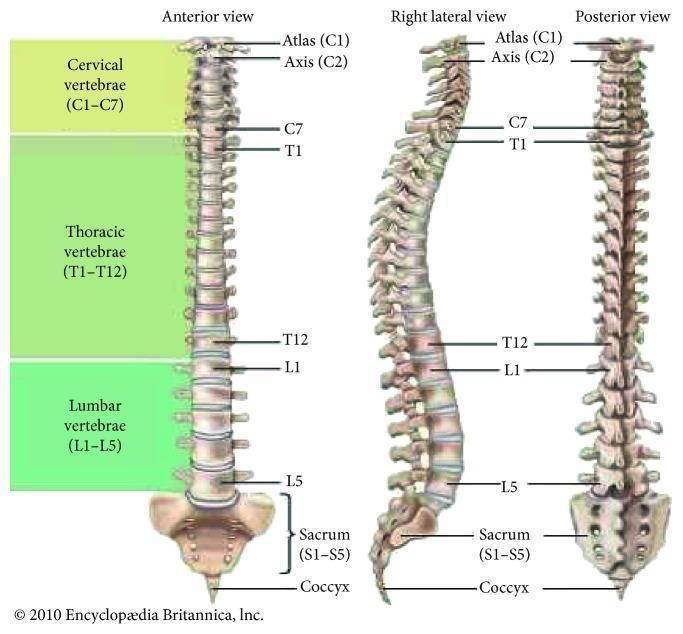
The vertebral column consists of 33 vertebrae at birth, reduced to 26 in adults (due to fusion of sacral and coccygeal segments).
Regions
| Region | Count | Key Features |
|---|---|---|
| Cervical (C1–C7) | 7 | Small bodies, bifid spinous processes, foramen transversarium in transverse processes (for vertebral artery/veins) |
| Thoracic (T1–T12) | 12 | Heart-shaped bodies, long downward-sloping spinous processes, facets for rib articulation |
| Lumbar (L1–L5) | 5 | Large kidney-shaped bodies (weight-bearing), short spinous processes |
| Sacrum (S1–S5) | 5 fused | Triangular, articulates with ilium at sacroiliac joints |
| Coccyx | 4 fused | Remnant tailbone |
Spinal Curvatures
- Cervical lordosis — anterior convexity
- Thoracic kyphosis — posterior convexity
- Lumbar lordosis — anterior convexity
- Sacrococcygeal kyphosis — posterior convexity
These S-shaped curves distribute axial load and provide shock absorption.
Special Cervical Vertebrae
- Atlas (C1): ring-shaped, no body, no spinous process — supports the skull on two lateral masses
- Axis (C2): has the dens (odontoid process) that projects superiorly into C1, forming the pivot joint for head rotation
Typical Vertebra — Parts
- Body — weight-bearing anterior cylinder
- Vertebral arch — pedicles + laminae, forms the spinal canal
- Spinous process — posterior midline projection
- Transverse processes (×2) — lateral projections for muscle/rib attachment
- Superior & inferior articular processes — form facet joints between vertebrae
- Intervertebral discs — fibrocartilaginous shock absorbers between bodies (nucleus pulposus + annulus fibrosus)
3. JOINTS
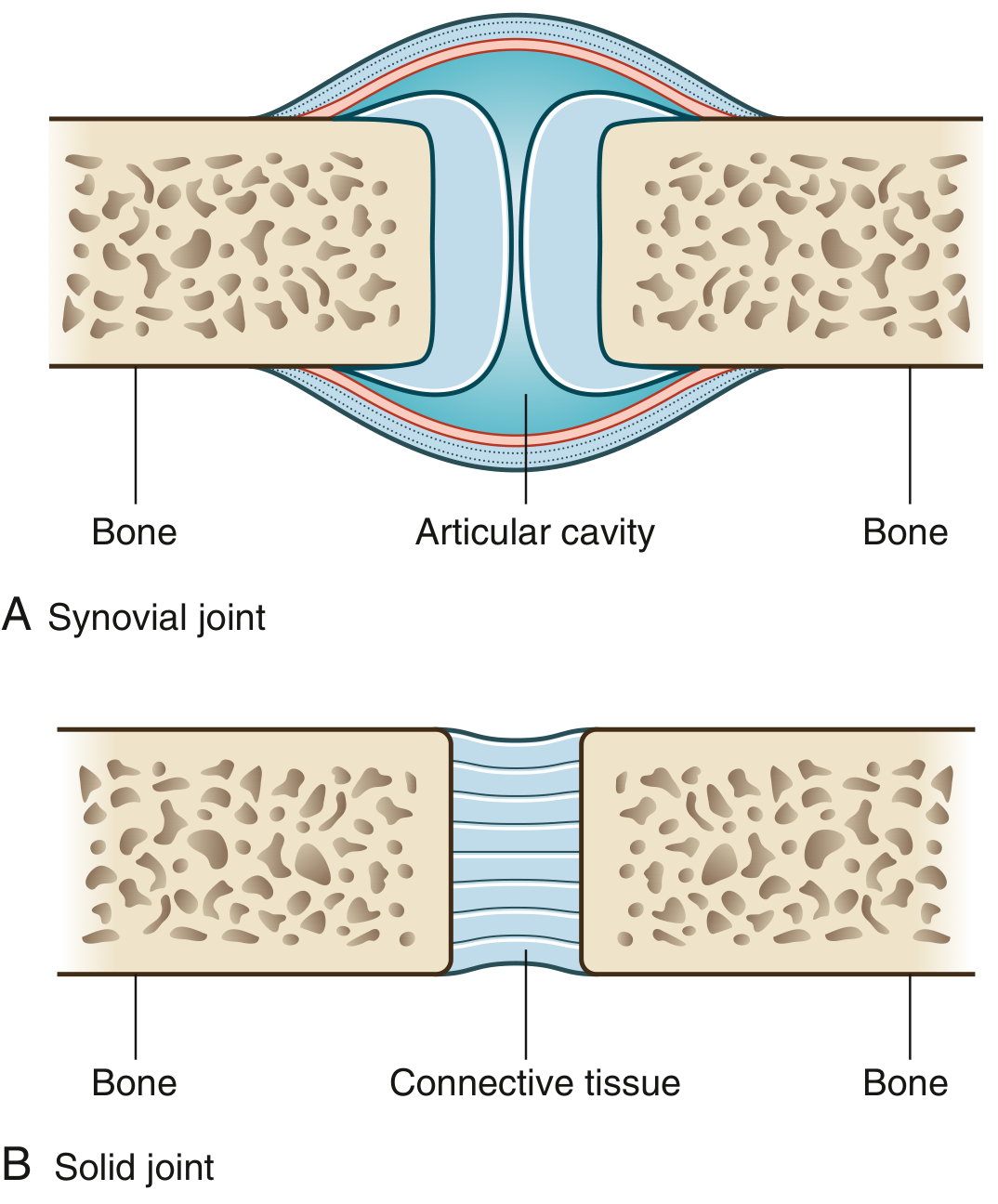
The two fundamental categories of joints:
A. Synovial Joints (Diarthroses)
Bones are separated by an articular cavity. Features:
- Articular cartilage (hyaline) covers bone surfaces — prevents direct bone contact
- Joint capsule = inner synovial membrane (produces synovial fluid for lubrication) + outer fibrous membrane
- Ligaments — thickenings of the fibrous membrane or separate bands
- Bursae — closed sacs of synovial membrane that reduce friction
- Intra-articular structures — articular discs (fibrocartilage), fat pads, tendons
Types of synovial joints by shape:
| Type | Axes | Example |
|---|---|---|
| Plane (gliding) | Multiaxial, limited glide | Intercarpal, acromioclavicular |
| Hinge (ginglymus) | Uniaxial | Elbow, interphalangeal |
| Pivot (trochoid) | Uniaxial (rotation) | C1–C2 atlanto-axial |
| Condyloid (ellipsoidal) | Biaxial | Metacarpophalangeal, wrist |
| Saddle | Biaxial | 1st carpometacarpal (thumb) |
| Ball-and-socket | Multiaxial | Hip, shoulder |
B. Solid Joints (Synarthroses)
No cavity; bones held by connective tissue:
- Fibrous joints — sutures (skull), syndesmoses (interosseous membranes), gomphoses (teeth in sockets)
- Cartilaginous joints — primary (synchondroses, growth plates) and secondary (symphyses, e.g., pubic symphysis, intervertebral discs)
4. UPPER LIMB
Bones of the Upper Limb (64 total per limb)
Shoulder girdle:
- Clavicle — S-shaped, only bony link between upper limb and axial skeleton
- Scapula — triangular flat bone with glenoid cavity, acromion, coracoid process, spine
Arm (brachium):
- Humerus — head articulates with glenoid (glenohumeral joint); has greater & lesser tubercles (rotator cuff insertions), deltoid tuberosity, medial/lateral epicondyles
Forearm:
- Radius — lateral; broader distally; articulates with scaphoid & lunate (wrist)
- Ulna — medial; has olecranon (forms point of elbow); trochlear notch articulates with humerus
Wrist (carpals) — 8 bones (proximal row → distal row):
- Proximal: Scaphoid, Lunate, Triquetrum, Pisiform
- Distal: Trapezium, Trapezoid, Capitate, Hamate
- Mnemonic: "Some Lovers Try Positions That They Can't Handle"
Hand:
- Metacarpals (5) — numbered I–V (thumb to little finger)
- Phalanges (14) — thumb has 2 (proximal, distal); fingers 2–5 have 3 each (proximal, middle, distal)
Key Upper Limb Joints
| Joint | Type | Movements |
|---|---|---|
| Glenohumeral (shoulder) | Ball-and-socket | Flexion/extension, abduction/adduction, rotation, circumduction |
| Acromioclavicular | Plane | Rotation of scapula |
| Sternoclavicular | Saddle (modified) | Elevation/depression, protraction/retraction |
| Elbow (humeroulnar + humeroradial) | Hinge + pivot | Flexion/extension |
| Radioulnar (proximal & distal) | Pivot | Pronation/supination |
| Wrist (radiocarpal) | Condyloid | Flexion/extension, radial/ulnar deviation |
| Metacarpophalangeal (MCP) | Condyloid | Flexion/extension, abduction/adduction |
| Interphalangeal (IP) | Hinge | Flexion/extension |
Muscles of the Upper Limb
Shoulder region:
| Muscle | Origin | Insertion | Action | Nerve |
|---|---|---|---|---|
| Deltoid | Clavicle, acromion, scapular spine | Deltoid tuberosity of humerus | Abduction (middle), flexion (anterior), extension (posterior) | Axillary (C5,C6) |
| Supraspinatus | Supraspinous fossa | Greater tubercle | Initiates abduction (0–15°) | Suprascapular |
| Infraspinatus | Infraspinous fossa | Greater tubercle | External rotation | Suprascapular |
| Teres minor | Lateral scapular border | Greater tubercle | External rotation | Axillary |
| Subscapularis | Subscapular fossa | Lesser tubercle | Internal rotation | Upper/lower subscapular |
The supraspinatus, infraspinatus, teres minor, and subscapularis form the SITS rotator cuff — they stabilize the glenohumeral joint.
Arm (brachium):
| Muscle | Action | Nerve |
|---|---|---|
| Biceps brachii | Elbow flexion + supination | Musculocutaneous (C5,C6) |
| Brachialis | Elbow flexion (prime mover) | Musculocutaneous (C5,C6) |
| Triceps brachii | Elbow extension | Radial (C6–C8) |
| Coracobrachialis | Shoulder flexion & adduction | Musculocutaneous |
Forearm — Anterior (flexor) compartment:
- Superficial: Pronator teres, Flexor carpi radialis, Palmaris longus, Flexor carpi ulnaris, Flexor digitorum superficialis
- Deep: Flexor digitorum profundus, Flexor pollicis longus, Pronator quadratus
- Nerve supply: Median nerve (mostly) + Ulnar nerve (FCU, medial FDP)
Forearm — Posterior (extensor) compartment:
- Extensor carpi radialis longus & brevis, Extensor digitorum, Extensor digiti minimi, Extensor carpi ulnaris
- Deep: Supinator, Abductor pollicis longus, Extensor pollicis brevis & longus, Extensor indicis
- Nerve supply: Radial nerve (posterior interosseous branch)
Hand (intrinsic muscles):
- Thenar group (thumb): Abductor pollicis brevis, Flexor pollicis brevis, Opponens pollicis — Median nerve
- Hypothenar group (little finger): Abductor digiti minimi, Flexor digiti minimi, Opponens digiti minimi — Ulnar nerve
- Lumbricals (4): Flex MCP, extend IP joints — Median (1st & 2nd), Ulnar (3rd & 4th)
- Interossei: Dorsal (abduct fingers), Palmar (adduct fingers) — all Ulnar nerve
- Adductor pollicis — Ulnar nerve
5. LOWER LIMB
Bones of the Lower Limb (62 total per limb)
Pelvic girdle:
- Hip bone (os coxae) — formed by 3 fused bones: ilium (upper wing), ischium (posterior/inferior), pubis (anterior). Together with the sacrum they form the bony pelvis.
- Acetabulum — deep socket formed by the union of all three bones; articulates with femoral head
Thigh:
- Femur — longest/strongest bone in body. Head, neck, greater & lesser trochanters; shaft; medial & lateral condyles distally
- Patella — sesamoid bone within quadriceps tendon; sits in front of knee
Leg (crus):
- Tibia — medial, weight-bearing; has medial condyle, tibial tuberosity, medial malleolus
- Fibula — lateral, non-weight-bearing (thin); lateral malleolus forms lateral ankle
Ankle (tarsals) — 7 bones:
- Talus — articulates with tibia/fibula above (ankle joint)
- Calcaneus — heel bone, largest tarsal
- Navicular, Cuboid, 3 Cuneiforms (medial, intermediate, lateral)
Foot:
- Metatarsals (5) — I–V
- Phalanges (14) — big toe has 2; toes 2–5 have 3 each
Key Lower Limb Joints
| Joint | Type | Movements |
|---|---|---|
| Hip (coxofemoral) | Ball-and-socket | Flexion/extension, abduction/adduction, rotation (less ROM than shoulder, more stable) |
| Knee (tibiofemoral) | Modified hinge | Flexion/extension + slight rotation in unlocking |
| Patellofemoral | Plane | Gliding during knee movement |
| Ankle (talocrural) | Hinge | Dorsiflexion/plantarflexion |
| Subtalar | Plane | Inversion/eversion |
| 1st metatarsophalangeal | Condyloid | Flexion/extension |
Muscles of the Lower Limb
Hip/Gluteal region:
| Muscle | Action | Nerve |
|---|---|---|
| Gluteus maximus | Hip extension, lateral rotation | Inferior gluteal (L5,S1,S2) |
| Gluteus medius | Hip abduction, medial rotation | Superior gluteal (L4,L5,S1) |
| Gluteus minimus | Hip abduction, medial rotation | Superior gluteal |
| Iliopsoas (iliacus + psoas major) | Hip flexion (primary) | Femoral + L1–L3 |
| 6 deep external rotators (piriformis, obturators, gemelli, quadratus femoris) | Lateral rotation | Sacral plexus |
Thigh — Anterior compartment:
| Muscle | Action | Nerve |
|---|---|---|
| Quadriceps femoris (rectus femoris + 3 vasti) | Knee extension | Femoral (L2–L4) |
| Sartorius | Hip flexion + lateral rotation, knee flexion | Femoral |
Thigh — Medial (adductor) compartment:
- Adductor longus, brevis, magnus; Gracilis; Pectineus
- Action: hip adduction — Obturator nerve (L2–L4)
Thigh — Posterior compartment (hamstrings):
| Muscle | Action | Nerve |
|---|---|---|
| Biceps femoris | Knee flexion, hip extension | Sciatic (tibial + common fibular) |
| Semitendinosus | Knee flexion, hip extension, medial knee rotation | Tibial division of sciatic |
| Semimembranosus | Knee flexion, hip extension | Tibial division of sciatic |
Leg — Anterior compartment:
- Tibialis anterior (dorsiflexion + inversion), Extensor digitorum longus, Extensor hallucis longus, Fibularis tertius
- Nerve: Deep fibular (peroneal) nerve
Leg — Lateral compartment:
- Fibularis longus & brevis — eversion of foot
- Nerve: Superficial fibular nerve
Leg — Posterior compartment:
- Superficial: Gastrocnemius + Soleus (= triceps surae) → plantarflexion via calcaneal (Achilles) tendon; also Plantaris
- Deep: Tibialis posterior (inversion), Flexor digitorum longus, Flexor hallucis longus
- Nerve: Tibial nerve
Foot (intrinsic muscles):
- Plantar surface: abductors/flexors of toes, lumbricals, interossei — primarily medial & lateral plantar nerves (branches of tibial nerve)
- Support longitudinal and transverse arches of the foot
Summary Comparison
| Feature | Upper Limb | Lower Limb |
|---|---|---|
| Primary function | Mobility & manipulation | Weight-bearing & locomotion |
| Girdle attachment | Clavicle → sternum (mobile) | Hip bone → sacrum (rigid pelvis) |
| Key joint | Glenohumeral (most mobile) | Hip & knee (most load-bearing) |
| Main extensor nerve | Radial | Femoral |
| Main flexor nerve | Musculocutaneous | Sciatic/tibial |
| Key stabilizer | Rotator cuff (SITS) | Gluteus medius (prevents Trendelenburg) |
Gray's Anatomy for Students, 5th Ed. — Chapter 7 (Upper Limb), Chapter 8 (Head & Neck), Chapter 6 (Pelvis & Lower Limb); relevant sections on Joints (Ch. 1)
This is a shared conversation. Sign in to Orris to start your own chat.