
Management of diabetic ketoacidosis
"diabetic ketoacidosis" AND management
diabetic ketoacidosis management flowchart protocol
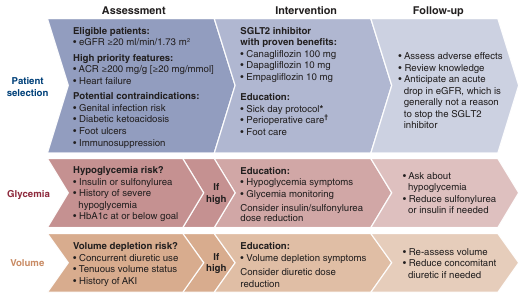
Summary : This figure presents a structured approach for the selection, intervention, and follow-up of patients considered for SGLT2 inhibitor therapy, with attention to patient selection, glycemia, and volume status. It is organized as a three-column flowchart covering assessment, intervention, and follow-up, with three horizontal sections for patient selection, glycemia, and volume.
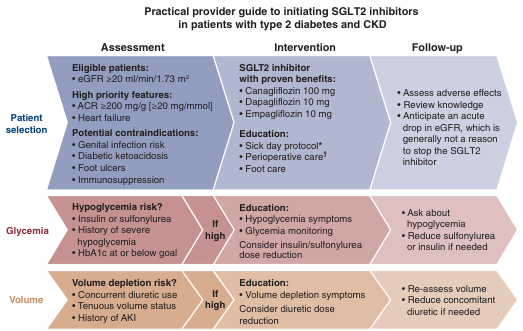
Summary : This figure provides a practical provider guide for initiating SGLT2 inhibitors in patients with type 2 diabetes and chronic kidney disease (CKD), structured into three main domains: patient selection, glycemia, and volume, each with assessment, intervention, and follow-up steps.
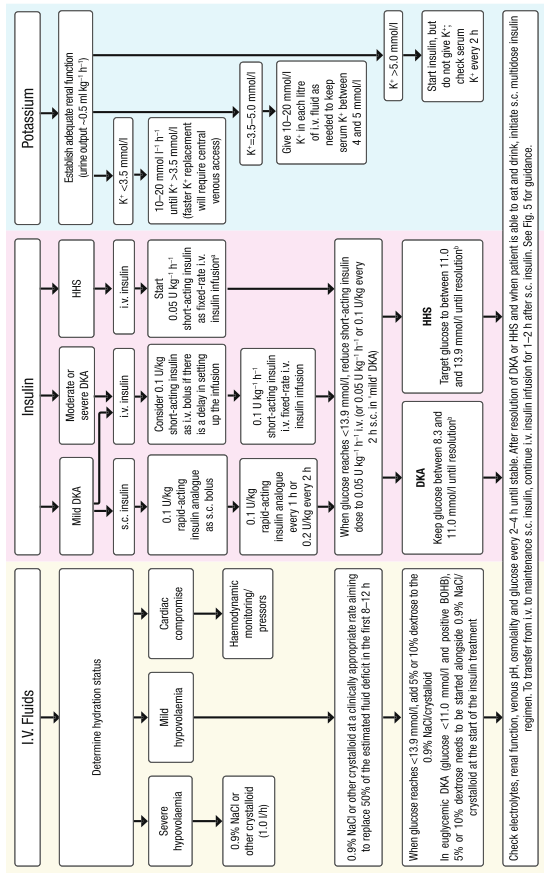
Summary : This figure is a clinical management flowchart for the treatment of diabetic ketoacidosis (DKA) and hyperosmolar hyperglycemic state (HHS), focusing on the protocols for potassium, insulin, and intravenous fluids. It provides stepwise decision-making based on laboratory values and patient status.
Management of Diabetic Ketoacidosis (DKA)
Diagnostic Criteria
- Hyperglycemia: blood glucose typically >250 mg/dL (can be lower in "euglycemic DKA," e.g., with SGLT2 inhibitors)
- Ketosis: serum/urine ketones positive
- Acidosis: pH <7.3, bicarbonate <18 mEq/L, elevated anion gap
| Parameter | Mild DKA | Moderate DKA | Severe DKA |
|---|---|---|---|
| pH | 7.25-7.30 | 7.00-7.24 | <7.00 |
| Bicarbonate | 15-18 mEq/L | 10-15 mEq/L | <10 mEq/L |
| Mental status | Alert | Drowsy | Stupor/coma |
Precipitating Causes (Must Be Identified and Treated)
- Infection (most common - pneumonia, UTI, skin)
- New-onset or poorly controlled Type 1 DM
- Insulin omission/non-adherence
- Myocardial infarction, stroke, pancreatitis
- Medications: corticosteroids, thiazides, SGLT2 inhibitors (euglycemic DKA)
- Pregnancy
Treatment Overview
1. Initial Assessment & Monitoring
- Serum glucose, electrolytes (Na+, K+, Cl-, HCO3-), BUN, creatinine
- Venous blood gas (correlates well with arterial pH; less invasive)
- Serum/urine ketones
- CBC with differential (note: leukocytosis reflects ketosis degree, not necessarily infection; only elevated band neutrophils indicate infection)
- Urinalysis, chest X-ray, ECG
- Lipase if pancreatitis suspected (amylase is non-specific in DKA)
- Sodium: Often falsely low due to hyperglycemia. Correct by adding 1.6 mEq/L for every 100 mg/dL glucose above normal
- Potassium: Often initially normal or high (shifted from intracellular by acidosis), but total body stores are depleted. Correct K+ by subtracting 0.6 mEq/L for every 0.1 decrease in pH
- Creatinine: May be falsely elevated on some analyzers
2. Fluid Resuscitation
- If in hypovolemic shock: Isotonic crystalloid (0.9% NS) as rapidly as possible in adults; 20 mL/kg boluses in children until systolic BP ≥80 mmHg
- Initial rate: 1-2 L NS IV over 1-3 hours (children: 20 mL/kg in first hour)
- Ongoing rate: 2-4 L in first 2-4 hours
- Switch to 0.45% NS once hemodynamically stable if corrected sodium is normal or elevated
- Add D5W (5% dextrose) when blood glucose falls to ≤250-300 mg/dL to prevent hypoglycemia while continuing insulin
Note: 0.9% NS remains the initial fluid of choice even with high osmolality, as it is still relatively hypotonic. Large volumes of NS may cause hyperchloremic metabolic acidosis; balanced crystalloids (e.g., Ringer's lactate) are an alternative once initial resuscitation is achieved.
3. Potassium Replacement
| Serum K+ | Action |
|---|---|
| <3.3 mEq/L | Hold insulin - replace K+ first at 10-40 mEq/h; give 20-40 mEq KCl per liter of IV fluid |
| 3.3-5.5 mEq/L | Start insulin + add 20-40 mEq KCl per liter of IV fluid |
| >5.5 mEq/L | Start insulin, hold potassium; recheck K+ every 2 hours |
- Once urine output >0.5 mL/kg/h, begin K+ replacement
- Continuous cardiac monitoring required when K+ replacement rate >10 mEq/h
- Target: Maintain K+ between 4-5 mEq/L
4. Insulin Therapy
- IV infusion: Regular insulin at 0.1 units/kg/hour (fixed-rate infusion)
- Alternatively, may give 0.1 units/kg IV bolus first, then 0.1 units/kg/h infusion
- Barash formula: Blood glucose ÷ 150 units/hour as a variable-rate guide
- Subcutaneous option for mild DKA: Rapid-acting insulin analogue 0.1 units/kg SC, then 0.1 units/kg every 1 hour (or 0.2 units/kg every 2 hours)
- Target blood glucose fall of ~10% per hour (Goodman & Gilman's, p. 1034)
- Once glucose reaches 250 mg/dL → add dextrose-containing IV fluid AND reduce insulin infusion to 0.05 units/kg/hour to prevent hypoglycemia
- Continue insulin until ketones <1.0 mmol/L and acidosis resolved (pH >7.3, HCO3- >18)
- Target glucose in DKA: 8.3-11.0 mmol/L (150-200 mg/dL) until resolution
- Continue IV insulin for 1-2 hours after the first SC dose to avoid gap
- When patient can eat and drink, switch to usual diabetes regimen
5. Other Electrolytes
- Total body depletion occurs but routine supplementation is generally not recommended unless severely symptomatic (<1.0 mg/dL or cardiac/respiratory dysfunction)
- If hypomagnesemia: 1-2 g MgSO4 IV; serum levels may not reflect body stores
- Rarely indicated
- Consider only if pH <6.9 (50-100 mEq NaHCO3 in 200-400 mL sterile water over 2 hours)
- Bicarbonate use carries risks: paradoxical CNS acidosis, hypokalemia, alkalosis rebound, impaired O2 delivery (shifts oxyhemoglobin curve)
- Acidosis corrects with insulin and fluids alone in the vast majority
6. Resolution Criteria
- Blood glucose <200 mg/dL
- Serum bicarbonate ≥15 mEq/L
- Venous pH >7.3
7. Special Situations
- Avoid if possible - patients have strong respiratory drive and matching ventilator to Kussmaul breathing is difficult
- If required (comatose, vomiting): maintain hyperventilation to prevent worsening acidosis
- Stop SGLT2 inhibitors immediately
- Advise withholding SGLT2 inhibitors and/or reducing insulin during illness or perioperatively (stop 3 days before surgery)
- Management same as standard DKA
- Treatment: dextrose + parenteral fluids; insulin is NOT indicated (unless patient has established DM)
- Predominant ketone is β-hydroxybutyrate (may be missed by standard nitroprusside reaction)
8. Monitoring During Treatment
- Vital signs and urine output (target >0.5 mL/kg/h)
- Glucose every 1-2 hours
- Electrolytes (K+, Na+, HCO3-, Cl-) every 2-4 hours
- Venous pH every 2-4 hours
- Insulin amount administered
Summary Algorithm
DKA Confirmed
     ↓
1. IV Fluids — 0.9% NS 1-2 L/h × 1-3 h
     ↓
2. Check K+
   K+ <3.3 → Replace K+ first, hold insulin
   K+ 3.3-5.5 → Start insulin + add K+ to fluids
   K+ >5.5 → Start insulin, hold K+
     ↓
3. Insulin — 0.1 units/kg/h IV infusion
     ↓
4. Glucose ≤250 mg/dL → Add D5W, reduce insulin to 0.05 U/kg/h
     ↓
5. Bicarbonate only if pH <6.9
     ↓
6. Identify & treat precipitant
     ↓
7. Resolution: glucose <200, HCO3 ≥15, pH >7.3 → Switch to SC insulin
Insulin iv drip
Insulin IV Drip (Continuous Intravenous Insulin Infusion)
Why IV Instead of Subcutaneous?
- DKA and hyperglycemic emergencies
- ICU or clinically unstable patients
- Perioperative management for major/prolonged surgery (>4 hours)
- Patients unable to eat (NPO)
- Any situation with poor skin/muscle perfusion (where SC absorption becomes unpredictable)
The half-life of IV regular insulin is very short (minutes), which makes it highly titratable. SC absorption is variable in critically ill patients - this is the key advantage of IV delivery.
Drug: ONLY Regular Insulin
- Insulin analogues (lispro, aspart, glargine, detemir) are not given IV
- Regular insulin is used because it is less expensive and equally effective for IV delivery
- Concentration: 1 unit/mL (100 units regular insulin in 100 mL 0.9% NS - standard preparation)
Preparation
- 100 units Regular insulin + 100 mL 0.9% NS = 1 unit/mL concentration
- Can also use 50 units in 50 mL NS (same concentration)
- Fill tubing with the insulin infusion solution
- Wait 30 minutes
- Flush the line
- Then connect to patient and start infusion
Dosing
In DKA (primary indication)
| Step | Action |
|---|---|
| Check K+ first | Do NOT start insulin if K+ <3.3 mEq/L - replace potassium first |
| Starting rate | 0.1 units/kg/h continuous infusion |
| IV bolus? | NOT recommended - no clinical benefit over infusion alone (Tintinalli's) |
| If glucose not falling 50-100 mg/dL/h | Increase infusion rate by 50% |
| When glucose reaches ≤250 mg/dL | Add D5W to IV fluids; reduce insulin to 0.05 units/kg/h |
| Target glucose in DKA | 150-200 mg/dL (8.3-11.0 mmol/L) until ketosis resolves |
Formula-Based Dosing (Perioperative)
Units/hour = Plasma glucose (mg/dL) ÷ 150
- Target intraoperative glucose: 85-180 mg/dL
- 1 unit of IV regular insulin lowers plasma glucose by ~25-30 mg/dL in an adult
In Critically Ill / ICU Patients
- Preferred over SC because of precise, rapid titration
- Adjust based on glucose trend (not just current value) - use institutional infusion algorithms
- Algorithms should incorporate the patient's insulin sensitivity
- Check glucose every 1-2 hours during infusion
In Labor (Obstetric)
| Glucose (mg/dL) | Insulin infusion rate |
|---|---|
| <80 | Turn off insulin |
| 80-100 | 0.5 U/h |
| 100-140 | 1.0 U/h |
| 140-180 | 1.5 U/h |
| >180 | 2.0 U/h + notify physician |
Concomitant Potassium
- Insulin drives K+ intracellularly - always anticipate hypokalemia
- Add 20 mEq KCl per liter of maintenance fluid when giving insulin infusions in surgical patients
- In DKA: replace K+ aggressively (see DKA protocol)
Monitoring During Infusion
- Blood glucose every 1-2 hours (capillary or serum)
- Electrolytes (K+, Na+, HCO3-) every 2-4 hours in DKA
- Do NOT use continuous glucose monitor (CGM) interstitial readings for management decisions - there is a ~10-minute lag and medications (e.g., acetaminophen) can cause inaccurate readings; use capillary or serum glucose
- Urine output hourly
Stopping the Drip - Transition to SC Insulin
Give long-acting SC insulin 2-4 hours BEFORE stopping the IV infusion.
- Continue IV insulin until anion gap closed, HCO3- >14-18 mEq/L, patient tolerating oral intake
- Administer SC dose (basal insulin) ≥1 hour before stopping drip (some guidelines say 2-4 hours)
- If insulin pump patient: restart pump ~1 hour before stopping IV drip
- Switch back to SC insulin when patient is eating
- Resume usual home regimen (basal + prandial dosing)
Insulin Pump Patients in DKA
- Assume pump malfunction - disconnect the pump
- Start IV insulin infusion per standard DKA protocol
- Do not give IV bolus before starting drip (no clinical benefit)
- Consider SC long-acting insulin at the time of drip initiation if pump therapy not expected to resume
Summary Card
| Parameter | Value |
|---|---|
| Insulin type | Regular only |
| Concentration | 1 unit/mL (100 units in 100 mL NS) |
| Starting dose (DKA) | 0.1 units/kg/h |
| Starting dose (perioperative) | 0.5-1.0 units/h (or glucose ÷ 150) |
| IV bolus | Not recommended |
| Target glucose (DKA) | 150-200 mg/dL after reaching 250 |
| Target glucose (periop/ICU) | 85-180 mg/dL |
| Glucose monitoring | Every 1-2 hours |
| Tubing preparation | Flush and wait 30 min before connecting patient |
| Transition to SC | Give long-acting insulin 2-4 h before stopping drip |