
Blood supply and innervation only deltoid and scapula region
Reading File
Finding Sources
Finding Sources
Finding Sources
Finding Sources
Finding Sources
Reading File
Reading File
Reading File
Finding Sources
Reading File
Reading File
Reading File
Loading Image
Loading Image
I now have comprehensive information. Let me also fetch the trapezius/deltoid neurovascular diagram.
Loading Image
Here is a comprehensive breakdown of the blood supply and innervation of the deltoid and posterior scapular region, sourced from Gray's Anatomy for Students and the THIEME Atlas of Anatomy.
DELTOID REGION
Innervation
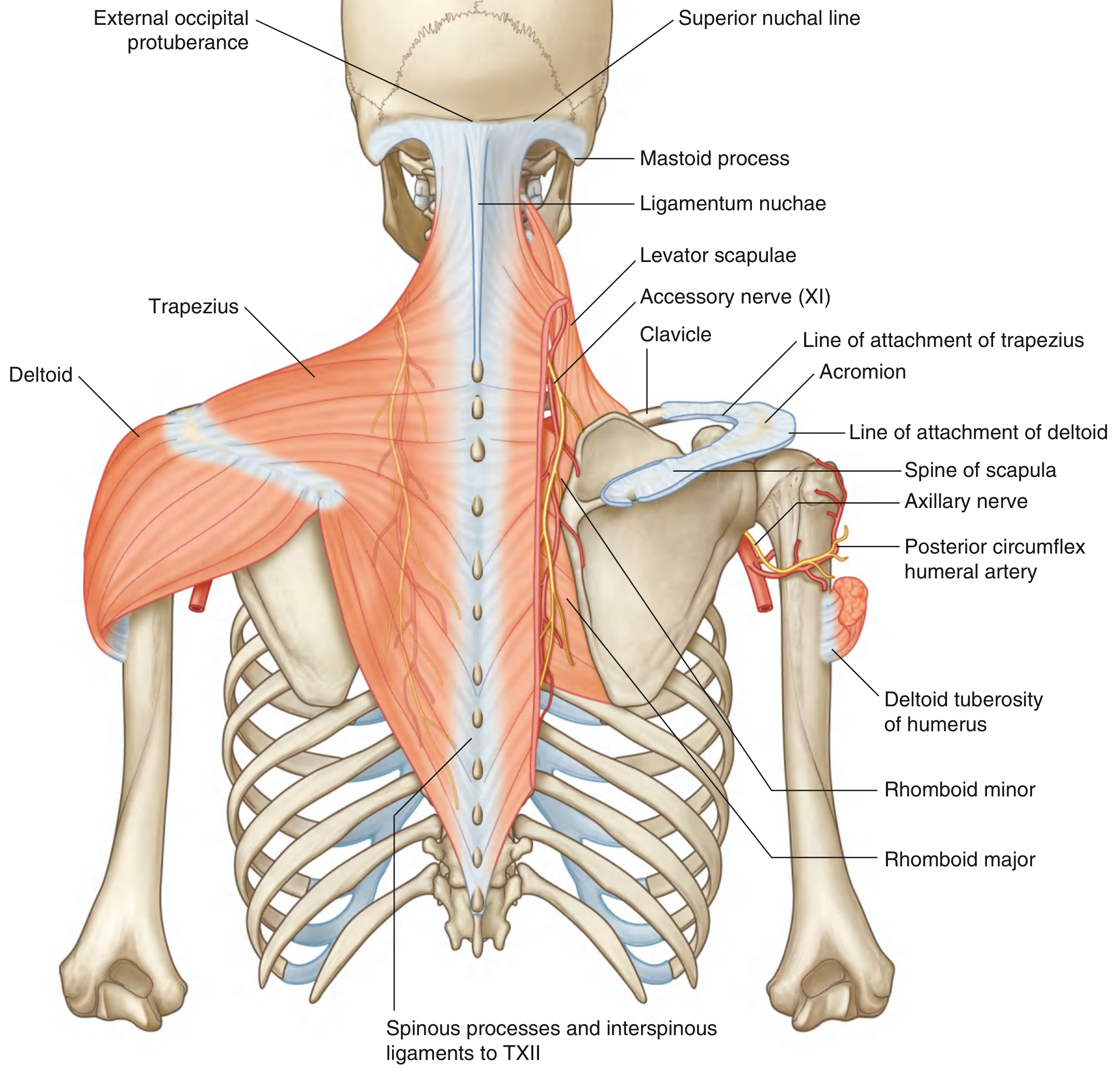
- Axillary nerve (C5, C6) — branch of the posterior cord of the brachial plexus
- Exits the axilla through the quadrangular space, passing posteriorly around the surgical neck of the humerus
- Innervates the deltoid (all three parts) and the teres minor
- Gives off the superior lateral cutaneous nerve of the arm — carries sensation from skin over the inferior part of the deltoid
Blood Supply
- Posterior circumflex humeral artery — arises from the 3rd part of the axillary artery
- Travels with the axillary nerve through the quadrangular space
- Supplies the deltoid, related muscles, and the glenohumeral joint
- Anterior circumflex humeral artery — also from the 3rd part of the axillary artery; smaller contribution, anastomoses around the surgical neck
Fig. 7.36 — Neurovascular supply of the deltoid (posterior view):
POSTERIOR SCAPULAR REGION
This region lies deep to the trapezius and deltoid, containing the rotator cuff muscles (supraspinatus, infraspinatus, teres minor, teres major) and the long head of triceps.
Nerves
1. Suprascapular Nerve (C5, C6)
- Originates from the superior trunk of the brachial plexus
- Passes through the suprascapular foramen (beneath the superior transverse scapular ligament)
- Innervates supraspinatus, then passes through the greater scapular (spinoglenoid) notch to innervate infraspinatus
- No cutaneous branches
2. Axillary Nerve (C5, C6)
- Enters the posterior scapular region via the quadrangular space
- Innervates deltoid and teres minor
- Cutaneous branch: superior lateral cutaneous nerve of the arm (skin over inferior deltoid)
Other muscles in the region (for completeness):
- Teres major → Inferior subscapular nerve (C6, C7)
- Rhomboids → Dorsal scapular nerve
- Levator scapulae → Dorsal scapular nerve + C3, C4 directly
- Long head of triceps → Radial nerve (C6–C8) — passes via triangular interval
Blood Supply — Three Major Arteries
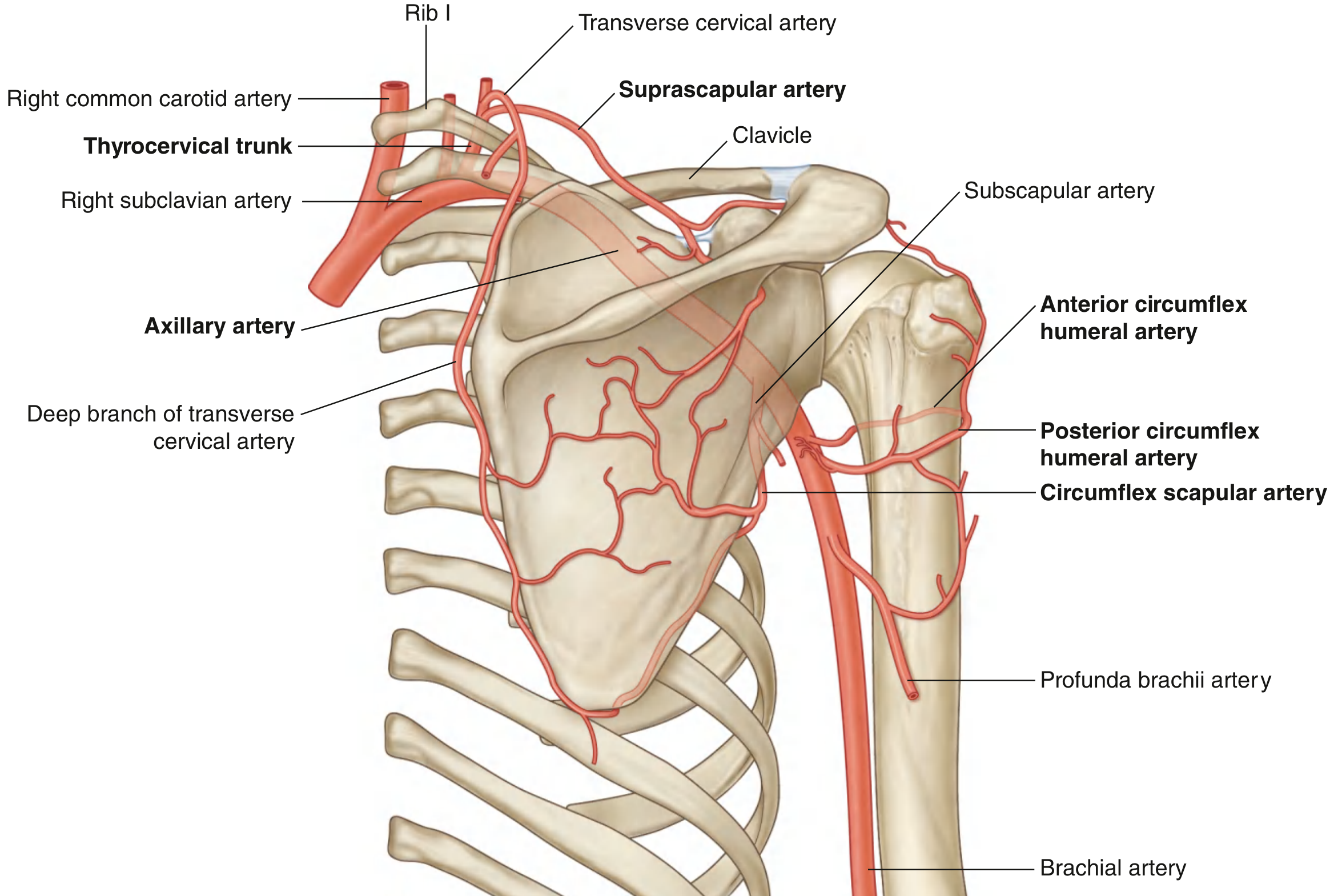
1. Suprascapular Artery
- Branch of the thyrocervical trunk (from subclavian artery), occasionally directly from the 3rd part of subclavian
- Enters the posterior scapular region superior to the suprascapular foramen (the nerve goes through the foramen; the artery goes over the ligament — mnemonic: "Army goes under the bridge, Navy goes over")
- Supplies supraspinatus, infraspinatus, and multiple structures along its course
2. Posterior Circumflex Humeral Artery
- Branch of the 3rd part of the axillary artery
- Passes through the quadrangular space with the axillary nerve
- Supplies deltoid, teres minor, glenohumeral joint
3. Circumflex Scapular Artery
- Branch of the subscapular artery (which itself branches from the 3rd part of the axillary artery)
- Leaves the axilla through the triangular space
- Passes through the origin of teres minor
- Forms an anastomotic network around the scapula with the suprascapular and posterior circumflex humeral arteries
Veins follow the named arteries and connect with vessels in the neck, back, arm, and axilla.
Fig. 7.38 — Nerves and arteries of the posterior scapular region (posterior view):
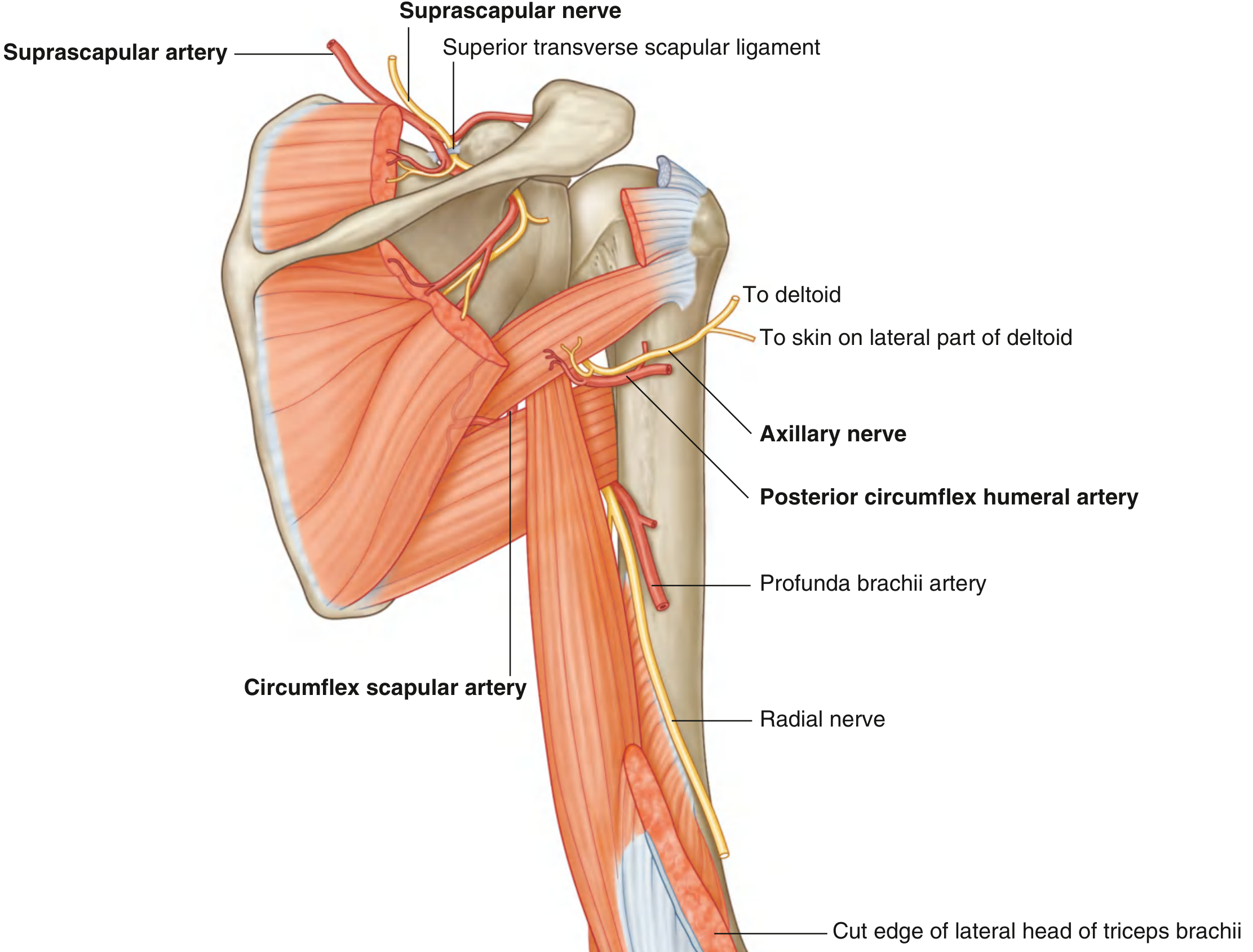
Fig. 7.39 — Scapular arterial anastomotic network:
Key Gateways (Spaces) Summary
| Space | Boundaries | Contents |
|---|---|---|
| Suprascapular foramen | Suprascapular notch + superior transverse ligament | Suprascapular nerve (through); suprascapular artery (over ligament) |
| Quadrangular space | Teres minor (sup), teres major (inf), long head of triceps (med), surgical neck of humerus (lat) | Axillary nerve + posterior circumflex humeral artery |
| Triangular space | Teres minor (sup), teres major (inf), long head of triceps (lat) | Circumflex scapular artery |
| Triangular interval | Teres major (sup), long head of triceps (med), humerus (lat) | Radial nerve + profunda brachii artery |
Clinical note — Quadrangular Space Syndrome: Hypertrophy or fibrosis of the quadrangular space muscles can compress the axillary nerve, causing teres minor atrophy and weakness/altered deltoid function.
— Gray's Anatomy for Students, pp. 834–840
This is a shared conversation. Sign in to Orris to start your own chat.