Here is a comprehensive clinical guide to urine study:
Urine Study — Complete Clinical Reference
Urinalysis (urine examination) consists of three sequential components:
- Physical examination
- Chemical (dipstick) examination
- Microscopic examination
PART 1 — PHYSICAL EXAMINATION
Volume
| Finding | Volume | Causes |
|---|
| Normal | 800–2000 mL/24 hr | — |
| Oliguria | <400 mL/24 hr | AKI (pre-renal, intrinsic, post-renal), severe dehydration, shock |
| Anuria | <100 mL/24 hr | Complete obstruction, cortical necrosis, severe ATN |
| Polyuria | >3000 mL/24 hr | Diabetes insipidus, diabetes mellitus, psychogenic polydipsia, CKD (early), diuretics |
| Nocturia | >1 void/night | CKD, CCF, DM, BPH, early renal insufficiency |
Color
| Color | Causes |
|---|
| Colorless / very pale | Dilute urine, diabetes insipidus, overhydration |
| Pale to dark yellow | Normal (pale = dilute; amber = concentrated) |
| Orange | Rifampicin, phenazopyridine, urobilinogen excess, dehydration |
| Red / pink | Hematuria, hemoglobinuria, myoglobinuria, beetroot ingestion, rifampicin |
| Brown / cola ("Coca-Cola") | Oxidized heme (hematuria), myoglobinuria, bilirubinuria, alkaptonuria |
| Green / blue | Pseudomonas UTI, methylene blue, propofol infusion, biliverdin |
| Milky / turbid white | Pyuria (pus), chyluria (filariasis), phosphaturia (benign), heavy proteinuria |
| Black on standing | Alkaptonuria (homogentisic acid), melaninuria, severe methemoglobinemia |
Turbidity
- Clear: Normal
- Turbid on voiding: Pyuria (UTI), heavy bacteriuria, heavy phosphaturia
- Turbid on cooling/standing: Uraturia (pink-orange sediment, clears on warming — benign); phosphaturia (white precipitate, clears with acid)
Odor
| Odor | Cause |
|---|
| Faintly aromatic | Normal |
| Ammonia | UTI with urea-splitting organisms (Proteus, Klebsiella) |
| Fruity / sweet | Ketones (DKA, starvation) |
| Foul / offensive | Infection, urinary-enteric fistula |
| Maple syrup | Maple syrup urine disease (MSUD) |
| Mousy / musty | Phenylketonuria (PKU) |
| Fishy | Trimethylaminuria |
| Cabbage-like | Tyrosinemia, hypermethioninemia |
Foam
- Persistent white foam: Heavy proteinuria
- Persistent yellow foam: Bilirubinuria (conjugated)
- Transient white foam: Normal (surfactant effect)
PART 2 — CHEMICAL (DIPSTICK) EXAMINATION
As described in Bailey & Love's Surgery (p. 1472): "In a urine dipstick test, used to screen for significant disease, urine is dipped with a stick on which there is a series of small chemical-containing pads designed to detect, typically, glucose, bilirubin, ketones, the specific gravity, blood, pH, protein, urobilinogen, nitrites and leukocyte esterase through colour changes."
1. Specific Gravity (SG)
- Normal: 1.001–1.035
- Reflects tubular concentrating ability (tubular function, not just glomerular)
| SG | Interpretation |
|---|
| 1.001–1.005 | Dilute: diabetes insipidus, overhydration, ATN |
| 1.010 | Isosthenuria (fixed SG): severe CKD — kidney lost concentrating AND diluting capacity |
| 1.020–1.030 | Concentrated: dehydration, SIADH, early prerenal AKI |
| >1.030 | Very concentrated; also glucose/protein artificially elevate SG |
2. pH
- Normal: 4.5–8.0 (average ~6.0)
| pH | Causes |
|---|
| Acidic (<5.5) | Metabolic acidosis, respiratory acidosis, DKA, high-protein diet, starvation, ammonium chloride, fever |
| Alkaline (>7.0) | UTI with urea-splitting bacteria, Type 1 RTA (paradoxically alkaline urine despite systemic acidosis), vegetarian diet, metabolic alkalosis, post-prandial alkaline tide, acetazolamide |
Clinical uses of urine pH:
- Uric acid stones → form in acidic urine; alkalize to dissolve/prevent
- Struvite (triple phosphate) stones → form in alkaline urine
- RTA diagnosis: Type 1 RTA — urine pH cannot drop below 5.5 despite acidosis
- Forced alkaline diuresis: salicylate, methotrexate, phenobarbitone poisoning
3. Protein
- Normal: <150 mg/24 hr; trace or negative on dipstick
- Dipstick primarily detects albumin — insensitive to Bence-Jones protein (light chains), globulins, tubular proteins
| Dipstick | Amount | Causes |
|---|
| Trace | 150–300 mg/day | Benign: fever, vigorous exercise, orthostatic |
| +1 | 300–1000 mg/day | Early glomerulonephritis, early diabetic nephropathy |
| +2 | 1–2 g/day | GN, hypertensive nephropathy |
| +3 | 2–3 g/day | Significant glomerular disease |
| +4 | >3.5 g/day | Nephrotic syndrome |
Types of proteinuria:
- Glomerular: Albumin dominant; GN, diabetic nephropathy, amyloidosis
- Tubular: Low-MW proteins (β2-microglobulin); Fanconi syndrome, heavy metal toxicity, interstitial nephritis
- Overflow: Bence-Jones (myeloma), myoglobin, hemoglobin — dipstick negative for protein
- Orthostatic/postural: Present in upright position, absent in morning recumbent sample — benign (common in adolescents)
- Transient: Fever, exercise, heart failure, seizure — resolves
4. Glucose (Glycosuria)
- Normal: Negative
- Renal threshold for glucose: ~180 mg/dL (10 mmol/L) blood glucose
- Dipstick uses glucose oxidase — specific for glucose only, does NOT detect galactose, fructose, lactose, pentose
| Cause | Blood Glucose | Mechanism |
|---|
| Diabetes mellitus | High | Exceeds renal threshold |
| Cushing's syndrome, acromegaly, steroids | High | Secondary hyperglycemia |
| Stress, pancreatitis | High | Transient |
| Renal glycosuria (Fanconi syndrome) | Normal | Lowered tubular reabsorption threshold |
| Pregnancy | Normal/low | Lowered threshold (GFR increase) |
| Proximal RTA | Normal | Tubular dysfunction |
Other reducing substances in urine (positive Benedict's test but negative dipstick): galactosuria (galactosemia), fructosuria, lactosuria (lactating mothers), alkaptonuria, pentosuria.
5. Ketones
- Normal: Negative
- Dipstick detects acetoacetate primarily; beta-hydroxybutyrate (predominant in early DKA) detected poorly
- Measured by nitroprusside reaction
| Cause |
|---|
| Diabetic ketoacidosis (DKA) |
| Starvation, prolonged fasting |
| High-fat / low-carbohydrate diet |
| Vomiting (prolonged) |
| Alcoholic ketoacidosis |
| Glycogen storage diseases |
| Pregnancy (morning sickness, hyperemesis gravidarum) |
Clinical pearl: In early/severe DKA, beta-hydroxybutyrate:acetoacetate ratio is high — dipstick may underestimate ketosis. As treatment progresses, acetoacetate rises and dipstick becomes more positive — not treatment failure.
6. Blood (Heme)
- Normal: Negative (≤2 RBCs/HPF)
- Dipstick detects peroxidase activity of heme — detects intact RBCs, free hemoglobin, and myoglobin
Differentiating causes of positive dipstick with no RBCs on microscopy:
| Condition | Microscopy | Plasma |
|---|
| Hemoglobinuria | No RBCs | Pink plasma (hemolysis) |
| Myoglobinuria | No RBCs | Clear plasma; elevated CK |
| Hematuria | RBCs present | Clear plasma |
Causes of hematuria:
- Glomerular (dysmorphic RBCs + casts): IgA nephropathy, post-streptococcal GN, lupus nephritis, Alport syndrome, ANCA vasculitis
- Non-glomerular (isomorphic RBCs, no casts): Stones, tumors (RCC, TCC), trauma, polycystic kidney disease, TB, schistosomiasis, BPH, bleeding disorders, anticoagulants
- False positive: Menstrual contamination, povidone-iodine, oxidizing agents
7. Bilirubin
- Normal: Negative
- Only conjugated (direct) bilirubin appears in urine — water soluble, filtered by glomerulus
- Unconjugated bilirubin is tightly bound to albumin — not filtered
| Result | Interpretation |
|---|
| Positive | Hepatocellular disease (hepatitis, cirrhosis), obstructive jaundice (cholestasis, pancreatic cancer) |
| Negative | Pre-hepatic (hemolytic) jaundice — unconjugated only |
8. Urobilinogen
- Normal: 0.1–1.0 Ehrlich units/dL (trace normally present — some urobilinogen always recirculates)
- Formed by gut bacteria from conjugated bilirubin; 80–90% reabsorbed → portal recirculation → small amount excreted in urine
| Pattern | Interpretation |
|---|
| Markedly increased | Hemolytic jaundice (excess bilirubin production), hepatocellular disease (impaired re-uptake) |
| Absent / very low | Complete biliary obstruction (no bile reaches gut → no urobilinogen formed) |
Jaundice Pattern Summary
| Type | Urine Bilirubin | Urine Urobilinogen | Urine Color | Stool |
|---|
| Pre-hepatic (hemolytic) | Negative | Markedly increased | Normal / dark | Dark |
| Hepatic (hepatocellular) | Positive (+) | Increased | Dark | Pale |
| Post-hepatic (obstructive) | Strongly positive (+++) | Absent | Dark ("tea-colored") | Clay/pale |
9. Nitrites
- Normal: Negative
- Gram-negative bacteria convert dietary nitrates → nitrites via bacterial nitrate reductase
- Requires ≥4 hr of urine in bladder for adequate conversion
| Feature | Detail |
|---|
| Positive | Strong indicator of UTI; E. coli, Klebsiella, Proteus, Enterobacter |
| False negative | Gram-positive organisms (enterococci, Staphylococcus saprophyticus), frequent voiding (insufficient contact time), dilute urine, ascorbic acid, non-reducing organisms |
| Specificity | ~95% for UTI |
10. Leukocyte Esterase (LE)
- Normal: Negative
- Released by lysed neutrophils in urine
| Result | Interpretation |
|---|
| Positive | Pyuria — UTI, urethritis, interstitial nephritis, TB, renal abscess, contamination |
| False negative | High SG (very concentrated), high glucose (>3 g/dL), high protein, ascorbic acid, tetracycline, gentamicin, oxalic acid |
| False positive | Vaginal contamination, Trichomonas |
Combined Nitrite + LE Interpretation
| Nitrite | LE | Interpretation |
|---|
| + | + | UTI highly likely |
| + | − | Early/mild UTI; repeat |
| − | + | Sterile pyuria (TB, interstitial nephritis, Chlamydia, partially treated UTI) |
| − | − | UTI very unlikely (high negative predictive value) |
PART 3 — MICROSCOPIC EXAMINATION
Technique: Centrifuge at 400–450 rpm × 5 min → decant supernatant → resuspend pellet → examine under LPF (100×) and HPF (400×). Phase-contrast microscopy enhances detection of dysmorphic RBCs and casts.
1. Red Blood Cells (RBCs)
| Type | Appearance | Origin | Significance |
|---|
| Dysmorphic (acanthocytes) | Irregular, budding, "Mickey Mouse" cell | Glomerular | Glomerulonephritis — phase contrast increases sensitivity |
| Isomorphic | Biconcave disc (normal shape) | Non-glomerular | Stones, tumors, infection, trauma |
Per Harrison's Principles (p. 1371): "The specificity of urine microscopy can be enhanced by examining urine with a phase contrast microscope capable of detecting dysmorphic red cells (acanthocytes) that are associated with glomerular disease."
2. White Blood Cells (WBCs / Pus Cells)
- Normal: 0–5/HPF
- Pyuria: >5 WBCs/HPF
Sterile pyuria (pyuria with negative routine culture) — key differentials:
- Renal/genitourinary TB (always exclude first)
- Chlamydia / Gonorrhea urethritis (requires special media)
- Drug-induced interstitial nephritis (NSAIDs, penicillins, PPIs)
- Renal papillary necrosis
- Partially treated UTI
- Bladder urothelial carcinoma
- Kawasaki disease (in children)
3. Epithelial Cells
| Type | Significance |
|---|
| Squamous epithelial cells (SECs) | Contamination from genital mucosa; >5 SECs/HPF invalidates the sample |
| Transitional (urothelial) cells | Normal in small numbers; clusters/clumps → suspect urothelial carcinoma |
| Renal tubular epithelial cells (RTECs) | ATN, viral nephritis (CMV, polyoma BK virus), heavy metal toxicity, cyclosporine toxicity |
4. Casts
Casts form in the distal tubule and collecting duct when Tamm-Horsfall protein (uromodulin) precipitates. They take the cylindrical shape of the tubule lumen. Best preserved in concentrated, acidic urine.
| Cast Type | Composition | Clinical Significance |
|---|
| Hyaline | Pure Tamm-Horsfall protein | Normal in small numbers; increased in fever, exercise, dehydration, diuretic use |
| RBC casts | Tamm-Horsfall + RBCs | Pathognomonic of glomerulonephritis; also ANCA vasculitis, SLE |
| WBC casts | Tamm-Horsfall + WBCs (neutrophils) | Pyelonephritis, acute interstitial nephritis, lupus nephritis |
| Granular ("muddy brown") | Degenerating cellular debris | ATN (muddy brown); non-specific GN; strenuous exercise |
| Epithelial cell casts | Renal tubular epithelial cells | ATN, viral nephritis, heavy metal toxicity, eclampsia |
| Fatty casts | Lipid-laden tubular cells | Nephrotic syndrome; oval fat bodies with Maltese cross (polarized light) |
| Waxy casts | Highly refractile, homogeneous | Advanced/chronic renal failure (very slow tubular flow) |
| Broad casts | Form in dilated/collecting tubules | End-stage renal disease ("renal failure casts") |
| Pigmented (bile) casts | Bilirubin-stained granular casts | Hepatorenal syndrome, severe obstructive jaundice, bile acid nephropathy |
Per Harrison's (p. 1371): "The finding of RBC casts in the urine is an indication for early renal biopsy, as the pathologic pattern has important implications for diagnosis, prognosis, and treatment. Hematuria without RBC casts can also be an indication of glomerular disease, since RBC casts are highly specific but very insensitive for glomerulonephritis."
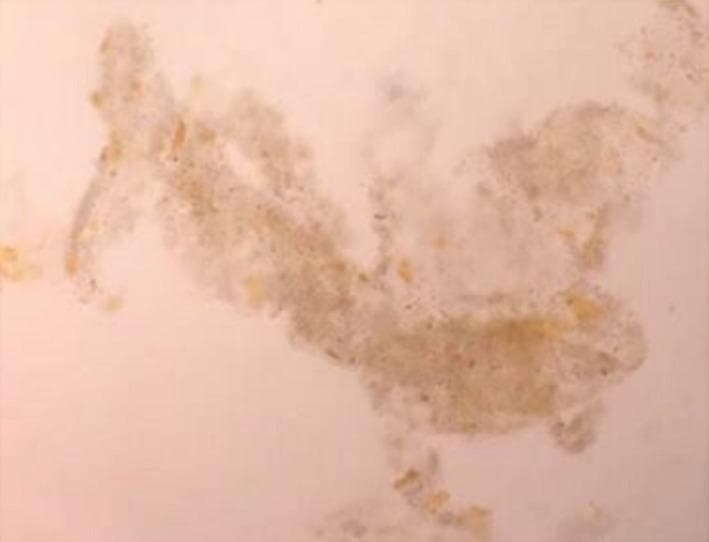
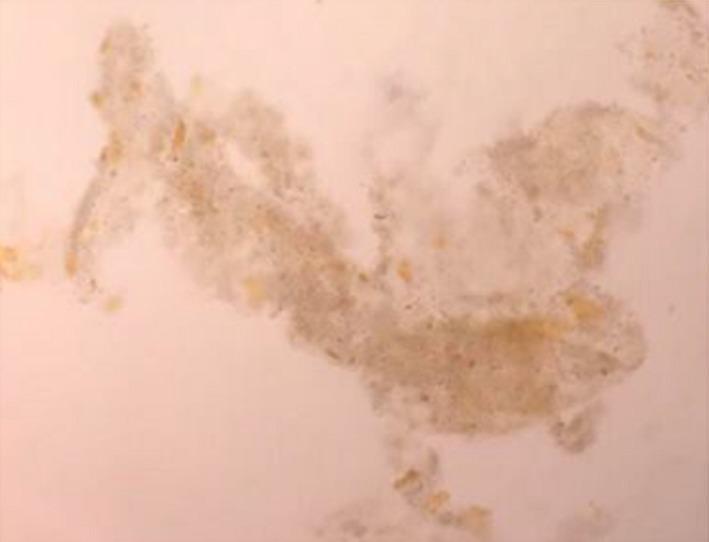
Granular (muddy brown) casts in ATN with bile staining (400× magnification):
Elongated cylindrical granular casts with muddy-brown and yellow-gold pigmentation. The bile staining indicates co-existing hyperbilirubinemia (hepatorenal syndrome or obstructive jaundice with ATN).
5. Crystals
| Crystal | Microscopic Appearance | Urine pH | Clinical Significance |
|---|
| Uric acid | Yellow-brown rhomboid, rosettes, barrels | Acidic | Gout, high-purine diet, uric acid nephrolithiasis, tumor lysis syndrome |
| Calcium oxalate monohydrate | Dumbbell / spindle shaped | Any | Hyperoxaluria, ethylene glycol poisoning (diagnostic), Crohn's disease, small bowel resection |
| Calcium oxalate dihydrate | Envelope shaped (octahedral) | Any | Common; oxalate-rich diet; also ethylene glycol |
| Triple phosphate (struvite) | Coffin-lid / prism shaped | Alkaline | UTI with urea-splitting organisms; staghorn calculi |
| Calcium phosphate | Needles / amorphous rosettes | Alkaline | Hyperparathyroidism, Type 1 RTA |
| Cystine | Hexagonal plates (flat, colorless) | Acidic | Cystinuria — pathognomonic; recurrent stones |
| Cholesterol | Rectangular plates with notched corners | Any | Nephrotic syndrome, chyluria |
| Bilirubin | Reddish-brown needles/granules | Acidic | Hepatocellular disease, obstructive jaundice |
| Tyrosine / Leucine | Fine yellow needles; spheroids | Acidic | Severe hepatic failure |
| 2,8-Dihydroxyadenine | Brown spheroids | Acidic | APRT deficiency — mimics uric acid stones |
6. Microorganisms
| Organism | Significance |
|---|
| Bacteria | Significant bacteriuria: >10⁵ CFU/mL on culture (>10⁸/L); correlate with symptoms |
| Yeast (Candida) | Immunocompromised, DM, prolonged catheterization, broad-spectrum antibiotics |
| Trichomonas vaginalis | Pear-shaped flagellated protozoa; sexually transmitted; causes urethritis/vaginitis |
| Schistosoma haematobium | Terminal-spined eggs; bladder schistosomiasis (Africa, Middle East); hematuria |
| Microfilaria (Wuchereria bancrofti) | Chyluria in lymphatic filariasis |
PART 4 — SPECIAL & QUANTITATIVE URINE TESTS
| Test | Purpose | Key Values |
|---|
| 24-hour urine protein | Gold standard proteinuria quantification | >3.5 g/day = nephrotic range |
| Urine albumin:creatinine ratio (ACR) | Microalbuminuria screening (DM, HTN) | Normal <30; Micro 30–300; Macro >300 mg/g |
| Urine protein:creatinine ratio (PCR) | Spot sample equivalent of 24-hr protein | PCR (mg/mmol) ≈ protein (g/day) |
| Urine electrolytes (Na⁺, K⁺, Cl⁻) | AKI workup, volume status | See FENa below |
| Urine osmolality | Concentrating ability, DI workup | >800 mOsm/kg = good concentration; <300 = dilute |
| Urine culture & sensitivity (MC&S) | UTI organism identification, antibiogram | >10⁵ CFU/mL significant |
| Urine cytology | Urothelial (transitional cell) carcinoma | Clusters of abnormal epithelial cells |
| Bence-Jones protein | Multiple myeloma, LCDD | Heat precipitation test; confirmed by SPEP/urine electrophoresis |
| Urine VMA / catecholamines / metanephrines | Pheochromocytoma | 24-hr collection |
| Urine 5-HIAA | Carcinoid tumor | >25 mg/day abnormal |
| Urine free cortisol (24-hr UFC) | Cushing's syndrome | >3× upper limit of normal |
| Urine porphyrins / ALA / PBG | Acute intermittent porphyria (AIP) | Elevated ALA + PBG during attack |
| Urine myoglobin | Rhabdomyolysis | Dipstick heme positive; no RBCs on microscopy; CK >5000 |
| 3-Glass test | Urethritis vs prostatitis vs cystitis localization | Initial/midstream/post-massage fractions |
PART 5 — FRACTIONAL EXCRETION OF SODIUM (FENa)
$$FE_{Na}(%) = \frac{U_{Na} \times P_{Cr}}{P_{Na} \times U_{Cr}} \times 100$$
| FENa | Interpretation |
|---|
| <1% | Pre-renal AKI — tubules intact, avidly reabsorbing Na |
| 1–2% | Indeterminate |
| >2% | Intrinsic renal (ATN) — tubular dysfunction |
Caveats:
- FENa <1% despite ATN in: contrast nephropathy, myoglobinuric AKI, early obstruction, GN, hepatorenal syndrome
- Use FEUrea (<35% = pre-renal) in patients on diuretics (diuretics artificially raise FENa)
PART 6 — CLINICAL SYNDROME PATTERNS
| Syndrome | Urinalysis Hallmarks |
|---|
| Nephrotic syndrome | Heavy proteinuria (>3.5 g/day), fatty casts, oval fat bodies, Maltese cross (polarized), hyaline casts, lipiduria |
| Nephritic syndrome | Hematuria (dysmorphic RBCs), RBC casts, sub-nephrotic proteinuria, WBCs, granular casts |
| Lower UTI (cystitis) | Pyuria, bacteriuria, positive nitrites + LE, no casts, hematuria possible |
| Pyelonephritis | Pyuria, WBC casts, bacteriuria, possible hematuria, fever |
| ATN (intrinsic AKI) | Muddy brown granular casts, renal tubular epithelial cells, FENa >2% |
| Pre-renal AKI | Concentrated urine (SG >1.020), hyaline casts, FENa <1% |
| Rhabdomyolysis | Dipstick heme positive, no RBCs on microscopy, pigmented granular casts, myoglobin |
| Hemolytic anemia | Hemoglobinuria, dipstick positive, no RBCs, pink plasma |
| Chronic renal failure | Fixed SG (~1.010), waxy/broad casts, proteinuria, isosthenuria |
| Interstitial nephritis | Sterile pyuria, WBC casts, eosinophiluria (Hansel stain), mild proteinuria |
| Bladder carcinoma | Hematuria (painless), clumps of transitional cells on cytology |
| TB of urinary tract | Sterile pyuria (the classic cause), hematuria, acid-fast bacilli on ZN stain |
| Alkaptonuria | Urine turns dark/black on standing; reducing substances positive |
| Cystinuria | Hexagonal crystals, recurrent radiolucent stones, positive cyanide-nitroprusside test |
| Hepatorenal syndrome | Oliguria, low FENa (<1%), bile-pigmented granular casts |
PART 7 — SAMPLE COLLECTION METHODS
| Method | Indication | Notes |
|---|
| Midstream clean catch (MSU) | Routine UA, culture | Reduce contamination; most common method |
| First morning sample | Protein, casts, orthostatic proteinuria, pregnancy test | Most concentrated; best for casts and protein |
| 24-hour urine | Quantitative protein, creatinine clearance, hormones, electrolytes | Requires complete timed collection |
| Catheter specimen (CSU) | Hospitalized, incontinent, post-op patients | Higher sensitivity for culture |
| Suprapubic aspiration (SPA) | Neonates, infants, ambiguous cultures | Gold standard — no urethral contamination |
| 3-glass test | Localizing UTI — urethral vs. bladder vs. prostate | Initial stream, midstream, post-massage fraction |
| Urine for TB (early morning) | Suspected renal TB | 3 consecutive early morning specimens; culture on Lowenstein-Jensen medium |
Processing precautions:
- Examine within 2 hours of voiding at room temperature
- If delayed: refrigerate at 4°C (stable up to 24 hr)
- Delayed processing causes: bacterial overgrowth, cast dissolution, RBC lysis, pH rise (ammonia production), crystal dissolution
This covers the complete clinical scope of urinalysis — from bedside physical findings through dipstick chemistry, microscopy, quantitative tests, and disease-specific patterns used in nephrology, urology, general medicine, surgery, and emergency care.