
Cauda equina vs conus medullaris
Reading File
Searching for a comparison of cauda equina and conus medullaris syndromes across anatomy, clinical features, and imaging.
search_medical_text
cauda equina syndrome vs conus medullaris syndrome clinical features comparison
Harrison's Principles of Internal Medicine, Twenty First Edition
Page 12522
search_medical_image
cauda equina conus medullaris anatomy diagram spinal cord
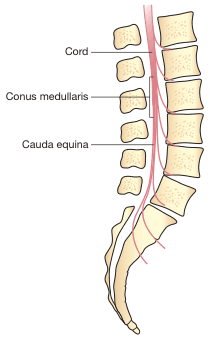
Bailey and Love's Short Practice of Surgery 28th Edition
Page 411
GradeResponse
GradeResponse
Here is a structured comparison of the two syndromes:
Cauda Equina vs. Conus Medullaris
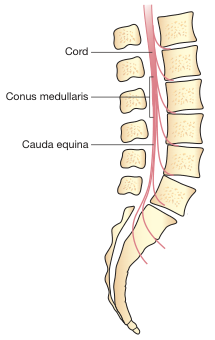
Anatomy
| Feature | Conus Medullaris | Cauda Equina |
|---|---|---|
| What it is | Tapered terminal end of the spinal cord (sacral + coccygeal segments) | Bundle of nerve roots below the cord (L2 onward) |
| Level | ~L1–L2 | Below L1–L2 |
| Neural tissue | Spinal cord (CNS) | Peripheral nerve roots (PNS) |
Clinical Comparison
| Feature | Conus Medullaris | Cauda Equina |
|---|---|---|
| Pain | Mild or absent | Prominent low back + radicular pain |
| Weakness | Largely preserved | Asymmetric, flaccid leg weakness |
| Sensory loss | Bilateral saddle anesthesia (S3–S5) | Asymmetric, variable dermatomal |
| Reflexes | Bulbocavernosus (S2–S4) and anal (S4–S5) reflexes absent | Variable areflexia in lower extremities |
| Bladder/Bowel | Prominent — urinary retention/incontinence, lax anal tone | Relatively spared (or late involvement) |
| Sexual function | Impotence prominent | Less prominent early |
| Symmetry | Bilateral/symmetric | Asymmetric |
| UMN signs | May be present | Absent (pure LMN) |
Harrison's Principles of Internal Medicine, 21st Ed., p. 12522
Key Clinical Pearls
- Conus = cord lesion → expect UMN + LMN mixed features, bilateral saddle anesthesia, early and severe sphincter/sexual dysfunction.
- Cauda equina = nerve root lesion → expect LMN-only features (flaccid, areflexic), asymmetric, pain-dominant, sphincters relatively spared.
- Mass lesions in the lower spinal canal (e.g., large central disc herniation, tumor) often produce a mixed picture of both syndromes simultaneously — this is common in clinical practice.
- Cauda equina syndrome (CES) is a surgical emergency; delayed decompression worsens bladder/bowel outcomes.
- Because cauda equina nerve roots are peripheral, they have greater regenerative potential than conus cord tissue.
Quick Memory Trick
| Conus | Cauda Equina | |
|---|---|---|
| Pain | Less | More |
| Symmetry | Symmetric | Asymmetric |
| Sphincters | Early/severe | Late/mild |
| Type | Mixed UMN/LMN | Pure LMN |
This is a shared conversation. Sign in to Orris to start your own chat.