
Teach me SDH
Asking for Preferences
Which SDH do you mean?
Reading File
Now let me search the medical library for subdural hematoma content in parallel:
Finding Sources
Finding Sources
Searching PubMed
"subdural hematoma"[MeSH Terms] AND management
Excellent sources found. Let me now read the most comprehensive sections in parallel:
Reading File
Reading File
Reading File
Reading File
Now let me grab the clinical features table from Plum & Posner, and the Robbins pathology description, plus fetch key images:
Reading File
Reading File
Loading Image
Loading Image
I now have comprehensive material from multiple authoritative textbooks. Let me compile the full teaching guide.
Subdural Hematoma (SDH)
1. Anatomy & Location
The subdural space is the potential space between the inner layer of the dura mater and the loosely adherent arachnoid mater. Normally this space is a virtual space—it only becomes real when blood (or fluid) accumulates.
Traversing this space are bridging veins: cortical veins that drain blood from the cerebral hemispheres upward through the subarachnoid space and dura to empty into the dural venous sinuses (especially the superior sagittal sinus). The brain is suspended in CSF, but the sinuses are fixed relative to the dura — so traumatic displacement of the brain tears these veins at the dural entry point.
"The brain is suspended in CSF, but the venous sinuses are fixed relative to the dura; as a result, traumatic displacement of the brain can tear the veins at the point where they penetrate the dura." — Robbins & Kumar Pathologic Basis of Disease
2. Pathogenesis
SDH is a venous bleed (not arterial — this distinguishes it from epidural hematoma).
Mechanism: Acceleration-deceleration injury → shear stress on bridging veins → venous tear → blood accumulates in the subdural space.
Because this is venous bleeding:
- Pressure is low → bleeds slowly
- Typically tamponades early unless coagulation is impaired
- Anticoagulant use (warfarin, DOACs) dramatically worsens outcomes — anticoagulation should be reversed promptly
Who is at risk?
| Population | Why |
|---|---|
| Elderly | Brain atrophy stretches bridging veins; minor trauma can rupture them |
| Chronic alcoholics | Brain atrophy + coagulopathy from liver disease |
| Infants (<2 years) | Bridging veins are thin-walled; large subdural space |
| Anticoagulated patients | Ongoing venous leakage not tamponaded |
| Hemodialysis patients | Anticoagulation + uremic coagulopathy |
In the elderly, "even seemingly benign falls from standing position can result in subdural bleeding." — Tintinalli's Emergency Medicine
3. Classification by Time
| Type | Onset | CT Appearance | Key Features |
|---|---|---|---|
| Acute | Symptoms within ≤14 days | Hyperdense (bright white), crescent-shaped | Usually severe trauma; often unconscious; associated brain injury |
| Subacute | 3–14 days | Isodense — hard to see on plain CT | May need contrast CT or MRI |
| Chronic | >2–3 weeks | Hypodense (dark, like CSF) | Often trivial/forgotten trauma; subtle symptoms |
CT density progression over time:
- Fresh blood = hyperdense (iron-containing oxyhemoglobin)
- ~1 week: clot lysis begins → isodense
- 3–4 weeks: fully liquefied → hypodense
- If recurrent bleeds occur → mixed density ("hematocrit effect" — dense acute blood settles below lighter chronic fluid)
4. CT Imaging
Subdural hematomas are crescent-shaped and spread over a large cortical area. Critically, they cross suture lines (unlike epidural hematomas, which are biconvex and limited by sutures).
Chronic SDH — CT (Gray's Anatomy for Students):
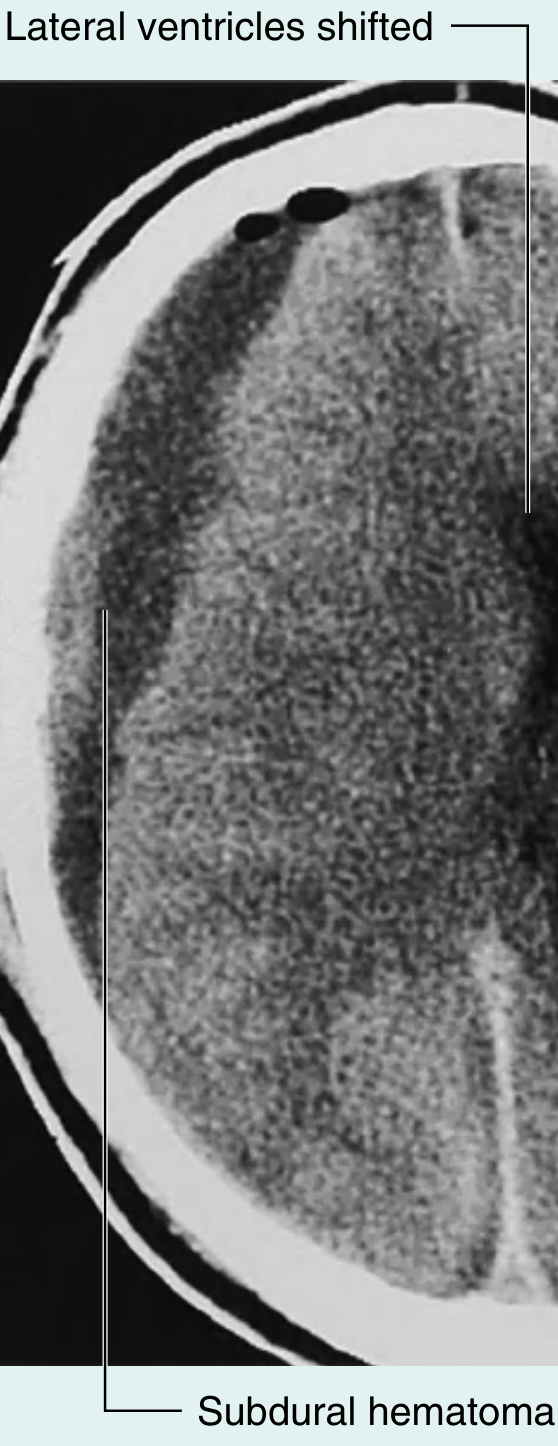
Chronic (hypodense) subdural hematoma. Note the hypodense crescent over the hemisphere and midline shift with lateral ventricle displacement.
Acute/subacute SDH on CT:
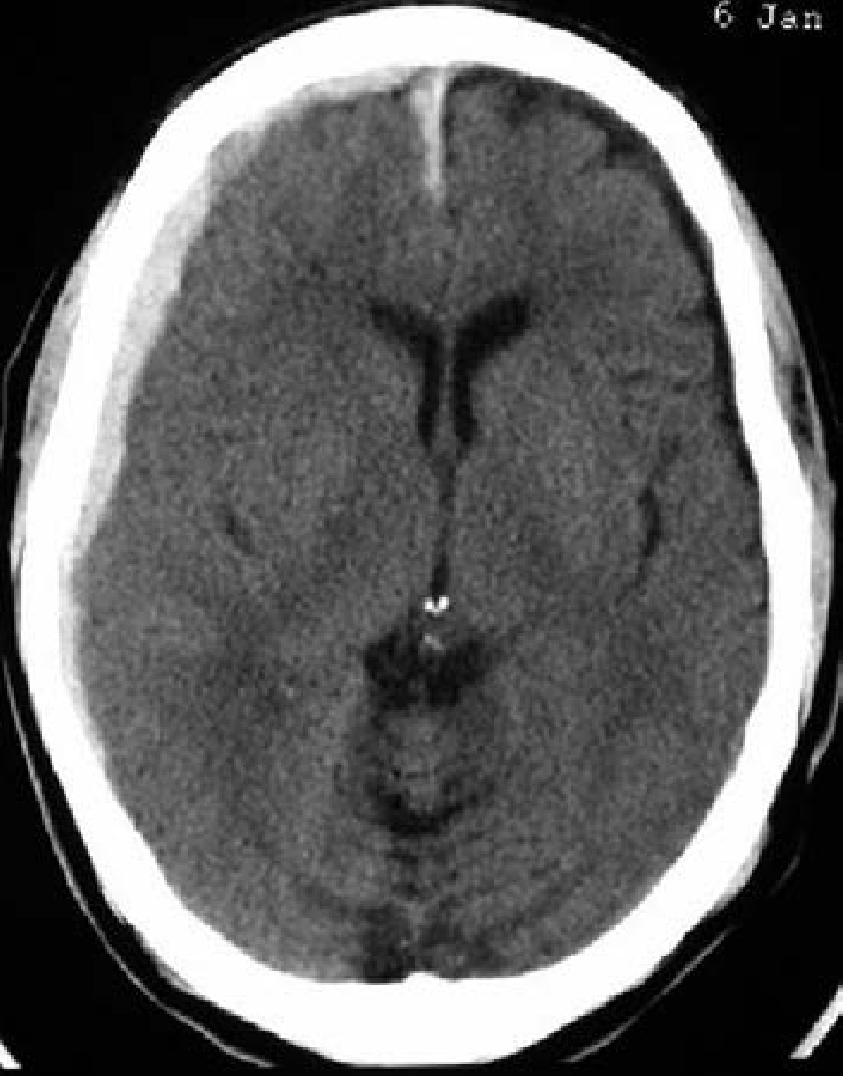
Small acute subdural hematoma in the right frontotemporal region — note the hyperdense (white) crescent-shaped collection.
5. Pathology (Gross & Histologic Evolution)
From Robbins & Kumar:
- Acute: Freshly clotted blood along brain surface; subarachnoid space often clear; underlying cortex is flattened.
- ~1 week: Clot lysis
- ~2 weeks: Fibroblasts grow in from the dural surface; neomembrane begins to form
- 1–3 months: Hyalinized connective tissue; mature membrane firmly attached to inner dura
- Final state: Either resolves as a thin "subdural membrane," OR thin-walled vessels in the granulation tissue bleed repeatedly → chronic expanding hematoma
The neomembrane has fragile, leaky neovascular channels that lack a blood-brain barrier — this explains:
- Recurrent bleeds
- Surrounding cerebral edema
- Why corticosteroids can help (reduce capillary leakage)
6. Clinical Features
Acute SDH
- Typically follows high-velocity trauma
- Patient often unconscious on presentation (no "lucid interval" unlike epidural)
- Associated with brain contusion, traumatic subarachnoid hemorrhage
- Worse prognosis than epidural hematoma due to underlying brain injury
Chronic SDH
This is the clinically tricky one — frequently misdiagnosed. From Plum & Posner's landmark series of 73 patients with fluctuating consciousness due to SDH:
| Misdiagnosis | # Patients |
|---|---|
| Cerebral vascular disease | 17 |
| Cerebral infarction/arteriosclerosis | 12 |
| Cerebral atrophy | 5 |
| Encephalitis | 8 |
| Meningitis | 3 |
| Metabolic encephalopathy | 3 |
Clinical features of chronic SDH:
- Headache (~70% of patients)
- Fluctuating consciousness — hallmark; may mimic TIAs or metabolic encephalopathy
- Cognitive/personality changes — often the presenting complaint in elderly
- Focal deficits (15–30%): hemiparesis, aphasia, visual field defects — may fluctuate
- Seizures
- Parkinsonism, dystonia, chorea — rare, but confounding
- Tenderness to skull percussion at hematoma site
"The symptoms of subdural hematoma have a remarkable tendency to fluctuate from day to day or even from hour to hour." — Plum & Posner
Why does it fluctuate? The brain teeters on the edge of herniation. Fluid shifts across the leaky hematoma membrane rapidly alter ICP — moving the patient in and out of uncal or diencephalic herniation.
Key rule: "It could always be a subdural" — image any comatose patient, even without focal signs.
7. Special Populations
Bilateral SDH (~20% of chronic cases)
- Can cause bilateral leg weakness by compressing medial frontal lobes (paracentral lobule — leg motor area)
- May be interhemispheric (within the falx)
Infants
- Non-accidental trauma (shaken baby syndrome) — think SDH + retinal hemorrhages + no adequate history
- Bifrontal chronic SDH may extend through open fontanelle
8. Management
| Scenario | Treatment |
|---|---|
| Acute SDH + coma | Surgical emergency — immediate evacuation (craniotomy or craniectomy) |
| Subacute SDH | Surgery typically indicated; higher mortality than chronic |
| Chronic SDH, symptomatic | Surgical drainage (burr hole craniotomy or twist-drill drainage) |
| Chronic SDH, small, minimal symptoms | Conservative management — serial imaging; some resolve spontaneously |
| Anticoagulated patient | Reverse anticoagulation immediately (vitamin K, FFP, PCC for warfarin; specific reversal agents for DOACs) |
| Cerebral edema from SDH | Corticosteroids reduce edema effectively (reduce capillary leakage from neomembrane) |
Prognostic factors in acute SDH:
- Age
- Time from injury to evacuation (earlier = better)
- Pupillary abnormalities at presentation
- Persistent coma vs. a lucid interval
- Volume of the hematoma
9. SDH vs. EDH — Quick Comparison
| Feature | Subdural (SDH) | Epidural (EDH) |
|---|---|---|
| Vessel | Bridging veins (venous) | Middle meningeal artery (arterial) |
| Space | Between dura & arachnoid | Between skull & dura |
| Shape on CT | Crescent, follows brain contour | Biconvex (lens-shaped) |
| Crosses sutures? | Yes | No (limited by sutures) |
| CT density (acute) | Hyperdense | Hyperdense |
| Lucid interval | Uncommon | Classic (60%) |
| Underlying brain injury | Often present | Usually absent |
| Typical patient | Elderly, atrophic brain | Young adult, temporal skull fracture |
| Prognosis | Worse | Better (if evacuated quickly) |
10. High-Yield Summary
- SDH = bridging vein tear → venous blood in subdural space
- Crescent-shaped, crosses suture lines; conforming to the brain surface
- Acute: hyperdense CT, severe trauma, often comatose, surgical emergency
- Chronic: hypodense CT, elderly/anticoagulated, insidious onset, fluctuating consciousness is the hallmark
- Chronic SDH is a great mimicker — think of it in any elderly patient with altered mental status, even without trauma history
- Bilateral in 20% → can cause bilateral leg weakness
- Reverse anticoagulation urgently; evacuate large/symptomatic hematomas; small chronic SDH may be managed conservatively
Sources: Tintinalli's Emergency Medicine; Plum & Posner's Diagnosis and Treatment of Stupor and Coma; Neuroanatomy through Clinical Cases (3rd ed.); Robbins & Kumar Pathologic Basis of Disease; Gray's Anatomy for Students
This is a shared conversation. Sign in to Orris to start your own chat.