
Carcinoma cervix clinical features(signs and symptoms)
Reading File
Finding Sources
Finding Sources
Finding Sources
Finding Sources
Reading File
Finding Sources
Finding Sources
Finding Sources
Reading File
Reading File
Reading File
Now let me fetch the staging diagram image and search for a dedicated clinical features section with more detail on signs (physical exam findings).
Loading Image
Finding Sources
I now have comprehensive information from multiple authoritative textbooks. Let me compile the full answer.
Carcinoma Cervix — Clinical Features (Signs & Symptoms)
Early Disease
Early cervical cancer is often completely asymptomatic, which is the fundamental rationale behind routine Pap smear screening programs. Most early-stage lesions are detected incidentally on cytology before any symptoms develop.
— Harrison's Principles of Internal Medicine 22E
Symptoms
1. Abnormal Vaginal Bleeding (Most Common Symptom)
- Postcoital bleeding (contact bleeding) — the hallmark early symptom; bleeding after sexual intercourse due to a friable tumor on the ectocervix
- Intermenstrual bleeding — spotting or bleeding between periods
- Menorrhagia — heavy or prolonged menstrual bleeding
- Postmenopausal bleeding — in older women, any vaginal bleeding after menopause warrants investigation — Harrison's Principles of Internal Medicine 22E; Tietz Textbook of Laboratory Medicine 7th Ed.
2. Abnormal Vaginal Discharge
- Blood-stained or blood-tinged discharge
- Foul-smelling yellow/purulent discharge — results from necrosis and secondary infection of the tumor
- Persistent or offensive discharge even without visible bleeding should raise suspicion — Harrison's 22E; Tietz 7th Ed.; Grainger & Allison's Diagnostic Radiology
3. Pelvic Pain & Dyspareunia
- Pelvic or lower abdominal pain — indicates locally advanced disease with parametrial invasion or involvement of the pelvic nerve plexus
- Sacral or back pain — suggests lateral extension into the pelvic nerve plexus or involvement of sacral nerve roots; a sign of advanced-stage disease
- Dyspareunia (painful intercourse) — Harrison's 22E; Tietz 7th Ed.
4. Symptoms of Advanced/Metastatic Disease
| Symptom | Mechanism |
|---|---|
| Flank pain / loin pain | Hydronephrosis from ureteral compression by tumor or nodal disease |
| Urinary symptoms (frequency, haematuria, difficulty voiding) | Direct bladder invasion (Stage IVA) |
| Rectal symptoms (rectal bleeding, constipation, tenesmus) | Direct rectal invasion (Stage IVA) |
| Leg oedema / deep vein thrombosis | Iliac vessel compression by nodal disease or direct extension to pelvic sidewall |
| Sciatica / leg pain | Pelvic sidewall involvement, sciatic nerve compression |
| Weight loss, anorexia, cachexia | Systemic features of advanced malignancy |
| — Harrison's Principles of Internal Medicine 22E |
Signs (Physical Examination)
Inspection (Speculum Examination)
- Visible exophytic tumor on the ectocervix — the most common finding; may appear as a cauliflower-like, ulcerated, or friable growth
- Endocervical tumors — may not be visible on direct inspection (deeper in the canal); cervix may feel indurated on palpation without obvious visual lesion
- Ulcerated/necrotic cervix with foul-smelling discharge
- Contact bleeding on swabbing or speculum insertion
Bimanual/Pelvic Examination
- Indurated, hard, irregular cervix — firm stony consistency distinguishes malignancy from benign conditions
- Enlarged cervix / barrel-shaped cervix in advanced cases
- Parametrial thickening — loss of the normal soft, pliable feel of the parametrium; "frozen pelvis" in very advanced disease when the tumor fixes to the pelvic side wall
- Vaginal wall involvement — tumor extending to the upper vagina (Stage IIA) or lower one-third (Stage IIIA)
- Uterine enlargement — if endocervical canal is obstructed, causing haematometra or pyometra
Rectal Examination
- Confirms parametrial involvement and pelvic sidewall fixity
- May reveal rectal mucosal involvement in Stage IVA disease
General Examination
- Lymphadenopathy — inguinal or supraclavicular nodes in metastatic disease
- Signs of anaemia (pallor) from chronic blood loss
- Lower limb oedema from lymphatic or venous obstruction
Staging Summary with Survival
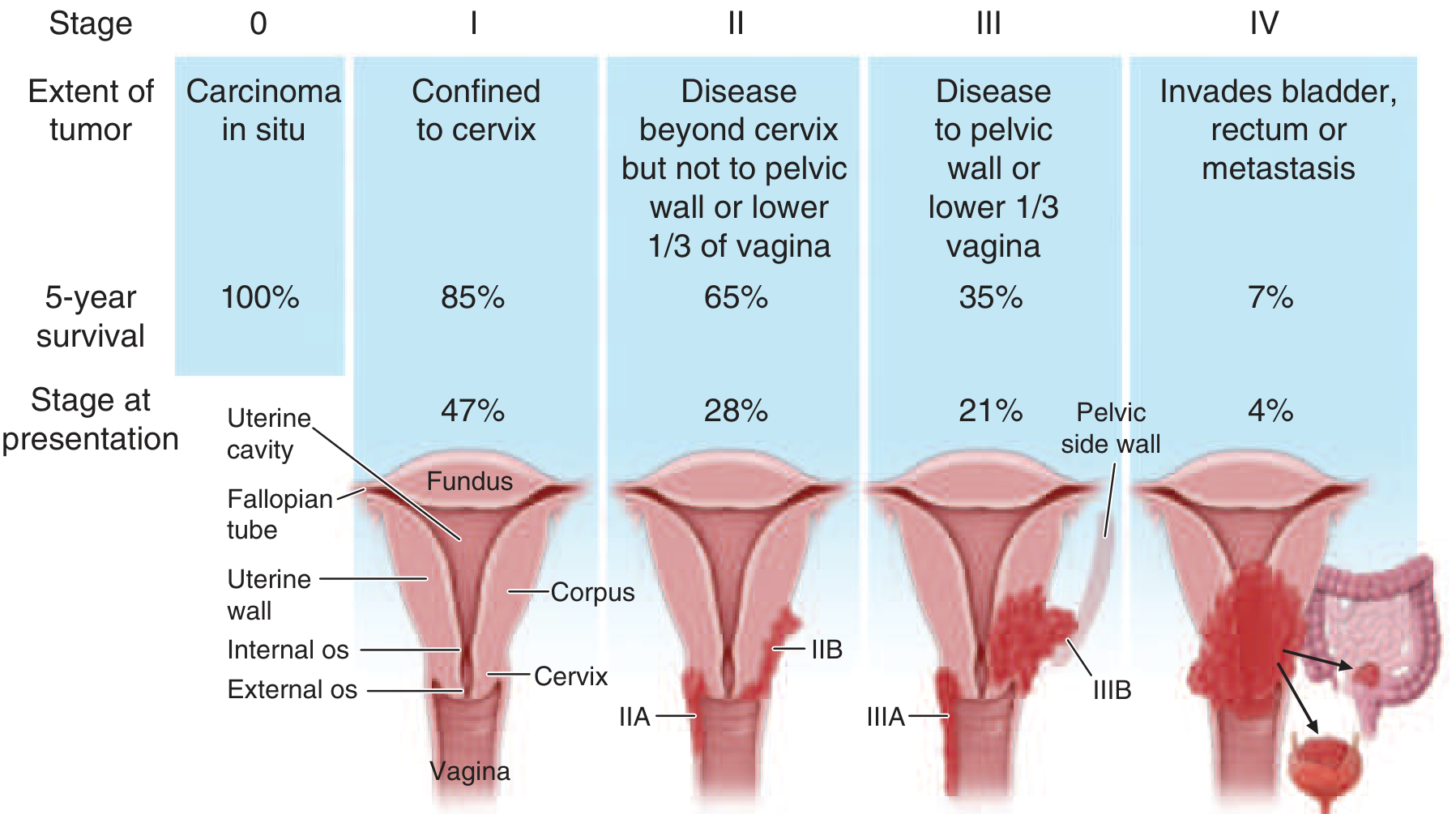
FIGO staging of cervical carcinoma with corresponding 5-year survival rates. Stage I (confined to cervix): 85%; Stage II (beyond cervix, not to pelvic wall): 65%; Stage III (to pelvic wall/lower vagina): 35%; Stage IV (bladder/rectum/distant): 7%. — Harrison's Principles of Internal Medicine 22E
Key Points to Remember
| Feature | Clinical Significance |
|---|---|
| Postcoital bleeding | Earliest & most characteristic symptom |
| Foul vaginal discharge | Tumor necrosis + secondary infection |
| Pelvic/sacral pain | Advanced local spread — parametrium/nerves involved |
| Hydronephrosis (flank pain) | Ureteral obstruction → Stage IIIB or above |
| Bladder/rectal symptoms | Stage IVA disease |
| "Frozen pelvis" | Bilateral parametrial involvement reaching pelvic sidewall |
Note: Adenocarcinomas arise in the endocervical canal and may not be visible on speculum exam, making them more likely to be missed clinically — accounting for why they are harder to screen with cytology. — Harrison's 22E
Sources: Harrison's Principles of Internal Medicine 22E | Tietz Textbook of Laboratory Medicine 7th Ed. | Grainger & Allison's Diagnostic Radiology | Berek & Novak's Gynecology
This is a shared conversation. Sign in to Orris to start your own chat.