
from Guyton and Hall textbook of medical physiology, 4th South Asia edition, write a 5-mark short note on Parturition- explain, the role of oxytocin
Reading File
Finding Sources
Finding Sources
Finding Sources
Reading File
Reading File
Reading File
Reading File
Loading Image
I now have all the content needed from Guyton and Hall. Here is the complete 5-mark short note:
Short Note: Parturition - Role of Oxytocin
(Guyton and Hall Textbook of Medical Physiology, 4th South Asia Edition - Chapter 83)
Definition
Parturition is the process by which the baby is expelled from the uterus at the end of pregnancy (approximately 38-40 weeks). The uterus, which undergoes weak irregular contractions (Braxton Hicks contractions) throughout pregnancy, suddenly develops strong, rhythmic, coordinated contractions that expel the fetus.
Factors Increasing Uterine Excitability Near Term
Two broad categories of changes prepare the uterus for labor:
1. Hormonal Factors
a) Estrogen-to-Progesterone Ratio:
- Progesterone inhibits uterine contractility throughout pregnancy, protecting the fetus.
- Estrogen increases uterine contractility by increasing gap junctions between smooth muscle cells.
- From the 7th month onward, estrogen continues to rise while progesterone remains constant or slightly falls.
- The resulting increase in the estrogen-to-progesterone ratio makes the uterine muscle progressively more sensitive to contractile stimuli, including oxytocin.
b) Oxytocin (key hormone - discussed below)
c) Fetal Hormones:
- The fetal pituitary secretes increasing oxytocin.
- The fetal adrenal secretes cortisol (a uterine stimulant).
- Fetal membranes release prostaglandins in high concentrations at the time of labor, further intensifying contractions.
2. Mechanical Factors
a) Stretch of Uterine Musculature: Increasing fetal size and intermittent fetal movements progressively stretch the uterine smooth muscle, enhancing contractility. Twins are born on average 19 days earlier than singletons, underscoring the importance of mechanical stretch.
b) Cervical Stretch/Irritation: Stretching or irritating the cervix elicits reflexes that cause the body of the uterus to contract and also triggers reflex release of oxytocin from the pituitary.
Onset of Labor: Positive Feedback Mechanism
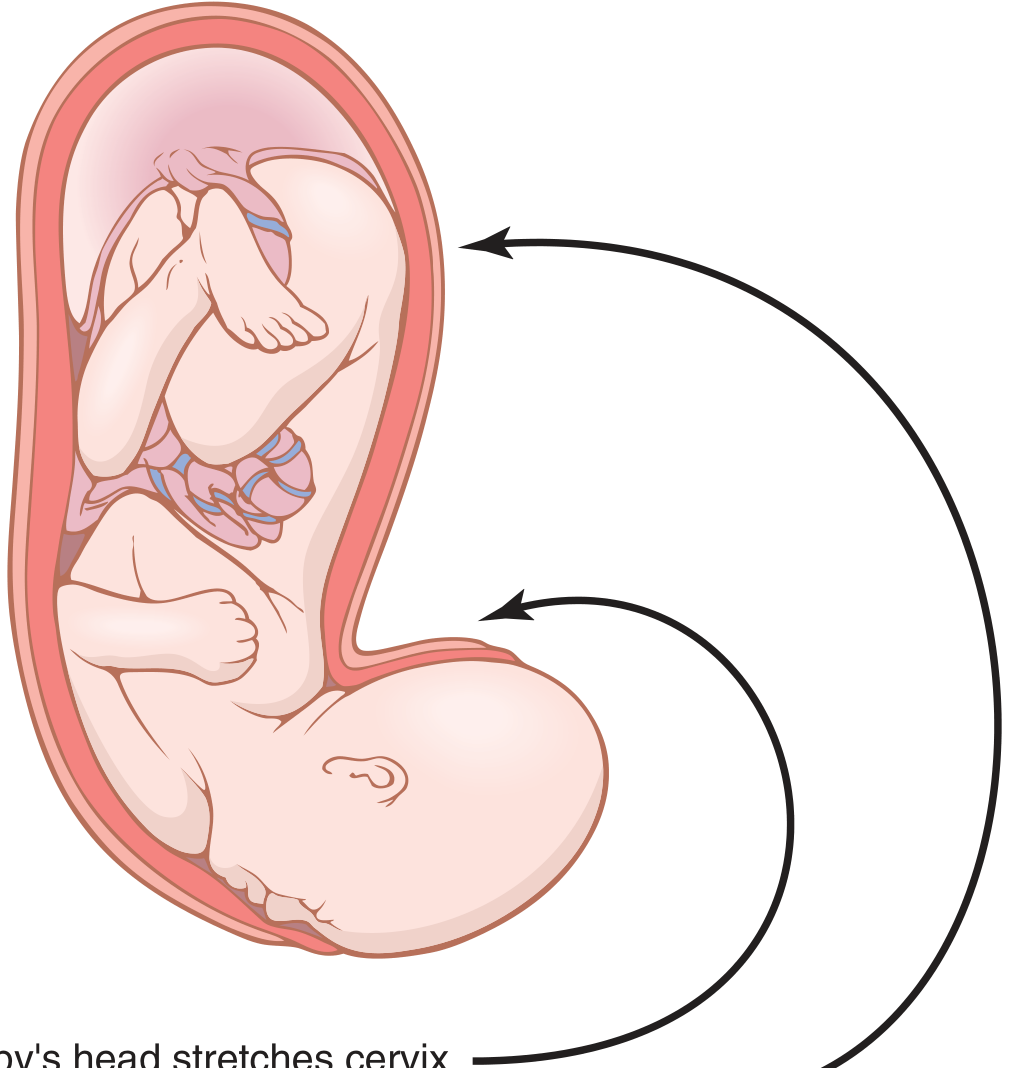
During pregnancy, weak Braxton Hicks contractions occur. Near term, these suddenly transform into strong labor contractions via a positive feedback loop:
- The baby's head stretches the cervix.
- Cervical stretch excites the uterine fundus to contract more strongly.
- Fundic contraction pushes the baby downward, stretching the cervix further.
- This cycle repeats with escalating intensity until the baby is expelled.
Cervical stretch simultaneously triggers reflex secretion of oxytocin from the posterior pituitary, amplifying this positive feedback further.
Role of Oxytocin in Parturition
Oxytocin is a nonapeptide hormone secreted by the neurohypophysis (posterior pituitary), synthesized in the paraventricular and supraoptic nuclei of the hypothalamus. It is the most important hormonal promoter of uterine contraction at term.
Four lines of evidence from Guyton support oxytocin's role:
-
Increased uterine oxytocin receptors near term: The uterine muscle markedly increases its oxytocin receptor density in the last few months of pregnancy, making it far more responsive to a given dose of oxytocin.
-
Increased oxytocin secretion during labor: The rate of oxytocin secretion by the neurohypophysis rises considerably during labor, especially in the final stage.
-
Prolonged labor after hypophysectomy: In hypophysectomized animals, labor still occurs (because mechanical and other factors remain), but its duration is significantly prolonged - indicating that endogenous oxytocin is important for a normal, timely delivery.
-
Ferguson Reflex: Irritation or stretching of the uterine cervix during labor sends neurogenic signals through the paraventricular and supraoptic nuclei of the hypothalamus, triggering reflex secretion of oxytocin from the neurohypophysis. This increases uterine contractility, which further stretches the cervix - a classic positive feedback loop.
Clinical note: Exogenous oxytocin is used clinically to induce or augment labor. However, overuse can cause uterine spasm (sustained tetanic contraction) rather than rhythmic contractions, which can impede or stop placental blood flow and cause fetal death.
Mechanics of Labor and Delivery
- Uterine contractions begin at the fundus and spread downward; the lower uterine segment near the cervix contracts weakly. This directs the fetus toward the cervix.
- Early contractions: once every 30 minutes. At full labor: once every 1-3 minutes; force ~25 pounds per contraction.
- Stage 1: Progressive cervical dilation (lasts 8-24 hours in first pregnancy).
- Stage 2: Full dilation to delivery of baby (minutes to 30+ minutes).
- Stage 3: Placental separation and delivery (10-45 minutes post-delivery). Uterine contraction constricts blood vessels in a figure-of-eight arrangement to limit bleeding (~350 mL average).
- In >95% of births, the head presents first (vertex); buttocks-first = breech presentation.
Summary
| Factor | Effect on Uterus |
|---|---|
| Increased estrogen/progesterone ratio | Increases sensitivity to contractile stimuli |
| Oxytocin (maternal + fetal) | Directly stimulates uterine smooth muscle contraction |
| Prostaglandins (fetal membranes) | Increase contraction intensity |
| Fetal cortisol | Uterine stimulant |
| Uterine stretch | Mechanically enhances contractility |
| Cervical stretch (Ferguson reflex) | Triggers reflex oxytocin release; positive feedback |
Parturition is the culmination of progressive hormonal sensitization and mechanical loading, with oxytocin playing a central amplifying role through the Ferguson reflex positive feedback mechanism.
Source: Guyton and Hall Textbook of Medical Physiology, Chapter 83 - Pregnancy and Lactation, pp. 1042-1043.
This is a shared conversation. Sign in to Orris to start your own chat.