
Non cyclicsl mastalgia
Reading File
Non-cyclical mastalgia is breast pain that is not related to the menstrual cycle - it tends to be constant or intermittent but without a hormonal pattern, often localized to one area of the breast, and is more common in postmenopausal women. Common causes include musculoskeletal problems (Tietze syndrome), large pendulous breasts, sclerosing adenosis, duct ectasia, and referred pain from the chest wall.
Searching sources...
Finding Sources
Searching PubMed
non-cyclical mastalgia treatment
Reading File
Reading File
Reading File
Reading File
Reading File
Reading File
I now have comprehensive information from Bailey & Love's Surgery and Berek & Novak's Gynecology. Here is the full answer:
Non-Cyclical Mastalgia
Definition and Characteristics
Non-cyclical mastalgia is breast pain that occurs independently of the menstrual cycle. Unlike cyclical mastalgia (which peaks in the luteal phase and resolves with menses), non-cyclical pain:
- Can occur at any time of the cycle, before or after menopause
- Is typically unilateral and well-localised
- Described as achy, burning, or sore - may be constant or intermittent
- More common in women in their 4th and 5th decades
- Is generally harder to treat than cyclical mastalgia
- Accounts for roughly one-third of all mastalgia cases
Causes
True Breast (Mammary) Causes
- Duct ectasia / periductal mastitis - a frequent underlying cause
- Trigger spot / trigger point - a localised, very tender spot on palpation
- Sclerosing adenosis
- Breast cancer - about 5% of breast cancers present with pain, but it is rarely the sole symptom
- Trauma
Extramammary (Chest Wall) Causes
- Tietze's syndrome (costochondritis) - painful costochondral junction with no radiological anomaly; also causes lateral chest wall pain in the anterior axillary line and over serratus anterior
- Radiculopathies / cervical spondylosis
- Herpes zoster
- Rib fractures
Referred / Systemic Causes
- Angina pectoris
- Biliary colic
- Reflux oesophagitis
- Cervical spondylosis
- Vitamin D and calcium deficiency (common in low-/middle-income countries, causing bony aches that mimic non-cyclical mastalgia)
Diagnosis
- History: nature of pain (burning, aching), timing (relation to cycle), location (localised vs diffuse), unilateral vs bilateral
- Pain chart diary for at least 1 month - essential to differentiate cyclical from non-cyclical pattern
- Clinical breast examination to identify trigger spots
- Breast imaging (ultrasound and/or mammography depending on age) to exclude cancer
- Reassurance that symptoms are not malignant is itself therapeutic
Management
Non-Pharmacological (First-Line)
| Intervention | Evidence |
|---|---|
| Reassurance | Improvement in the majority of patients after cancer excluded |
| Well-fitting supportive brassiere (day and night) | Threefold risk of mastalgia with ill-fitting bra; sports bra shown superior to danazol in one RCT |
| Exercise (3x/week) | RCT showed greater QoL improvement than reassurance + garments alone |
| Pain diary | Clarifies pattern, guides therapy |
Pharmacological
Step 1 - Topical/OTC:
- Topical NSAIDs (diclofenac gel) - significant reduction in both cyclic and non-cyclic pain vs placebo; preferred as first pharmacological step to avoid systemic side effects
Step 2 - SERMs:
- Tamoxifen 10-20 mg/day - reduces breast pain; equivalent to danazol and bromocriptine in most studies; not FDA-approved for this indication
- Ormeloxifene (Centchroman) - non-steroidal SERM; equivalent to tamoxifen for non-cyclical breast pain; ~60% relief at 12 weeks, but drops to 30% by 24 weeks; side effects include ovarian cysts, menstrual irregularity, dizziness
Step 3 - Hormonal therapy (for severe, refractory cases):
- Danazol 100-200 mg twice daily (tapering to 100 mg/day) - the only FDA-approved drug for mastalgia; synthetic androgen that suppresses pituitary gonadotropins; side effects (acne, hirsutism, voice change, weight gain, headache, depression) often limit compliance
- Bromocriptine 2.5 mg twice daily for 3-6 months - dopamine agonist that inhibits prolactin; useful in women with TRH-induced elevated prolactin; side effects: nausea, vomiting, headache
- LH-RH analogues - used in severe cases
Other pharmacological options:
- Vitamin D / calcium supplementation (if deficient, especially in relevant populations)
- Evening primrose oil (gamolenic acid) - widely used though evidence is modest
- Withdrawal of hormonal contraceptives or HRT - may be sufficient to resolve symptoms
Special Situations
- Localised trigger spot: local anaesthetic + steroid injection into the trigger point can be highly effective for non-cyclical mastalgia
- Duct ectasia / periductal mastitis: duct excision (Hadfield's procedure) may be considered in refractory cases
- Macromastia-related pain: weight loss, physical therapy; consider reduction mammoplasty if symptoms persist (94% improvement in shoulder grooving, 93% in shoulder pain post-op)
- Chest wall pain (Tietze's): local injection of corticosteroid + LA, physiotherapy
Treatment Algorithm Summary
Exclude malignancy (examination + imaging)
        ↓
Reassurance + Pain diary
        ↓
Well-fitting bra + Exercise
        ↓
Topical NSAIDs
        ↓
Oral SERM (Tamoxifen / Ormeloxifene)
        ↓
Danazol / Bromocriptine (severe cases)
        ↓
Consider local injection for trigger spot or surgical intervention for duct ectasia
Key Points (vs Cyclical Mastalgia)
| Feature | Cyclical | Non-Cyclical |
|---|---|---|
| Relation to cycle | Yes (luteal phase) | No |
| Laterality | Usually bilateral | Usually unilateral |
| Age group | 3rd-4th decade | 4th-5th decade |
| Location | Diffuse / upper outer | Well-localised |
| Response to hormonal Rx | Good | Variable / poorer |
| Duration | Resolves at menopause | May persist |
Sources:
- Bailey and Love's Short Practice of Surgery, 28th Ed., pp. 940-941 (Mastalgia and Treatment section)
- Berek & Novak's Gynecology, pp. 989-991 (Types of Mastalgia; Management of Mastalgia)
Recent evidence note: A 2025 systematic review (PMID 40898150) examined vitamin B6 for mastalgia reduction - this is an emerging supplement option worth noting, particularly relevant for non-cyclical cases, though the textbook evidence base for established treatments above remains the primary guide.
Mondoes disease
Mondor's disease is a rare, benign condition characterized by thrombophlebitis of the superficial veins of the breast and anterior chest wall. It presents as a tender, cord-like structure under the skin, typically running from the breast toward the axilla or epigastrium. It is self-limiting in most cases.
Searching sources...
Finding Sources
Searching PubMed
Mondor disease breast thrombophlebitis
Reading File
Reading File
Reading File
Reading File
Reading File
Searching Images
Mondor's disease breast thrombophlebitis cord
I now have comprehensive information from four textbooks. Here is the full answer:
Mondor's Disease
Definition
Mondor's disease is a superficial thrombophlebitis of the superficial veins of the breast and anterior chest wall. Originally described by Henri Mondor in 1939 as "string phlebitis", it is a benign, self-limiting condition.
Veins Involved
The most frequently affected veins are:
- Lateral thoracic vein (most common)
- Thoracoepigastric vein
- Superior/superficial epigastric vein
Rarely, a vein coursing up the inside of the upper arm and across the axilla may be thrombosed, producing the "axillary web syndrome". Similar stringlike phlebitis has been described in the penis, antecubital fossa, groin, and abdomen.
Epidemiology
- Occurs 3 times more frequently in women than in men
- Most patients are aged 30 to 60 years
- Usually unilateral - both sides of the chest wall have an equal rate of involvement
- Bilateral presentation is rare
Aetiology / Predisposing Factors
In many cases the cause is obscure (idiopathic). Known associations include:
- Strenuous exercise
- Breast surgery (post-operative)
- Breast cancer (occult or known)
- Pregnancy
- IV drug abuse
- Trauma / injury to the chest wall
- Jellyfish stings
- Infection
Important: Mondor's disease may be the initial presentation of an occult breast carcinoma - this must always be excluded.
Clinical Features
Early stage:
- Sudden onset of acute pain in the lateral aspect of the breast or anterior chest wall
- Erythema and tenderness overlying the affected vein
- A tender, firm, cord-like structure palpable subcutaneously, running along the distribution of a superficial vein
Later stage:
- The inflammation subsides and the cord becomes a painless, tough, fibrous band with a hard, ropelike appearance
- Occasional furrowing or grooving of the breast skin overlying the cord
Pathognomonic sign:
When the skin over the breast is stretched by raising the arm, a narrow, shallow, subcutaneous groove alongside the cord becomes apparent - this is the classic diagnostic sign.
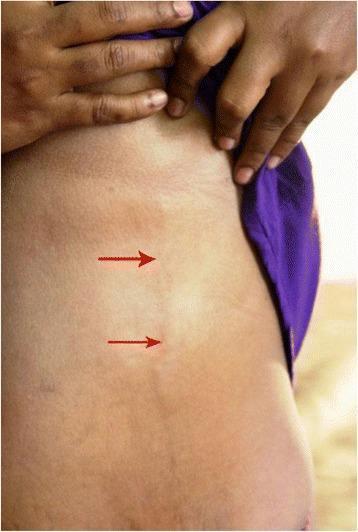
Clinical photo showing the palpable cord-like thrombosed thoracoepigastric vein in Mondor's disease, highlighted by elevation of the breast.
Differential Diagnosis
- Lymphatic permeation from occult carcinoma of the breast (the most important differential - must be excluded)
- Cellulitis
- Erythema nodosum
- Other causes of superficial thrombophlebitis
Investigations
- Mainly a clinical diagnosis
- Doppler ultrasound - confirms thrombosis in the superficial vein; can exclude a deep vein component
- Mammography / breast imaging - to exclude underlying breast carcinoma, especially if a mass is palpable near the cord
- Biopsy - indicated when the diagnosis is uncertain or when a mass is present near the tender cord
Treatment
The condition is benign and self-limiting - treatment is largely supportive:
| Treatment | Details |
|---|---|
| Restriction of arm movements | First-line; reduces tension on the affected vein |
| NSAIDs / anti-inflammatory drugs | Liberal use for analgesia and reducing inflammation |
| Warm/hot moist compresses | Applied along the symptomatic vein |
| Excision of the vein segment | Reserved for cases where symptoms persist or are refractory to conservative management |
Prognosis / Course
- Usually resolves within 4-6 weeks (Schwartz's) to 3 weeks - 6 months (Andrews' Dermatology)
- No recurrence, complications, or permanent deformity in most cases
- The condition is not indicative of cancer per se, but underlying malignancy must be actively excluded
Sources:
- Bailey and Love's Short Practice of Surgery, 28th Ed., p. 941
- Schwartz's Principles of Surgery, 11th Ed., p. 578
- Andrews' Diseases of the Skin, Clinical Dermatology, p. 957
- Berek & Novak's Gynecology, p. 989
This is a shared conversation. Sign in to Orris to start your own chat.