
perimortem cesarean section ms obg short notes
Reading File
Finding Sources
Finding Sources
Searching Images
perimortem cesarean section resuscitative hysterotomy cardiac arrest pregnancy
Searching PubMed
"perimortem cesarean delivery" maternal cardiac arrest
Reading File
Reading File
Reading File
Reading File
Perimortem Cesarean Section (PCS) / Resuscitative Hysterotomy — Short Notes
Definition
Emergency delivery of the fetus by cesarean section performed during ongoing maternal cardiopulmonary arrest, with the dual goal of:
- Salvaging a viable fetus
- Improving maternal resuscitation by relieving aortocaval compression
Newer terminology prefers "resuscitative hysterotomy" over "perimortem cesarean delivery" - the name change emphasizes that the procedure primarily benefits the mother's resuscitation, not just the fetus (Tintinalli's Emergency Medicine, p. 1724).
Rationale (Why it helps the mother)
- After ~20 weeks' gestation, the gravid uterus causes aortocaval compression in the supine position, reducing venous return and cardiac output.
- CPR in pregnancy generates only 30-40% of normal cardiac output even with correct technique (left lateral tilt/manual uterine displacement).
- Delivery of the fetus increases maternal venous return and cardiac output by 25-30%, which can be the deciding factor in achieving return of spontaneous circulation (ROSC).
- PCS itself may be "the most important variable for successful maternal resuscitation" (Roberts and Hedges' Clinical Procedures in Emergency Medicine, p. 1369).
Indications
- Maternal cardiac arrest with gestational age ≥ 24 weeks (fundus at or above the umbilicus) - the threshold of fetal viability.
- No ROSC despite adequate ACLS-guided CPR.
- If gestational age is uncertain, estimate quickly: between 18-30 weeks, fundal height (cm from symphysis pubis) ≈ gestational age in weeks (e.g., fundus at umbilicus ≈ 20 weeks; fundus halfway between umbilicus and xiphoid ≈ 28-30 weeks).
- Common causes of maternal arrest necessitating consideration: hemorrhage, amniotic fluid embolism, cardiomyopathy/other cardiac disease, pulmonary embolism, hypertensive disorders (eclampsia), sepsis, trauma, anaphylaxis (Creasy & Resnik's Maternal-Fetal Medicine, p. 6122).
Timing - The "4-5 Minute Rule"
- Begin the procedure within 4 minutes of maternal cardiac arrest (if no ROSC with CPR).
- Complete delivery within 5 minutes of arrest.
- Neonatal outcome is best when delivery occurs within 4 minutes and poor after 20 minutes.
- CPR must continue throughout and after the procedure, with manual uterine displacement/left lateral tilt maintained until delivery.
- Do NOT delay to: wait for obstetric/neonatology backup, check fetal heart tones, get ultrasound confirmation of viability, or transport to OT/prep a sterile field - all performed at the bedside/in the ED.
Technique
- Continue CPR (with left uterine displacement) throughout.
- Most experienced available person performs it (ideally obstetrician; neonatologist if available - but don't wait).
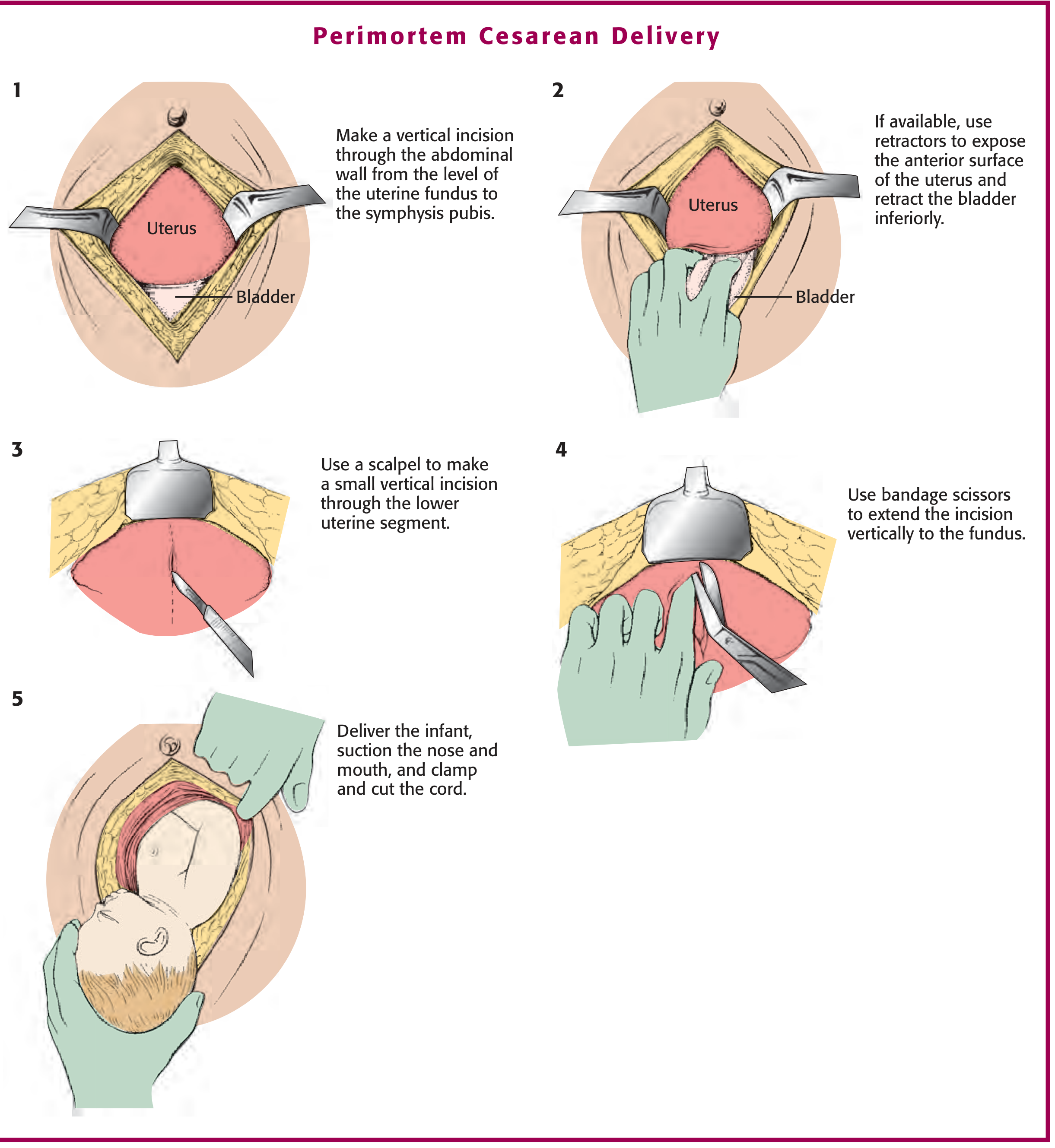
- Midline vertical (classical) skin incision from symphysis pubis to umbilicus (use the linea nigra as a guide), through all abdominal layers into the peritoneum.
- Retract laterally, reflect/decompress the bladder inferiorly.
- Small (~5 cm) vertical classical uterine incision until amniotic fluid/uterine cavity entered.
- Insert fingers to lift uterine wall off the fetus; extend incision to the fundus with bandage scissors under direct digital protection.
- Deliver the infant (breech-style extraction by the feet if the head is high), clamp/cut cord, hand off for neonatal resuscitation.
- Continue maternal CPR; consider uterine massage/hemostasis once resuscitation permits.
Key Points for Exams
- Gestational age cutoff for PCS: ≥24 weeks
- Time to start: within 4 minutes of arrest; complete by 5 minutes
- Skin incision: vertical midline; Uterine incision: classical (vertical) - fastest access, not low transverse
- Primary benefit demonstrated is to the mother, via relief of aortocaval compression
- No time wasted on sterile prep, transport, or fetal heart tone confirmation
- CPR continues during and after the procedure
Note on evidence currency
Library sources (Tintinalli's, Roberts and Hedges', Creasy & Resnik's) are consistent on the 4-minute rule. Recent literature (PMIDs 41569106, 41170232, 35947175 - all 2023-2026 case reports) continues to reinforce early resuscitative hysterotomy as central to maternal survival in arrest, with no major protocol change identified; these are case reports (low evidence tier), not new guideline-level evidence, so the core teaching above still holds for exam purposes.
This is a shared conversation. Sign in to Orris to start your own chat.