
Oxygen therapy definition, types, types of mask and o2 toxicity
Reading File
Now let me search the medical library and web in parallel for all aspects of this topic.
Finding Sources
Searching the Web
oxygen therapy definition types masks O2 toxicity clinical
Now let me read the most relevant textbook sections in parallel:
Reading File
Reading File
Finding Sources
Now let me read the O2 toxicity and mask/device sections:
Reading File
Reading File
Finding Sources
Excellent. Now let me read the comprehensive masks/devices and O2 toxicity sections from Murray & Nadel's and Fishman's:
Reading File
Reading File
I have rich content. Let me fetch the device image and also get the Roberts & Hedges section on O2 devices for completeness:
Loading Image
Reading File
I now have comprehensive information to write a thorough, well-structured answer. Let me compile everything:
Oxygen Therapy: Definition, Types, Delivery Devices, and O2 Toxicity
Definition
Oxygen therapy is the administration of supplemental oxygen at concentrations above room air (FiO2 > 21%) to correct or prevent hypoxia and ensure adequate oxygen delivery to tissues. The goal is to maintain arterial oxygen saturation (SpO2/SaO2) and partial pressure (PaO2) within acceptable physiological limits.
Adequate O2 delivery depends on five factors:
- Inspired partial pressure of O2
- Alveolar ventilation
- Pulmonary gas exchange
- Oxygen-carrying capacity of blood (hemoglobin)
- Cardiac output
The easiest of these to manipulate clinically is the inspired partial pressure of O2, achieved by increasing the fraction of inspired oxygen (FiO2).
- Roberts & Hedges' Clinical Procedures in Emergency Medicine
Indications
- Definite: Arterial hypoxemia - PaO2 < 60 mmHg or SaO2 < 90%
- Shock states: Hemorrhagic, septic, cardiogenic, obstructive - administer until hypoxia is excluded
- Carbon monoxide poisoning: 100% O2 via non-rebreather mask (reduces carboxyhemoglobin half-life from ~5 h to ~1 h)
- Cardiac arrest / resuscitation: 100% O2
- High-altitude illness: Low flow (1-2 L/min) for AMS; higher flows for HACE/HAPE
Note: O2 is NOT routinely indicated in acute MI without hypoxemia (may worsen infarct size), and routine use in stroke without documented hypoxia is not recommended by current guidelines.
Types of Oxygen Therapy Systems
Oxygen delivery systems are broadly divided into low-flow and high-flow systems.
1. Low-Flow Systems
Provide O2 at a flow rate less than the patient's inspiratory demand - room air is entrained to make up the difference, making delivered FiO2 variable and dependent on the patient's breathing pattern.
a) Nasal Cannula (NC)
- Flow: 1-6 L/min
- FiO2: ~24-45% (increases ~3-4% per L/min)
- Well tolerated, allows eating/speaking
- Limitation: FiO2 fluctuates with respiratory rate and tidal volume; requires nasal patency; high flows dry mucosa (humidification advised above 4 L/min)
b) Enhanced/Hudson Nasal Cannula
- Flow: up to 15 L/min
- FiO2: ~50-70%
- Three-channel design; should not be confused with heated high-flow nasal cannula (HFNC)
c) Simple Face Mask (Hudson Mask)
- Flow: 5-10 L/min
- FiO2: ~35-60%
- Minimum flow of 5 L/min needed to flush exhaled CO2 from the mask
- Well tolerated; FiO2 still variable with breathing effort
2. Reservoir Systems
A reservoir bag attached to the mask stores O2 during exhalation, allowing higher FiO2.
a) Partial Rebreathing Mask
- Flow: 10-15 L/min
- FiO2: ~50-75%
- No one-way valves; patient rebreathes a small amount of exhaled gas (first portion from dead space, which is O2-rich)
b) Non-Rebreathing Mask (NRM)
- Flow: 10-15 L/min
- FiO2: ~60-95% (up to ~95% at 15 L/min when tightly sealed)
- One-way valves prevent rebreathing exhaled CO2
- First-line for critically ill patients requiring high FiO2
- Limitation: FiO2 varies with respiratory distress; cannot be titrated below 10 L/min
3. High-Flow Systems
Provide O2 at a flow rate that meets or exceeds the patient's peak inspiratory flow demand, delivering a predictable, fixed FiO2.
a) Venturi Mask (Air-Entrainment Mask)
- Flow: varies by valve color-coded for FiO2
- FiO2: precisely controlled at 24%, 28%, 31%, 35%, 40%, or 60%
- Based on the Bernoulli/Venturi principle - O2 jet creates a fixed entrainment of room air
- Best choice when precise FiO2 is needed (COPD, titrated therapy)
b) High-Flow Nasal Cannula (HFNC / Optiflow / Vapotherm)
- Flow: up to 60 L/min of heated, humidified O2
- FiO2: 21-100%, titrated independently
- Provides positive nasopharyngeal pressure (~1 cmH2O per 10 L/min)
- Reduces work of breathing, flushes CO2 from anatomical dead space
- Evidence-based for acute hypoxemic respiratory failure; reduces need for intubation
c) CPAP / BiPAP (Non-Invasive Ventilation)
- CPAP delivers continuous positive airway pressure
- BiPAP delivers two levels: IPAP (inspiratory) and EPAP (expiratory)
- FiO2: 21-100%
- Used for COPD exacerbations, cardiogenic pulmonary edema, OSA, hypoxemic failure
d) Mechanical Ventilation
- FiO2: 21-100%
- Fully controlled delivery via endotracheal tube
4. Specialized Systems
a) Hyperbaric Oxygen Therapy (HBOT)
- 100% O2 at >1 ATA (typically 2.0-3.0 ATA)
- Dramatically increases dissolved plasma O2
- Indications: CO poisoning, decompression sickness, gas gangrene, non-healing wounds, radiation necrosis
b) Long-Term Oxygen Therapy (LTOT)
- Domiciliary O2 for COPD patients with resting PaO2 ≤ 55 mmHg (or ≤ 60 mmHg with cor pulmonale/polycythemia)
- Via concentrators (stationary) or portable liquid O2/cylinders
- Oxygen-conserving devices (pulse-dose systems, transtracheal catheters) reduce usage by 50-75%
Oxygen Delivery Devices at a Glance
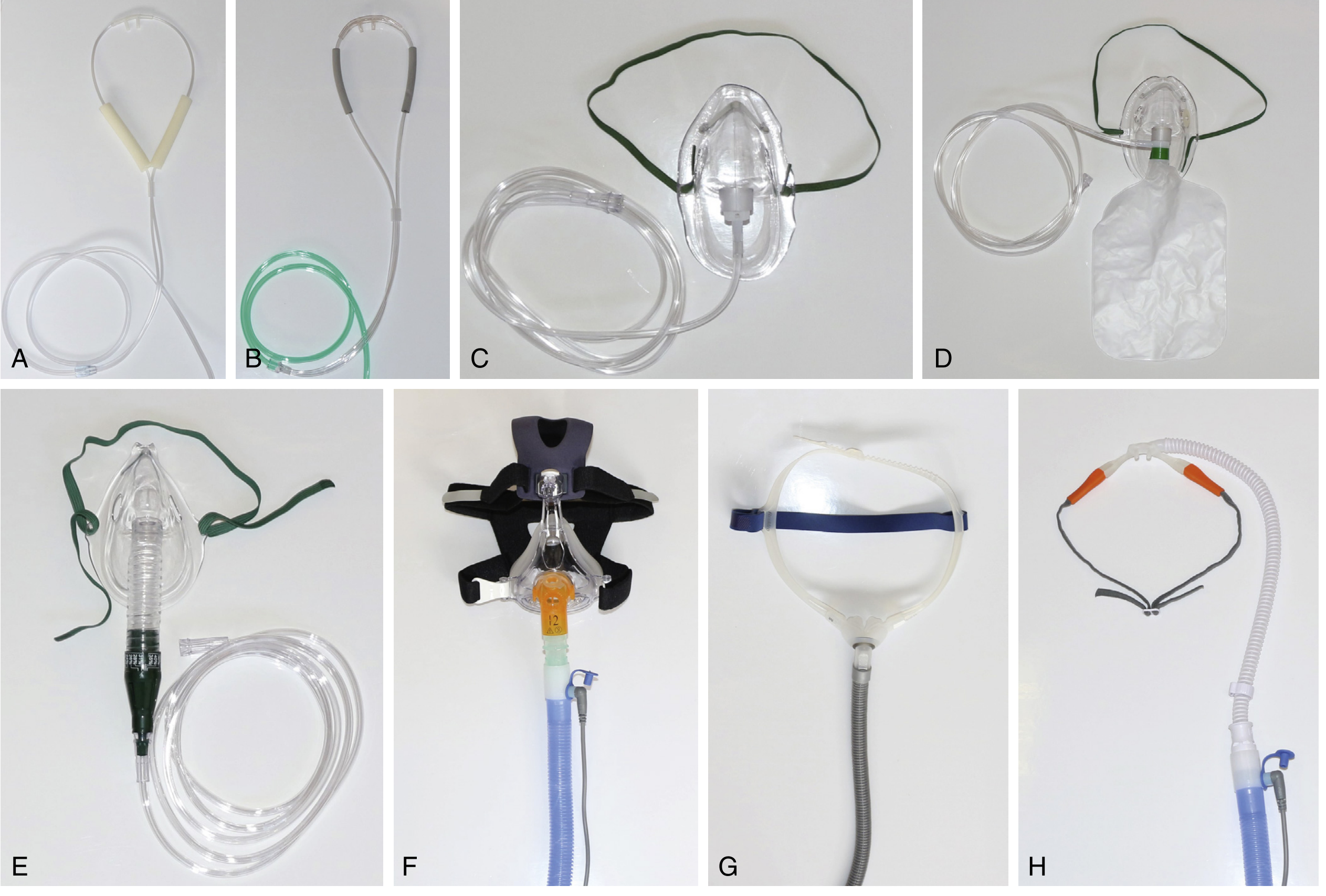
Figure: (A) Simple nasal cannula, (B) Enhanced nasal cannula up to 15 L/min, (C) Simple face mask, (D) Reservoir/non-rebreathing mask, (E) Venturi mask, (F) Full-face CPAP mask, (G) Nasal prong CPAP, (H) High-flow nasal cannula - Murray & Nadel's Respiratory Medicine
| Device | Flow (L/min) | FiO2 (%) |
|---|---|---|
| Simple nasal cannula | 2 / 4 / 6 | 28 / 35 / 40-45 |
| Enhanced nasal cannula | 10-15 | 50-70 |
| Simple face mask | 5-10 | 35-60 |
| Partial rebreathing mask | 10-15 | 50-75 |
| Non-rebreathing mask | 15 | ~95 |
| Venturi mask | variable | 24-60 (fixed) |
| HFNC | up to 60 | 21-100 |
Oxygen Toxicity
Oxygen toxicity results from exposure to oxygen at partial pressures above physiological levels (hyperoxia), generating reactive oxygen species (ROS) that overwhelm cellular antioxidant defenses.
Biochemical Mechanism
In hyperoxic conditions, excess free radicals form - specifically superoxide (O2-), hydrogen peroxide (H2O2), and hydroxyl radical (OH-) - at a rate that exceeds the capacity of cellular antioxidants (superoxide dismutase, catalase, glutathione peroxidase). This leads to:
-
Lipid peroxidation - membrane dysfunction
-
Protein oxidation - enzymatic failure
-
DNA/nucleic acid damage - cell death or mutagenesis
-
Fishman's Pulmonary Diseases and Disorders
Two Main Clinical Forms
1. Pulmonary Oxygen Toxicity (Low-Pressure / Normobaric)
- Occurs with FiO2 > 0.5 for prolonged periods (typically >12-24 h at high FiO2)
- Clinical toxicity generally absent when FiO2 < 0.5
Phases of injury:
- Exudative phase (days 3-4): Death of type I pneumocytes and endothelial cells, interstitial edema, neutrophil infiltration, alveolar exudate
- Proliferative phase: Type II pneumocyte and endothelial proliferation, fibroblast expansion, interstitial scarring
Clinical manifestations:
- Substernal chest pain and cough (tracheobronchitis)
- Decreased vital capacity and DLCO
- Reduced lung compliance
- Progressive ARDS-like picture at high exposures
Key complications:
- Absorption atelectasis - Breathing high FiO2 washes out nitrogen (the "stent" that keeps alveoli open); alveolar collapse follows, worsened with 100% O2 pre-oxygenation
- Hypercapnic respiratory failure (CO2 retention in COPD) - Mechanisms include: abolition of hypoxic pulmonary vasoconstriction (worsening V/Q mismatch), Haldane effect (O2 displaces CO2 from hemoglobin), and possible blunting of hypoxic drive
- ARDS - High FiO2 in mechanically ventilated patients contributes to lung injury
- Bronchopulmonary dysplasia (BPD) in premature neonates
2. CNS (Cerebral) Oxygen Toxicity (High-Pressure / Hyperbaric)
- Occurs at pO2 > 1.4-1.6 ATA (short duration exposure)
- Classic in diving and HBOT
Signs and symptoms (mnemonic VENTID):
- Visual disturbances (tunnel vision)
- Ear symptoms (tinnitus)
- Nausea
- Twitching (facial/lip muscles)
- Irritability
- Dizziness
The most serious manifestation is seizures, which can be fatal underwater. Incidence in clinical HBOT is rare (<1 per 1000 treatments).
Other Toxic Effects
- Retinopathy of prematurity (ROP): High O2 in premature infants causes abnormal retinal vascularization
- Oxygen-induced hypercapnia in COPD: Use Venturi mask to titrate to SpO2 88-92% in COPD
- Coronary effects: Hyperoxia causes coronary vasoconstriction and may worsen myocardial infarction - avoid in normoxic MI patients
Safe Thresholds (Clinical Guidance)
| Situation | Target SpO2 | Notes |
|---|---|---|
| Most acute illness | 94-98% | Standard target |
| COPD / CO2 retainers | 88-92% | Avoid uncontrolled high FiO2 |
| CO poisoning | 100% | Use NRM until COHb normalized |
| Premature neonates | 91-95% | Strict titration to prevent ROP |
| Post-cardiac arrest | 94-98% | Avoid hyperoxia (worsens neurological outcome) |
Key principle: Never withhold oxygen from a hypoxemic patient out of fear of complications - the risks of hypoxemia always outweigh those of judicious O2 use. However, titrate to the lowest effective FiO2 once the patient is stabilized.
Sources: Roberts & Hedges' Clinical Procedures in Emergency Medicine | Murray & Nadel's Textbook of Respiratory Medicine | Fishman's Pulmonary Diseases and Disorders | Tintinalli's Emergency Medicine | ROSEN's Emergency Medicine
This is a shared conversation. Sign in to Orris to start your own chat.