
Club foot
I'll look up club foot in the medical library for a thorough answer.
Reading File
Searching sources...
Finding Sources
Searching PubMed
"clubfoot" OR "talipes equinovarus"
Finding Sources
Searching the Web
clubfoot talipes equinovarus clinical overview etiology treatment 2024
Good - I found detailed content in Campbell's Operative Orthopaedics and Creasy & Resnik. Let me read the key sections now.
Reading File
Reading File
Excellent content. Let me now read the treatment and clinical management sections from Campbell's.
Reading File
Reading File
I now have rich content from Campbell's Operative Orthopaedics (2026) and Creasy & Resnik's Maternal-Fetal Medicine. Let me read a bit more on surgical treatment and relapse.
Reading File
I now have comprehensive content. Let me also fetch one of the clinical images to enhance the answer.
Loading Image
I now have all the information needed for a thorough answer. Here is a complete clinical overview of clubfoot:
Clubfoot (Congenital Talipes Equinovarus)
Definition
Congenital clubfoot (talipes equinovarus) is a malformation of the fetal ankle producing abnormal posturing of the foot, characterized by four components remembered by the mnemonic CAVE: Cavus, Adduction, Varus, Equinus.
- Creasy & Resnik's Maternal-Fetal Medicine, p. 576
Incidence & Epidemiology
- Occurs in approximately 1-3 per 1,000 live births
- Male:female ratio = 2:1
- Bilateral in ~50% of cases (some sources cite up to two-thirds)
- Unilateral cases are evenly distributed between right and left
- No correlation with developmental dysplasia of the hip (DDH) - only routine clinical hip screening is needed
- Campbell's Operative Orthopaedics 15th Ed 2026, p. 1305
Etiology & Risk Factors
The exact cause remains unknown, but etiology is multifactorial:
Proposed mechanisms:
- Primary germplasm defect in the talus causing persistent plantarflexion and inversion
- Primary soft-tissue/neuromuscular abnormalities causing secondary bony changes
- Vascular anomaly - many affected children have a hypertrophic anterior tibial artery
- Abnormal distribution of type I and type II muscle fibers
- Intrinsic disruption of the neuromuscular unit (brain, spinal cord, nerve, muscle)
Extrinsic factors: oligohydramnios, malpresentation, uterine fibroids, multifetal crowding
Genetic factors: ~25% of cases are familial; associated gene mutations include TBX4, PITX1, NAT2, RMB10, and HOXA/HOXC/HOXD gene clusters. Autosomal dominant inheritance with incomplete penetrance has been reported.
Quantified risk factors (odds ratios):
| Risk Factor | OR (95% CI) |
|---|---|
| Family history of clubfoot | 7.80 (4.04-15.04) |
| SSRI exposure in pregnancy | 1.78 (1.34-2.37) |
| Maternal smoking | 1.65 (1.54-1.78) |
| Maternal BMI ≥30 | 1.46 (1.29-1.65) |
| Gestational diabetes | 1.40 (1.13-1.72) |
- Creasy & Resnik's Maternal-Fetal Medicine, p. 576
Pathoanatomy
The deformity results from medial displacement of the navicular and calcaneus around the talus. In 3D:
- The calcaneus rotates in sagittal, coronal, and horizontal planes, pivoting on the interosseous ligament
- The calcaneal tuberosity moves toward the fibular malleolus
- The heel appears to be in varus due to horizontal rotation of the talocalcaneal joint
- The medial soft tissues (tibiotalar, talocalcaneal, and talonavicular joint capsules; ligaments; spring ligament; deltoid ligament) are all shortened and contracted
- In unilateral cases, the affected foot may be one-half to one shoe size smaller than the normal foot
The deformity ranges from mild and passively correctable (positional) to severe rigid equinovarus. It is often accompanied by internal tibial torsion.
- Campbell's Operative Orthopaedics 15th Ed 2026, p. 1305
Prenatal Diagnosis
- ~80% of isolated cases are detected prenatally on ultrasound
- False-positive rate: ~30% (especially third trimester, unilateral)
- On 2D ultrasound: both tibia and fibula visualized in coronal plane with metatarsals or sole visible in same plane
- Most common posture: plantarflexed (equinus) + inverted medially (varus)
- 3D imaging improves sensitivity/specificity when 2D is equivocal
Differential diagnosis of prenatal foot abnormality:
- Transient positional finding (normal fetus, especially third trimester)
- Rocker bottom foot
- Arthrogryposis
Classification
Pirani Score (most widely used clinically):
- 6 physical exam findings: 3 for hindfoot contracture, 3 for midfoot contracture
- Each scored 0 (none), 0.5 (moderate), or 1 (severe) - total max = 6
- Higher score = more severe deformity
Dimeglio Classification grades severity (I-IV) based on reducibility.
Radiographic Evaluation
Indicated for atypical, syndromic, or treatment-resistant cases.
Key angles (simulated weight-bearing views):
| Measurement | Normal | In Clubfoot |
|---|---|---|
| AP talocalcaneal angle | 30-55° | Decreased (with increasing heel varus) |
| Lateral talocalcaneal angle | 25-50° | Decreases to 0° (parallelism) |
| Tibiocalcaneal angle (lateral) | 10-40° | Negative (equinus of calcaneus) |
| Talus-1st metatarsal angle (AP) | 5-15° | Negative (forefoot adduction) |
Treatment
1. Ponseti Method (Gold Standard)
The Ponseti method is the first-line treatment for all idiopathic clubfeet and is highly effective.
Two phases:
Phase 1 - Correction (Treatment Phase)
- Begin as early as possible (ideally within first 4 weeks of life)
- Weekly gentle manipulation and above-knee serial casting
- Order of correction (strictly observed to prevent rocker-bottom deformity):
- Correct cavus (forefoot supination aligned with hindfoot, first metatarsal elevated)
- Correct forefoot adduction (abduction around the talar head)
- Correct heel varus
- Correct equinus (via ankle dorsiflexion, NOT midfoot)
- Approximately 5-6 casts are typically required
- Before the final cast: percutaneous Achilles tenotomy in most infants (to gain Achilles length and prevent rocker-bottom)
Phase 2 - Maintenance (Bracing Phase)
- Foot abduction brace (Denis Browne brace) worn full-time for 3 months, then nights/naps until age 4-5 years
- Non-compliance with bracing is the primary cause of relapse
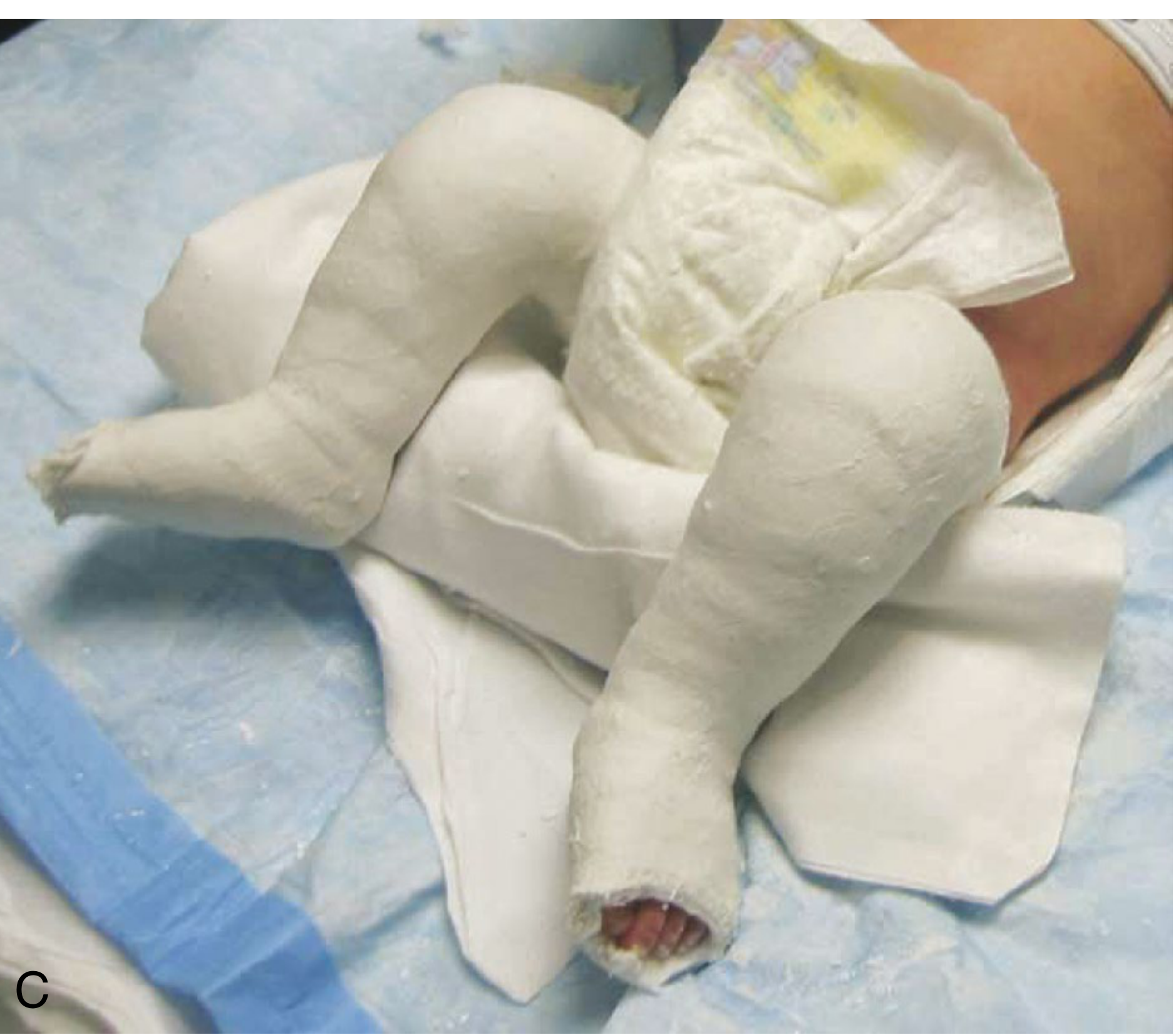
Bilateral Ponseti casting in a newborn - Campbell's Operative Orthopaedics 15th Ed 2026, p. 1308
Modifications with equivalent outcomes:
- Accelerated biweekly casting (faster correction, comparable results)
- Fiberglass casting equivalent to plaster
- Various qualified providers can perform the manipulation (surgeons, APNs, PTs, cast technicians)
2. French Functional Method (Physical Therapy-Based)
- Daily physiotherapy with manipulation, stretching, and taping/splinting
- Less commonly used; requires highly trained therapist and very motivated family
3. Surgical Treatment
Surgery is reserved for:
- Failures of conservative management
- Recurrent/resistant deformities
- Syndrome-associated clubfeet
Recurrence management:
- Repeat serial casting (first line for early recurrence)
- Repeat Achilles tendon lengthening if dorsiflexion is insufficient
- Anterior tibial tendon transfer (ATTT): indicated for persistent dynamic supination in swing phase with flexible plantigrade foot at rest
- Used in ~15% of clubfoot patients
- Ideal age: >3 years (after lateral cuneiform ossification) and <8 years
Extensive posteromedial release (EPMR): now largely replaced by Ponseti method. Rate of additional surgical procedures beyond Achilles tenotomy was ~35% in one recent study.
Prognosis & Outcomes
- Untreated clubfoot is cosmetically, functionally, and psychologically unacceptable; leads to fused joints, contractures, and degenerative arthritis
- With Ponseti method, success rates are high in idiopathic cases
- Recurrence is more common in:
- Syndromic clubfoot (e.g., arthrogryposis, spina bifida)
- Older children treated late
- Poor brace compliance
- The initial severity (Pirani score) and number of casts needed correlate with recurrence risk
- A 2025 systematic review and meta-analysis confirms the Ponseti method is also effective in neurogenic clubfoot (spina bifida, etc.), though with lower success rates than idiopathic cases
Associated Conditions to Exclude
Clubfoot can be isolated (idiopathic) or part of a syndrome:
- Arthrogryposis multiplex congenita
- Spina bifida / myelomeningocele
- Amniotic band syndrome
- Diastrophic dysplasia
- Down syndrome, trisomies
A thorough workup for associated anomalies is warranted, especially when clubfoot is detected prenatally or appears atypical.
Sources: Campbell's Operative Orthopaedics 15th Ed 2026, pp. 1305-1310; Creasy & Resnik's Maternal-Fetal Medicine, p. 576. Recent evidence: PMID 41272751 (Ponseti in neurogenic clubfoot, 2025 meta-analysis); PMID 39134994 (ATTT fixation techniques, 2024 systematic review).
This is a shared conversation. Sign in to Orris to start your own chat.