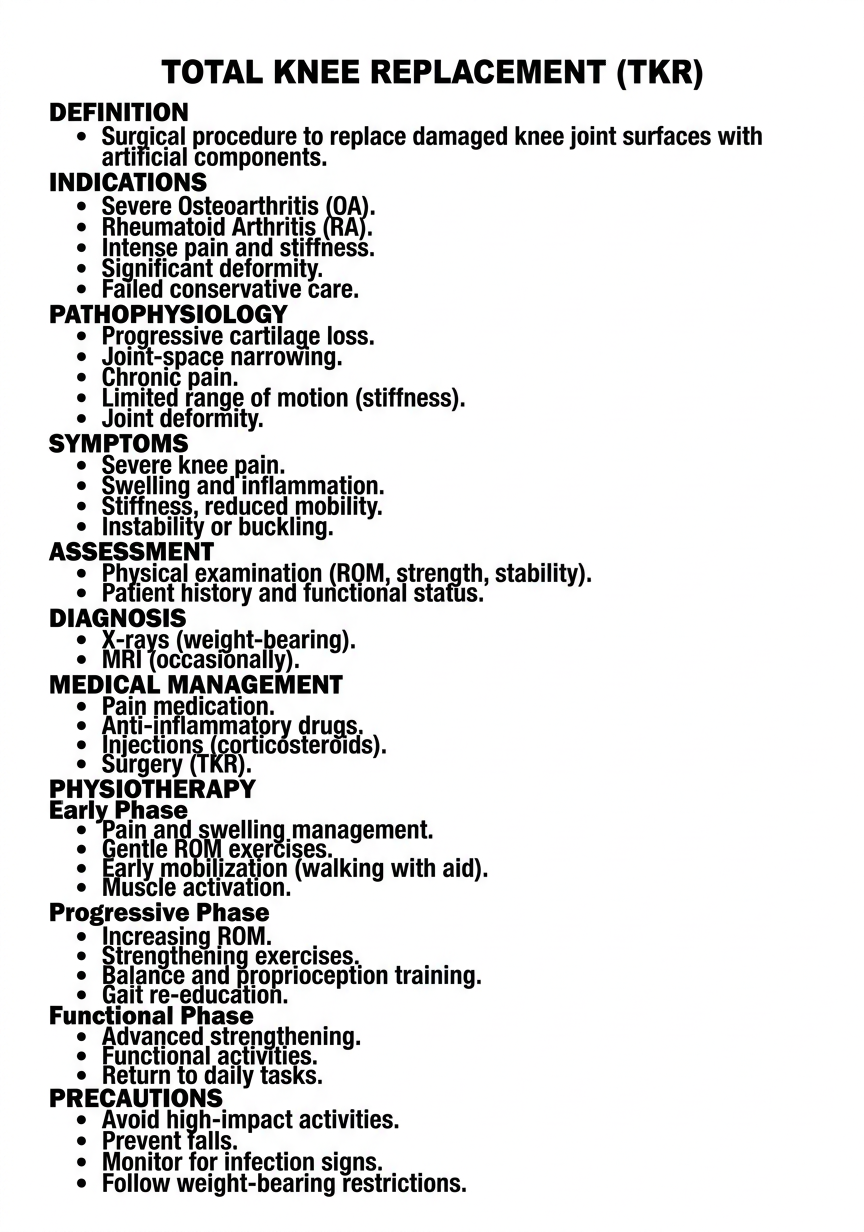
Definition Total Knee Replacement (TKR) is a surgical procedure in which the damaged articular surfaces of the knee joint are removed and replaced with artificial prosthetic components. 2. Causes / Indications Severe osteoarthritis Rheumatoid arthritis Severe knee pain and stiffness Knee deformity Failure of conservative treatment Severe joint destruction 3. Pathophysiology Degeneration or destruction of the articular cartilage leads to joint space narrowing, pain, stiffness, deformity and reduced function. In severe cases, the damaged joint surfaces are replaced with prosthetic components. 4. Signs and Symptoms Severe knee pain Stiffness Swelling Reduced range of motion Difficulty in walking Deformity of knee Muscle weakness Difficulty in activities of daily living 5. Assessment History taking Pain assessment निरीक्षण/inspection for swelling and deformity Knee ROM assessment Muscle strength assessment Gait assessment Functional assessment, such as sit-to-stand and stair climbing 6. Diagnosis Clinical examination X-ray of the knee joint Assessment of joint damage Other investigations if required before surgery 7. Medical Management Analgesics and anti-inflammatory drugs Weight reduction and activity modification Intra-articular injections in selected cases Total knee replacement surgery when conservative treatment fails and joint damage is severe 8. Physiotherapy Management Early postoperative phase Positioning and monitoring Pain and swelling control Cryotherapy and elevation Breathing exercises Ankle-toe movements to improve circulation Static quadriceps and hamstring exercises Gentle knee ROM exercises Progressive phase Straight leg raising Active and active-assisted ROM exercises Quadriceps and hamstring strengthening Bed mobility and transfer training Gradual weight bearing as advised Functional phase Gait training with walker/crutches Stair climbing and descending training Balance and functional exercises Improve independence in ADL Home exercise programme and precautions This lines are in one white page written like book page without images and all only lines for Xero printe visibility
- Definition and overview of Total Knee Replacement
- Indications and pathophysiology, including osteoarthritis and rheumatoid arthritis
- Clinical features and assessment, including pain, deformity, ROM, strength, gait, and function
- Diagnosis and medical management
- Postoperative physiotherapy rehabilitation, from early exercises to gait, stairs, ADLs, and home programme
- One-page xerox-print layout, using plain black text on a white page with no images
Choose the next focus.
- Definition and overview of Total Knee Replacement
- Indications and pathophysiology, including osteoarthritis and rheumatoid arthritis
- Clinical features and assessment, including pain, deformity, ROM, strength, gait, and function
- Diagnosis and medical management
- Postoperative physiotherapy rehabilitation, from early exercises to gait, stairs, ADLs, and home programme
- One-page xerox-print layout, using plain black text on a white page with no images
"Arthroplasty, Replacement, Knee"[MeSH Terms] AND rehabilitation
AAOS total knee replacement exercise rehabilitation clinical practice guideline
TOTAL KNEE REPLACEMENT (TKR)
1. Definition
2. Causes / Indications
- Severe osteoarthritis
- Rheumatoid arthritis with joint destruction
- Severe knee pain and stiffness
- Knee deformity, such as varus or valgus deformity
- Marked limitation of daily activities and walking
- Failure of conservative treatment
- Severe radiological joint damage
3. Pathophysiology
4. Signs and Symptoms
- Severe knee pain
- Stiffness, especially after rest
- Swelling
- Reduced range of motion
- Difficulty in walking
- Knee deformity
- Muscle weakness
- Difficulty in activities of daily living
5. Assessment
- Detailed history taking
- Pain assessment
- Inspection for swelling, scar, and deformity
- Knee range-of-motion assessment
- Muscle-strength assessment
- Gait assessment
- Functional assessment: bed mobility, sit-to-stand, walking, and stair climbing
6. Diagnosis
- Clinical examination
- X-ray of the knee joint
- Assessment of joint-space narrowing, deformity, and joint destruction
- Preoperative investigations as advised by the surgeon
7. Medical Management
- Analgesics and anti-inflammatory medicines
- Weight reduction and activity modification
- Intra-articular injections in selected patients
- Total knee replacement when conservative treatment fails and joint damage is severe
8. Physiotherapy Management
Early Postoperative Phase
- Proper positioning and monitoring
- Pain and swelling control
- Cryotherapy and limb elevation
- Breathing exercises
- Ankle-toe movements to improve circulation
- Static quadriceps and hamstring exercises
- Gentle knee range-of-motion exercises
Progressive Phase
- Straight-leg raising
- Active and active-assisted knee ROM exercises
- Quadriceps and hamstring strengthening
- Bed mobility and transfer training
- Gradual weight bearing as advised by the surgeon
- Improve knee extension and flexion progressively
Functional Phase
- Gait training with walker or crutches
- Stair climbing and descending training
- Balance and functional exercises
- Training for independence in activities of daily living
- Home exercise programme and precautions
Precautions
- Follow the surgeon’s weight-bearing instructions.
- Avoid twisting or sudden forceful movements at the knee.
- Report excessive pain, increasing redness, wound discharge, fever, calf pain, or sudden swelling immediately.
Create image like one white book page
A single clean white A4 textbook-style study page for black-and-white xerox printing. No images, no borders, no colours, no decorations. Use crisp, highly legible black typography with a bold centered title: TOTAL KNEE REPLACEMENT (TKR). Present compact numbered headings and short bullet points exactly covering: Definition; Causes / Indications; Pathophysiology; Signs and Symptoms; Assessment; Diagnosis; Medical Management; Physiotherapy Management with Early Postoperative Phase, Progressive Phase, Functional Phase; and Precautions. Use plain medical textbook page formatting, black text on white background, tightly but clearly spaced so all content fits on one page.
AAOS total knee replacement exercise guide precautions weight bearing walking
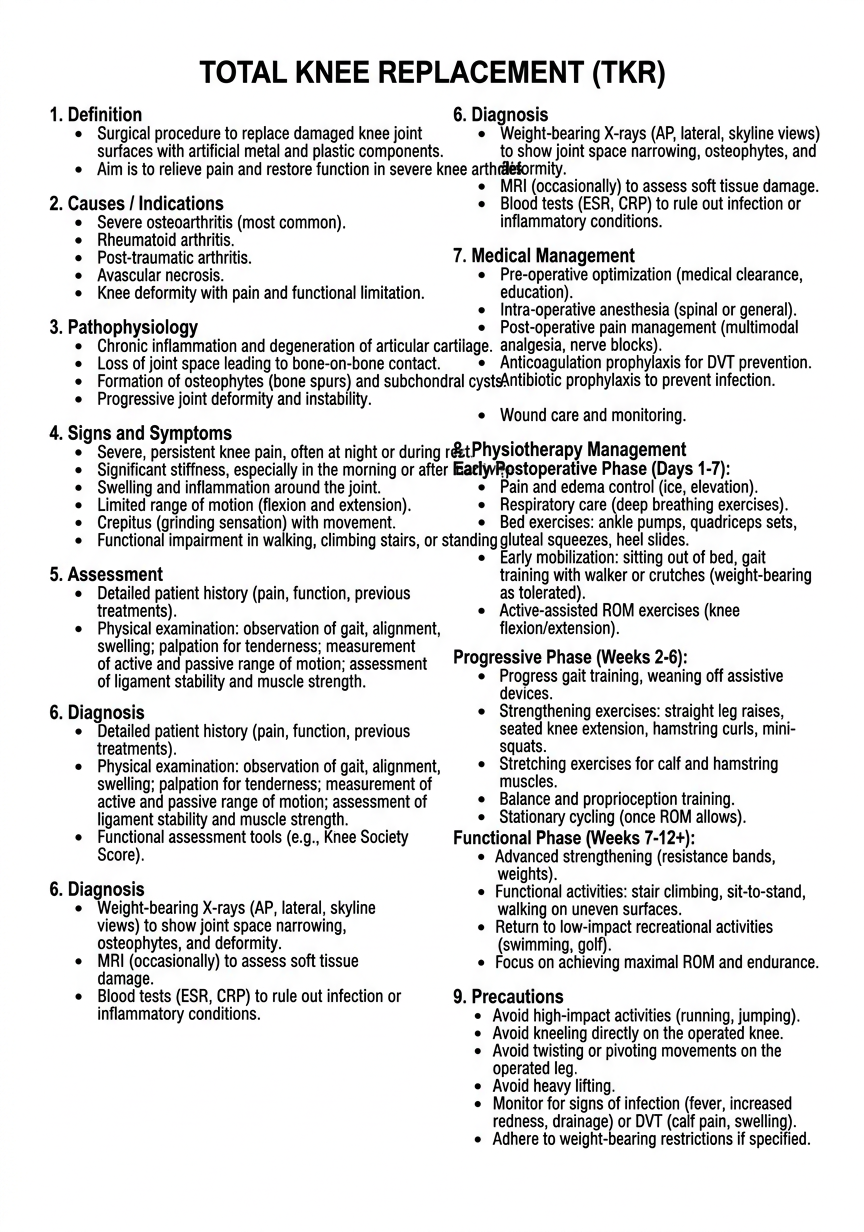
Make the text larger for clearer xerox printing
A single white A4 textbook-style note page about TOTAL KNEE REPLACEMENT (TKR), designed specifically for high-contrast black-and-white xerox printing. Make every line of text substantially larger and darker than a normal handout, using only crisp bold black type on a pure white background. No images, no coloured elements, no border, no decorations. Reduce the wording to fit with very short large-print bullets. Centered bold title. Include: Definition; Indications (severe OA, RA, pain/stiffness, deformity, failed conservative care); Pathophysiology (cartilage loss, joint-space narrowing, pain, stiffness, deformity); Symptoms; Assessment; Diagnosis; Medical management; Physiotherapy: early phase, progressive phase, functional phase; Precautions. Clear section headings, generous line spacing, large readable text, one-page clinical textbook note.
AAOS total knee replacement exercise guide